Quick Answer
Koi genuinely can learn to recognize the people who feed them — not through facial recognition exactly, but through a combination of visual cues, sound vibrations, and routine. Koi hear through an internal structure called the Weberian ossicles, see color well (though they’re actually quite short-sighted, with sharp vision only within 1-2 meters), and rest near the pond bottom rather than truly “sleeping” since they have no eyelids. A landmark 2016 Oxford University study proved a different fish species (archerfish) can distinguish individual human faces — a genuinely compelling finding, though it hasn’t been directly tested on koi specifically.

Can Koi Recognize Their Owners? What Science Actually Says
Ask any longtime koi keeper, and they’ll swear their fish know them — swimming up eagerly when they approach, ignoring strangers, gathering at a specific spot where feeding happens. Is this real recognition, or just routine conditioning? The honest answer is genuinely more interesting than a simple yes or no — it’s worth understanding how koi actually sense their world first.
Can Koi Hear?
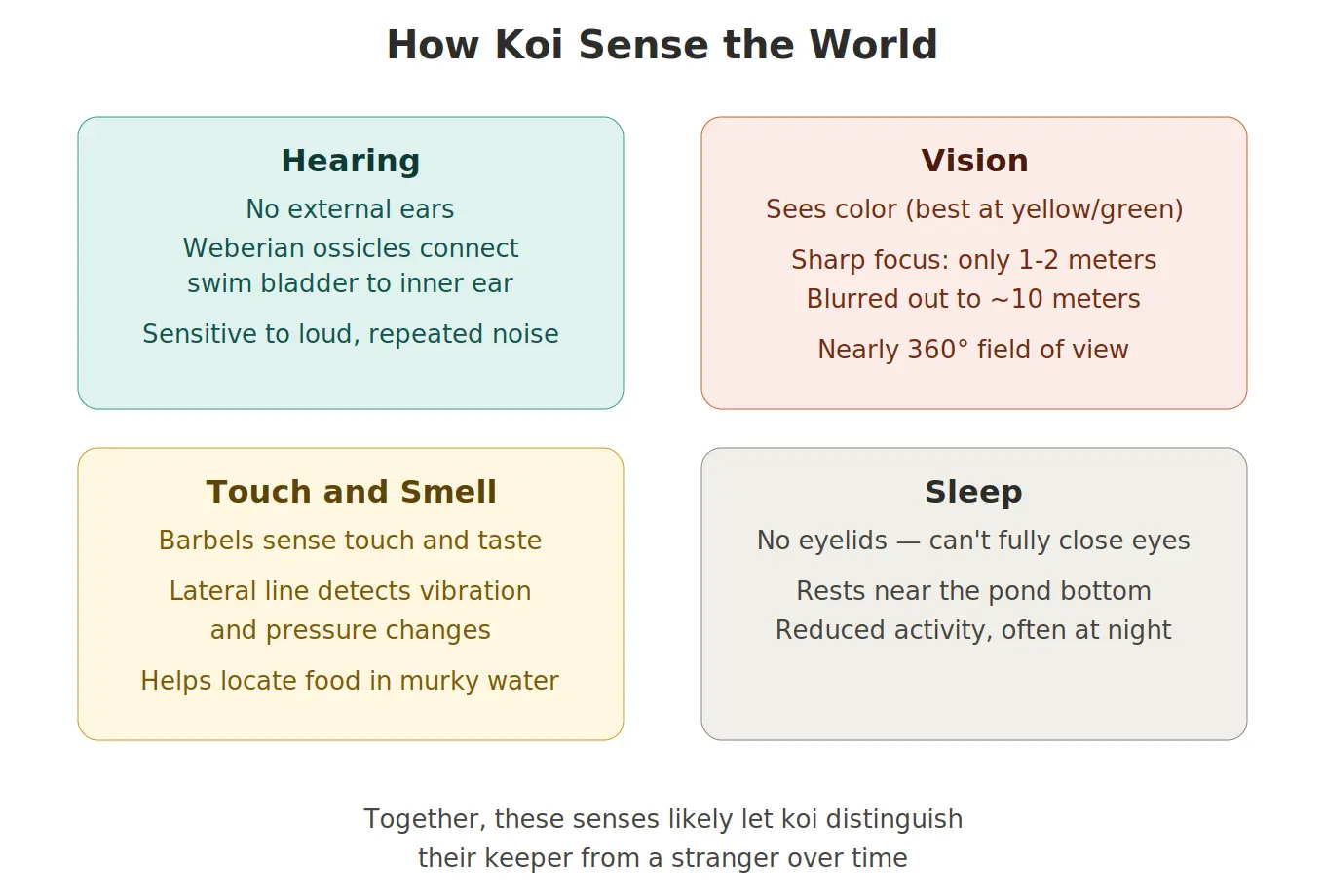
Yes — though not through external ears, which koi don’t have. Instead, koi hear via the Weberian ossicles, a chain of small bones connecting the swim bladder to an internal auditory structure that functions much like an inner ear. The swim bladder itself acts as a kind of amplifier, picking up vibrations in the water and transmitting them to this hearing apparatus. Koi are genuinely sensitive to sound — loud, repeated noises (like banging on ice to break up a frozen pond) can cause real, documented stress, so it’s worth being mindful of noise near your pond.
Interestingly, koi hearing is somewhat more sensitive than their close relative, the goldfish, with a broader range of audible frequencies on both the high and low end.
Can Koi See Color? How Good Is Their Eyesight?
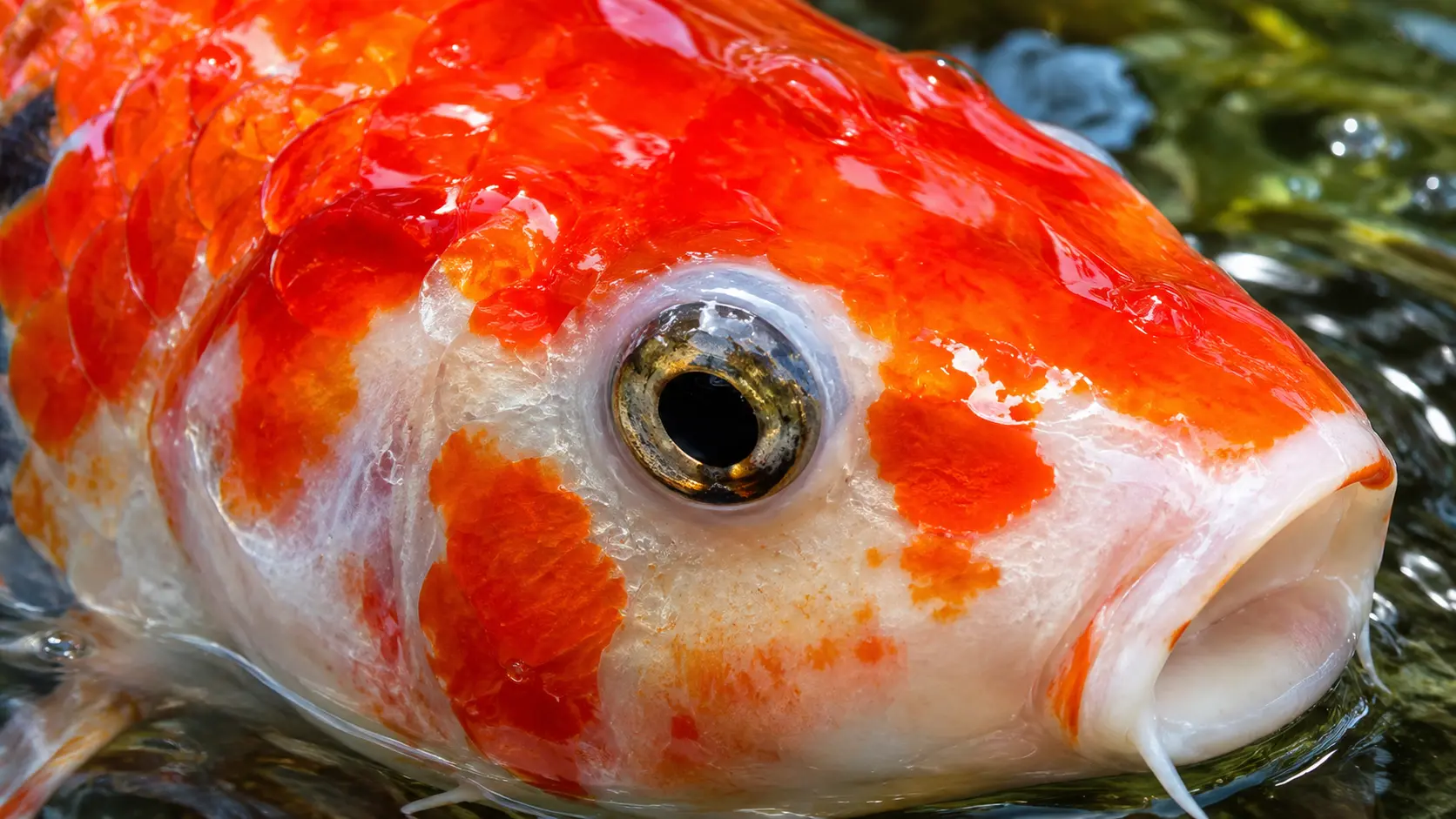
Koi do see color — they have both rods and cones in their eyes, the structures responsible for color and light/dark vision respectively, and research suggests they’re particularly accurate at distinguishing yellow and green. Their eyes sit on either side of the head and move independently, giving koi an impressively wide field of view (including behind and below them) that helps with spotting predators while feeding.
Here’s the genuinely surprising part most guides don’t mention: koi are actually quite short-sighted. Their sharp, well-focused vision only extends about 1-2 meters, with everything beyond that appearing increasingly blurred out to roughly 10 meters. This isn’t really a limitation in practice, since pond water (with algae and sediment) rarely offers clear visibility much beyond that range anyway — but it does mean koi likely recognize you more by overall shape, movement, and color pattern at a distance, sharpening into clearer detail only as you get close to the water’s edge.
Do Koi Actually Recognize Their Owners?
This is where things get genuinely interesting — and where it’s important to be precise about what’s actually been proven. In 2016, researchers from the University of Oxford and the University of Queensland published a landmark study in Scientific Reports showing that archerfish — a different tropical fish species, not koi — could learn to distinguish one individual human face from dozens of unfamiliar ones, with up to 86% accuracy in controlled testing. This was genuinely significant: archerfish lack the neocortex brain structure that humans and other face-recognizing animals rely on, suggesting sophisticated visual pattern recognition doesn’t require a complex brain.
This study was not conducted on koi, and it would be overstating things to claim it proves koi can recognize faces in the same tested, verified way. What it does show is that facial-style recognition is genuinely within reach for fish more broadly — and combined with koi’s well-documented color vision, decent eyesight at close range, and genuinely strong memory (other fish species have been shown to retain learned routes and routines for up to a year), the behavior koi keepers observe — fish that reliably approach a specific person and seem to distinguish them from strangers — is very plausibly real recognition, built from a combination of visual cues, vibration/sound, and routine, even without a dedicated koi-specific study to confirm facial recognition in the strict sense.
📖 Koi: A Complete Guide to their Care and Color Varieties
A genuinely solid reference for understanding koi behavior and biology more deeply, alongside their care and varieties.
🛒 Check Price on Amazon →Smell and Touch: The Senses Behind the Barbels
Koi also rely heavily on smell and touch, often overlooked compared to sight and hearing. Their barbels (the whisker-like feelers near the mouth) are packed with touch and taste receptors, helping koi locate food even in murky water where vision alone wouldn’t be enough. Combined with the lateral line — a row of sensory pores running along each side of the body that detects vibrations and pressure changes — koi build up a surprisingly detailed picture of their surroundings without needing to rely on sight alone.
Do Koi Fish Sleep?

Koi don’t sleep the way mammals do, and since they have no eyelids, they can’t fully close their eyes. Instead, they enter a period of reduced activity — typically hovering near the bottom of the pond, often at night or during quiet periods — that serves a similar restorative function. If you’ve ever spotted your koi looking unusually still after dark, this is almost certainly what’s happening, not illness.
Conclusion
Koi are genuinely more perceptive than most people assume — hearing through an internal bone structure borrowed from their swim bladder, seeing color (if somewhat short-sightedly), and very likely learning to distinguish their own keeper from a stranger through a real combination of sensory cues and memory. While the strongest scientific proof of fish facial recognition comes from a different species (archerfish), the underlying biology genuinely supports the idea that your koi know who you are — even if science hasn’t run that exact experiment on koi themselves just yet.
FAQs
Has it been scientifically proven that koi recognize their owners?
Not in a koi-specific study. The strongest related evidence is a 2016 Oxford/Queensland study showing archerfish (a different species) can distinguish individual human faces. Koi keepers widely report recognition-like behavior, plausibly explained by koi’s genuine color vision, hearing, and memory.
How do koi hear without ears?
Through the Weberian ossicles, a chain of small bones connecting the swim bladder to an internal auditory structure that functions like an inner ear.
How far can koi actually see?
Koi have sharp vision only within about 1-2 meters, with increasingly blurred vision out to roughly 10 meters — they’re genuinely short-sighted, though this is rarely a practical limitation given typical pond visibility.
Do koi sleep with their eyes open?
Yes, technically — koi have no eyelids, so they can’t close their eyes. Instead, they enter a low-activity resting state, often near the pond bottom at night.
You may also like


Passionate about fish keeping since elementary school in the 1980s, Giovanni Carlo has dedicated countless hours to collecting and breeding a diverse array of ornamental freshwater fish. From vibrant guppies and majestic koi to striking bettas and classic goldfish, he continues to explore the fascinating world of aquatics, sharing knowledge and enthusiasm with fellow fish enthusiasts.