Quick Answer
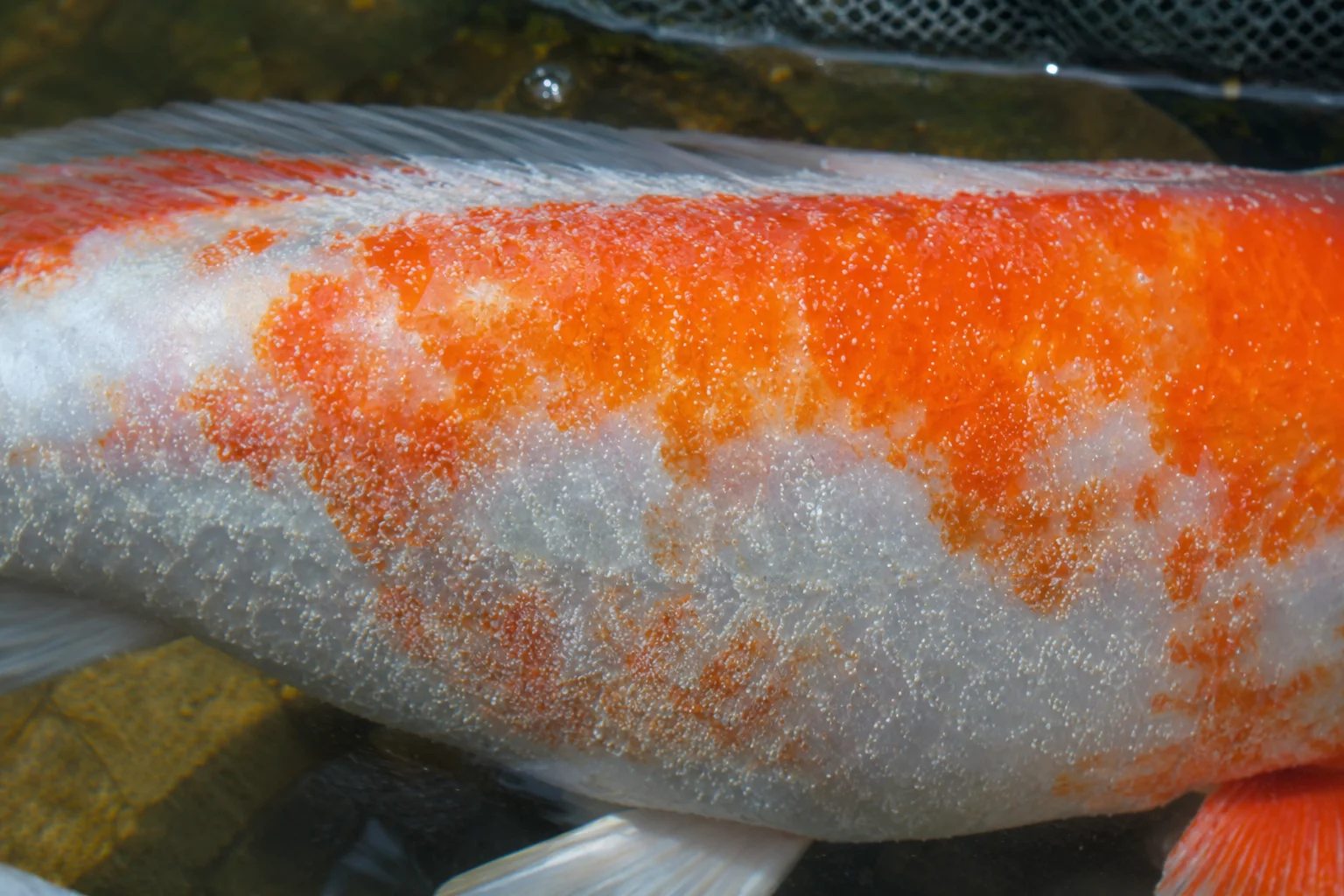
Koi ich (white spot disease) is caused by Ichthyophthirius multifiliis, a protozoan parasite that shows up as tiny white spots — like grains of salt — scattered across the body, fins, and gills. Unlike anchor worm or fish lice, these spots don’t move and aren’t attached structures; they’re the parasite itself embedded in the skin. The most effective koi ich treatment targets the free-swimming stage only, since the embedded stage is protected by a hard cyst wall, which is why repeated dosing over 7-10 days is required rather than a single treatment. Unusually for a tropical pond parasite, ich is triggered by a drop in water temperature below 20°C, not by heat.
If you came from our anchor worm and fish lice guide or the flukes guide, this one works differently in one important way: ich isn’t a warm-water problem. It’s the one parasite in this series where a cold snap — not tropical heat — is what actually starts an outbreak.
As an Amazon Associate, I earn from qualifying purchases. Product links in this article are affiliate links.
What Is Koi Ich (White Spot Disease)?
Ich is a protozoan parasite that appears as small, stationary white spots resembling grains of salt on the skin, fins, and gills.
Ich (Ichthyophthirius multifiliis) is a ciliated protozoan — one of the largest single-celled parasites known to affect fish — and it’s genuinely one of the most common diseases in koi ponds worldwide. Each spot is about 0.1mm across, and as an infestation grows, spots can multiply until they resemble a fish dusted in sand.
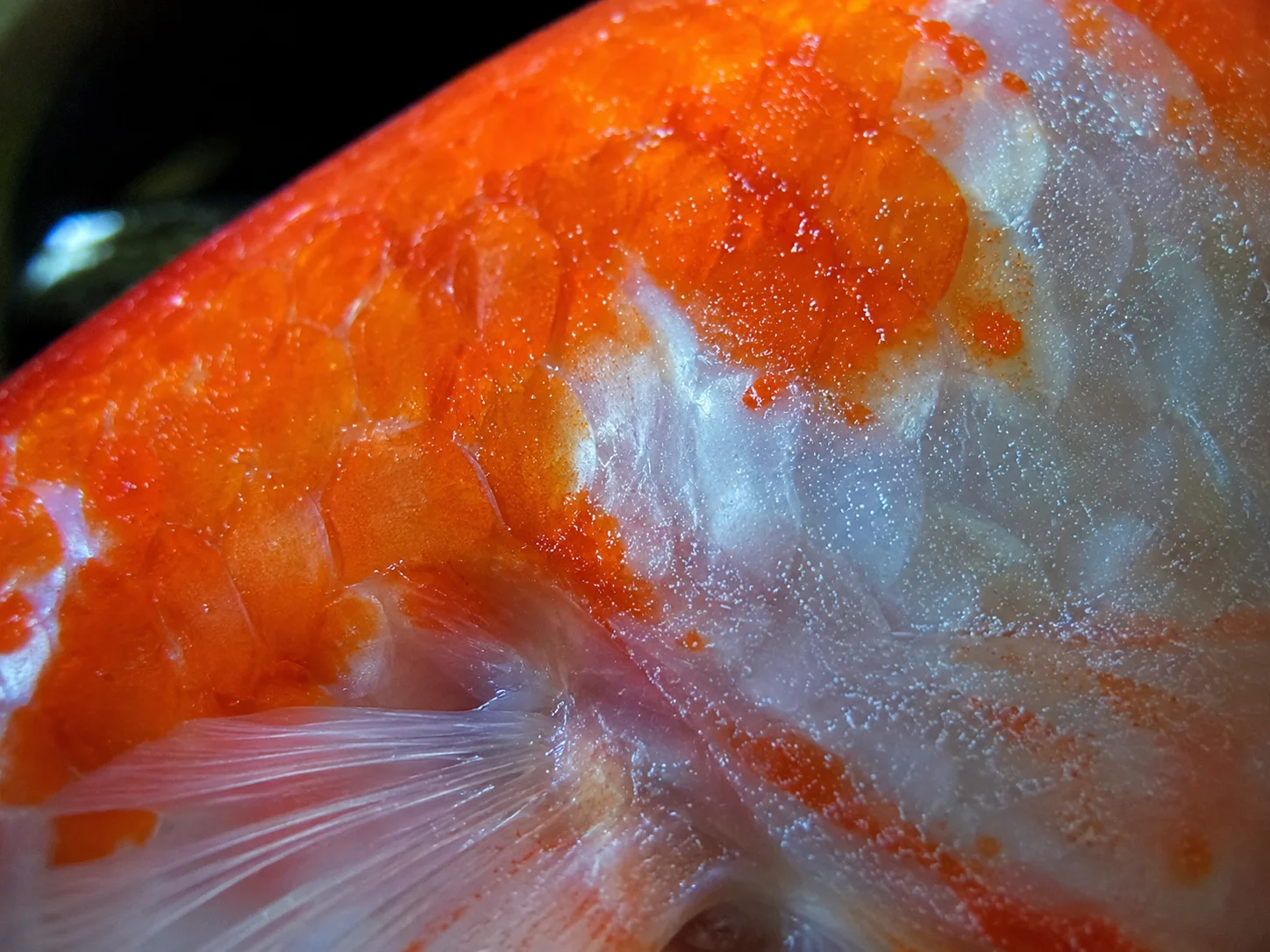
The parasite has a three-stage life cycle that explains why it’s so hard to eliminate in one treatment:
- Trophont: the visible white spot — the parasite embedded under the skin, feeding and protected by a hard cyst wall. This stage lasts 3-7 days depending on temperature and is resistant to treatment.
- Tomont: the trophont drops off the fish and settles on the pond floor or surfaces, where it divides into hundreds of tomites.
- Theront: the free-swimming infective stage that seeks out a new host. This is the only stage a treatment can actually kill.
How Do You Tell Ich Apart From Anchor Worm or Fish Lice?
Ich spots are tiny, numerous, and don’t move; anchor worm is a single thread-like structure, and fish lice is a larger, flat, mobile disc.
| Feature | Ich | Anchor Worm | Fish Lice |
|---|---|---|---|
| Size | ~0.1mm, pinpoint | 8-20mm thread | 4-10mm disc |
| Count | Many, scattered like sand | Usually one or a few | Usually one or a few |
| Movement | None — embedded and stationary | None — embedded and stationary | Mobile, relocates |
| Trigger | Water temp drop below 20°C | Warm water, 23-30°C | Warm water, 20-28°C |
The size difference is usually the fastest tell: ich looks like the fish was dusted with sand, while anchor worm and fish lice are individually large enough to identify on sight once you know what you’re looking for. If you’re unsure, check our anchor worm and fish lice identification guide for a side-by-side comparison.
Why Is Ich a Cold-Water Risk in a Tropical Climate?
Ich outbreaks are triggered by water temperature dropping below 20°C, which in the Philippines usually happens after heavy rain, typhoon season cooling, or newly transported fish arriving in cooler water.
This is the opposite pattern from anchor worm, fish lice, and flukes, all of which thrive in the warm water Philippine ponds sit in most of the year. Ich is different: research on ichthyophthiriasis identifies low water temperature — below 20°C — as one of the key predisposing factors, since cold stress weakens a koi’s immune response right as the parasite’s life cycle slows down and lingers longer on the fish. In a tropical setting, that means:
- A sudden cold snap from heavy monsoon rain or typhoon runoff is a more realistic trigger than the ambient heat that drives the other parasites in this series.
- Newly purchased koi transported in cooler water (especially from air-conditioned shops or long trips) can arrive stressed and vulnerable even if your pond itself stays warm.
- Because warmer water speeds up the parasite’s life cycle, deliberately keeping pond temperature stable and on the warmer side during treatment actually helps theronts emerge and get exposed to treatment faster.
In other words: your pond’s tropical baseline temperature is protective against ich most of the year, but a rainy-season cold snap or a stressed, recently transported fish can undo that protection quickly.
How Do You Treat Koi Ich?
Dose the full pond with a malachite green and formalin treatment, repeated every few days for 7-10 days, since only the free-swimming stage can be killed.
Look closely at spot size and count. Ich is numerous and pinpoint; anchor worm and fish lice are singular and large enough to see individually. Treating for the wrong parasite wastes the treatment window while ich continues its life cycle.
These are the standard active ingredients for ich, effective against the free-swimming theront stage. Dose the entire pond, not just affected fish — theronts are free-swimming and will seek out every fish in the water.
MICROBE-LIFT Broad Spectrum Disease Treatment, 32 oz
★★★★★ 4.5 (622 ratings) · 100+ bought in past month
A malachite green and formalin combination labeled specifically for ich, along with Costia, Trichodina, Chilodonella, Oodinium, and fungal infections — the primary treatment for this guide.
Check Price on Amazon →Since the trophont stage is protected under the skin and untouchable by treatment, and new tomonts keep releasing theronts on staggered timing, one dose is never enough. Continue treatment for a few days past the last visible white spot to catch straggling theronts, and keep water temperature stable rather than letting it swing cold again mid-treatment.
HODIK Floating Digital Pond Thermometer (Solar Powered)
★★★★★ 4.5 (97 ratings) · 300+ bought in past month
Useful both for catching the cold snap that likely triggered the outbreak, and for confirming your pond stays warm and stable through the full 7-10 day treatment window.
Check Price on Amazon →If the outbreak followed a new fish arrival, that fish likely carried cold-transport stress into your pond. Quarantine new arrivals and let them acclimate to your pond’s temperature gradually rather than introducing them straight from a cooler transport container.
How Do You Prevent Ich From Coming Back?
Quarantine new fish, avoid sudden temperature swings, and treat promptly after any cold snap since ich escalates fast once it starts.
- Quarantine every new fish for 3-4 weeks, and let them acclimate gradually to your pond’s water temperature rather than a sudden drop from cooler transport water.
- Watch for temperature swings after heavy rain or typhoon season, since a sudden cold snap is the most realistic ich trigger in a tropical pond.
- Act quickly once you spot even a few white spots. A single infected fish can seed an entire pond within days, since each cyst releases hundreds of new parasites.
- Reduce stress generally. Overcrowding, poor water quality, and rough handling all weaken a koi’s resistance right when ich is most likely to take hold.
Related Parasite Guides
Ich is one of several conditions that can look similar to koi keepers at a glance, especially in the early stages:
Larger, singular parasites, unlike ich’s numerous tiny spots. Flukes (Gill & Skin)
Invisible without a microscope, unlike visible ich spots. Trichodina & Costia
Other protozoan parasites, also treated by the same broad-spectrum medication. Koi Ulcer Disease
A possible secondary infection if ich damage goes untreated.
Frequently Asked Questions
Is ich the same as anchor worm or fish lice?
No. Ich (Ichthyophthirius multifiliis) is a protozoan parasite that appears as numerous tiny white spots, while anchor worm and fish lice are larger, individual parasites you can identify on sight. All three can cause flashing and irritation, which is why they’re commonly confused early on.
Why would ich appear in a warm tropical pond?
Ich is triggered by a drop in water temperature below 20°C, not by heat. In a tropical pond, this usually happens after heavy rain, typhoon season cooling, or when a newly purchased fish arrives stressed from cooler transport water.
Why does ich need repeated treatment instead of just one dose?
Only the free-swimming theront stage can be killed by treatment. The embedded trophont stage is protected under the skin, and new theronts continue emerging over several days, which is why treatment is repeated over a 7-10 day window.
Can ich kill koi?
Yes, and quickly. Ich is highly contagious, and a heavy infestation can cause severe gill damage and rapid mortality if not treated promptly, especially since one infected fish can spread the parasite to an entire pond within days.
Does raising water temperature help treat ich?
Yes, within safe limits for koi. Since ich’s life cycle slows down in cold water, keeping the pond warm and stable during treatment speeds up the cycle, causing theronts to emerge sooner where treatment can actually reach them.

Giovanni Carlo Bagayas
Koi keeper and breeder since the 1980s, and founder of Giobel Koi Center. Writes from hands-on experience treating parasites, diseases, and pond conditions in tropical climates.
This article is for general educational purposes and reflects common koi-keeping practices. For fish showing severe symptoms or repeated infestations, consult a local aquatic veterinarian or experienced koi health specialist for treatment tailored to your pond’s specific conditions.

Passionate about fish keeping since elementary school in the 1980s, Giovanni Carlo has dedicated countless hours to collecting and breeding a diverse array of ornamental freshwater fish. From vibrant guppies and majestic koi to striking bettas and classic goldfish, he continues to explore the fascinating world of aquatics, sharing knowledge and enthusiasm with fellow fish enthusiasts.