Quick Answer
No — the data points the other way. According to Japan’s own Ministry of Finance trade statistics, nishikigoi (ornamental koi) export value genuinely doubled from ¥2.9 billion in 2013 to ¥5.9 billion in 2021, with the Japanese government targeting ¥9.7 billion by 2025. China resumed koi imports from Japan in October 2024 after a pause. These are real, government-sourced figures — not the wildly inconsistent “market size” numbers you’ll find on many koi industry sites, which vary by 3-4x between supposedly similar reports and shouldn’t be trusted as reliable data.
Is the Koi Hobby Dying? What the Data Actually Shows
Every few years, someone in a koi forum or Facebook group declares that the hobby is dying — too expensive, too niche, too dependent on an aging generation of enthusiasts. It’s a genuine, recurring conversation in the koi-keeping community. But rather than relying on forum sentiment either way, let’s look at what real, verifiable data actually says.
The Real Data: Japan’s Own Export Statistics
According to trade statistics published by Japan’s Ministry of Finance, the export value of ornamental carp has shown sustained, genuine growth over the past decade — not a decline:
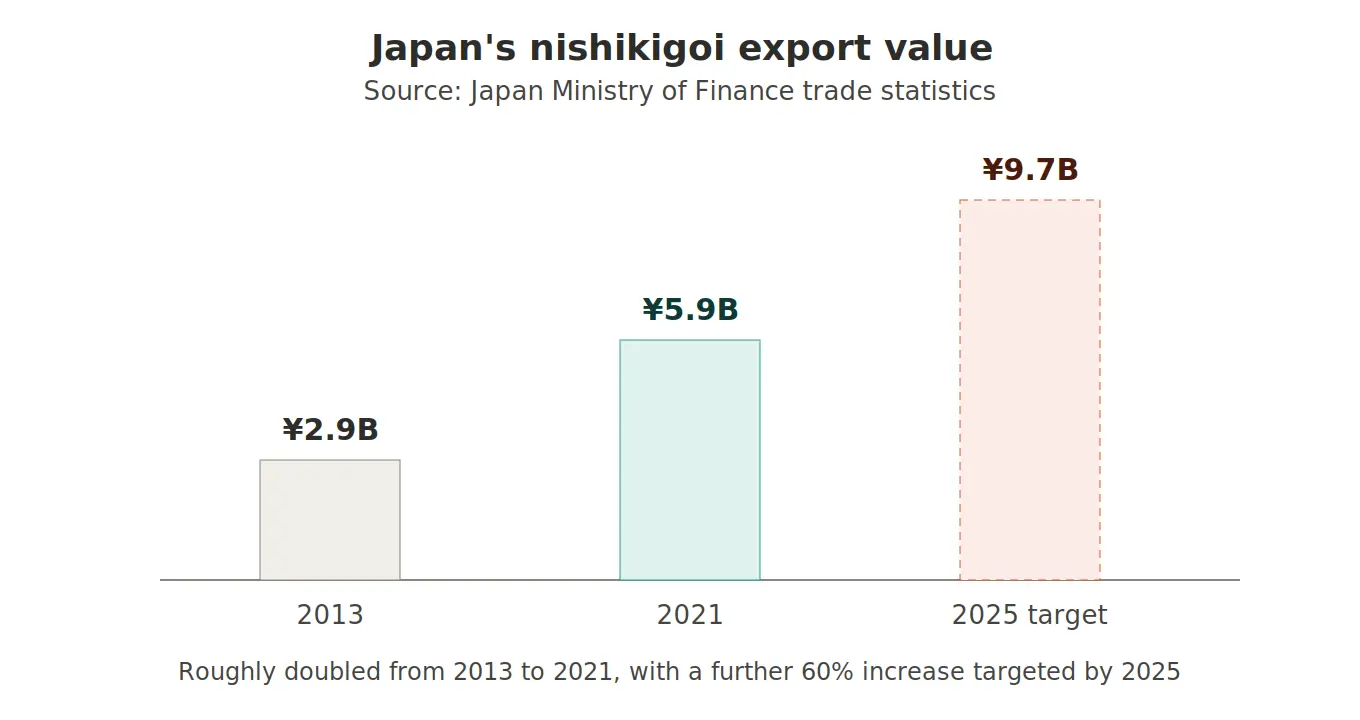
- 2013: ¥2.9 billion in nishikigoi export value
- 2021: ¥5.9 billion — roughly double the 2013 figure
- 2025 target: ¥9.7 billion, a 60% increase over 2021, set by the Japanese government as part of a broader agricultural export growth strategy
Niigata Prefecture — the historical birthplace of modern Nishikigoi breeding — accounts for roughly 55-60% of domestic koi production, and a genuinely striking statistic: approximately 80% of koi produced in Japan are exported rather than kept domestically. The top destination markets (Hong Kong, the United States, China, Germany, the Netherlands, and Indonesia) together account for roughly 60% of total export value.
In October 2024, China resumed importing Japanese koi after a temporary pause, with six fish farms across Niigata, Fukuoka, and Hiroshima prefectures qualified to resume exports — a concrete, dateable signal of continued international demand, not a shrinking market.
| Fact | Figure |
|---|---|
| Niigata share of domestic koi production | 55-60% |
| Top export destinations’ combined share | ~60% |
| China resumed koi imports | October 2024 |
| Record single koi sale price | ¥200 million (2017) |
Source: Japan Ministry of Finance trade statistics
A Word of Caution About “Koi Market Size” Reports
Here’s something worth being direct about, since it’s a genuine content gap in most coverage of this topic: if you search for “koi market size,” you’ll find a flood of generic commercial market-research reports citing wildly different figures for the same year — anywhere from $1.6 billion to $5.8 billion for 2025 alone, a 3-4x discrepancy between supposedly similar reports. These numbers come from templated, semi-automated industry-report mills and shouldn’t be treated as reliable data; several even contradict themselves on basic figures like compound annual growth rate.
The genuinely trustworthy numbers are the ones above, sourced directly from Japan’s Ministry of Finance — the actual government body tracking real export transactions, not a marketing-oriented industry report.
📖 Koi: A Complete Guide to their Care and Color Varieties
If the data has you thinking about getting into the hobby yourself, this is a genuinely solid starting point covering care and color varieties.
🛒 Check Price on Amazon →Why Does It Feel Like the Hobby Is Shrinking?
If the real export data shows growth, why does the “dying hobby” narrative persist? A few genuine factors likely contribute:
- Traditional koi club structures are under real pressure. Local, in-person koi clubs — once the primary way hobbyists connected — have seen declining membership in some regions, even as overall interest grows through other channels.
- Digital communities are replacing, not eliminating, engagement. Social media, YouTube, and online forums now introduce far more people to koi than traditional clubs ever did — but this activity is less visible to longtime club members who measure the hobby’s health by meeting attendance.
- Rising entry costs create a perception problem. Premium show-quality koi and elaborate pond setups get the most visibility online, leading newcomers to assume they need a massive pond and elite fish before “really” joining the hobby — discouraging entry even as broader interest increases.
Conclusion
The koi hobby isn’t dying — the verifiable export data genuinely points toward sustained growth over the past decade, not decline. What’s actually happening is a shift in how people engage with the hobby: fewer traditional club meetings, more digital communities, and a perception gap between premium show culture and the much broader, more accessible reality of koi keeping. If you’re considering joining, the real data suggests you’d be entering a genuinely growing community, not a dying one.
FAQs
Is koi keeping becoming less popular?
No — according to Japan’s own Ministry of Finance trade statistics, nishikigoi export value has roughly doubled over the past decade, indicating sustained growth rather than decline.
Why do I see market size figures that disagree with each other?
Many “koi market size” reports come from generic commercial market-research mills that produce templated, often inconsistent figures. Government trade statistics (like Japan’s Ministry of Finance data) are a much more reliable source.
What percentage of Japanese-bred koi are exported?
Approximately 80% of koi produced in Japan are exported rather than kept domestically, with Niigata Prefecture responsible for roughly 55-60% of national production.
Are koi too expensive for beginners now?
Premium show-quality koi can be genuinely expensive, but entry-level koi and pond setups remain accessible — the perception that you need an elite collection to participate is more a result of social media visibility than an actual barrier to entry.
You may also like


Passionate about fish keeping since elementary school in the 1980s, Giovanni Carlo has dedicated countless hours to collecting and breeding a diverse array of ornamental freshwater fish. From vibrant guppies and majestic koi to striking bettas and classic goldfish, he continues to explore the fascinating world of aquatics, sharing knowledge and enthusiasm with fellow fish enthusiasts.