Quick Answer
To estimate your koi’s weight, use the calculator below with just its length, or add girth for a more precise result. On average, healthy koi in a well-maintained pond gain 0.5–1.5 inches of length per month during warm growing season (65–75°F / 18–24°C water), with growth rate depending most heavily on pond size, water quality, and food protein content — not just age.
If you’ve ever stood at the edge of your pond wondering “how big is that koi, really?” — you’re not alone. Most hobbyists never actually weigh their koi (it’s awkward and stressful for the fish), so a length-based estimate is the practical way to track condition and growth over time.
I built the three tools below from formulas actually used in koi and pond-fish husbandry — a length/girth weight estimator, a growth projector, and a stocking-and-feeding calculator — so you can plug in your own numbers instead of guessing.
Koi Weight Calculator
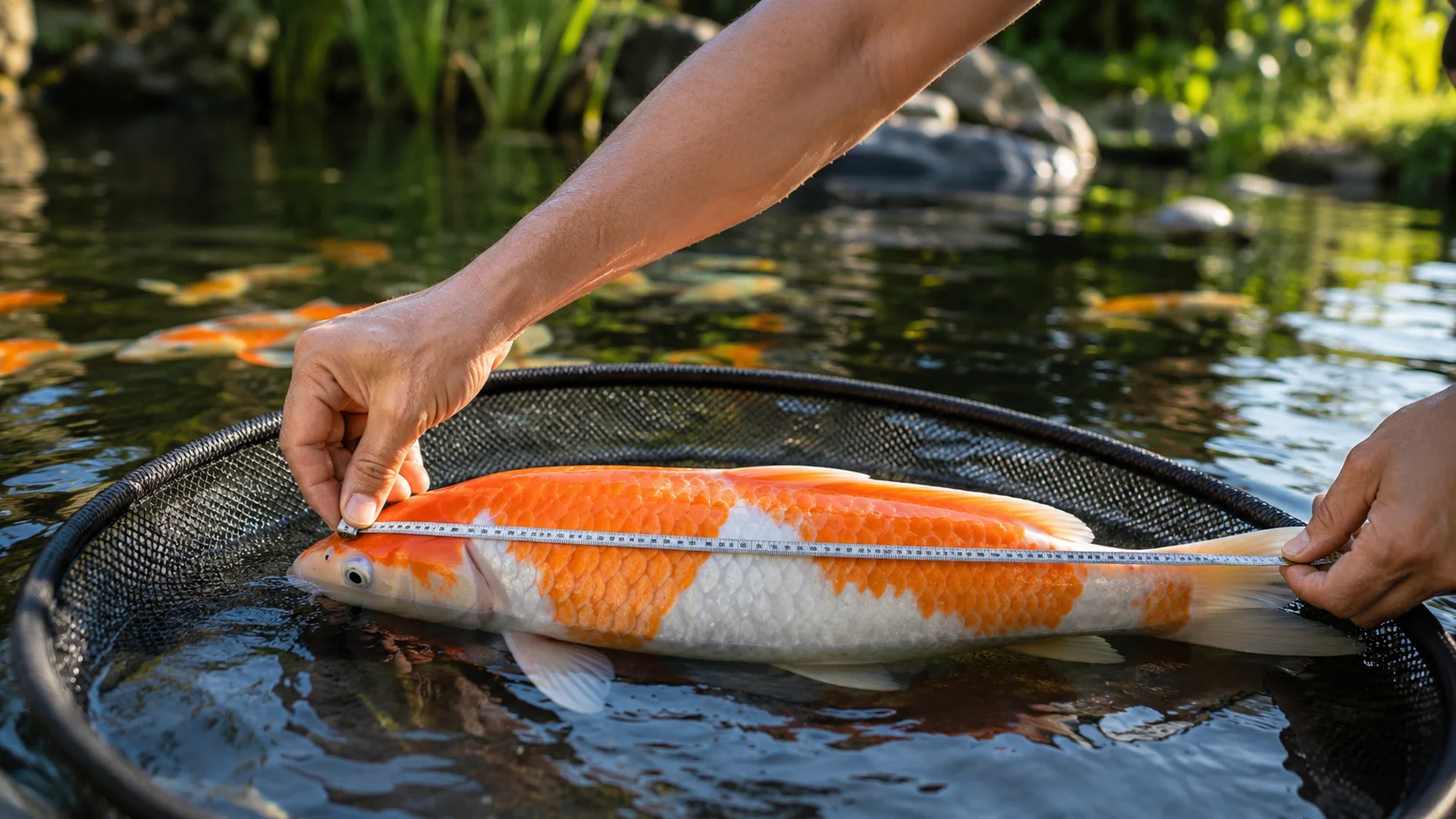
Enter your koi’s length (and girth, if you have it, for a more accurate result). Measure gently with a soft tape while your koi is in a shallow net or bag — never out of water for more than a few seconds.
This is a mathematical estimate based on standard length–weight relationships for carp-bodied fish, not a substitute for an actual scale. Individual koi vary by bloodline and condition.
Growth projections assume a warm growing season (65°F+/18°C+). Koi grow very little below 50°F/10°C. Actual growth depends heavily on genetics, water quality, and stocking density.
Stocking guidance assumes a pond with adequate biological filtration and regular water changes. These are conservative hobbyist benchmarks, not a substitute for testing your actual water parameters (ammonia, nitrite, nitrate).
How to Measure Your Koi Correctly
Accurate inputs matter more than a fancy formula. Here’s how to get numbers you can trust:
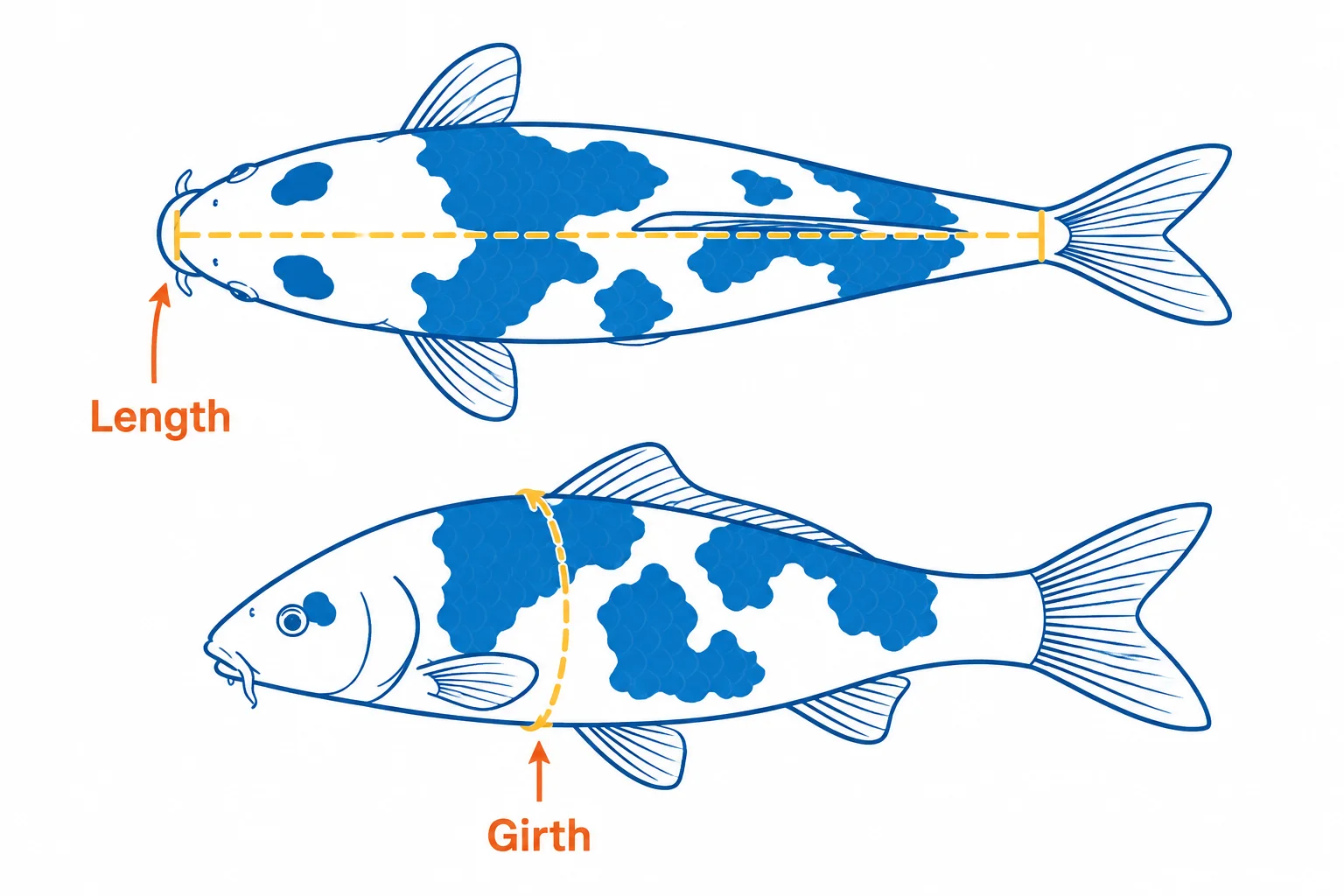
- Length — Measure in a straight line from the tip of the nose to the base of the tail fin (where the tail meets the body), not the tip of the tail itself.
- Girth — Wrap a soft measuring tape around the widest part of the body, usually just behind the pectoral fins. Don’t pull it tight enough to compress the fish.
- Handling — Use a soft koi sock or shallow net in water whenever possible. If you must lift the fish out, keep it wet and support the full body weight — never hold a koi by the tail or gills.
Recommended Tool
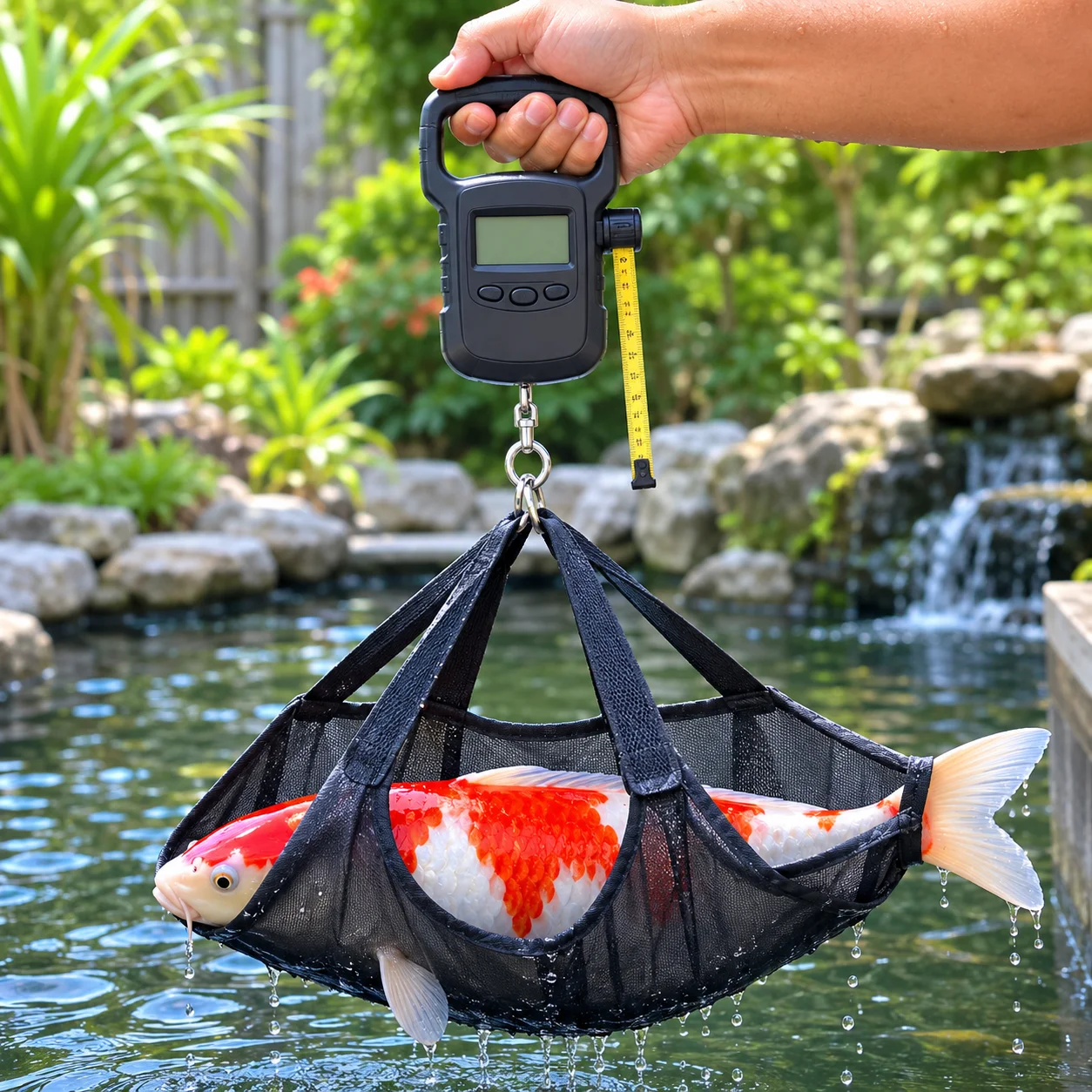
Fishfun Digital Fish Scale with Built-In Measuring Tape
Once you’ve got an estimate from the calculator above, this is the fastest way to get an exact number — it has a built-in tape for length and a 110 lb capacity hanging scale in one tool, so you can weigh and measure in the same step without juggling two gadgets pond-side.
Check Price on AmazonAs an Amazon Associate, Giobel Koi Center earns from qualifying purchases.
What Determines How Fast a Koi Grows?
Age sets the baseline, but four other factors do most of the work:
- Water temperature — Koi are cold-blooded, so growth all but stops below 50°F/10°C and accelerates in the 65–75°F/18–24°C range.
- Pond volume and stocking density — Crowded ponds mean more competition for food and worse water quality, both of which slow growth even with good feeding.
- Protein content of food — Growth-formula koi foods (typically 35–40% protein) push faster length gain than maintenance pellets (28–32% protein), especially in young koi.
- Water quality — Elevated ammonia or nitrite stresses koi and diverts energy away from growth even when feeding is generous.
Feed-to-growth rule of thumb: at around 70°F (21°C) water with a quality growth-formula food, roughly 1.5 lb of food fed over a month converts to about 1 lb of weight gain and 1 inch of length in a young, actively growing koi. Lower-quality foods can take 3–5x more volume to hit the same growth, since a large share of the pellet is filler rather than usable protein.
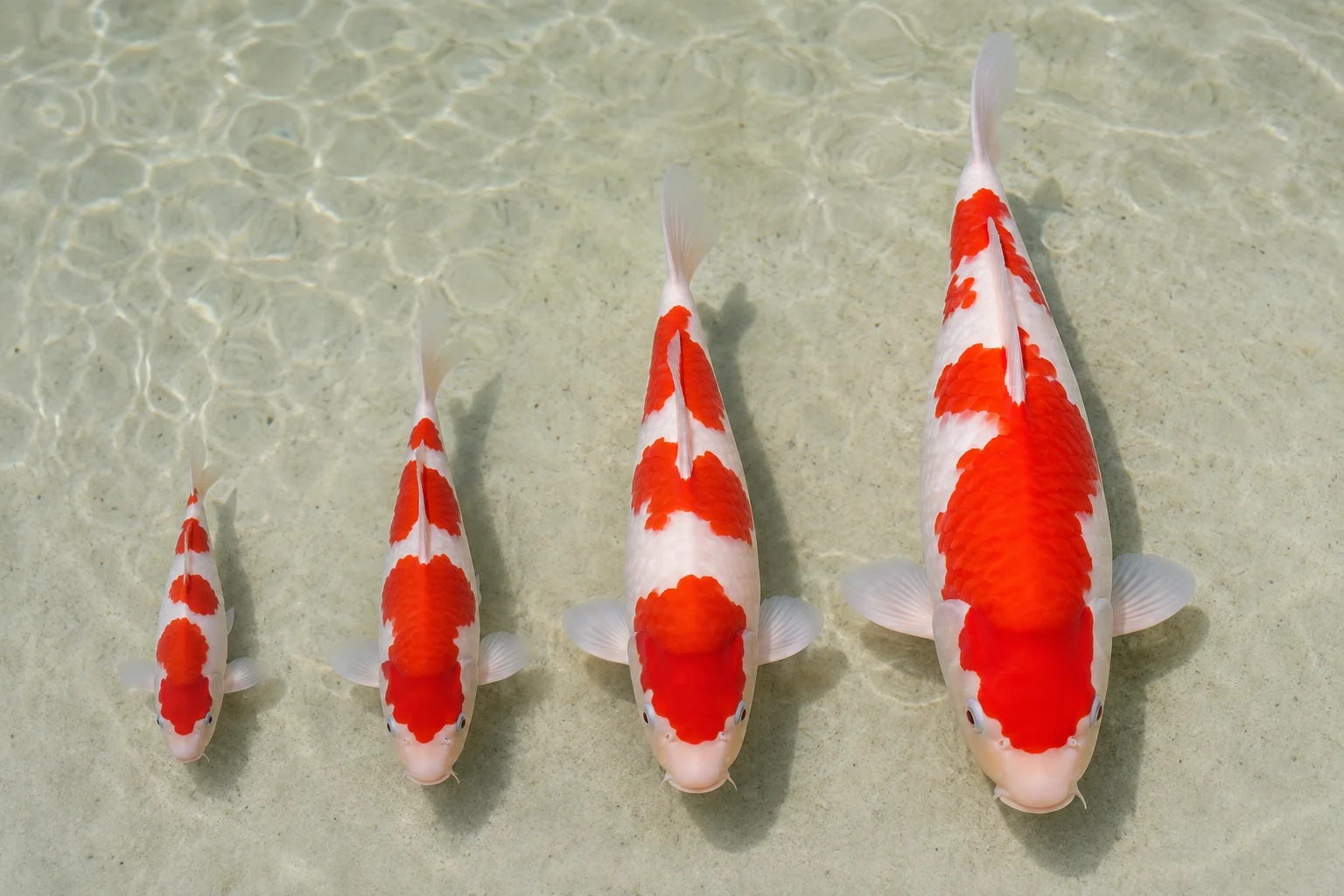
Average Koi Growth Rate by Age
| Life Stage | Typical Growth Rate | Notes |
|---|---|---|
| Tosai (under 1 year) | 1–2 in / month in season | Fastest growth window of a koi’s life |
| Nisai (1–2 years) | 0.5–1 in / month in season | Still rapid, especially with growth food |
| Young adult (2–4 years) | 0.25–0.5 in / month in season | Growth visibly slows as the fish matures |
| Mature (4+ years) | Under 0.25 in / month | Length gain minimal; focus shifts to body depth and color |
Percent of Adult Length by Age
A useful way to sanity-check whether your koi is on track: rather than a fixed inch count, compare its length to this rough percentage of its eventual adult size.
| Age | % of Adult Length |
|---|---|
| 1 year | ~29% |
| 2 years | ~50% |
| 3 years | ~64% |
| 4 years | ~75% |
| 5 years | ~82% |
| 6 years | ~88% |
| 7 years | ~91% |
| 10 years | ~95% |
| 14 years | ~99% |
These percentages are general benchmarks compiled from long-term hobbyist growth tracking, not a guarantee — bloodline, pond conditions, and feeding history all shift individual fish above or below this curve.
Frequently Asked Questions
How much should a healthy koi weigh?
A healthy koi’s weight tracks closely with length and body type — the calculator above uses this relationship. As a rough anchor, a well-conditioned 18-inch koi typically weighs somewhere in the 3–5 lb range, with jumbo-bodied bloodlines running heavier at the same length.
Can I speed up my koi’s growth?
Yes, within limits — clean water, a larger pond, lower stocking density, and a growth-formula food during warm months are the biggest levers. Genetics set the ceiling, but poor conditions are almost always the reason a koi grows slower than its potential.
Why did my koi stop growing?
Most often it’s temperature (winter dormancy is normal), maturity (growth naturally slows after 3–4 years), or a pond that’s become too crowded for the fish’s size. Sudden growth stalls paired with other symptoms are worth checking against our koi disease guide.
Is this calculator accurate enough for a koi show entry?
No — koi shows weigh and measure fish with calibrated equipment under standardized conditions. This tool is meant for hobbyist tracking and planning, not competition documentation.
How do I know if my pond is overstocked?
Weight is what matters, not fish count — because weight scales with the cube of length, a pond can look fine for years and then quietly become overstocked as the same fish simply grow larger. Use the Stocking & Feeding tab above with your total koi weight and pond volume; as a conservative hobbyist benchmark, staying under roughly 1 lb of koi per 100 gallons is safe with basic filtration, while anything beyond that needs strong biological filtration and frequent water changes to avoid ammonia spikes.

Giovanni Carlo Bagayas
Koi keeper and breeder since the 1980s, founder of Giobel Koi Center, raising koi, tilapia, guppies, and crayfish on a backyard fish farm in Mindanao, Philippines.

Passionate about fish keeping since elementary school in the 1980s, Giovanni Carlo has dedicated countless hours to collecting and breeding a diverse array of ornamental freshwater fish. From vibrant guppies and majestic koi to striking bettas and classic goldfish, he continues to explore the fascinating world of aquatics, sharing knowledge and enthusiasm with fellow fish enthusiasts.