


By Giovanni Carlo Bagayas | Updated: June 2026 | 22 min read

Quick Answer
Koi care comes down to 5 non-negotiables: a pond of at least 1,000 gallons and 3 feet deep · zero ammonia and nitrite at all times · 20–25% water changes weekly · high-quality protein pellets fed 2–4x daily in warm water · and daily observation at feeding time. Master these five and your koi will thrive. Everything else — plants, decor, lighting — is secondary. The single most common cause of koi death is poor water quality, not disease.
Koi care at a glance — the 5 non-negotiables
| Non-negotiable | The standard | What happens if you miss it |
|---|---|---|
| ⭐ 1. Pond size | 1,000+ gallons minimum; 250 gallons per adult koi; 3+ feet deep | Stunted growth, chronic stress, suppressed immunity, shortened lifespan |
| ⭐ 2. Zero ammonia/nitrite | Ammonia: 0 ppm. Nitrite: 0 ppm. At all times. | Gill damage, immune suppression, disease susceptibility, rapid death at high levels |
| ⭐ 3. Weekly water changes | 20–25% of pond volume every week | Nitrate accumulation, pH crash, mineral depletion, chronic low-grade stress |
| ⭐ 4. Quality diet | Fish meal first ingredient; 35–40% protein in warm water; wheat germ below 60°F; stop below 50°F | Poor growth, faded color, weakened immunity; overfeeding crashes water quality |
| ⭐ 5. Daily observation | Watch every fish surface at every feeding — note any that miss a meal | Disease caught late is disease that kills. Early detection saves fish. |
From 40+ years of koi keeping
I have kept koi since the 1980s. In that time I have seen beginners kill expensive koi with neglect and I have seen cheap koi thrive for 20 years with good care. The variable is never the fish — it is always the keeper. Koi are forgiving animals if water quality is maintained. They are fragile animals when it is not. Everything in this guide flows from that one truth: clean water is koi care.
Pond setup — size, depth, and design
Your pond is your koi’s entire world. Getting the size and design right from the start saves years of problems.
| Parameter | Minimum | Recommended | Why it matters |
|---|---|---|---|
| Total volume | 1,000 gallons | 2,000–5,000 gallons | More water = more stable parameters = healthier koi |
| Depth | 3 feet | 4–6 feet | Temperature stability; predator protection; koi growth |
| Gallons per koi | 250 gallons | 500+ gallons | Prevents overcrowding stress and water quality problems |
| Surface area | 50 sq ft | 100+ sq ft | Gas exchange — oxygen in, CO2 out at the water surface |
| Shade coverage | 30% | 40–60% | Prevents temperature spikes and algae blooms |
| Fish caves/hiding | At least 1 per koi | Multiple per fish | Predator escape; stress reduction; spawning |
The most common pond design mistake
Building too small. Almost every koi keeper who builds their first pond wishes it were bigger. Koi grow to 24–36 inches over 5–10 years — the small juvenile you purchase this year will be a large adult in 3 years. Plan for adult size, not juvenile size. If you can only afford a 500-gallon pond, keep goldfish and upgrade later.
🧮 Not sure how many koi your pond can hold?
Use our free Koi Pond Volume Calculator — enter your pond dimensions and it instantly tells you your pond’s volume in gallons and the safe number of adult koi you can keep.
Water quality — the foundation of koi health
| Parameter | Ideal range | Danger zone | Test frequency |
|---|---|---|---|
| ⭐ Ammonia | 0 ppm | Any reading above 0 | Weekly; daily if new pond or new fish |
| ⭐ Nitrite | 0 ppm | Any reading above 0 | Weekly; daily if cycling |
| Nitrate | Under 40 ppm | Above 80 ppm | Weekly |
| pH | 7.0–8.5 | Below 6.5 or above 9.0 | Weekly |
| Dissolved oxygen | Above 7 mg/L | Below 5 mg/L | Monthly; monitor in hot weather |
| Temperature | 59–77°F (15–25°C) | Above 86°F or below 35°F | Daily in extreme seasons |
| KH (carbonate hardness) | 100–200 ppm | Below 60 ppm (pH crash risk) | Monthly |
Related: Complete koi pond water quality guide — pH, ammonia, nitrite and nitrate
The nitrogen cycle — understanding your pond’s biology
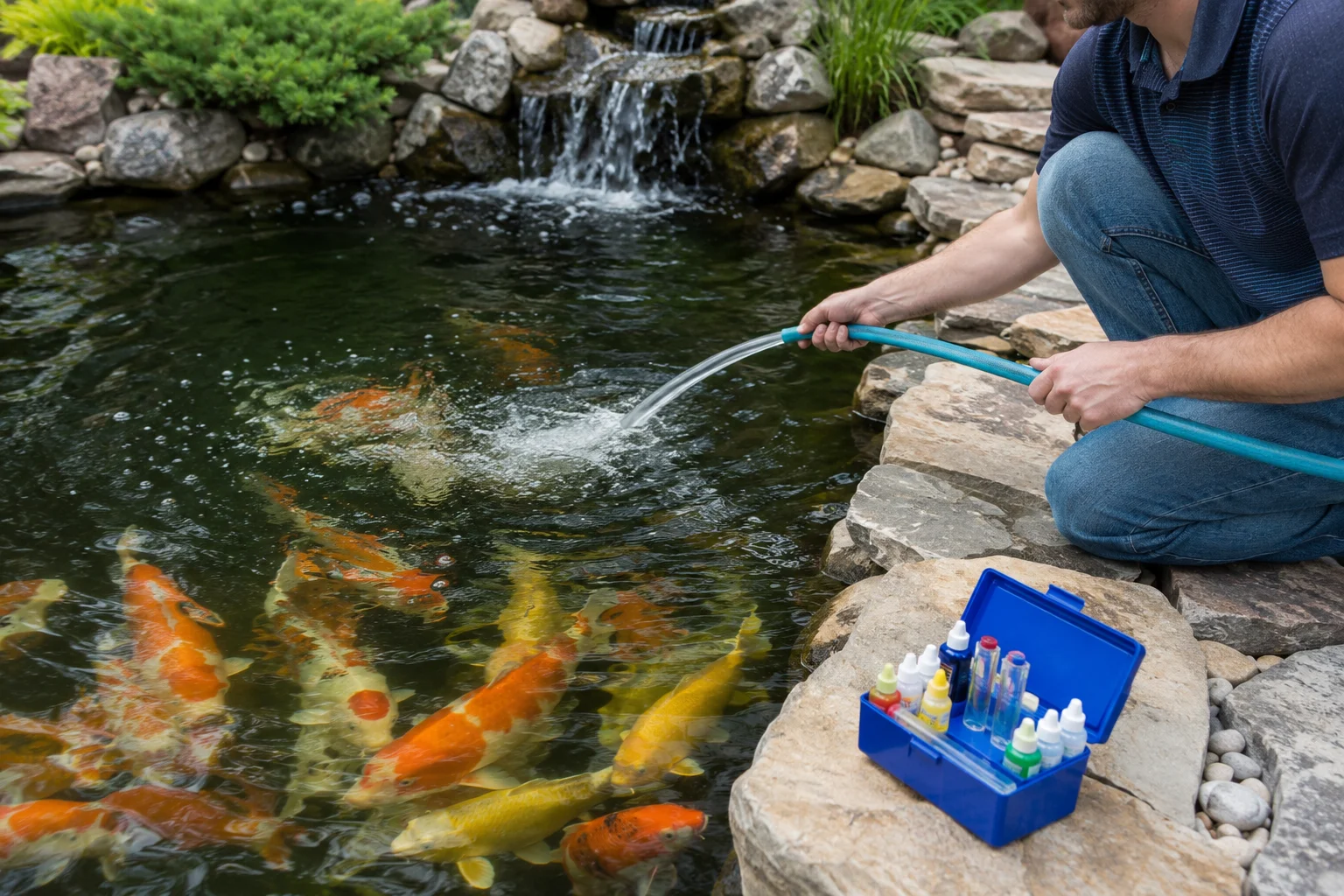
Koi waste produces ammonia → beneficial bacteria convert ammonia to nitrite → a second bacteria colony converts nitrite to nitrate → water changes remove nitrate. This biological process is called the nitrogen cycle and it is the foundation of all pond filtration. A new pond takes 4–8 weeks to establish this cycle — during this time ammonia and nitrite will spike (called “new pond syndrome”). Test daily and do frequent water changes during this period.
Filtration — what you need and why
Koi produce significantly more waste per fish than most pond fish. Proper filtration is not optional — it is the mechanical and biological system that keeps your nitrogen cycle functioning and your water clear.
| Filter type | What it does | Best for |
|---|---|---|
| Mechanical filter | Removes solid waste — uneaten food, fish waste, debris | All ponds — must be cleaned weekly |
| Biological filter | Houses beneficial bacteria that convert ammonia → nitrite → nitrate | All ponds — never clean aggressively or you kill the bacteria |
| UV clarifier | Kills single-cell algae causing green water | Ponds with green water problems |
| Bottom drain | Pulls waste from pond floor to filter automatically | Ponds 2,000+ gallons — most efficient waste removal |
| Pressurized bead filter | Combines mechanical and biological in one compact unit | Smaller ponds under 2,000 gallons |
Golden rule: Always oversize your filter. A filter rated for 2,000 gallons should be used for a 1,000-gallon koi pond. Koi produce 2–3x more waste than the fish most filter ratings are based on. Your filter’s flow rate should turn over the full pond volume at least once every two hours — so a 2,000-gallon pond needs a pump with a minimum 1,000 GPH flow rate.
Aeration — oxygen is as important as filtration
Most beginner guides underemphasize aeration. Dissolved oxygen is as critical as filtration — koi need a minimum of 6–7 mg/L of dissolved oxygen at all times. Oxygen levels drop in hot weather, at night when plants respire, and in overstocked ponds. Low oxygen stress is a leading cause of disease vulnerability that most keepers never test for.
| Aeration method | How it works | Best for |
|---|---|---|
| Air pump + diffuser plates | Pumps air through diffuser stones on pond floor — oxygenates the full water column including deep zones | All ponds — most reliable 24/7 oxygen source |
| Waterfall / stream | Water surface agitation at the point of return oxygenates naturally | Aesthetic ponds — also works as partial aeration |
| Fountain | Surface agitation and visual appeal — oxygenates surface layer only | Shallow ponds; supplementary aeration only |
| Venturi injector | Draws air into the water flow through a constriction in the return pipe | Easy addition to existing pump/filter setup |
⚠️ Summer oxygen emergency signs
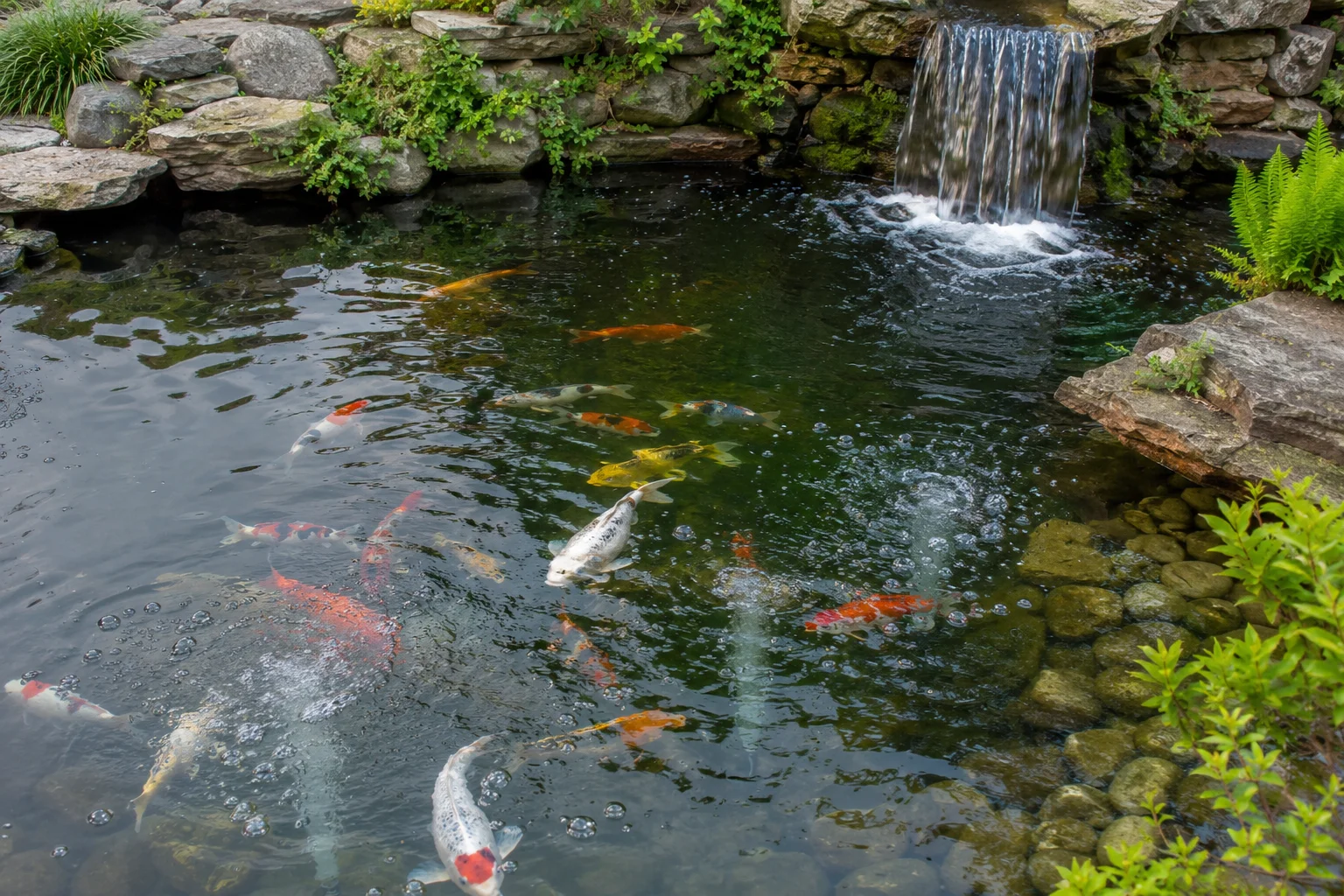
Koi gasping at the surface on a hot summer morning is a low oxygen emergency — not a disease. The water has depleted overnight. Immediately: add emergency aeration (splash water from a hose into the pond to introduce oxygen), turn on all pumps and waterfalls, and do a 20–30% water change with well-oxygenated tap water. This is one of the most common summer koi fatality causes and it is entirely preventable with adequate aeration installed before summer.
Feeding koi — what, how much, and when
| Water temperature | Feed type | Frequency | Amount |
|---|---|---|---|
| Above 68°F (20°C) | High-protein pellets (35–40% protein) | 3–4x daily | What they consume in 5 minutes |
| 60–68°F (15–20°C) | Wheat germ pellets (lower protein, easier digestion) | 2x daily | Small amounts only |
| 50–60°F (10–15°C) | Wheat germ only | Once daily if eating | Very small amounts |
| Below 50°F (10°C) | Stop feeding completely | None | Koi cannot digest food below 50°F — undigested food causes bacterial infection |
Related: Complete koi fish food guide — best brands, feeding schedule, and what to avoid
Sunlight and pond placement — what most guides miss
Where you place your koi pond matters as much as how you build it. This is one of the most overlooked factors in koi care — most guides mention it briefly, but placement mistakes cause problems that are expensive and sometimes impossible to fix after the pond is built.
| Placement factor | Ideal | Problem if wrong |
|---|---|---|
| Daily sunlight | 4–6 hours of direct sun | Too little: weak plant growth, reduced koi immune function. Too much: algae blooms, dangerous temperature spikes above 86°F |
| Tree proximity | Keep ponds away from deciduous trees | Falling leaves decompose rapidly, spike ammonia, and clog filters — a single large tree can overwhelm a pond in autumn |
| Afternoon shade | Natural or artificial shade in afternoon peak heat | Water temperatures above 86°F crash dissolved oxygen and cause heat stress — most dangerous in tropical climates |
| Wind exposure | Some wind is good — increases surface aeration | Strong constant wind blows debris into pond and increases evaporation |
| Drainage and runoff | Position pond so garden/lawn runoff cannot drain into it | Fertilizer and pesticide runoff is lethal to koi — a single heavy rain event can wipe out an entire pond |
Tropical climate tip — from my koi farm in Mindanao
In the Philippines and other tropical climates, afternoon shade is not optional — it is essential. Water temperatures regularly exceed 86°F in direct midday sun, which depletes oxygen and stresses immune systems. I position my ponds to receive morning sun and natural shade from late morning onward, and use water lily coverage of 50–60% as the primary temperature management tool. A well-shaded pond in a hot climate outperforms a sunny pond in a temperate climate almost every time.
Seasonal koi care — spring, summer, autumn, winter
| Season | Key actions | Watch for |
|---|---|---|
| Spring | Resume feeding with wheat germ as temps rise above 50°F; spring clean pond; inspect filter; treat prophylactically for parasites; introduce new fish only after quarantine | Spring disease outbreak — koi immune systems are weakest after winter; KHV risk highest in spring |
| Summer | Switch to high-protein pellets; feed 3–4x daily; increase water change frequency; add extra aeration; monitor for algae blooms | Low dissolved oxygen in heat; overfeeding water quality crashes; predator activity increases |
| Autumn | Transition back to wheat germ pellets as temps drop; reduce feeding frequency; autumn clean before winter; treat for parasites before temperatures drop below treatment range | Parasite treatment effectiveness drops below 60°F; prepare koi for reduced metabolism |
| Winter | Stop feeding below 50°F; maintain pond aeration through ice; keep a hole in ice if pond freezes (toxic gases must escape); do not disturb koi in torpor | Complete ice-over traps toxic gases — use a pond heater or aerator to maintain open water; never break ice by force (shockwave stresses koi) |
Koi pond maintenance schedule — daily, weekly, monthly
| Frequency | Task |
|---|---|
| Daily | Feed koi and observe every fish — check all are surfacing and eating |
| Check pump and filter are running | |
| Remove surface debris with pond net | |
| Check water temperature | |
| Weekly | Test ammonia, nitrite, nitrate, and pH |
| Do 20–25% water change | |
| Clean mechanical filter (rinse, do not scrub biological media) | |
| Add beneficial bacteria dose | |
| Monthly | Test KH (carbonate hardness) and dissolved oxygen |
| Inspect pond liner, pipes, and equipment for damage | |
| Trim and manage aquatic plants | |
| Check and clean UV clarifier bulb (replace annually) | |
| Twice yearly | Full pond clean (spring and autumn) — remove sludge from bottom, clean all equipment |
| Parasite treatment (spring before immune systems are stressed; autumn before temperatures drop below treatment range) |
Koi diseases — how to identify and treat common problems
| Disease / problem | Symptoms | First action |
|---|---|---|
| Ammonia/nitrite poisoning | Gasping at surface; red streaks on body; lethargy | Test water immediately; 30–50% water change; find and fix ammonia source |
| White spot (Ich) | White salt-like spots on body and fins; flashing; scratching | Raise temperature to 77–82°F to accelerate life cycle; treat with ich-specific medication |
| Fin rot | Ragged, fraying, or discolored fin edges | Improve water quality; treat with antibacterial medication; isolate if severe |
| Anchor worm | Visible thread-like parasites attached to skin; inflammation at attachment point | Remove physically with tweezers; treat pond with appropriate antiparasitic |
| Dropsy | Scales raised like a pinecone; bloated body | Isolate immediately; Epsom salt bath; vet-prescribed antibiotics; often fatal — early intervention critical |
| Ulcers | Open wounds or red crater-like lesions on body | Treat topically with antibiotic ointment; systemic antibiotics for deep ulcers; improve water quality |
| KHV (Koi Herpesvirus) | Mass die-off at 61–77°F; gill necrosis; sunken eyes | No cure; notifiable disease in many countries; quarantine all surviving fish |
⚠️ Most important disease rule
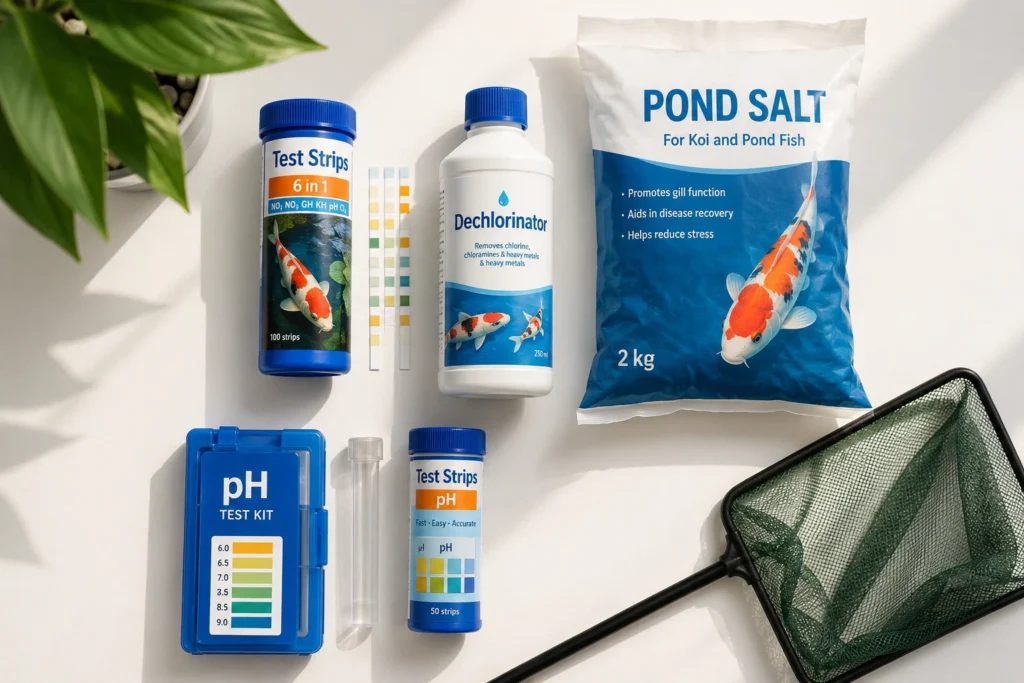
Always test water quality first before diagnosing or treating disease. At least 80% of koi “disease” cases are actually water quality problems. Ammonia, nitrite, pH crash, or low oxygen cause symptoms that look identical to parasitic or bacterial infection. Treat the water before treating the fish — you will be right most of the time and you will never make a water quality problem worse by improving water quality.
Predator protection
Herons, raccoons, cats, otters, and kingfishers are the most common koi predators. A single heron can empty a koi pond overnight. The most effective layered defense:
- Pond depth 3+ feet at perimeter: Herons can only wade in shallow water
- Raised pond netting: Physical barrier over the pond surface (raised 12–18 inches on posts)
- Fish caves: Pipe sections on the pond floor give koi somewhere to retreat
- Motion-activated sprinklers: Drive herons away 24/7 including at night
- Fishing line at 6 and 12 inches: Disrupts the heron’s walking approach to the pond
Related: Complete guide to deterring herons from koi ponds — 10 best methods
Koi pond plants — benefits, best choices, and what to avoid
Aquatic plants are one of the most underrated tools in koi care. They absorb excess ammonia and nitrate, provide shade and hiding places, add oxygen during daylight hours, and make your pond more beautiful. The challenge: koi will eat many plants.
| Plant | Koi-safe? | Benefit | Notes |
|---|---|---|---|
| Water lily | Yes | Shade, surface coverage, nutrient absorption | Koi may nibble roots — protect with baskets |
| Cattails / reeds | Yes | Nutrient absorption; marginal heron deterrent | Grow in shallow margins; contain as they spread aggressively |
| Water hyacinth | Yes | Excellent nutrient absorption; fast-growing | Invasive in warm climates — never release into natural waterways |
| Iris | Yes | Marginal beauty; nutrient absorption | Koi generally leave iris roots alone |
| Anacharis (Elodea) | Koi eat it | Oxygenates water; absorbs nutrients | Koi will eat it — replace regularly or use as a treat plant |
| Lotus | Yes | Beautiful; large leaves provide shade | Needs full sun; spectacular in summer |
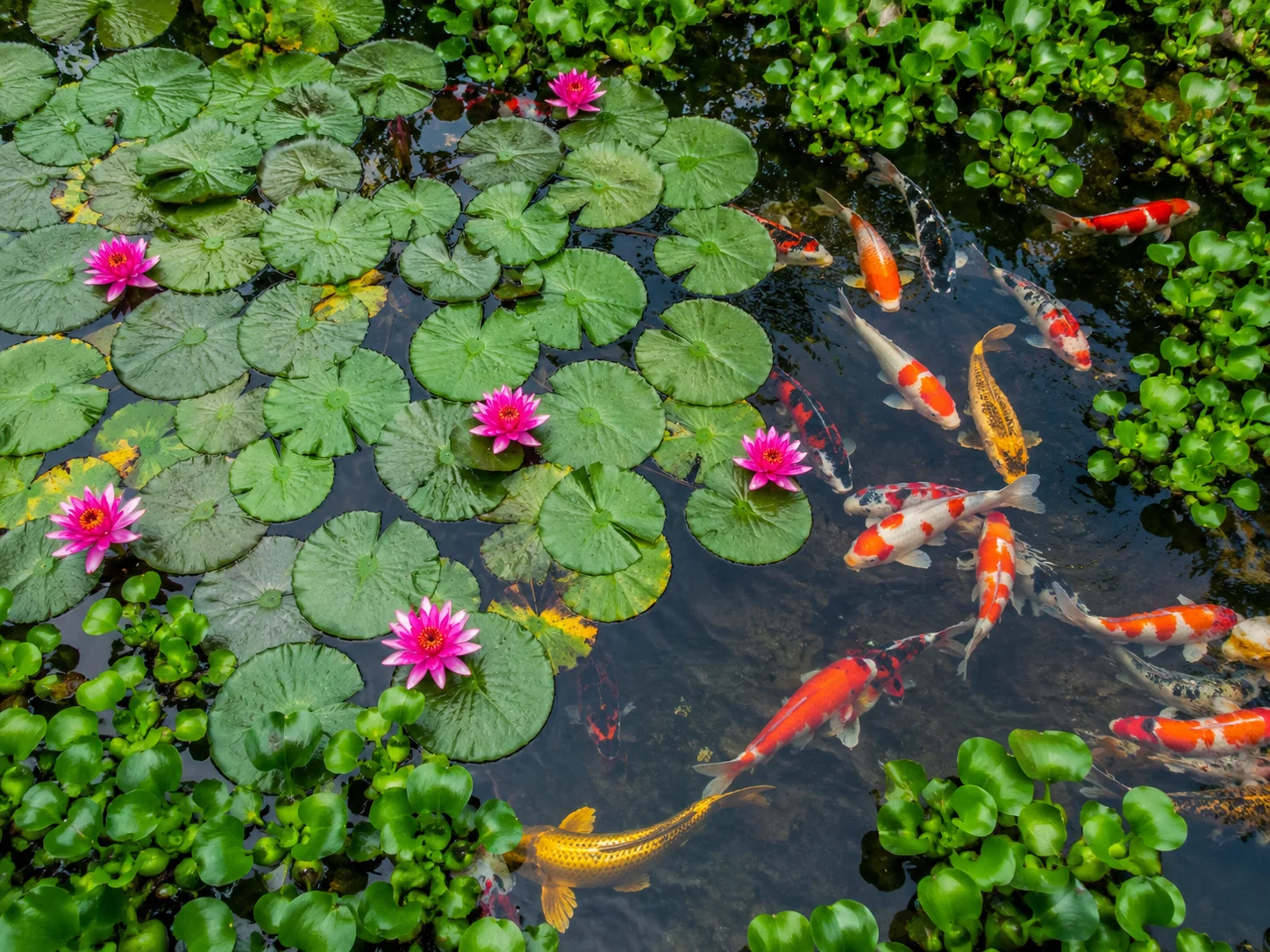
Coverage target: Aim for 40–60% surface coverage with floating plants like water lily and water hyacinth. This reduces algae (by blocking sunlight), keeps water cooler in summer, and gives koi shade and hiding spots.
How many koi can your pond hold?
Overstocking is one of the most common beginner mistakes — and one of the most damaging. Too many fish in too little water overwhelms your biological filter, spikes ammonia, suppresses immune systems, and causes chronic low-grade stress that shortens koi lifespans. The safe stocking rules are simple:
| Pond size | Safe adult koi (250 gal/fish) | Comfortable max (500 gal/fish) |
|---|---|---|
| 1,000 gallons | 4 koi | 2 koi |
| 2,000 gallons | 8 koi | 4 koi |
| 3,000 gallons | 12 koi | 6 koi |
| 5,000 gallons | 20 koi | 10 koi |
| 10,000 gallons | 40 koi | 20 koi |
These numbers assume adult koi averaging 20–24 inches. Juveniles take far less space — but they grow fast. Always plan for adult size, not juvenile size. If you are starting with small koi, use the comfortable maximum column as your target to give them room to grow without requiring a pond upgrade in 3 years.
🧮 Calculate your exact safe stocking number
Every pond is different. Enter your actual pond dimensions into our free Koi Pond Volume Calculator and get your pond’s volume in gallons, liters, and the exact safe number of adult koi — in seconds.
Use the free pond calculator →Adding new koi — quarantine protocol
One unquarantined fish has destroyed entire pond populations. Never skip quarantine — not even for fish from a trusted supplier.
- Quarantine tank: Separate 100–200 gallon tank with its own filter, heater, and aeration
- Minimum 3 weeks: Most diseases show symptoms within 21 days
- Salt treatment: Add 3 lbs non-iodized salt per 100 gallons as a mild prophylactic
- Daily observation: Check every fish every day during quarantine
- Never share equipment: Nets, buckets, and tools used in the quarantine tank must not touch your main pond
- Gradual introduction: Float new koi in a bag in the pond for 20 minutes to equalize temperature before release
- Monitor main pond water: Test ammonia and nitrite for 2 weeks after any new fish introduction — even post-quarantine, adding new fish increases bioload and can cause a temporary mini-cycle
Do koi recognize their owners?
Yes — and this is one of the most surprising things new koi keepers discover. Koi do develop the ability to recognize individual people over time, particularly whoever feeds them consistently. This is not instinct or coincidence — it is learned behavior built through repetition.
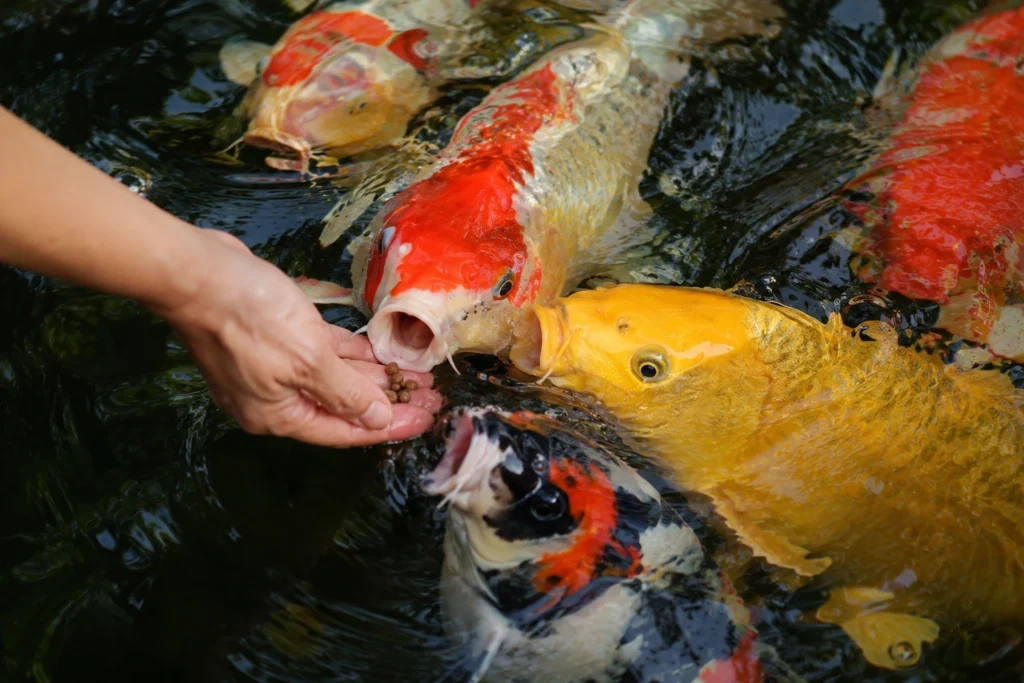
Koi that are hand-fed daily will begin swimming to the surface when their keeper approaches — even before food appears. Some will eat directly from an open hand. The recognition appears to be visual (koi have good color vision) and possibly based on the shadow and silhouette of the person approaching. Koi fed by multiple people generally respond to all of them, but show the strongest reaction to the primary feeder.
From 40+ years of observation
My koi respond to my approach within seconds — before I reach the feeding spot. They follow me along the pond edge. The Chagoi in particular will eat from my hand within a few weeks of a new fish being added, and older fish will approach strangers within minutes if I am standing nearby. This is one of the most rewarding aspects of long-term koi keeping — these are not anonymous fish. They are individual animals with personalities, and over years, you come to know them.
Which variety is most people-friendly? Chagoi koi are universally regarded as the most human-friendly variety — they are typically the first to hand-feed and will often lead shyer varieties to the surface. If you want a koi that interacts with you, Chagoi is the place to start. Related: Chagoi koi — the friendliest and hardiest variety for beginners
Choosing your koi — best varieties for beginners
| Variety | Why it’s good for beginners | Colors |
|---|---|---|
| ⭐ Kohaku | Simple two-color pattern easy to evaluate; the most iconic koi; widely available; forms basis of all Nishikigoi understanding | White + Red |
| ⭐ Chagoi | Hardiest variety; friendliest fish (first to eat from hand); calming influence on other koi; excellent for pond keepers new to koi | Brown/olive/tea |
| Ogon | Solid metallic color easy to evaluate; very hardy; highly visible in any pond | Gold, platinum, orange |
| Showa | Bold, dramatic — one of the most striking varieties; good hardiness from Ki Utsuri ancestry | Black + Red + White |
| Sanke | Three-color Gosanke; more refined than Showa; good for keepers ready to learn pattern evaluation | White + Red + Black |
Related: Complete guide to all koi varieties | Chagoi koi — the friendliest and hardiest variety
Common koi care myths — debunked
| Common myth | The truth |
|---|---|
| “Clear water means safe water” | False. Ammonia and nitrite are colorless and odorless at lethal concentrations. Crystal clear water can have ammonia levels that will kill koi within hours. Always test — never trust appearance alone. |
| “Koi only grow to the size of their pond” | Partly true, but the mechanism is harmful. Koi in small ponds release growth-inhibiting hormones that slow growth — a stress response, not a healthy adaptation. A stunted koi is a stressed koi with a shorter lifespan. |
| “Plants are enough to filter a koi pond” | False. Plants help but cannot handle the bioload of adult koi. Koi produce far more ammonia than aquatic plants can absorb. A dedicated biological filter is non-negotiable. |
| “More feeding means faster growth” | False beyond a point. Overfeeding crashes water quality, causing stress that suppresses growth. Feed only what koi consume in 5 minutes — consistent quality food at the right amount grows koi faster than overfeeding ever will. |
| “Sick fish should be medicated immediately” | Usually wrong. Test water quality first. Most koi “disease” symptoms are water quality reactions. Medicating a fish with an ammonia problem without fixing the water will not help — and many medications stress fish further. |
| “Koi are low-maintenance pond fish” | False. Koi require weekly water changes, regular testing, seasonal feeding adjustments, quarantine protocols, predator management, and daily observation. They are moderately demanding pets. Goldfish are genuinely low-maintenance pond fish. |
| “A new pond is ready for koi immediately” | False. A new pond must cycle for 4–8 weeks before it is safe for koi. During cycling, beneficial bacteria colonies establish and ammonia/nitrite will spike dangerously. Add a few hardy fish first (or use fishless cycling with ammonia dosing) and test daily until parameters stabilize. |
Frequently asked questions
How do you take care of koi fish?
Provide a 1,000+ gallon pond at least 3 feet deep. Maintain 0 ppm ammonia and nitrite through proper filtration and weekly 20–25% water changes. Feed high-quality pellets 2–4x daily in warm water; stop feeding below 50°F. Test water weekly. Observe fish daily at feeding time. Quarantine all new fish for 3 weeks.
What size pond do koi need?
Minimum 1,000 gallons total with at least 250 gallons per adult koi, and at least 3 feet deep. Deeper ponds (4–6 feet) are strongly recommended for temperature stability, predator protection, and koi growth. When in doubt, build bigger — every koi keeper wishes their first pond was larger.
What do koi fish eat?
High-quality floating pellets with fish meal as the first ingredient and 35–40% protein. Feed 2–4x daily in warm water. Switch to wheat germ pellets below 60°F. Stop feeding entirely below 50°F. Healthy treats: watermelon, peas, lettuce, shrimp. Never feed bread, corn, crackers, or any food not designed for koi.
How often should you change koi pond water?
20–25% of pond volume every week. This is the single most important maintenance task. Never do a 100% water change — it kills beneficial bacteria in your filter. In summer when feeding is heaviest, increase to 25–30% weekly.
How do you keep koi pond water clear?
Properly sized biological filtration + weekly 20–25% water changes + do not overstock + do not overfeed + UV clarifier for green water. Clear water is the result of biological balance, not chemicals. Fix the cause, not the symptom.
What is the best koi pond filter?
A system combining mechanical filtration (removes solid waste) and biological filtration (converts ammonia through the nitrogen cycle). For ponds under 2,000 gallons: pressurized bead filter. For larger ponds: bottom drain + vortex chamber + multi-chamber biofilter. Always oversize — a filter rated for 2,000 gallons should be used for a 1,000-gallon koi pond. Your filter flow rate should turn over the full pond volume at least once every two hours.
How do you know if koi fish are sick?
Missing a feeding is the earliest warning sign. Also watch for: gasping at surface, clamped fins, flashing (rubbing on walls), visible spots or lesions, lethargy, color changes, bloating. Test water quality immediately — most koi “sickness” is actually a water quality problem. Test before you treat.
Can koi live in a tank indoors?
Young koi under 6 inches can be kept temporarily in a 29+ gallon tank. Adult koi cannot — they grow to 24–36 inches and produce too much waste for standard aquarium filtration. Koi are pond fish and need pond conditions to thrive long-term. For indoor aquariums, goldfish are the better choice.
How many koi can I keep in my pond?
The safe rule is 250 gallons per adult koi. A 1,000-gallon pond supports 4 adult koi; a 2,000-gallon pond supports 8. Always understock — koi grow fast and a pond that feels uncrowded today can become dangerously overcrowded in 3 years. Use the Koi Pond Volume Calculator to find your exact safe number.
Do koi recognize their owners?
Yes. Koi learn to recognize the person who feeds them consistently and will swim to the surface when that person approaches — even before food appears. Hand-fed koi will eat directly from an open hand. The Chagoi variety is the most human-friendly and the quickest to hand-feed. Recognition builds over weeks and months of daily feeding.
What sunlight do koi ponds need?
Koi ponds need 4–6 hours of sunlight per day. Too much full sun causes algae blooms and dangerous temperature spikes above 86°F. Too little weakens plant growth and reduces koi immune health. Aim for morning sun with afternoon shade, and use 40–60% surface plant coverage to regulate light naturally.
Complete koi care — in-depth guides
- Koi pond water quality — pH, ammonia, nitrite and nitrate complete guide
- Koi fish food — complete feeding guide with seasonal schedule
- How long do koi fish live — complete lifespan guide
- Deterring herons from koi ponds — 10 best methods
- All koi fish varieties — complete identification guide
- Chagoi koi — the hardiest and friendliest variety for beginners
- Butterfly koi — complete care guide
- Lucky number of koi fish in a pond — stocking and Feng Shui guide
- Showa koi — complete variety guide
- Koi pond volume calculator — how many koi can your pond hold?

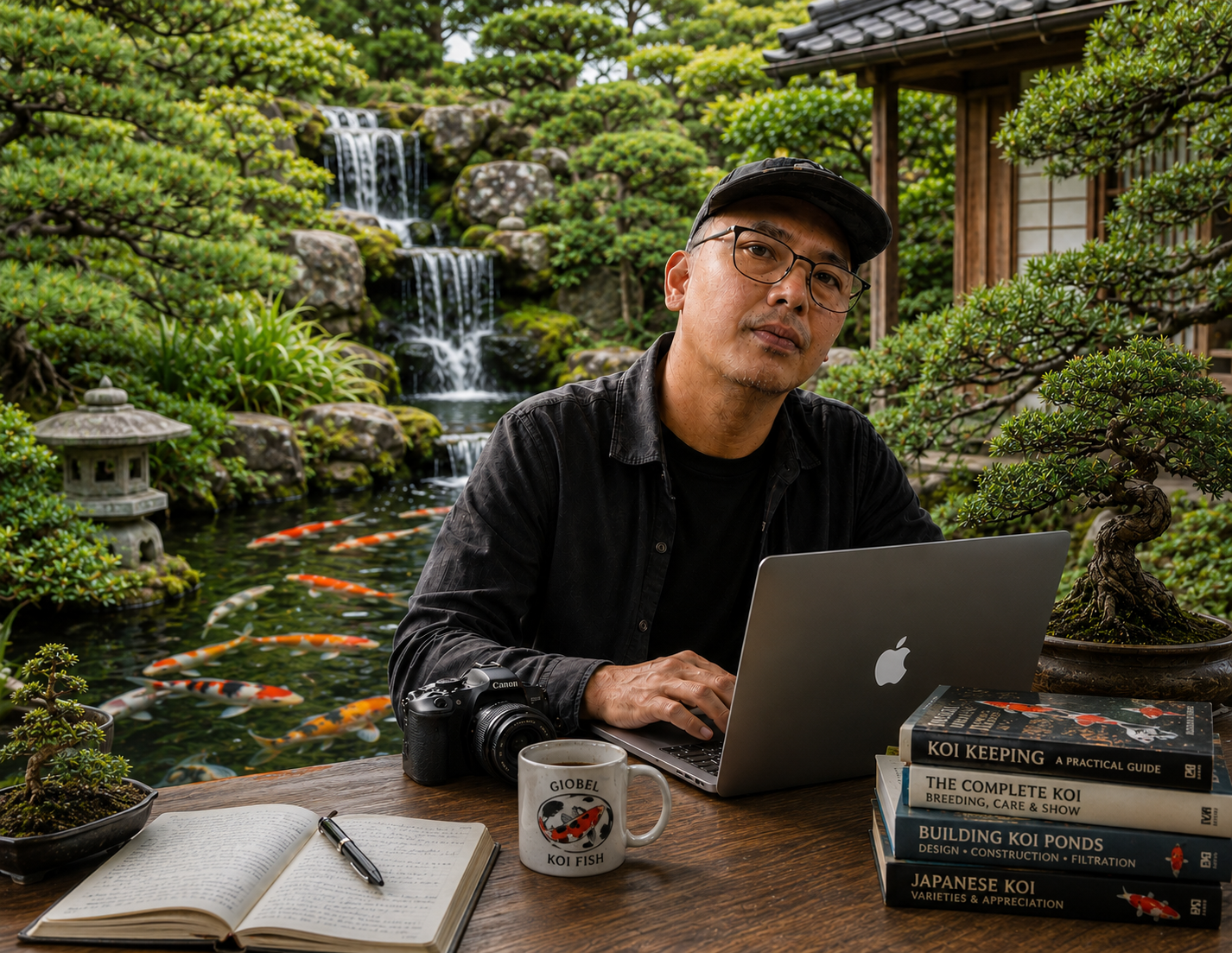
Giovanni Carlo Bagayas
Founder, Giobel Koi Center · Koi keeper and breeder since the 1980s · Labangan, Zamboanga del Sur, Philippines
Giovanni has kept and bred koi for over 40 years — from his first pond in the 1980s to his current koi farm in Mindanao. He has experienced every aspect of koi care firsthand: new pond syndrome, disease outbreaks, heron predation, breeding programs, and the daily joy of watching koi thrive in clean water. His koi care advice comes from four decades of direct experience, not textbooks.