Chagoi Koi: Complete Guide to the Friendliest Koi Fish (Care, Colors & Size)
By Giovanni Carlo Bagayas | Updated: June 2026 | 12 min read
Quick Answer
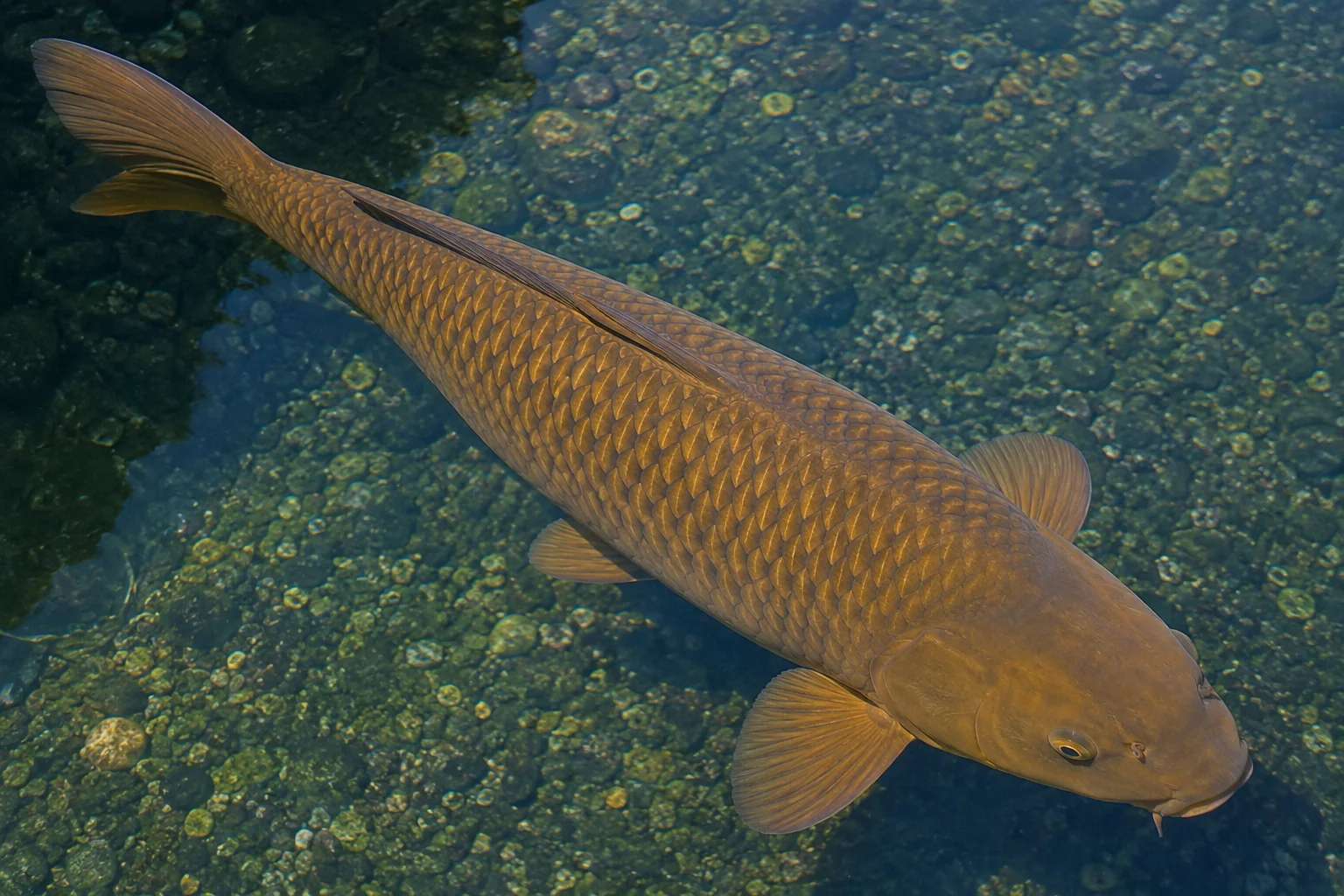
Chagoi koi (茶鯉, “tea carp”) are the friendliest koi variety in existence — they are almost always the first fish in a pond to eat directly from your hand, and their confident, calm temperament encourages all other pond fish to become hand-tame. They come in earthy brown, olive, bronze, and copper tones, grow exceptionally large (regularly 80–90 cm), and are one of the hardiest and most beginner-friendly varieties. In Japanese culture, Chagoi symbolize good friendship and warm relationships.
Why Chagoi are the friendliest koi — the science behind it
Every experienced koi keeper will tell you the same thing: put a Chagoi in your pond and within weeks, every fish will be eating from your hand. This is not mythology — it is an observed and repeatable behavioral phenomenon, and it is the single most distinctive quality that sets Chagoi apart from every other koi variety.
Here is what actually happens:
- Chagoi are genetically bold. Unlike most koi that flee when a person approaches, Chagoi move toward people. This boldness is partly hardwired — Chagoi were selectively bred over generations not just for color but for this interactive, confident temperament.
- They are intensely food-motivated. Chagoi associate humans with food faster than any other variety. This association overrides the flight instinct that dominates most koi’s behavior around people.
- Social learning spreads through the pond. Koi are highly observant social fish. When other koi watch a Chagoi repeatedly approach and hand-feed without harm, they learn that this behavior is safe. One confident Chagoi tames an entire pond — sometimes within weeks, sometimes within months.
- Their large size builds confidence. Chagoi grow exceptionally large, and larger fish are naturally less fearful of perceived threats. Their size gives them the confidence to investigate and approach that smaller fish won’t develop until much later.
From 40+ years of koi keeping
I added my first Chagoi to a pond of shy Kohaku and Sanke in the late 1990s. Within six weeks, fish that had never approached the pond edge were surfacing to feed from my hand — fish I had kept for years without ever achieving this. The Chagoi was the only variable that changed. I have since recommended Chagoi to every beginner who wants a tactile, interactive koi pond experience. It is the single most effective way to tame a koi pond.
Origin and history of Chagoi koi
Chagoi belong to the Kawarimono classification — the Japanese koi category that encompasses all non-metallic, single-color koi that do not fit into the other major variety groups. The word Kawarimono means “different things” — a catch-all for varieties too distinctive to categorize elsewhere.
The Chagoi’s earthy coloration is believed to originate from common carp genetics — the wild carp ancestor of all ornamental koi was itself a brown, olive fish. Early Japanese breeders who selectively bred wild carp for ornamental purposes retained and refined this natural coloration, enhancing the scale pattern and body conformation while preserving the earthy brown hues that make Chagoi recognizable.
The variety gained prominence among Japanese koi keepers in the 20th century, prized not for visual drama (the more colorful Gosanke varieties dominated competition) but for the Chagoi’s unique relationship with its keeper. Japanese koi culture places significant value on the bond between fish and keeper — and no variety embodies this more completely than the Chagoi.
How to identify Chagoi koi


Chagoi are among the easier koi varieties to identify once you know what to look for. Here are the three defining characteristics:
- Earthy base color: Brown, olive, bronze, copper, or tea-colored. No sharp contrast patterns, no red Hi plates, no black Sumi. The color is even and warm across the whole body.
- Reticulated scale pattern: Each scale has a slightly darker edge and lighter center, creating a net-like mosaic across the fish. This pattern is consistent across all color variants and is the most reliable single identifier of the Chagoi variety.
- Large, deep body: Chagoi have a broad, deep, torpedo-shaped body. They are often the largest fish in any mixed-variety pond. Their wide mid-section and rounded belly profile set them apart from slimmer varieties.
Additional identifiers:
- Fins are typically the same earthy tone as the body — not contrasting
- Behavior: approaching humans confidently, surfacing readily, often the first to the feeding spot
- Eyes can have a reddish tinge (unlike Karashigoi which have dark eyes) — this is a useful distinction when fish are similar in color
Chagoi koi color variants — complete guide
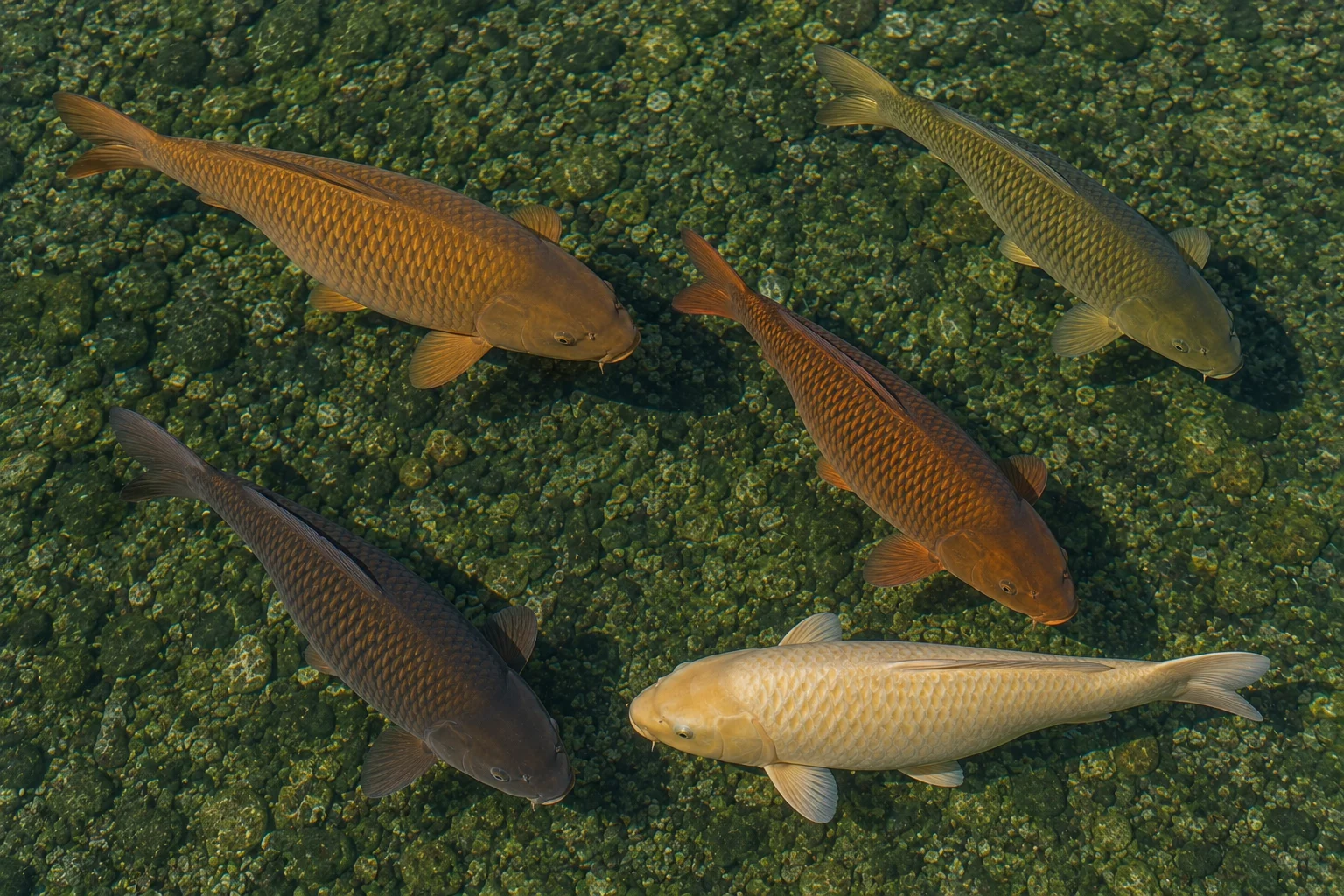
| Color variant | Description | Rarity | Notes |
|---|---|---|---|
| Brown / tea | Classic warm brown, the color of brewed tea — the variety’s namesake | Common | The most traditional and widely available Chagoi coloration |
| Olive / khaki | Muted green-brown tone; blends naturally with pond environment | Common | Popular for natural garden ponds; harder to spot at depth |
| Bronze / copper | Warm metallic orange-brown; more vibrant than standard brown | Common | Particularly striking when viewed from above in bright sunlight |
| Cream / pale amber | Light, warm beige; borders on Karashigoi territory | Uncommon | Distinguish from Karashigoi by scale reticulation pattern and eye color |
| Dark chocolate | Deep, rich brown — almost black at depth | Uncommon | Dramatic and elegant; highly sought by collectors |
| Midori (green) | Rare genuine green tone; one of the only truly green koi | Rare | Extremely unusual; commands a significant premium |
| Ginrin Chagoi | Any Chagoi color with sparkling silver reflective scale edges | Uncommon | The Ginrin scales add glittering brilliance; particularly stunning in sunlight |
| Butterfly Chagoi | Standard Chagoi coloration with long, flowing butterfly fins | Common | Popular in Western markets; not recognized in Japanese koi shows |
All Chagoi variants share the characteristic reticulated scale pattern — the net-like mosaic of slightly darker scale edges over a lighter center. This is consistent regardless of base color and is the defining visual trait of the variety.
Size and growth — how big do Chagoi get?
Chagoi are one of the largest-growing koi varieties. This is not incidental — their size is a core part of their value and personality. Here are the typical growth benchmarks:
| Age | Typical length | Notes |
|---|---|---|
| 1 year (Tosai) | 20–35 cm (8–14 in) | Fastest growing year — can gain 1 cm per week in summer with good feeding |
| 2 years | 40–55 cm (16–22 in) | Growth slows slightly; body starts to deepen significantly |
| 3–5 years | 55–75 cm (22–30 in) | Scale pattern becomes fully defined; color fully developed |
| 5–10 years | 75–90 cm (30–35 in) | Full adult size in most pond conditions |
| 10+ years | 90–100+ cm (35–40+ in) | Exceptional pond conditions required; some exceed 1 meter |
Growth maximizers for Chagoi: pond volume (more water = more growth potential), feeding frequency and protein content, water temperature stability, and stocking density. Chagoi grow fastest in large ponds — 2,000 gallons or more — with regular high-protein feeding and excellent filtration.
Chagoi vs Karashigoi vs Soragoi — key differences
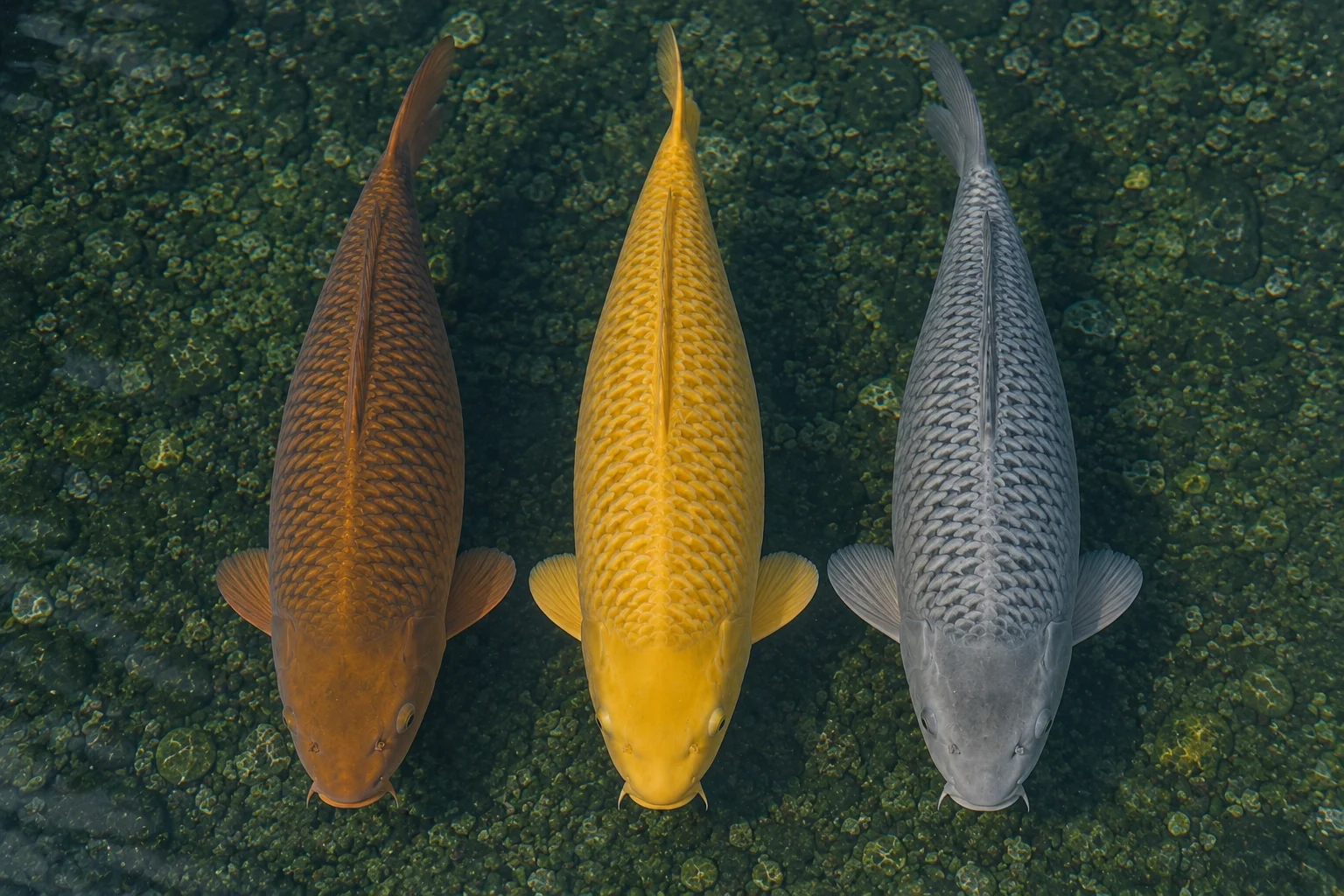
Chagoi, Karashigoi, and Soragoi are three closely related single-color koi varieties that share the same friendly temperament and large-growing nature. New koi keepers often confuse them. Here is how to tell them apart at a glance:
| Feature | Chagoi | Karashigoi | Soragoi |
|---|---|---|---|
| Color | Brown, olive, bronze, copper | Yellow, mustard, golden | Silver-grey, blue-grey, pale blue |
| Japanese name meaning | Tea carp (茶鯉) | Mustard carp (芥子鯉) | Sky carp (空鯉) |
| Scale pattern | Reticulated (net-like) | Reticulated (net-like) | Reticulated (net-like) |
| Eye color | Often reddish or amber | Dark / black | Dark / black |
| Friendliness | ⭐⭐⭐⭐⭐ Most friendly variety | ⭐⭐⭐⭐⭐ Equally tame | ⭐⭐⭐⭐⭐ Equally tame |
| Max size | 90–100+ cm | 76–90 cm | 70–90 cm |
| Visibility in pond | Moderate — earthy tones blend | High — bright yellow stands out | Moderate — grey blends with water |
| Classification | Kawarimono | Kawarimono | Kawarimono |
| Best for | Taming a pond; beginners; natural ponds | Visual contrast; collectors | Elegant, understated ponds |
Tip from the pond
All three varieties — Chagoi, Karashigoi, and Soragoi — are excellent choices and share the same taming effect on pond mates. If you want the most visual contrast in your pond, choose Karashigoi. If you want the most natural, earthy aesthetic, choose Chagoi. If you want an elegant, calm pond with a cooler palette, choose Soragoi. Many experienced keepers have one of each.
Chagoi koi care guide
Chagoi are one of the hardiest and most forgiving koi varieties — an excellent reason they are frequently recommended for beginners. However, “forgiving” does not mean “no standards.” To achieve the Chagoi’s full size potential and maintain their color vibrancy, consistent water quality and proper nutrition are essential.
Pond size
Given that Chagoi regularly reach 80–90 cm, they need more space than most pond koi. A minimum of 2,000 gallons (7,500 liters) is recommended for adult Chagoi. Apply the standard koi stocking density: 10 gallons of water per 1 inch of fish length. A fully grown 90 cm Chagoi (35 inches) requires 350 gallons of water volume allocated to it alone.
Filtration
Chagoi’s large size means higher waste production. A biological filtration system capable of processing the full pond volume at least once per hour is essential. Chagoi are more tolerant of minor ammonia fluctuations than many varieties, but prolonged exposure to elevated ammonia or nitrite still suppresses their immune system and stunts growth.
Chagoi koi care parameters
| Parameter | Ideal range | Notes |
|---|---|---|
| Pond size (adult) | 2,000 gal (7,500 L) minimum | Larger volume = larger growth potential |
| Water temperature | 59°F – 77°F (15°C – 25°C) | Hardy beyond this range but ideal growth and color within it |
| pH | 7.0 – 8.5 | Chagoi tolerate slightly wider range than most varieties |
| Ammonia (NH₃) | 0 ppm | Any detectable level causes gill stress; test weekly |
| Nitrite (NO₂) | 0 ppm | Critical during pond cycling |
| Nitrate (NO₃) | < 40 ppm | Manage with weekly 20–25% water changes |
| KH (alkalinity) | 100 – 200 ppm | Stabilizes pH; prevents overnight crashes |
| Dissolved oxygen | > 6 mg/L | Chagoi’s large size = higher oxygen demand; good aeration essential |
| Pond depth | Minimum 3 ft (90 cm) | Chagoi need depth; shallow ponds limit both temperature stability and size |
| Feeding (warm season) | 2–4× daily, high-protein pellets | Chagoi are voracious eaters; 5-minute rule applies |
| Feeding (cool season) | Wheat germ only below 60°F | Stop feeding entirely below 50°F (10°C) |
| Lifespan | 20–30 years (50+ in ideal conditions) | One of the longer-lived varieties when well cared for |
| Compatible with | All non-aggressive koi varieties | Chagoi are gentle giants — suitable for any community pond |
How to hand-feed your Chagoi koi — step-by-step
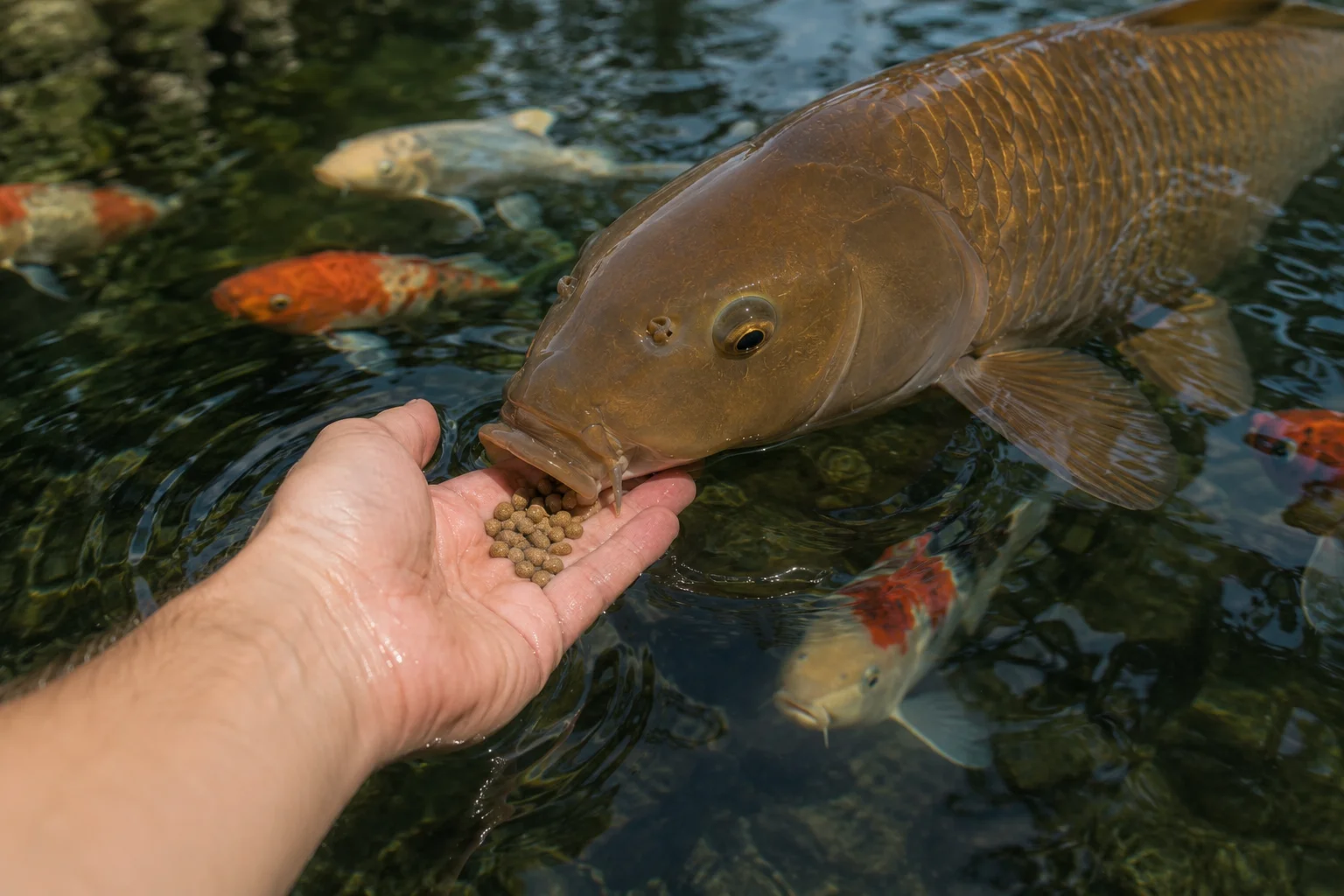
The Chagoi’s greatest asset is its interactive personality. Here is how to establish and accelerate hand-feeding with your Chagoi — and use it to tame your entire pond:
- Feed at the same time, same spot every day. Koi learn routines quickly. Stand at the same corner of the pond at the same time each day. Your footsteps and shadow become feeding signals.
- Crouch or sit at pond level. A standing human is a potential predator — a crouching one is less threatening. Get low, move slowly, and approach quietly each time.
- Start by throwing food near the pond edge. Do not reach into the water yet. Let the Chagoi come to you. Watch — it will be first every time. Once it feeds confidently within arm’s length, proceed.
- Place food in your palm and hold it just at the water surface. Your Chagoi will investigate. The first time may take 5 minutes. The tenth time will take 5 seconds.
- Watch the other koi observe. Once your Chagoi feeds from your hand, other koi will approach increasingly close — they are watching and learning. Do not rush them. The Chagoi is your ambassador.
- Be consistent, not persistent. If the fish move away, stop and try again tomorrow. Never force interaction. The taming happens in accumulated sessions, not single events.
Best hand-feeding foods: floating pellets (the fish sees and pursues them), watermelon pieces, orange slices, whole wheat bread. Avoid hard-boiled egg, peas, or anything that sinks — floating food keeps the interaction at the surface.
Chagoi koi meaning and symbolism
In Japanese koi culture, different varieties carry different symbolic associations. Chagoi are associated with:
- Friendship and warmth: The Chagoi’s tendency to approach humans and create bonds is interpreted as a symbol of open, warm friendship. Giving someone a Chagoi is considered a gift of friendship.
- Stability and groundedness: The brown, earthy color of Chagoi is associated with the earth element — stability, reliability, and a grounded, practical nature.
- Good fortune through relationships: Because Chagoi create social harmony in a pond (taming other fish), they are seen as symbols of positive social influence and bringing out the best in those around them.
- Longevity: As one of the longer-lived and hardiest koi varieties, Chagoi are associated with endurance and long, healthy life.
In feng shui, the brown earth tone of Chagoi connects to the earth element — stability, nourishment, and family foundations. A Chagoi in a garden pond is believed to strengthen the bonds within a household and promote stable, lasting prosperity.
How to choose a quality Chagoi koi
Chagoi are less visually complex than Gosanke varieties, but quality still matters significantly. Here is what to look for:
- Color consistency: The base color should be even across the entire body — no patches of dramatically different shade, no fading areas. A quality Chagoi has one consistent, rich base color from head to tail.
- Scale pattern uniformity: The reticulated net pattern should be even and consistent across the full body. Irregular, missing, or disrupted pattern areas indicate health or genetic issues.
- Body conformation: Wide, deep, torpedo shape with a broad mid-section, well-proportioned head, and strong tail. Chagoi should look robust and powerful — not narrow or pinched.
- Skin quality: Should be clear and lustrous, not dull or patchy. Look for shine — even on a brown fish, good skin quality is visible as a healthy glow.
- Behavioral check: A true quality Chagoi will approach you at the tank or pond edge during viewing. If the fish hides or is reluctant to surface, it may be unhealthy or may not have the characteristic Chagoi boldness.
- Eyes: Clear and bright. Some reddish tinge is normal for Chagoi (distinct from Karashigoi which have dark eyes).
- Fins: Intact, no splits or damage, flowing naturally.
Buyer’s tip
Always quarantine new Chagoi for 2–3 weeks before introducing to an established pond. Despite their hardiness, they can carry parasites or pathogens that are invisible at purchase. A healthy Chagoi in quarantine will eat eagerly from day one — this is one of the easiest quarantine checks available for any koi variety.
Ochiba Shigure — the Chagoi offspring
One of the most significant pieces of Chagoi trivia that competitors cover but most keepers don’t know: Ochiba Shigure koi are a direct cross between Chagoi and Soragoi.
Ochiba Shigure (落ち葉時雨) — meaning “autumn leaves on water” in Japanese — display a beautiful two-color pattern: the warm brown or copper of the Chagoi parent overlaid on the silver-grey base of the Soragoi parent. The result looks like autumn leaves drifting on the surface of still water. The highest quality Ochiba have a Kohaku-like stepped pattern in brown and grey.
Like both parent varieties, Ochiba Shigure inherit the exceptional friendliness and large-growing nature of the Chagoi lineage. They are equally good pond-tamers and equally hardy.
If you love Chagoi but want a two-color variety: Ochiba Shigure is the natural next step. They carry all of Chagoi’s personality with added visual complexity.
Breeding note: crossing Chagoi with Kohaku produces Chagoi, Ochiba Shigure, and Soragoi offspring. This makes Chagoi one of the most genetically interesting parent varieties for hobbyist breeders.
How to tell male from female Chagoi koi
Sexing koi is notoriously difficult outside of spawning season, and Chagoi are no exception. Here are the reliable indicators:
| Feature | Male Chagoi | Female Chagoi |
|---|---|---|
| Body shape | Slimmer, more streamlined mid-section | Broader, rounder belly — especially visible from above |
| Breeding season | Develops white tubercles (small bumps) on head and pectoral fins | Swollen, rounded abdomen as eggs develop |
| Size (same age) | Typically smaller | Typically larger — females always grow bigger in koi |
| Pectoral fins | First ray is thicker and harder to the touch | First ray is softer and more flexible |
| Value | Lower — males are more common | Higher — females are larger and more valuable for breeding |
Outside of breeding season, sexing juvenile Chagoi (under 2 years old) is nearly impossible visually. The most reliable method is waiting until spring spawning season when males develop breeding tubercles and females visibly swell with eggs.
Chagoi feeding schedule — maximizing growth
Chagoi are notoriously voracious eaters — one of the reasons they grow so large. This is an asset, but it requires careful management. Overfeeding a large Chagoi pond creates serious ammonia problems fast. Here is the seasonal feeding schedule optimized for Chagoi’s growth potential:
| Water temperature | Food type | Frequency | Chagoi note |
|---|---|---|---|
| Below 50°F (10°C) | Stop feeding | None | Chagoi will still beg — do not give in |
| 50–60°F (10–15°C) | Wheat germ pellets only | Once daily, small amount | Easy-digest only — high protein = digestive risk |
| 60–68°F (15–20°C) | Wheat germ + standard pellets | 2× daily | Transition period — ease into full diet |
| Above 68°F (20°C) | High-protein growth pellets | 3–4× daily, 5-min rule | Peak growth season — Chagoi grow fastest here; large pellets for large fish |
The 5-minute rule is especially important with Chagoi — because they are so bold and food-motivated, they will consume everything you give them and then circle for more. Only feed what they consume in 5 minutes and remove any remainder immediately. Uneaten food from a large, voracious Chagoi can spike ammonia faster than with smaller, more hesitant varieties.
For Chagoi specifically, large-pellet formulas are recommended once the fish exceed 30 cm — small pellets require too many bites for a large fish and can lead to overfeeding before the 5-minute window closes.
Frequently asked questions about Chagoi koi
What is a Chagoi koi?
Chagoi (茶鯉) are a Japanese koi variety in the Kawarimono classification, named for their earthy brown “tea” coloration. They are best known as the friendliest koi variety — almost always the first fish to eat from a human hand — and as one of the largest-growing koi, regularly reaching 80–90 cm.
Why are Chagoi koi so friendly?
Chagoi are genetically bold and intensely food-motivated — they approach humans rather than fleeing. Their boldness creates a social learning effect: other koi observe the Chagoi interacting safely with the keeper and gradually mirror the behavior, taming the entire pond over weeks or months.
How big do Chagoi koi get?
Chagoi regularly reach 80–90 cm (30–35 inches) in well-maintained ponds and exceptional specimens exceed 100 cm. They are one of the largest-growing koi varieties. First-year Tosai Chagoi can grow 1 cm per week during peak summer feeding.
What colors do Chagoi koi come in?
Chagoi come in earthy warm tones: classic brown/tea, olive/khaki, bronze/copper, pale cream-amber, dark chocolate, and the rare Midori (green). Ginrin Chagoi have sparkling silver scale edges over any base color. Butterfly Chagoi have the standard earthy coloration with long flowing fins.
What is the difference between Chagoi and Karashigoi?
Color is the primary difference: Chagoi are brown, olive, or bronze. Karashigoi are yellow or mustard. Both share the same friendly temperament, large size, and reticulated scale pattern. Chagoi typically have amber or reddish eyes; Karashigoi have dark eyes. Karashigoi stand out more visually in a pond due to their brighter hue.
Are Chagoi koi good for beginners?
Yes — Chagoi are one of the three best beginner varieties alongside Kohaku and Ogon. They are exceptionally hardy, forgiving of minor water quality fluctuations, fast-growing, and their friendliness makes them rewarding from the very first weeks. They are also excellent “pond tamers” that help other fish become interactive.
What does Chagoi mean in Japanese?
Chagoi (茶鯉) means “tea carp” — “cha” (茶) means tea, referring to the warm brown color of brewed tea that characterizes the variety. “Goi” (鯉) is the Japanese word for carp.
How long do Chagoi koi live?
Chagoi live 20–30 years with proper care, and some documented specimens have lived over 50 years. As one of the hardiest koi varieties, Chagoi tend toward the longer end of koi lifespan ranges in well-maintained ponds.
Related koi variety guides
- Karashigoi koi — the mustard-yellow relative of Chagoi
- 30 koi fish varieties — complete identification guide
- Matsuba koi — the pine cone koi
- Goshiki koi — the five-color variety guide
- How to hand-feed koi fish — complete guide
- Koi food guide — best feeds for growth and color
- Koi pond water quality — pH, ammonia and nitrate guide
- Koi fish meaning — complete symbolism guide
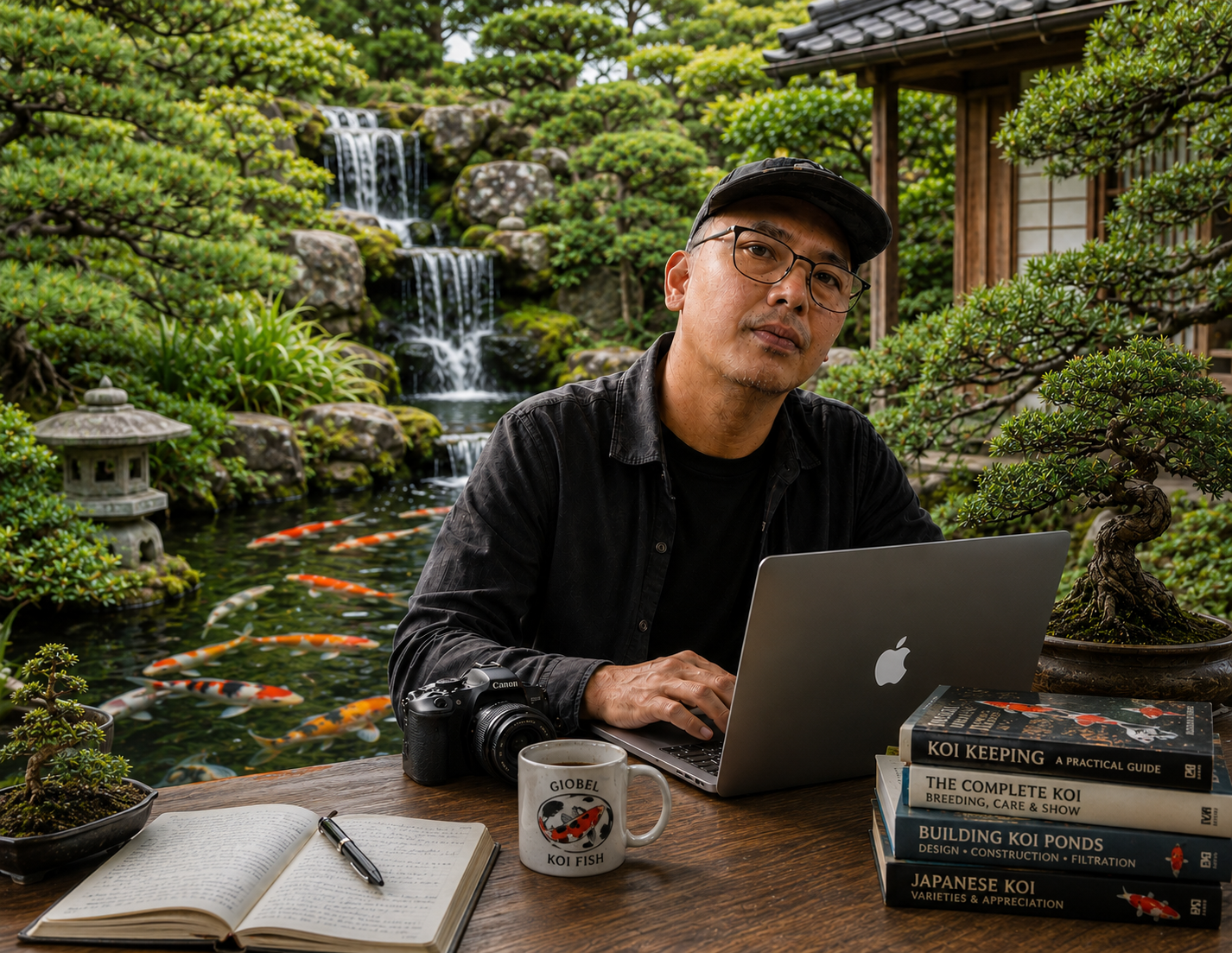
Giovanni Carlo Bagayas
Founder, Giobel Koi Center · Koi keeper since the 1980s · Labangan, Zamboanga del Sur, Philippines
Giovanni has been keeping and breeding ornamental koi since the 1980s — over 40 years of hands-on experience. He has kept Chagoi koi throughout his decades in the hobby and has personally witnessed the taming effect they have on mixed-variety ponds. He founded Giobel Koi Center to share practical koi knowledge with enthusiasts worldwide.

Passionate about fish keeping since elementary school in the 1980s, Giovanni Carlo has dedicated countless hours to collecting and breeding a diverse array of ornamental freshwater fish. From vibrant guppies and majestic koi to striking bettas and classic goldfish, he continues to explore the fascinating world of aquatics, sharing knowledge and enthusiasm with fellow fish enthusiasts.