Koi Fish Varieties: 30 Types Identified With Pictures — Complete Guide
By Giovanni Carlo · Koi keeper & founder, Giobel Koi Center · Updated June 8, 2026
Quick Answer
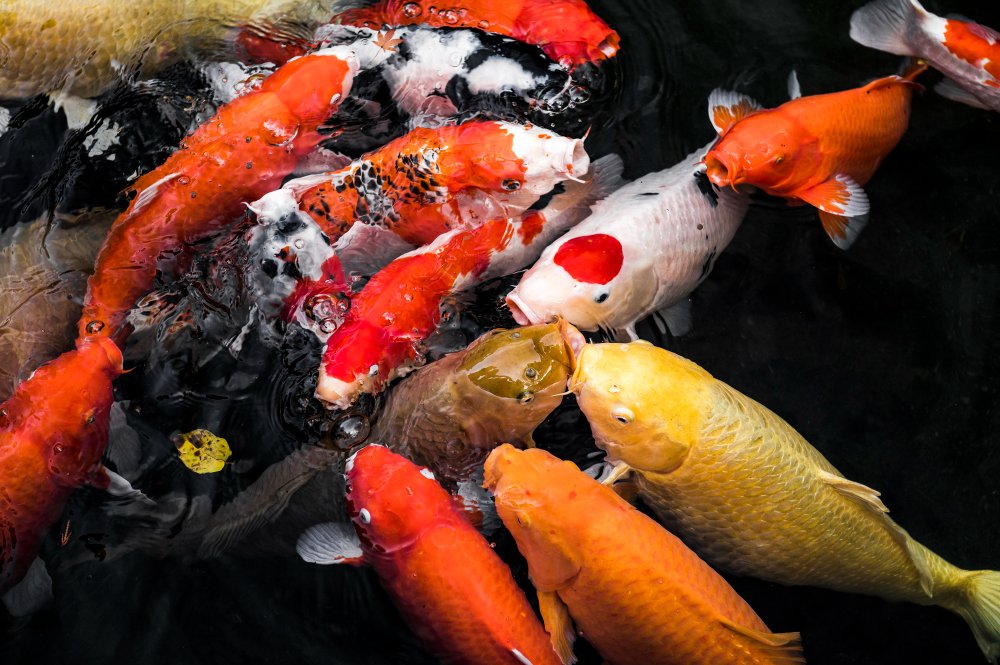
There are over 100 recognized koi varieties, organized into 13 official Japanese classification groups. The most prestigious are the Go-Sanke — Kohaku, Sanke, and Showa — whose grand champions dominate competitions worldwide. This guide covers 30 of the most important and commonly kept varieties, organized by group so you can understand not just what they look like, but how they relate to each other.
Variety Groups in This Guide
How Japanese Koi Classification Works
Japanese koi are classified into formal groups by the All Japan Nishikigoi Promotion Association. Understanding this system makes it far easier to identify any koi you encounter — because varieties in the same group share genetic traits, visual rules, and quality criteria.
The classification is not primarily about color — it is about base genetics and pattern structure. A red koi and a blue koi can be in the same group if they share the same genetic background. This guide organizes all 30 varieties by their official groups.
| Group | Meaning | Key Varieties |
|---|---|---|
| Go-Sanke | “The three families” | Kohaku, Sanke, Showa |
| Utsurimono | Black-based two-color koi | Shiro Utsuri, Hi Utsuri, Ki Utsuri |
| Bekko | Black spots on colored base | Shiro Bekko, Aka Bekko |
| Asagi / Shusui | Blue-scaled / Doitsu Asagi | Asagi, Shusui |
| Hikari-Muji | Single-color metallic | Yamabuki, Orange, Platinum, Matsuba Ogon |
| Hikari-Moyomono | Multi-color metallic | Kujaku, Hariwake, Kikusui, Yamatonishiki |
| Hikari-Utsurimono | Metallic Utsuri/Showa | Kikokuryu, Beni Kikokuryu |
| Kawarimono | “Different” — all others | Chagoi, Soragoi, Ochiba, Goshiki, Koromo, Kumonryu |
| Tancho | Single head spot | Tancho Kohaku, Tancho Showa, Tancho Sanke |
| Kinginrin | Sparkling reflective scales | Gin Rin Kohaku, Gin Rin Showa, etc. |
| Doitsu | Scaleless or mirror-scaled | Doitsu versions of any variety |
Group 1: Go-Sanke — The Three Prestige Varieties
Go-SankeGo-Sanke means “the three families” — Kohaku, Sanke, and Showa. Grand champions at every major koi competition worldwide come almost exclusively from this group. Mastering Go-Sanke appreciation is the mark of a serious koi hobbyist.
1. Kohaku

Kohaku is the most celebrated koi variety in the world. The name means “red and white” in Japanese — a pure snow-white body with red (hi) markings is the defining characteristic. There is a famous saying: “Koi appreciation begins and ends with Kohaku.” Quality Kohaku is judged on the purity of the white base (called shiro), the depth and consistency of the red, and the balance of the pattern. The red should be thick, uniform, and well-defined — not bleeding into the white or appearing faded.
Common Kohaku patterns include Nidan (two-step), Sandan (three-step), and Yondan (four-step), referring to the number of red pattern segments from head to tail. The more balanced and step-like the pattern, the more highly valued the fish. Full Kohaku guide →
2. Taisho Sanke (Sanke)

Taisho Sanke — named after the Taisho era of Japanese history (1912–1926) when it was developed — is genetically a white koi with red and black markings overlaid. The white base is dominant; red and black appear as patterns on top. A key identification rule: Sanke has no black on the head — all black markings appear on the body only, in stepping-stone-like patterns. The black (sumi) should appear as separate, distinct spots, not streaks or patches.
Sanke is often confused with Showa, but the base genetics differ fundamentally. Think of it this way: Sanke is a white fish with markings; Showa is a black fish with markings.
3. Showa Sanshoku (Showa)
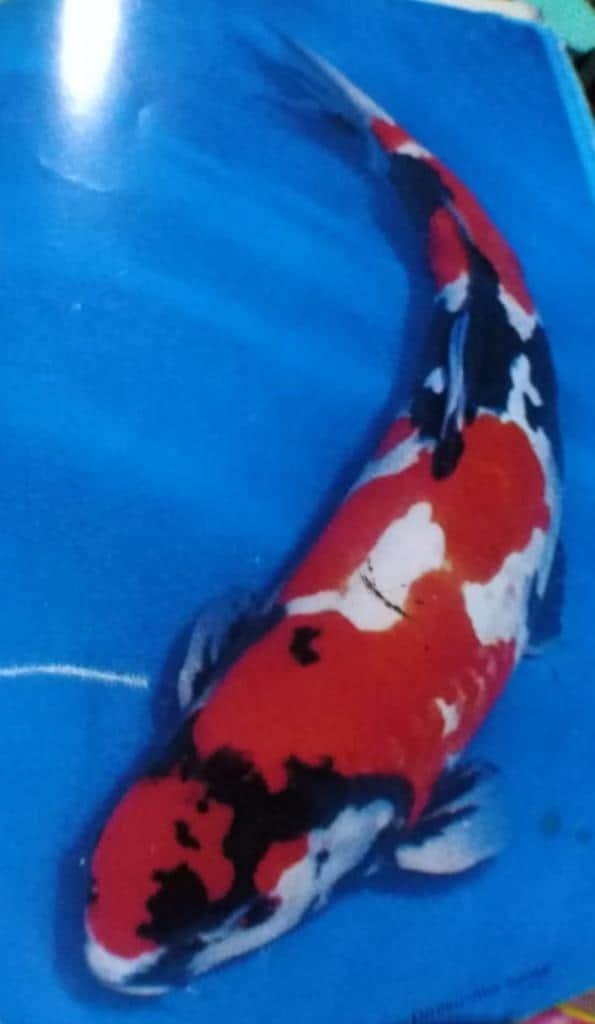
Showa Sanshoku is named for the Showa era (1926 onward). Unlike Sanke, Showa is genetically a black koi — the black (sumi) is the dominant base color, with red and white appearing as markings on top. Showa almost always has black present on the head and black that wraps around the body in large, bold motifs. The sumi in Showa typically looks more lacquer-like and three-dimensional than Sanke sumi.
Showa koi hatched from eggs are almost entirely black and develop their red and white coloring as they grow — a dramatic transformation that takes months to years to complete. Full Showa guide →
Group 2: Tancho
TanchoTancho koi have a single circular red spot centered on the head — and no other red markings anywhere on the body. The name honors the Japanese Red-Crowned Crane (Tancho Zuru), Japan’s national bird, which carries a distinctive red crown marking.
4. Tancho Kohaku
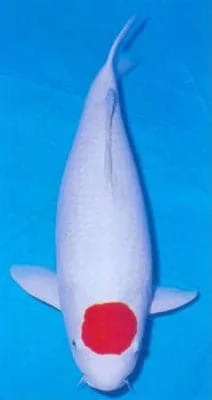
Tancho Kohaku is the most celebrated Tancho variety. The ideal specimen has a perfectly circular, vivid red spot centered precisely on the head, set against an immaculate white body. The challenge in breeding quality Tancho is enormous — the red spot must be circular (not oval or irregular), well-centered (not extending over the eyes or gill plates), and the white body must be spotlessly clean with no stray red anywhere. A perfect Tancho Kohaku is extraordinarily rare and highly prized.
Tancho Showa and Tancho Sanke also exist — these have black sumi on the body but retain the single-spot Tancho head pattern. All Tancho varieties are judged separately from their base variety equivalents at competition.
Group 3: Utsurimono
UtsurimonoUtsurimono means “reflections” in Japanese. These are black-based koi with bold two-color patterning — the dominant base is always black (sumi), and the secondary color is either white, red, or yellow. Black must appear on the head and wrap boldly around the body to be considered quality Utsurimono.
5. Shiro Utsuri
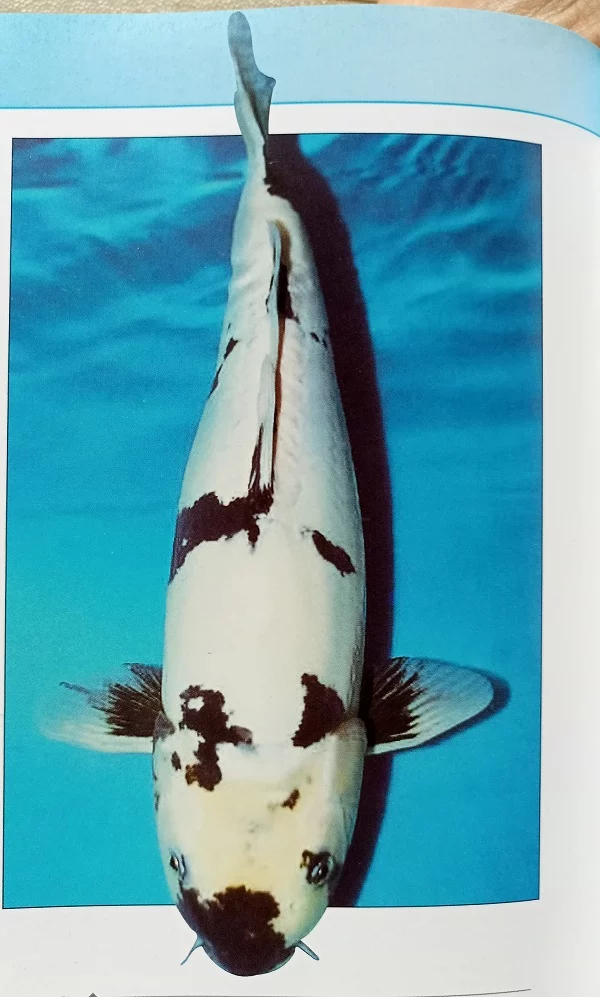
Shiro Utsuri is the most popular Utsurimono variety — a striking two-color koi with a jet-black base and bold white markings. “Shiro” means white. The sumi in quality Shiro Utsuri should have a deep, lacquer-like quality — not flat or grey-toned. The white should be pure and distinct. Shiro Utsuri are sometimes confused with Shiro Bekko, but the key difference is that Utsuri always have black on the head; Bekko do not.
6. Hi Utsuri (Kage Hi Utsuri)

Hi Utsuri combines a black base with deep red or orange-red markings. “Hi” means red. Nicknamed the “tiger koi,” it has the same structural requirements as Shiro Utsuri — black must appear prominently on the head and wrap boldly around the body. The Kage Hi Utsuri shown here is a sub-variety with a shadowy, mesh-like reticulation (kage means “shadow”) overlaid on the red pattern, creating a more complex visual texture.
Young Hi Utsuri often appear orange and develop into true red as they mature — judges favor the deeper red. Full Hi Utsuri guide →
7. Ki Utsuri

Ki Utsuri is by far the rarest of the three Utsurimono varieties. “Ki” means yellow. The combination of lacquer-black and bright yellow creates a striking visual that stands out in any pond — the contrast between the two colors is one of the most dramatic in the koi world. Quality Ki Utsuri are genuinely difficult to produce, and finding a specimen with deep, pure yellow rather than a washed-out pale tone is a significant challenge.
The candy-striped pectoral fins — alternating black and white with a golden overlay — are a hallmark of quality Ki Utsuri. Full Ki Utsuri guide →
Group 4: Bekko
BekkoBekko means “tortoiseshell” in Japanese. These are single-colored koi (white, red, or yellow) with black sumi markings on the body — but crucially, no black on the head. This is the key visual distinction from Utsurimono, which always has black on the head. Think: Bekko = Sanke without the red; Utsurimono = Showa-genetics without one color.
8. Aka Bekko
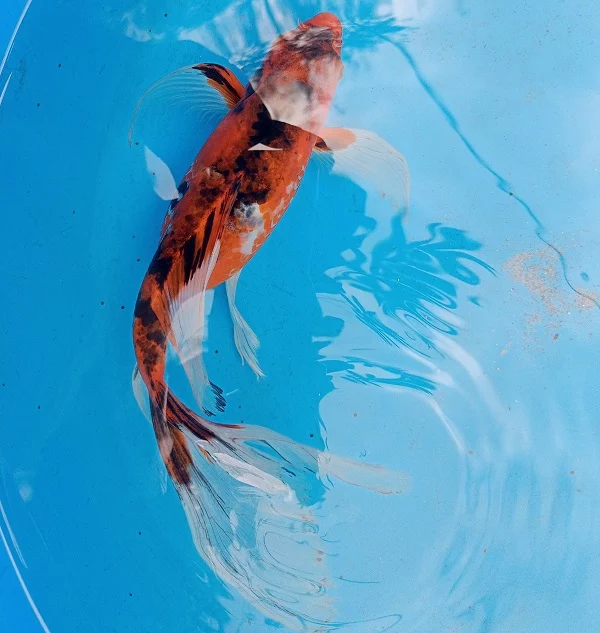
Aka Bekko has a red or orange base with black sumi markings on the body. “Aka” means red. The red base should be deep and uniform — not faded or patchy — and the black spots should be clearly defined and well-distributed across the body. The head must be completely clear of sumi to qualify as true Bekko. High-quality Aka Bekko with a deep crimson base and bold black patterns are relatively uncommon and sought after.
9. Shiro Bekko
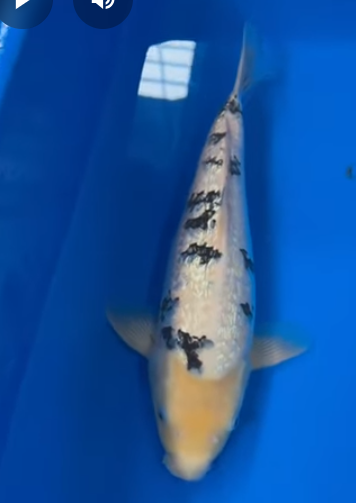
Shiro Bekko is the most common Bekko variety — white base with black sumi spots. Like all Bekko, the head must be clean (no sumi). Quality Shiro Bekko requires a crystal-clear white base with deeply pigmented, well-separated black markings. The black spots should not be streaky or fade at their edges. Shiro Bekko is frequently confused with Shiro Utsuri — remember: Bekko has no black on the head, Utsuri always does.
Group 5: Asagi & Shusui
Asagi / ShusuiAsagi is one of the oldest koi varieties and the ancestor of many modern varieties including Matsuba. Shusui is the Doitsu (scaleless) version of Asagi, developed in the early 20th century.
10. Asagi

Asagi has one of the most distinctive appearances in the koi world — a blue-grey back with a net-like reticulation created by the dark edges of each scale, and red or orange developing on the belly, gill plates, fins, and lower body as the fish matures. The blue must be even and consistent across the back; uneven or muddy coloring reduces quality. The red develops up from below as the fish ages, so mature Asagi can be far more colorful than juveniles. Full Asagi guide →
11. Shusui

Shusui is the Doitsu (scaleless) version of Asagi — it has a pale blue body with large mirror scales running along the dorsal line and a single lateral row, and red developing on the belly and sides. The Red Shusui shown here is a more vivid variant where the red extends across the back between the scale rows, creating one of the most dramatically colored koi in the non-metallic category. Quality Shusui requires even, deep-blue skin and a clean row of well-aligned dorsal scales. Full Shusui guide →
Group 6: Hikari-Muji — Single-Color Metallic (Ogon)
Hikari-MujiHikari-Muji means “metallic single-color.” These are Ogon koi — the purest expression of metallic luster in a single uniform color. Quality is judged almost entirely on the intensity and evenness of the metallic sheen and the purity of the base color. They are among the most beginner-accessible koi because their clean color makes quality easy to appreciate.
12. Gin Matsuba

Gin Matsuba is a metallic silver Ogon with the distinctive Matsuba pinecone reticulation — each scale has a dark center surrounded by a lighter metallic edge, creating a net-like pattern across the entire body. The combination of the brilliant silver metallic base with the dark reticulation makes this one of the most visually arresting Ogon varieties. See our full Matsuba koi guide for all varieties.
13. Yamabuki Ogon

Yamabuki Ogon is the most popular Ogon variety among beginners — a bright, vivid yellow-gold metallic koi that is highly visible from every angle in a pond. “Yamabuki” refers to the yellow Kerria japonica flower. Quality Yamabuki requires an unblemished head, consistently intense yellow-gold coloring from head to tail with no fading or striping, and a metallic sheen that covers every scale evenly. Full Yamabuki Ogon guide →
14. Orange Ogon

Orange Ogon occupies the warm middle ground between Yamabuki Ogon (yellow) and the red-orange end of the Ogon spectrum. The base color is a warm, saturated metallic orange — vivid and highly visible in pond water. Like all Ogon, the quality markers are evenness of color, intensity of metallic sheen, and a clean, unblemished head. Orange Ogon pair beautifully with darker varieties like Shiro Utsuri or Asagi in mixed ponds.
15. Mizuho Ogon
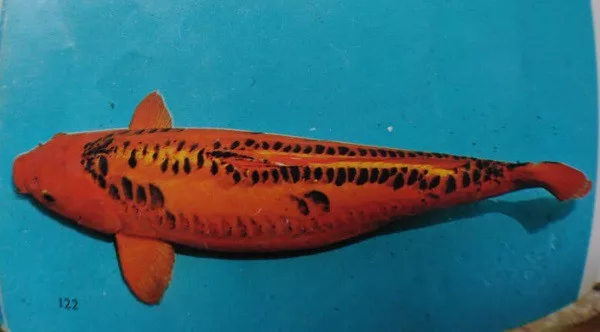
Mizuho Ogon is a deep red-orange metallic Ogon — one of the rarer Ogon varieties, named after the Japanese word for ears of rice (“mizuho”). The body has a rich, burnished red-orange metallic sheen that is distinctly different from the brighter orange or yellow of other Ogon varieties. Quality specimens have a deep, consistent color throughout the body without fading toward the tail, and an intensely reflective head.
16. Platinum Ogon
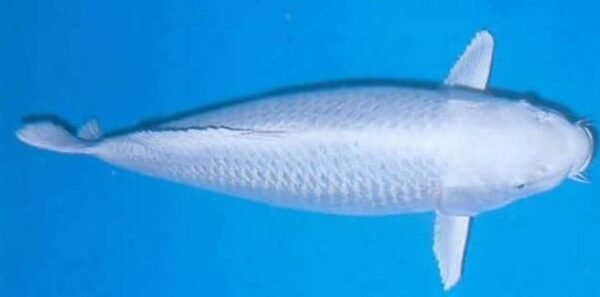
Platinum Ogon (Purachina Ogon) is a solid, brilliant white metallic koi — the purest expression of metallic luster. When a high-quality Platinum Ogon moves through clear water in full sun, the effect is extraordinary — the entire fish appears to glow. Quality criteria: the white must be absolutely clean and unblemished (no yellow or grey tinting), the head must be spotless, and the metallic sheen must be uniform from nose to tail. Any discoloration, stripe, or blemish on the head dramatically reduces value. Full Platinum Ogon guide →
Group 7: Hikari-Moyomono — Multi-Color Metallic
Hikari-MoyomonoHikari-Moyomono means “metallic patterned.” These are metallic koi with two or more colors — they combine the brilliant sheen of Ogon with the pattern complexity of non-metallic varieties. The group includes some of the most ornate and visually striking koi available.
17. Kujaku

Kujaku means “peacock” in Japanese — an apt name for one of the most visually spectacular koi varieties. Kujaku combines a metallic white base with red or orange Kohaku-like patterning and a Matsuba pinecone reticulation overlaid across the entire body. The result is a fish that shimmers with multiple visual layers simultaneously — the metallic base, the color pattern, and the reticulation all interact in changing light. Full Kujaku guide →
18. Kikusui
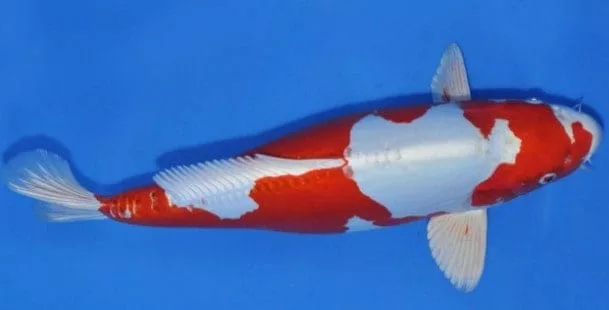
Kikusui is a Doitsu (scaleless) metallic koi combining a platinum white base with vivid orange or red pattern markings — effectively a metallic Doitsu Kohaku. The absence of scales allows the metallic base color to appear without the net-like reticulation of scaled varieties, creating a smoother, more fluid metallic surface. The orange or red pattern stands out dramatically against the platinum white. Kikusui are lively, eye-catching pond fish that have grown significantly in popularity among Western hobbyists. Full Kikusui guide →
19. Doitsu Hariwake

Hariwake means “divided” in Japanese — these are two-toned metallic koi combining platinum (white) with either bright yellow or orange metallic markings. Both colors are fully metallic, creating an intensely bright fish with high pond visibility. The Doitsu version shown has the smooth, clean appearance of a scaleless fish, which allows the two metallic colors to contrast without any scale pattern interference. Quality Hariwake is judged on the clarity of the two-tone division and the intensity of the metallic luster on both colors.
20. Yamatonishiki (Metallic Sanke)

Yamatonishiki is the metallic version of Taisho Sanke — created by crossing Platinum Ogon with Sanke. The result is a three-color koi (white, red, and black) with a brilliant metallic sheen applied to the white base. The metallic quality adds a luminous dimension to the already complex Sanke pattern, creating one of the most ornate koi varieties in existence. Quality Yamatonishiki requires balanced Sanke-level patterning (correct hi and sumi placement) combined with an evenly metallic base — a difficult combination to achieve at a high level.
Group 8: Hikari-Utsurimono — Metallic Utsuri & Showa
Hikari-UtsurimonoHikari-Utsurimono are the metallic versions of Utsurimono and Showa koi. The metallic sheen adds a new visual dimension to the bold black-pattern varieties — but the strong luster can sometimes suppress the intensity of the hi (red) or sumi (black), making quality evaluation more nuanced.
21. Kikokuryu
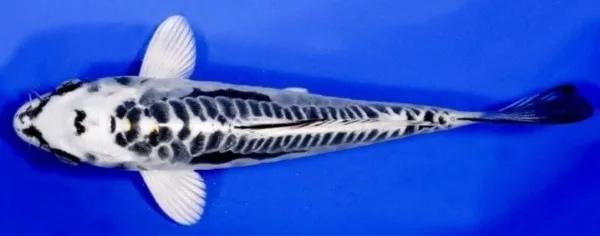
Kikokuryu is the metallic version of Kumonryu — a Doitsu koi with black and white pattern on a brilliant metallic base. Like Kumonryu, Kikokuryu can change its color pattern seasonally or in response to water temperature and quality — a characteristic that makes it one of the most dynamic and unpredictable koi to keep. The metallic sheen gives the black and white pattern an extraordinary luminosity that Kumonryu lacks.
22. Beni Kikokuryu

Beni Kikokuryu adds red or orange (beni) to the Kikokuryu’s black and white pattern — creating a three-color metallic variety of extraordinary visual impact. The interplay of the bright metallic base, bold black sumi, and vivid red creates a fish that is unlike any other in the koi world. Like all Kumonryu-based varieties, the pattern can shift over time, meaning the fish you buy may develop differently as it matures — part of what makes these varieties so captivating.
Group 9: Kawarimono — “Different” Varieties
KawarimonoKawarimono is the classification group for all koi that do not fit neatly into the other categories — it literally means “different type.” This diverse group includes some of the most beloved varieties among experienced hobbyists: Chagoi, Soragoi, Goshiki, Ochiba, Koromo, and Kumonryu.
23. Chagoi

Chagoi is a legend among pond keepers — not for visual drama but for personality. “Cha” means tea, and Chagoi ranges from warm tea-brown through green and olive tones. They are the friendliest koi variety by far — highly food-motivated, they hand-feed almost immediately after introduction and have a documented ability to calm every other koi in a pond. Adding one Chagoi to a skittish pond can transform it into a hand-feeding experience within weeks. For this reason, serious koi keepers almost always include at least one Chagoi. Chagoi also grow exceptionally large. Full Chagoi guide →
24. Soragoi
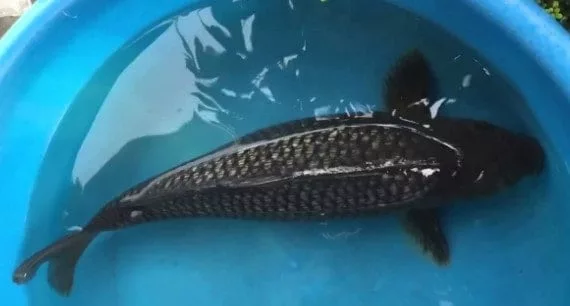
Soragoi is Chagoi’s blue-grey cousin — “sora” means sky in Japanese. A solid blue-grey koi with a subtle net-like reticulation visible on close inspection, Soragoi has the same friendly, food-motivated temperament as Chagoi and the same pond-calming effect. The understated, quiet color of the Soragoi makes it a sophisticated choice for hobbyists who appreciate subtlety — its grey-blue tone provides a visual rest in a pond dominated by bright reds and oranges. Soragoi also grow to impressive sizes.
25. Ochiba Shigure

Ochiba Shigure means “fallen leaves in autumn rain” — and the name perfectly captures the visual poetry of this variety. Created by crossing Chagoi with Soragoi, Ochiba combines the blue-grey base of Soragoi with copper-brown or bronze pattern markings that evoke autumn leaves floating on still water. The subtlety and natural color palette of Ochiba has made it increasingly popular with hobbyists who find the bold reds and blues of other varieties too visually intense. No two Ochiba look exactly alike.
26. Goshiki

Goshiki means “five colors” — and in its most complex form, this variety displays white, red, black, light blue, and dark blue simultaneously in its pattern. Developed by crossing Asagi with Kohaku, Goshiki has a Kohaku-like red and white pattern overlaid with the blue-grey reticulation of Asagi, creating a uniquely complex visual layering. Young Goshiki can appear dark and almost muddy, but mature with age into strikingly beautiful fish as the colors clarify and separate. The word “Goshiki begins dark and improves” is a common observation among koi keepers.
27. Koromo

Koromo means “robed” — describing the way the blue or purple scale edging appears to cloak the red pattern like a garment draped over the Kohaku base. Developed in the early 1950s from crossing Kohaku with Asagi, Koromo has a Kohaku body pattern (white with red) with the addition of blue or indigo scale-edge reticulation that appears only over the red (hi) areas. The blue reticulation does not appear on the white sections. This distinctive “robed” effect has earned Koromo a devoted following among connoisseurs who value its quiet, refined elegance.
28. Beni Kumonryu
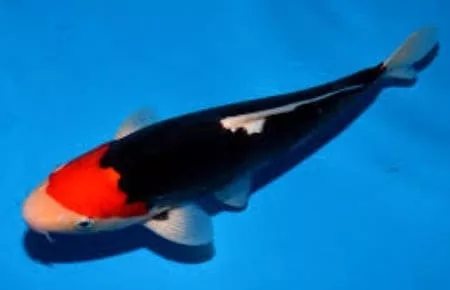
Kumonryu means “dragon fish” or “nine tattooed dragon” in Japanese — a name that reflects the dramatic, dragon-like black patterns on these Doitsu koi. Beni Kumonryu adds red (beni) to the standard Kumonryu’s black and white. The defining — and most fascinating — characteristic of all Kumonryu is their ability to change their color pattern seasonally in response to water temperature and quality. A Kumonryu that appears predominantly white in winter may become largely black in summer. No other koi variety exhibits this level of color dynamism.
Group 10: Kinginrin (Gin Rin) — Sparkling Scale Varieties
KinginrinKinginrin (often shortened to Gin Rin) refers to any koi variety whose scales have a sparkling, glittering quality — caused by guanine crystals concentrated in the scale structure. “Kin” means gold, “Gin” means silver. Any koi variety can have a Gin Rin version — Gin Rin Kohaku, Gin Rin Showa, Gin Rin Sanke, etc. Gin Rin koi are judged in their own separate class at competitions. The effect is like watching a fish that carries its own internal light source.
Group 11: Doitsu — Scaleless & Mirror-Scale Varieties
DoitsuDoitsu koi have either no scales (fully scaleless) or a single row of enlarged mirror scales along the dorsal and lateral lines. The term comes from the German carp genetics introduced to Japan in the early 20th century (“Doitsu” is the Japanese pronunciation of “Deutsch” — German). Any koi variety can have a Doitsu version. Doitsu koi have a sleek, smooth appearance and often show their base colors more cleanly without the visual texture of scaled skin.
Doitsu Sanke (shown above), Doitsu Showa (shown above), Doitsu Shiro Utsuri (shown above)
All the Doitsu varieties featured in earlier sections of this guide illustrate the range of what Doitsu genetics add to any variety. The Doitsu Sanke, Doitsu Showa, and Doitsu Shiro Utsuri in the images above show how the absence of scaling creates a cleaner, more minimalist version of each variety’s underlying pattern — the colors appear more vivid and uninterrupted without the net-like texture that scaled versions create.
Group 12: Rare & Specialist Varieties
These varieties are among the most unusual, rarest, or recently developed koi in the hobby — sought by experienced collectors who want something beyond the established classics.
29. Mukashi Ogon
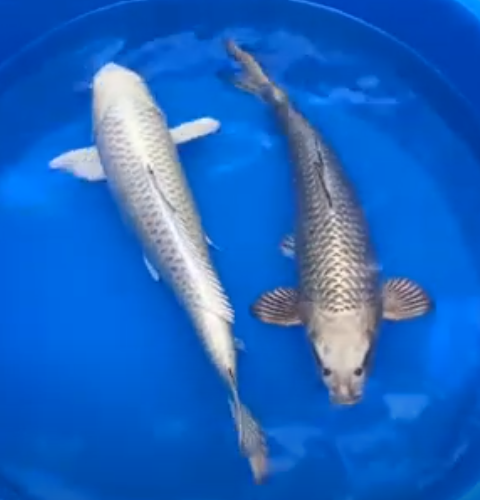
Mukashi Ogon means “ancient Ogon” — this is an early or ancestral form of the metallic Ogon varieties, with a more muted, antique metallic quality compared to the high-gloss modern Ogon. Mukashi Ogon are rarely seen in Western collections and are primarily of interest to dedicated collectors and historians of koi breeding. They represent a living connection to the early development of metallic koi in Japan and are kept more for their historical significance than visual showiness.
30. Midori Koi
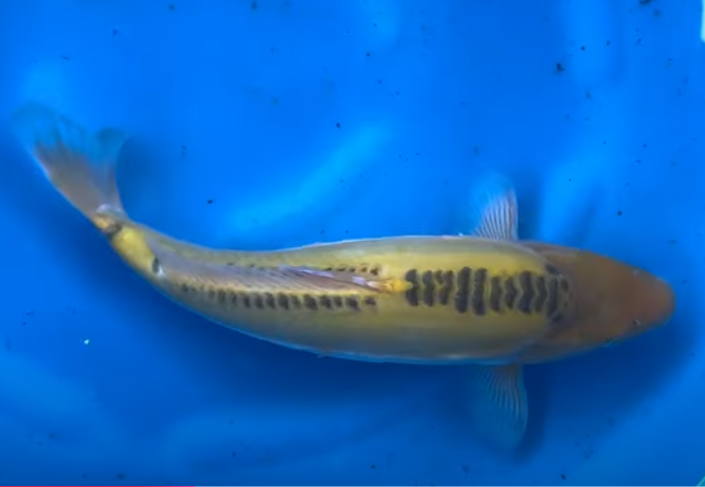
Midori Koi — “midori” means green — is one of the rarest koi varieties in existence. Achieving a consistent, recognizable green coloration in koi is extraordinarily difficult genetically, and truly green koi are scarce even in Japan. Most Midori Koi display a metallic greenish tinge rather than a pure green, and the variety has never stabilized sufficiently to be widely reproduced. For collectors, a quality Midori Koi is a genuine rarity — the kind of fish that draws immediate attention at any koi show.
Which Koi Variety Is Right for You?
| Your Goal | Best Variety | Why |
|---|---|---|
| First koi, want classic beauty | Kohaku or Yamabuki Ogon | Clean patterns, easy to appreciate quality |
| Maximum visual impact | Kujaku or Kikokuryu | Multi-layer metallic drama — stunning in any pond |
| Friendly fish for hand-feeding | Chagoi or Soragoi | Tamest variety — calms the whole pond |
| Prestige / competition | Kohaku, Sanke, or Showa | Grand champions always from Go-Sanke |
| Understated, nature-inspired | Ochiba Shigure or Goshiki | Subtle palette, deepens beautifully with age |
| Dramatic, bold contrast | Shiro Utsuri or Showa | Black patterns are the boldest in the koi world |
| Something unpredictable | Kumonryu or Kikokuryu | Pattern shifts seasonally — always changing |
| Rare collector’s fish | Ki Utsuri or Midori | Genuinely rare — conversation-starters at any show |
Related Reading on Giobel Koi Center
Frequently Asked Questions
What are the main koi fish varieties?
What is the most popular koi variety?
What is the rarest koi variety?
What is Go-Sanke?
What is the difference between Sanke and Showa?
What is a Tancho koi?
What are Doitsu koi?
What is Kinginrin (Gin Rin) in koi?
Giovanni Carlo
Koi keeper & founder, Giobel Koi Center · Labangan, Zamboanga del Sur
Giovanni has been keeping koi since the 1980s and runs one of the Philippines’ most widely read koi fish resources. He breeds and raises multiple koi varieties on his farm in Mindanao and writes from decades of hands-on experience with variety identification, pond management, and koi care.

Passionate about fish keeping since elementary school in the 1980s, Giovanni Carlo has dedicated countless hours to collecting and breeding a diverse array of ornamental freshwater fish. From vibrant guppies and majestic koi to striking bettas and classic goldfish, he continues to explore the fascinating world of aquatics, sharing knowledge and enthusiasm with fellow fish enthusiasts.