Quick Answer
Asagi is one of the oldest koi varieties, with a net-like pattern of pale-edged blue scales across its back and red (motoaka) at the fins, cheeks, and belly. It’s considered a direct descendant of the Asagi Magoi — the wild black carp regarded as the ancestor of all modern ornamental koi — with a history going back roughly 160 years.
What Is Asagi Koi?

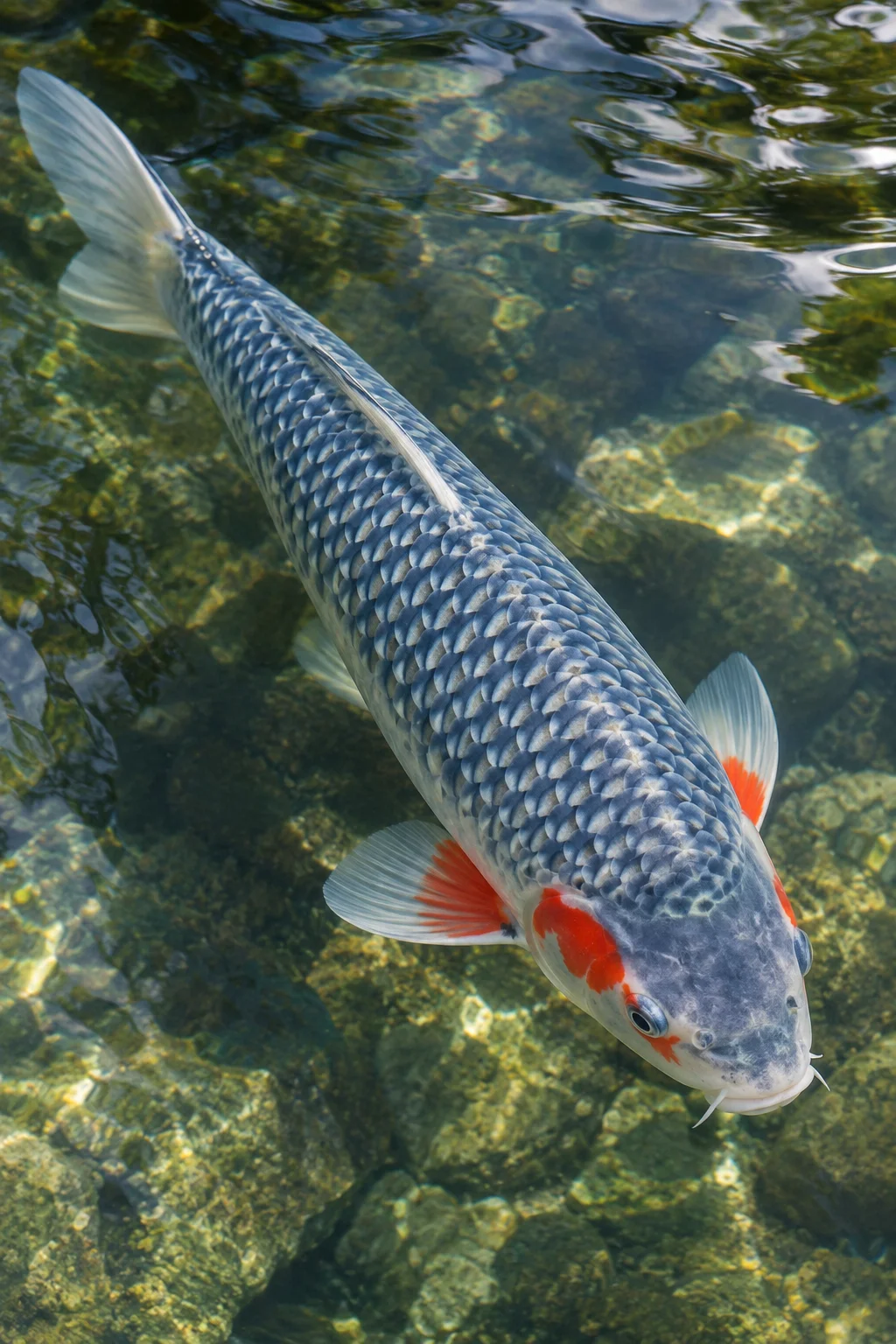
Asagi is instantly recognizable: a pale-blue or grey-blue body covered in a net-like reticulation pattern, where each scale is edged in a darker blue against a lighter base. That blue is set off by red — called motoaka — at the base of the pectoral fins, cheeks, and sometimes the belly. Unlike flashier varieties like Showa or Hikari Utsurimono, Asagi’s appeal is subdued and structural: the beauty is in how evenly and cleanly the scale pattern reads, not in bold color contrast.
Asagi shares its bloodline directly with Shusui, its scaleless (Doitsu) counterpart — the two are judged together in the same competition category.
History and Origin
Asagi’s history stretches back roughly 160 years, making it one of the oldest recognized koi varieties — some accounts trace early breeding attempts even further, into the 1700s and 1800s in Niigata, Japan. Asagi descends from the Asagi Magoi, one of three recognized types of Magoi (wild black carp), which is widely regarded by breeders as the ancestor of essentially all modern ornamental koi varieties.
Two named sub-varieties emerged from this early Asagi stock: the darker Konjo Asagi, which was mostly valued as food stock but contributed to the later development of Matsuba koi, and the lighter Narumi Asagi, which became the standard, most widely recognized form of the variety. Narumi is generally said to take its name from the Narumi district of Japan, known historically for a tie-dyed fabric pattern (shibori) that resembled the koi’s reticulated scale pattern.

Asagi Varieties
“Asagi” covers several named sub-varieties, distinguished mainly by shade of blue and the extent of red markings:

| Variety | Key Trait |
|---|---|
| Narumi Asagi | Mid-blue with pale-edged scales and red markings — the standard, most typical Asagi |
| Konjo Asagi | Darkest blue, close to black; least valued for pattern, historically kept as food stock |
| Mizu (Akebi) Asagi | Palest blue, almost grey; may show little to no red |
| Hi Asagi | Extra red extending past the lateral line, sometimes covering most of the body |
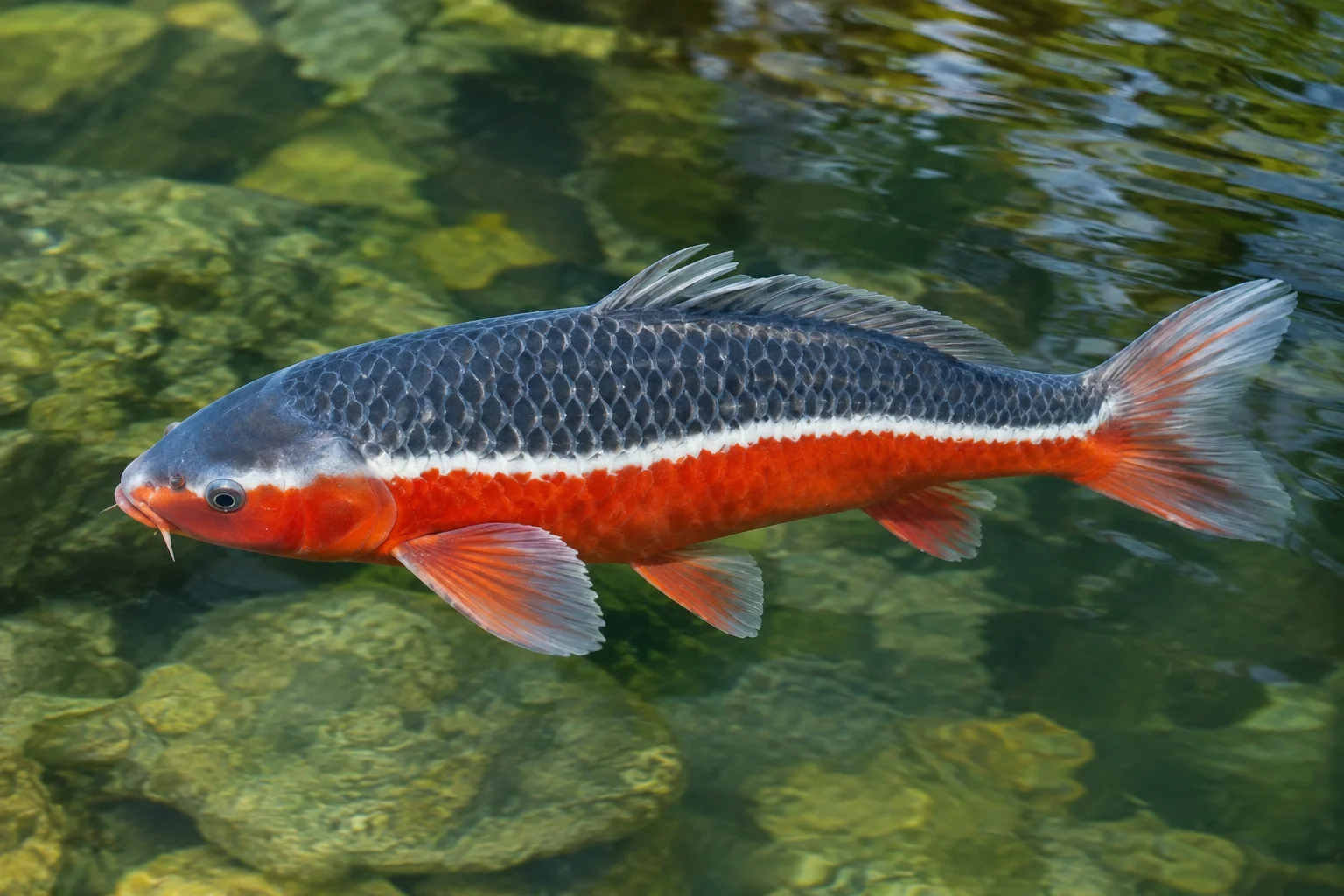
| Taki Asagi | A horizontal white line separating the dark back from the red belly, like a waterfall |
| Gin Rin Asagi | Any of the above with sparkling, metallic-edged scales |
| Doitsu Asagi (Shusui) | Scaleless body with a single row of large mirror scales along the dorsal line — judged as its own category |
In practice, the lines between these sub-varieties blur — most hobbyists and even breeders simply call any of them “Asagi” and let a judge sort out the finer distinctions.
How to Judge Asagi: Kiwa, Motoaka, and Head Quality

A handful of specific traits separate a genuinely good Asagi from a mediocre one:
- Head clarity — a pure white or very pale head is considered the single most important trait. Dark spots (jyami) or a yellowish tinge on the head are treated as flaws. It’s normal for young Asagi to show a slightly greyish head; this typically isn’t a lasting flaw and often clears as the fish matures.
- Scale reticulation — the net-like pattern should be sharp and even, ideally five to six evenly spaced rows of scales running from the dorsal fin down each side to the lateral line, with a clear, consistent contrast between each scale’s pale base and darker edge.
- Motoaka — the red at the base of the pectoral fins. In young Asagi the fins are often uniformly red; as the fish matures, the red typically recedes from the tip inward until only the base — roughly a third to half of the fin — remains red. Good motoaka is prized, but its absence isn’t disqualifying on an otherwise strong specimen.
- Kiwa — the boundary between the hi (red) and the surrounding color. As with other koi varieties, a crisp, clean kiwa reads as higher quality than a blurred one.
Note that motoaka (red at the fin base) and motoguro (black at the fin base, seen on varieties like Showa and Ki Utsuri) are different terms for different traits — Asagi is judged on the former, not the latter.
Asagi Koi Care Guide
Asagi are hardy and don’t require meaningfully different care from other koi varieties. The basics: adequate pond size and filtration, a balanced high-quality koi pellet diet supplemented with occasional live or frozen treats, a stable and appropriate temperature range, and regular water testing to keep ammonia and nitrite at zero. With good care, Asagi can live for decades — some well-kept individuals reportedly live past 50 years.
Asagi vs. Shusui
Shusui is essentially Doitsu (scaleless) Asagi — same blue-and-red color scheme and the same judging logic, but with a scaleless body and a single visible row of large mirror scales running along the dorsal line instead of full body scaling. The two are judged in the same competition category since they share the same bloodline and pattern standards.
Asagi in Japanese Culture
Koi broadly symbolize perseverance and good fortune in Japanese culture. Asagi’s understated, structural beauty is often read differently from the boldness of varieties like Kohaku or Showa — collectors sometimes describe its appeal as an acquired taste that rewards a closer, more deliberate look rather than an immediate visual impact.
Conclusion
Asagi rewards patience more than most koi varieties: its beauty is in the precision of the scale netting and the clarity of the head, not in bold color. If you’re new to judging Asagi, start with the head — a clean, unmarked white head is the single trait that separates a good specimen from an average one, with everything else building from there.
Frequently Asked Questions (FAQs)
Can Asagi koi be kept in outdoor ponds?
Yes — Asagi are well-suited to outdoor ponds and are considered a hardy variety, provided the pond has adequate filtration, aeration, and stable water quality.
What is the lifespan of an Asagi koi?
With good care, Asagi can live for several decades, and some well-kept individuals are reported to live past 50 years — lifespan depends heavily on water quality, diet, and genetics rather than being fixed by variety.
Are there specific dietary requirements for Asagi koi?
No — Asagi thrive on the same balanced diet as most koi varieties: a high-quality koi pellet as the base, supplemented with occasional live or frozen treats.
Why do some Asagi koi have a grey head instead of white?
It’s common for young Asagi to show a slightly greyish head rather than the pure white considered ideal in mature, show-quality specimens. This usually isn’t a lasting flaw and often improves as the fish matures.
What’s the difference between Asagi and Shusui?
Shusui is the scaleless (Doitsu) version of Asagi — same blue-and-red color pattern and judging standards, but with a mostly scaleless body and a single row of large mirror scales along the dorsal line. The two are judged in the same competition category.
What is the significance of Asagi koi in Japanese art?
Asagi carries the same broad symbolism as koi generally — perseverance and good fortune — though its subdued coloration sets it apart visually from the bolder varieties more commonly depicted in traditional Japanese art.
You may also like
- Hi Utsuri Koi: The Complete Guide
- Ki Utsuri Koi: The Complete Guide
- Matsuba Koi Guide
- Koi Fish Meaning
- Most Expensive Koi Fish Ever Sold
- Koi Breeding Basics


Passionate about fish keeping since elementary school in the 1980s, Giovanni Carlo has dedicated countless hours to collecting and breeding a diverse array of ornamental freshwater fish. From vibrant guppies and majestic koi to striking bettas and classic goldfish, he continues to explore the fascinating world of aquatics, sharing knowledge and enthusiasm with fellow fish enthusiasts.