Goshiki Koi: Complete Guide to the 5-Color Koi Fish (Care, Types & Facts)
By Giovanni Carlo Bagayas | Updated: June 2026 | 12 min read
Quick Answer
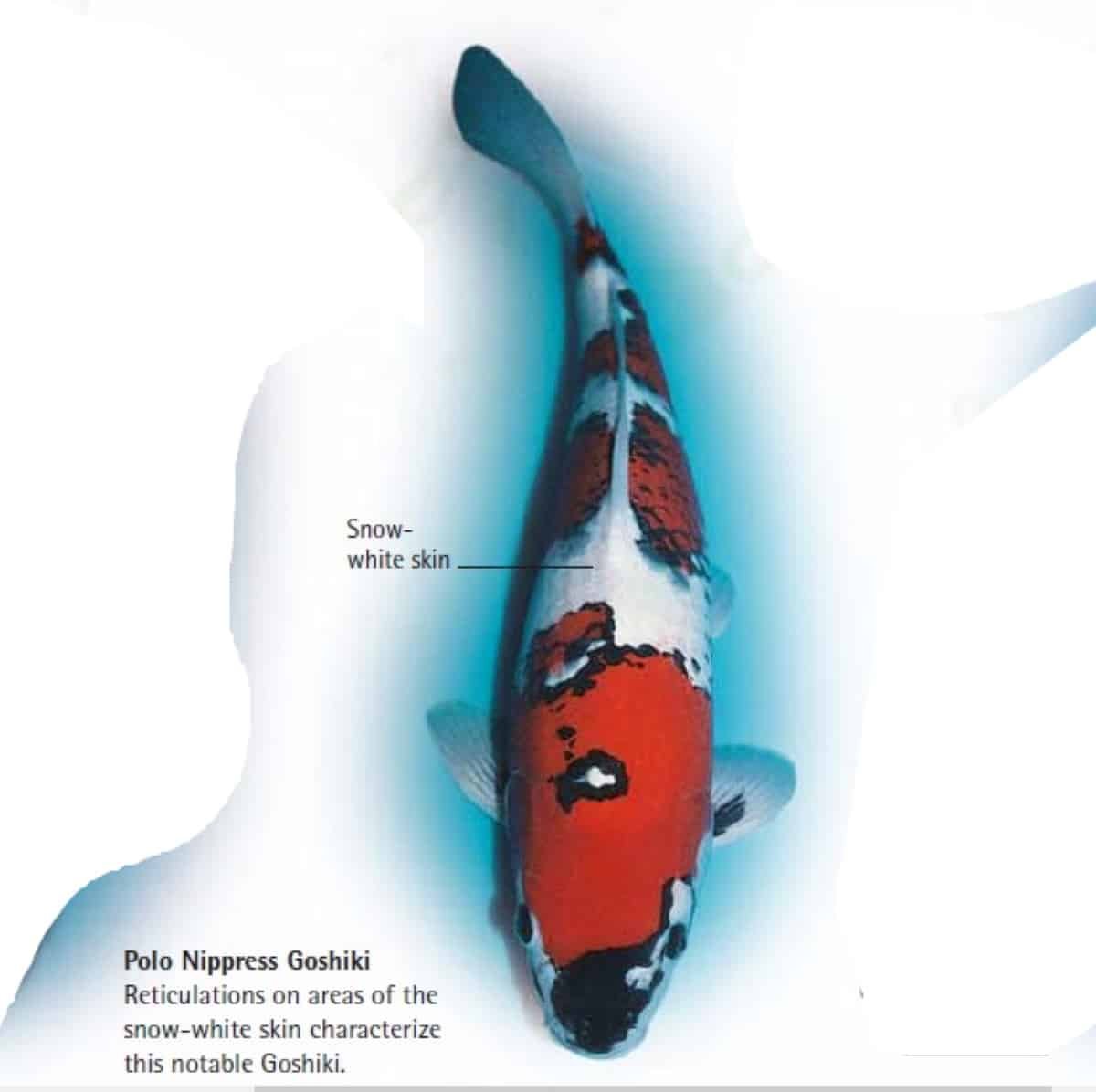
Goshiki koi (五色, “five colors”) are a Japanese ornamental koi variety created in 1918 by crossing Asagi and Kohaku. They display five distinct colors — white, red, black, blue, and indigo — in a characteristic net-like scale pattern. Goshiki grow to 12–18 inches, live 20–25 years, and are well-suited to ponds of 500 gallons or more. Their bold red Hi plate and Asagi-style netting make them one of the most visually complex koi varieties available.
What is a Goshiki koi?
Goshiki koi (pronounced goh-shee-kee) are a non-metallic Japanese nishikigoi variety that belong to the Kawarimono classification. The name comes from the Japanese 五色 — “go” meaning five, and “shiki” meaning colors. A well-bred Goshiki displays all five colors simultaneously: a white (shiro) base, bold red hi markings, and a reticulated overlay of black, dark blue, and indigo reminiscent of its Asagi ancestor.
What makes Goshiki distinct from most other koi is the sashi — the dark netting that radiates from each scale’s edge across the body. On a high-quality specimen, this netting should be clean and uniform, like a fishnet draped over the white ground, with the Hi plate sitting atop like a crown of fire.
I have been keeping koi since the 1980s, and Goshiki remain one of the most underappreciated varieties in the hobby. Their complexity only becomes apparent when you see a show-quality specimen up close — the layering of five colors in a single fish is genuinely remarkable.
History and origin of Goshiki koi

Goshiki koi were first developed in Japan in 1918 through the deliberate crossing of Asagi koi (known for their blue reticulated scales and red-orange belly markings) with Kohaku koi (the iconic white-and-red variety). The goal was to combine the Kohaku’s powerful Hi plate with the Asagi’s distinctive scale netting — and the result was the five-colored Goshiki.
The variety went through significant evolution over the 20th century. Early Goshiki tended toward dark, heavily netted bodies that could appear murky or overpatterned. From the 1990s onward, Japanese breeders focused on producing cleaner specimens — prioritizing bright white ground, vivid Hi free of sashi intrusion, and a uniform, delicate net pattern rather than large black blotches.
Today’s competition Goshiki reflects these refinements. Modern judges reward fish with crisp white skin, unblemished Hi, and a net pattern that enhances rather than overwhelms the overall composition.
How to identify Goshiki koi

Identifying a true Goshiki requires looking for all five colors simultaneously — not just two or three. Here is what to look for:
- Shiro (white): The base ground color. Should be clean and bright, not yellowish or grey.
- Hi (red): Bold red markings inherited from the Kohaku parent. Should be deep, saturated, and clearly defined.
- Sumi (black): The darkest element of the net pattern, appearing as scale outlines or borders.
- Ai (indigo/blue): The intermediate tones in the netting, inherited from Asagi. Creates the “fishnet” depth.
- Kon (dark blue): The deepest blue tones, visible particularly in the dorsal area and scale centers.
The defining feature is the reticulated (net-like) scale pattern. Each scale is darker at its edge and lighter at the center, creating a mosaic effect across the body. This netting should be present across the full body — not just the dorsal area.
Size-wise, Goshiki are more compact than most koi varieties: typical adult size is 12–18 inches (30–46 cm), though exceptional pond conditions can push specimens to 24 inches. Their body conformation is similar to Kohaku — torpedo-shaped, deep-bodied, with a broad head.
Types of Goshiki koi
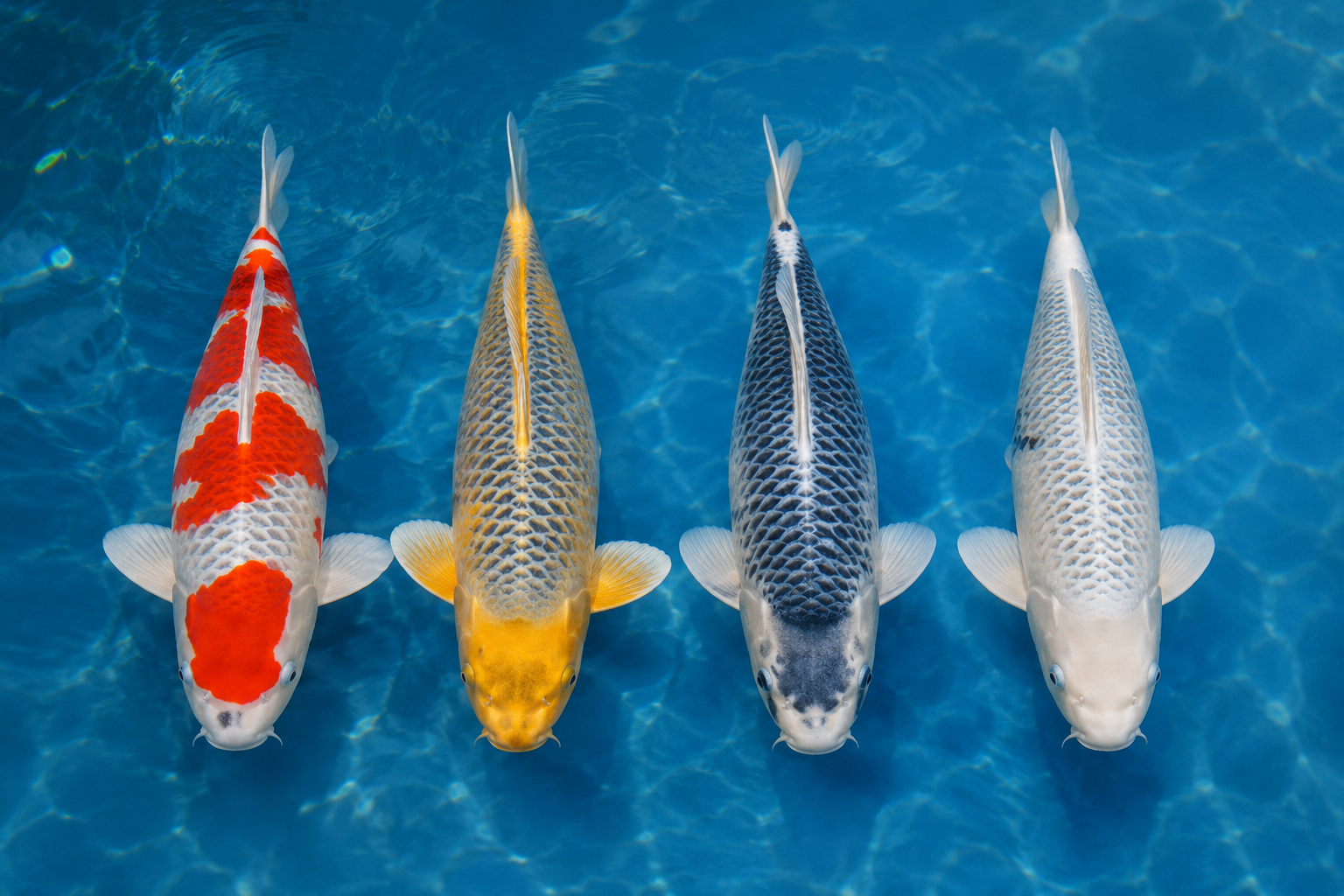
There are four main subtypes of Goshiki koi, each distinguished by the dominant color expression or the intensity of specific pigments. A fifth variant — Tancho Goshiki — is defined by pattern rather than color.
| Type | Key feature | Rarity | Best for |
|---|---|---|---|
| Aka Goshiki | Dominant, deep red Hi covering large body areas | Common | Bold, dramatic pond display |
| Ki Goshiki | Yellow or golden tones replacing or supplementing red | Uncommon | Collectors and variety enthusiasts |
| Ai Goshiki | Deep indigo/blue dominates the net pattern; sophisticated, darker look | Uncommon | Show competition; prized by connoisseurs |
| Shiro Goshiki | Predominantly white body with subtle red and minimal netting | Rare | Clean, elegant pond aesthetic |
| Tancho Goshiki | Single circular red spot on head only; Goshiki body coloring otherwise | Rare | Show ponds; culturally significant |
Aka Goshiki

The most widely available Goshiki subtype. The Hi plate is intense and covers large portions of the body, making Aka Goshiki one of the most visually striking fish in any pond. In Japanese culture, dominant red koi are associated with good luck and prosperity. When selecting an Aka Goshiki, look for Hi that does not bleed into the white ground — clean demarcation lines are a quality indicator.
Tancho Goshiki

Tancho Goshiki feature a single, circular red marking centered on the head — no Hi elsewhere on the body. This is among the rarest and most valuable Goshiki configurations. The Tancho marking echoes the Japanese Red-crowned Crane (Grus japonensis), a symbol of longevity and good fortune. For a Tancho to be competition-worthy, the spot must be perfectly circular, centrally placed, and deeply colored without bleeding.
Goshiki vs Asagi koi: key differences
Because Goshiki were bred from Asagi, the two varieties share visible traits — particularly the blue-net reticulated scale pattern. New koi keepers sometimes confuse them. Here is how to tell them apart at a glance:
| Feature | Goshiki | Asagi |
|---|---|---|
| Base color | White (shiro) | Blue-gray |
| Hi (red) location | Across upper body (like Kohaku) | Belly, cheeks, and pectoral fin base only |
| Scale netting | Black + indigo over white | Blue reticulation over blue-gray body |
| Number of colors | Five | Three (blue, red-orange, white) |
| Classification | Kawarimono (non-metallic) | Kawarimono (non-metallic) |
| Visual impression | Bold, complex, five-color layering | Calmer, two-tone with belly accents |
Goshiki koi care guide
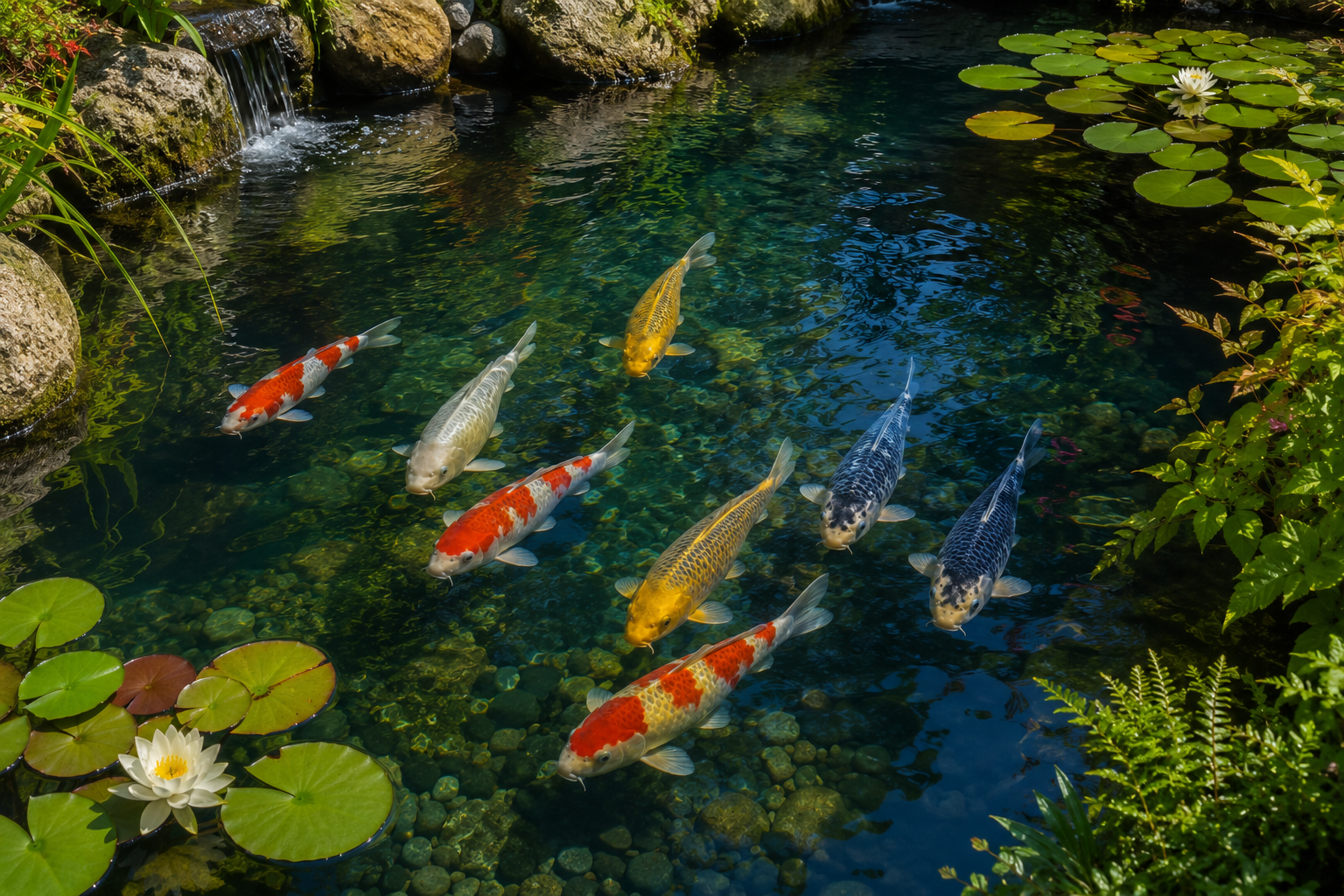
Goshiki koi are considered a hardy, intermediate-level variety. They are more forgiving than some high-end show varieties but still require consistent water quality to maintain their color vibrancy — particularly the Hi plate, which can fade without a carotenoid-rich diet and clean water.
Pond size and stocking
While Goshiki are smaller than many koi varieties, they still need adequate swimming space. A minimum pond size of 500 gallons (1,900 liters) is recommended for a small group. Follow the standard koi stocking rule: 10 gallons of water per 1 inch of fish length. Goshiki do well in mixed-variety ponds and are not aggressive toward other koi.
Filtration
A biological filtration system capable of processing the full pond volume at least once per hour is essential. Goshiki are sensitive to ammonia spikes — like all koi, their immune system weakens under high ammonia stress, making them vulnerable to bacterial infections. A UV sterilizer alongside mechanical and biological filtration will significantly reduce disease pressure.
Water parameters for Goshiki koi
| Parameter | Ideal range | Notes |
|---|---|---|
| Temperature | 59°F – 77°F (15°C – 25°C) | Avoid swings >5°F per day |
| pH | 7.0 – 8.5 | Slightly alkaline is preferred |
| Ammonia (NH₃) | 0 ppm | Any detectable level is dangerous |
| Nitrite (NO₂) | 0 ppm | Spikes during cycling; use beneficial bacteria |
| Nitrate (NO₃) | < 40 ppm | Manage with partial water changes |
| KH (carbonate hardness) | 100 – 200 ppm | Stabilizes pH; prevents crashes |
| Dissolved oxygen | > 6 mg/L | Critical in summer heat |
| Pond depth | Minimum 3 ft (90 cm) | 4 ft+ for climates with freezing winters |
Feeding Goshiki koi and enhancing color
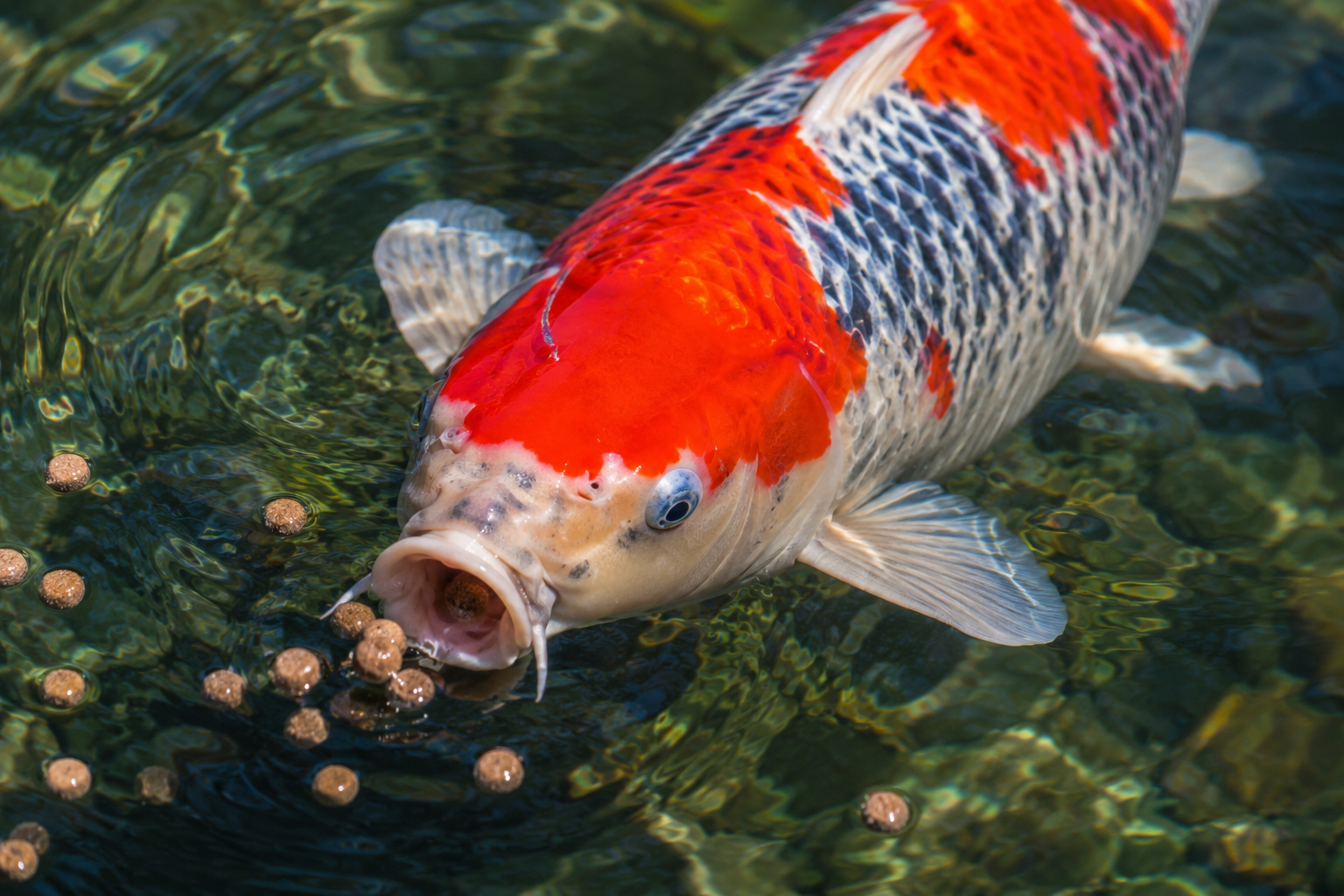
Feeding is one of the most impactful ways to maintain and enhance Goshiki koi color. The red Hi plate is pigment-dependent — it will fade without dietary carotenoids (astaxanthin and canthaxanthin) that the fish cannot synthesize on their own.
Seasonal feeding schedule
| Water temp | Food type | Frequency |
|---|---|---|
| Below 50°F (10°C) | Do not feed | Digestion stops; uneaten food pollutes pond |
| 50°F – 59°F (10°C – 15°C) | Wheat germ pellets only | Once daily, small amounts |
| 59°F – 68°F (15°C – 20°C) | Wheat germ + standard koi pellets | 2× daily |
| Above 68°F (20°C) | High-protein + color-enhancing pellets | 3–4× daily, 5-minute rule |
Color-enhancing supplements: Spirulina, astaxanthin-enriched pellets, and occasional treats of orange-colored vegetables (carrots, orange bell peppers) all support Hi intensity. Mud pond conditions — as used by top Japanese breeders — naturally contain organisms high in carotenoids, which is why koi raised in mud ponds typically show deeper coloration.
Recommended product
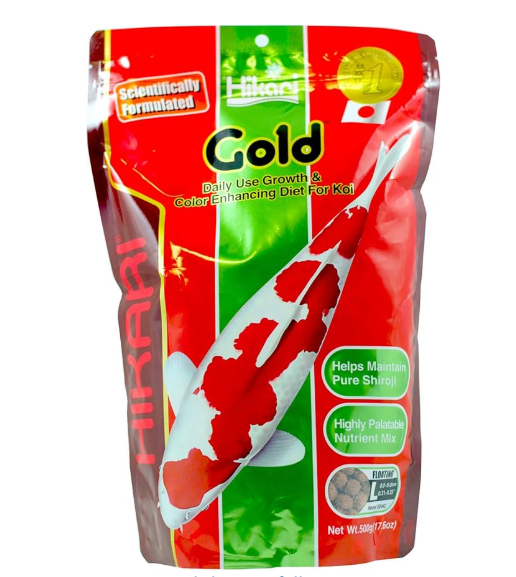
Hikari Koi Gold Floating Pellets
High-protein formula with astaxanthin for color development. Ideal for Goshiki during peak feeding season (water above 68°F). Floating pellets let you monitor how much your koi eat and remove uneaten food easily.
View on Amazon ↗Disclosure: As an Amazon Associate, Giobel Koi Center earns from qualifying purchases at no extra cost to you.
Breeding Goshiki koi

Breeding Goshiki koi is a rewarding challenge. Because Goshiki genetics involve multiple color genes from two distinct varieties (Asagi and Kohaku), offspring are highly variable — you will not get a pond full of identical five-color fish from a single spawn.
Selecting a brood pair
Choose parent fish that each display the traits you want to amplify. For classic Goshiki offspring, pair a strong Aka Goshiki male (bold Hi, clean net pattern) with a female showing excellent white ground (shiro). Avoid parents with murky netting, bleeding Hi edges, or dull blue tones — these traits pass readily to offspring.
Spawning conditions
- Water temperature rising through 64°F–72°F (18°C–22°C) triggers spawning naturally in spring.
- A breeding brush or spawning mop provides substrate for egg adhesion.
- Remove adults from the spawning tank after egg deposition — koi will eat their own eggs.
- Eggs hatch in 4–7 days at 68°F–72°F (20°C–22°C).
Culling fry
Goshiki fry must be culled (sorted) at multiple growth stages. At 2–3 inches, remove any fry lacking color development. At 4–6 inches, cull for pattern quality. Only a small percentage of any Goshiki spawn will develop all five colors in proper balance — this is normal and expected. From personal experience breeding koi in the Philippines, I typically see 10–15% of a Goshiki spawn develop into presentable specimens.
How to choose a quality Goshiki koi
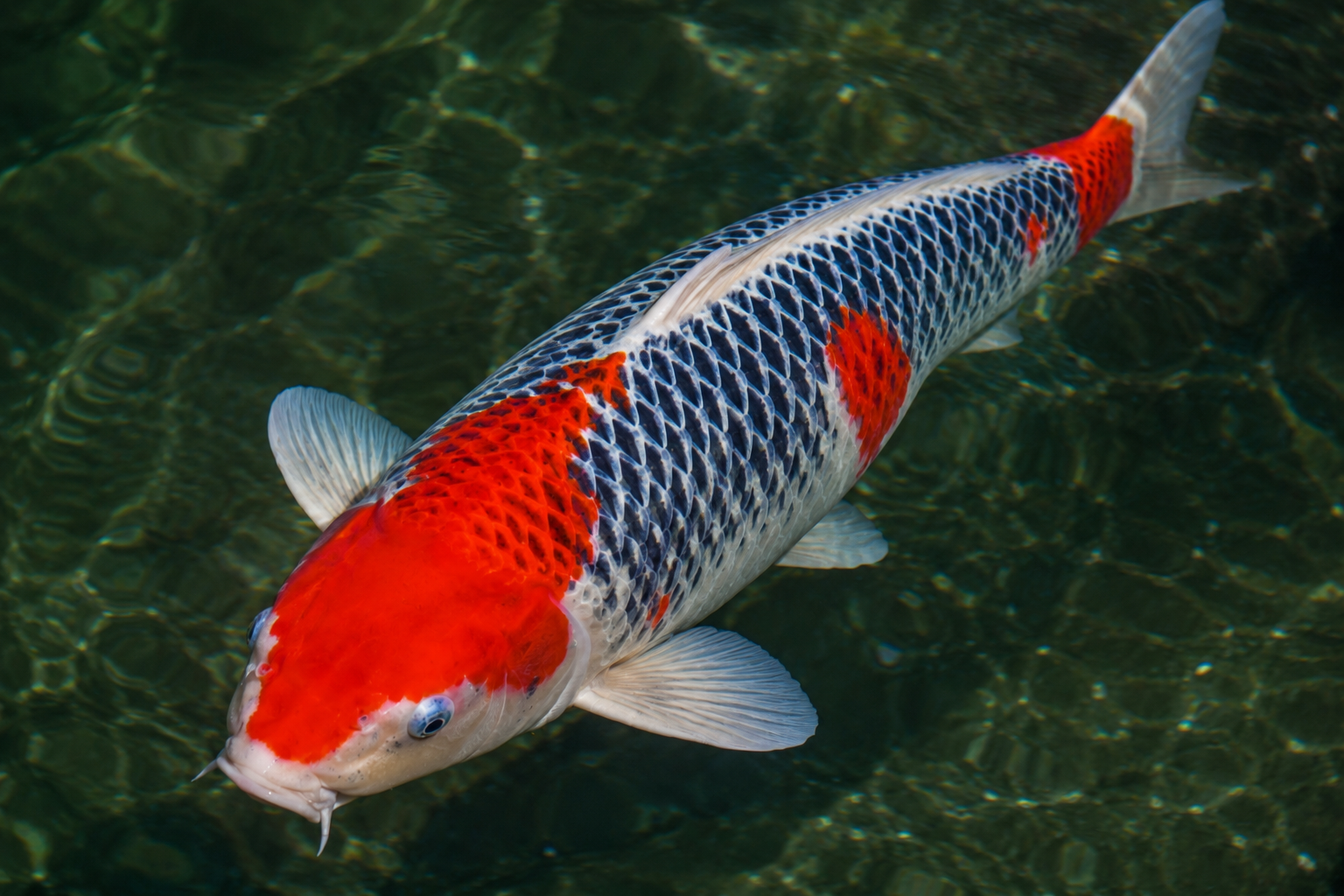
When buying a Goshiki koi, evaluate these quality indicators in order of importance:
- White ground (shiro): Should be bright, paper-white, and free from yellowish or grey cast. Poor shiro is the most common flaw in budget Goshiki.
- Hi plate definition: Clear edges between red and white. Hi should be deep red (not orange), evenly pigmented, and free from sashi (dark scale netting bleeding into the red area).
- Net pattern uniformity: The blue-black netting should cover the body evenly. Large black blotches or irregular patches are quality defects.
- Body conformation: Well-proportioned torpedo body. Avoid fish with curved spines, pinched tails, or asymmetrical heads.
- Active behavior: Alert, responsive fish that surface eagerly for food. Lethargy at purchase time usually indicates stress or disease.
- Clear eyes and intact fins: Cloudy eyes, split fins, or missing scales are red flags regardless of color quality.
From my 40+ years of keeping koi: Always quarantine new Goshiki for at least 2–3 weeks before adding to an established pond. Goshiki from budget sources often carry parasites that are invisible at purchase time but can devastate an established collection within weeks.
Frequently asked questions about Goshiki koi
What does Goshiki mean in Japanese?
Goshiki (五色) means “five colors” in Japanese. The five colors are white (shiro), red (Hi), black (sumi), indigo (ai), and dark blue (kon). All five should be visible simultaneously on a quality specimen.
What are the different types of Goshiki koi?
The four main types are Aka Goshiki (dominant red), Ki Goshiki (yellow tones), Ai Goshiki (deep indigo), and Shiro Goshiki (predominantly white). A fifth variant, Tancho Goshiki, has a single circular red spot on the head only.
How long do Goshiki koi live?
With proper care, Goshiki koi typically live 20 to 25 years. Stable water quality, good nutrition, and disease prevention are the main factors that determine lifespan.
How big do Goshiki koi get?
Goshiki koi typically grow to 12–18 inches (30–46 cm). In ideal, large-volume ponds some can reach up to 24 inches, but they generally remain smaller than Kohaku or Sanke of the same age.
Are Goshiki koi good for beginners?
Yes — Goshiki are hardy and relatively easy to care for compared to more delicate varieties. They suit intermediate beginners who can maintain basic water quality. Their color development does require consistent care and a carotenoid-rich diet.
What is the difference between Goshiki and Asagi koi?
Both share the Asagi-derived reticulated scale pattern. The key differences: Goshiki have a white body base (Asagi is blue-gray), and Goshiki have a full dorsal Hi plate from the Kohaku parent (Asagi have red-orange on the belly and fin bases only). Goshiki show five colors; Asagi show three.
What water temperature do Goshiki koi need?
Goshiki thrive between 59°F and 77°F (15°C–25°C). Stop feeding below 50°F (10°C). Avoid temperature swings greater than 5°F per day — sudden changes stress their immune systems and trigger disease outbreaks.
Related koi variety guides

Giovanni Carlo Bagayas
Founder, Giobel Koi Center · Koi keeper since the 1980s · Labangan, Zamboanga del Sur, Philippines
Giovanni has been keeping and breeding ornamental koi since elementary school in the 1980s — over 40 years of hands-on experience spanning koi varieties, pond management, koi health, and crayfish and tilapia farming. He founded Giobel Koi Center to share practical, experience-backed knowledge with koi enthusiasts worldwide.

Passionate about fish keeping since elementary school in the 1980s, Giovanni Carlo has dedicated countless hours to collecting and breeding a diverse array of ornamental freshwater fish. From vibrant guppies and majestic koi to striking bettas and classic goldfish, he continues to explore the fascinating world of aquatics, sharing knowledge and enthusiasm with fellow fish enthusiasts.