Quick Answer
Egg binding (dystocia) happens when a female koi can’t naturally release her mature eggs. Home care includes daily Epsom salt baths (1 tablespoon per gallon, 15 minutes, in a separate container — never in the main pond) and gradually raising water temperature to 77°F (25°C) for about a week. But an important caveat: a real fish veterinarian’s most common warning here is that hobbyists often misdiagnose ordinary swelling as egg binding when it’s actually a tumor, cyst, or dropsy — persistent or worsening swelling deserves an actual veterinary exam, not just home remedies.
Before you assume it’s egg binding: a fish veterinarian who specializes in koi has directly cautioned that “egg binding” is frequently over-diagnosed by hobbyists. Female koi carry eggs regularly, and a swollen abdomen can also indicate a tumor, ovarian cyst, or dropsy (a genuinely different, often fatal condition) — not just retained eggs. If swelling is severe, hasn’t resolved with basic home care, or is accompanied by protruding scales (a dropsy warning sign), get an actual veterinary exam rather than continuing home remedies alone.

What Is Egg Binding in Koi?
Egg binding, medically known as dystocia, occurs when a mature female koi is unable to naturally expel her eggs during or after the breeding season. The eggs remain trapped, putting pressure on internal organs. It’s most commonly seen in mature breeding-age females, and if genuinely present and left unaddressed, it can be serious — but as noted above, confirming that egg binding is actually what’s happening matters more than jumping straight to treatment.
Signs and Symptoms
- Swollen abdomen — particularly noticeable below the vent (genital opening).
- Loss of appetite — disinterest in food due to internal discomfort.
- Lethargy — uncharacteristic sluggishness and reduced activity.
- Difficulty swimming — the weight of retained eggs can affect buoyancy and balance.
Watch specifically for scales protruding outward in a “pinecone” pattern — this is a hallmark sign of dropsy, a different and often more serious condition than simple egg retention, and a good reason to seek veterinary input rather than assuming egg binding.
Home Care Options
Epsom Salt Baths
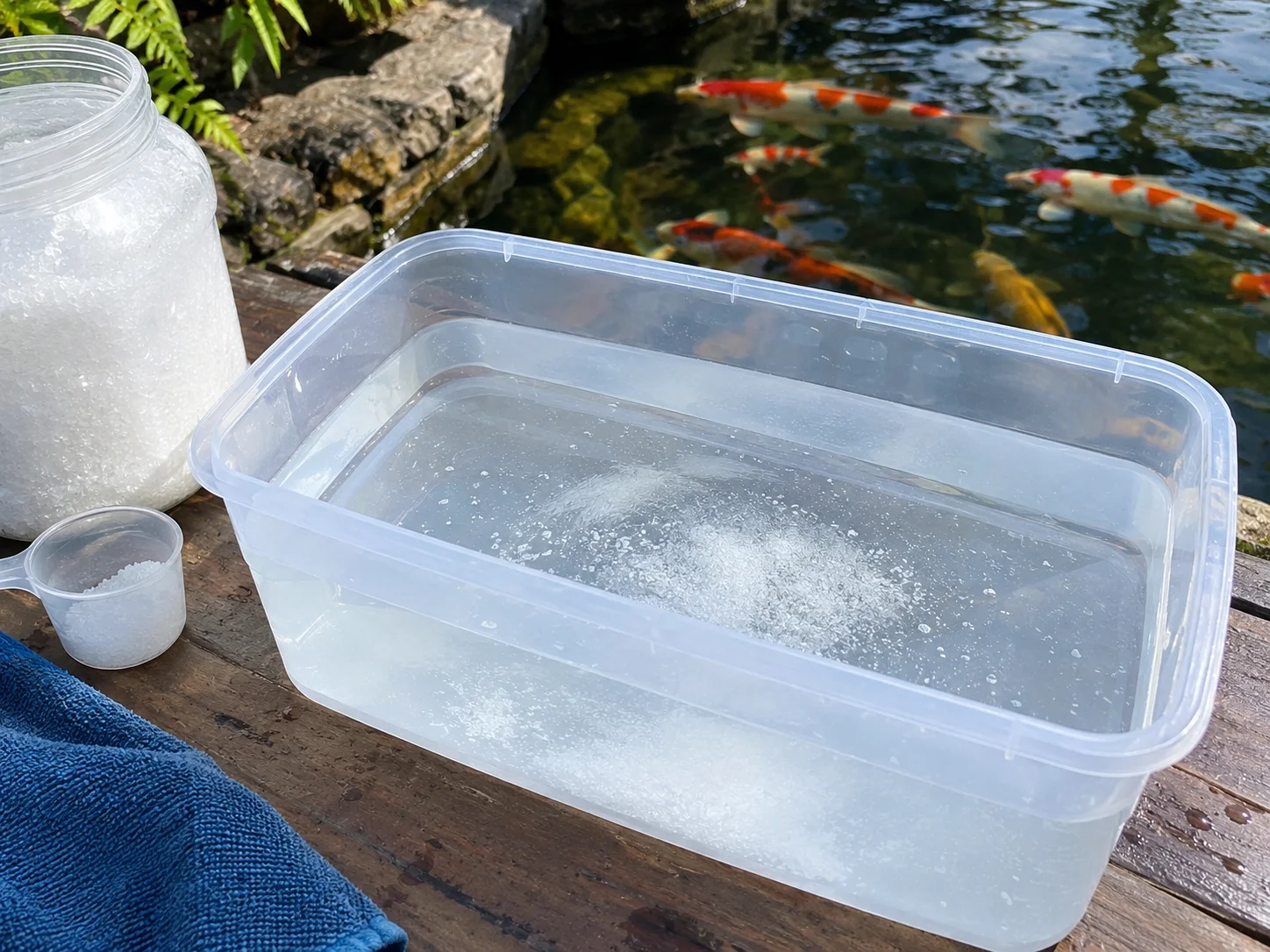
Epsom salt (magnesium sulfate) can act as a mild muscle relaxant, potentially easing the passage of eggs. Use 1 tablespoon of Epsom salt per gallon of water in a separate container (never the main pond), matching the bath’s temperature to the fish’s home water. Keep the koi in the bath for about 15 minutes once daily.
Use plain, unscented Epsom salt — Amazon Basics Unscented Epsom Salt is pure magnesium sulfate with no added fragrance oils, which matters since scented bath salts aren’t appropriate for fish.
Gradually Raising Water Temperature
Koi naturally spawn as water warms in late summer, typically triggered around 68°F (20°C). Gradually raising the temperature to about 77°F (25°C) and holding it there for roughly a week can sometimes stimulate natural egg release, mimicking that seasonal cue.
Fasting
Withholding food for a few days is sometimes recommended alongside the above — as cooler weather approaches, a female koi will often naturally reabsorb unreleased eggs as an energy source if given the chance.
Professional Veterinary Intervention
If home care doesn’t resolve the issue within a few days, or if the koi is showing serious distress, veterinary treatment is the appropriate next step:
- Hand stripping — a technique where a veterinarian or experienced breeder gently expresses ripe eggs from the fish by hand. This should only be attempted by someone experienced, and only when the eggs are confirmed ready to release — done incorrectly or too early, it can injure the fish.
- Hormone injections — a veterinarian may administer carp pituitary extract (CPE), luteinizing hormone-releasing hormone (LHRH), or human chorionic gonadotropin (HCG) to induce spawning. Dosing (such as CPE at roughly 0.3g per kilogram of body weight, sometimes repeated after 18 hours) is a veterinary decision, not something to attempt yourself.
- Surgery — in severe or advanced cases, surgical removal of retained eggs may be necessary, performed only by a veterinarian experienced with fish.
Prevention
- Maintain water quality — stable pH, ammonia, and nitrite levels reduce overall stress on breeding-age females.
- Feed a balanced diet — proper nutrition supports healthy egg development and release.
- Minimize stress — overcrowding, predator exposure, and sudden water changes can all interfere with normal spawning behavior.
- Keep an appropriate male-to-female ratio — during spawning, males physically nudge females to help trigger egg release; an imbalanced or overly stressed group can disrupt this natural process.
Frequently Asked Questions
Is a swollen koi always egg bound?
No — this is a genuinely common misdiagnosis. A swollen abdomen can also indicate a tumor, ovarian cyst, or dropsy. Persistent or worsening swelling, especially with protruding scales, warrants a proper veterinary exam rather than assuming egg binding.
How much Epsom salt do I use for an egg-bound koi?
1 tablespoon per gallon of water, in a separate bath container (never the main pond), for about 15 minutes once daily.
Can I massage the eggs out of my koi myself?
This isn’t recommended without experience — squeezing or improperly massaging a fish can cause real injury. “Hand stripping” is a specific technique that should only be performed by an experienced breeder or veterinarian, and only once the eggs are confirmed ready to release.
What temperature helps release eggs in koi?
Gradually raising water temperature to about 77°F (25°C) and holding it there for roughly a week can sometimes stimulate natural spawning, mimicking the seasonal warming that normally triggers it.
You may also like

Passionate about fish keeping since elementary school in the 1980s, Giovanni Carlo has dedicated countless hours to collecting and breeding a diverse array of ornamental freshwater fish. From vibrant guppies and majestic koi to striking bettas and classic goldfish, he continues to explore the fascinating world of aquatics, sharing knowledge and enthusiasm with fellow fish enthusiasts.