Most Expensive Koi Fish in the World: Prices, Records & Valuation Guide (2026)
By Giovanni Carlo Bagayas | Updated: June 2026 | 14 min read

Quick Answer
The most expensive koi fish ever sold is S Legend — a female Kohaku koi from Sakai Fish Farm, Hiroshima, Japan. She sold for $1.8 million (203 million yen) at auction in October 2018, setting a world record for the most expensive fish ever sold. Koi prices range from $10 for pond koi to over $1 million for championship specimens. The highest-value varieties are Kohaku, Taisho Sanke, and Showa — the Gosanke “Big Three.” Six factors drive price: bloodline, size, color quality, skin quality, gender, and show history.
S Legend — the $1.8 million world record koi
In October 2018, at the Sakai Fish Farm auction in Hiroshima, Japan, a single fish changed the record books forever. A 101 cm (nearly 40-inch) female Kohaku koi named S Legend sold for $1.8 million USD (203 million yen) — the highest price ever paid for a fish in recorded history.
The buyer was Ms. Ying Ying Chung, a highly respected koi collector and enthusiast, who secured S Legend after an intense bidding war. The fish was bred by Kentaro Sakai of Sakai Fish Farm — one of Japan’s most prestigious koi breeding operations with a lineage spanning generations.
What made S Legend worth $1.8 million?
| Factor | S Legend’s specification |
|---|---|
| Variety | Kohaku (white ground, red Hi markings) |
| Gender | Female (females are always more valuable — larger body, better color retention) |
| Size | 101 cm / 40 inches — exceptionally large for a Kohaku |
| Breeder | Sakai Fish Farm, Hiroshima — one of Japan’s most prestigious breeding operations |
| Show record | Won the All Japan Koi Show 2017 — the world’s most prestigious koi competition |
| Color quality | Near-flawless white ground with deep, evenly distributed Hi — virtually no blemishes |
| Tragic end | S Legend died in 2019 — reportedly from complications after international transport |
From 40+ years of koi keeping
When I started keeping koi in the 1980s in the Philippines, a premium koi cost a few hundred dollars. The jump to $1.8 million in a single generation reflects how koi have evolved from decorative pond fish into genuine luxury collectibles — comparable to rare art or vintage wine. I have evaluated hundreds of koi over the decades and can say: S Legend was not just a fish. She was the culmination of multiple generations of precise, patient, expert breeding. The price was extraordinary but not irrational.
Hanako — the oldest koi fish ever recorded
Alongside S Legend, one other koi has achieved legendary status in recorded history — not for her price, but for her extraordinary lifespan. Hanako (花子, “flower girl”) was a scarlet Higoi koi fish kept at a private pond in Gifu Prefecture, Japan. She died on July 7, 1977 — at the verified age of 226 years old, having been born in 1751.
Hanako’s age was determined by examining the growth rings on her scales — the same technique used to age trees by their rings. Her age was confirmed by Dr. Komei Koshihara, who announced the finding publicly in 1966.
While Hanako was never auctioned, her verified existence permanently expanded what collectors and breeders understand about koi longevity. Most koi live 25–35 years with proper care. Some reach 50+ years. Hanako’s 226 years remains the documented extreme — a reminder that a well-kept koi is not just a fish but potentially a multi-generational family heirloom.
Longevity and value
From 40+ years of keeping koi: longevity directly correlates with value. A koi that has lived 15–20 years with excellent color and conformation is worth significantly more than a young fish — the sustained quality over time is proof of superior genetics. When I evaluate older koi, I look for color stability: does the Hi on a 15-year-old Kohaku still pop? That tells you everything about the bloodline.
Top 8 most expensive koi fish ever sold

| Rank | Koi / name | Variety | Price | Year / location |
|---|---|---|---|---|
| 🥇 1 | S Legend | Kohaku | $1,800,000 | 2018 · Sakai Fish Farm, Hiroshima |
| 2 | Dainichi Kohaku (female) | Kohaku | $1,100,000 | 2025 · Dainichi Farm auction, Japan |
| 3 | Kin Showa | Showa Sanshoku | $950,000 | 2017 · Japan |
| 4 | Yamabuki Ogon | Ogon (metallic gold) | $700,000 | 2018 · Japan |
| 5 | Ginrin Karin | Showa Sanke (Ginrin) | ~$400,000+ | Private sale · Japan |
| 6 | Maruten Sanke | Taisho Sanke | $341,990 | 2015 · Sakai Fish Farm auction |
| 7 | Shining Rose (Taisho Sanke) | Taisho Sanke | $213,223 | 2013 · Sakai Fish Farm auction |
| 8 | Asagi (champion) | Asagi | $152,000 | 2016 · Japan |

Koi fish price range by variety — complete table
Every koi variety has a different price ceiling driven by how difficult the variety is to breed to show quality. Here is the complete price range by variety from hobbyist to championship grade:
| Variety | Colors | Hobbyist price | Show quality price | Why it’s expensive |
|---|---|---|---|---|
| Kohaku ⭐ | White + red | $50 – $500 | $75,000 – $1,800,000 | Hardest two-color balance to perfect; #1 show variety globally |
| Taisho Sanke ⭐ | White + red + black | $50 – $3,000 | $50,000 – $341,990 | Requires perfect three-color balance; ancient bloodlines |
| Showa Sanshoku ⭐ | Black + white + red | $50 – $2,000 | $50,000 – $950,000 | Bold black base is rare to achieve with clean Hi; dramatic show fish |
| Yamabuki Ogon | Metallic gold | $100 – $300 | Up to $700,000 | Metallic sheen must be perfect; top specimens are breathtaking |
| Tancho Kohaku | White + single red circle on head | $200 – $1,000 | $10,000 – $50,000+ | Perfect red circle on head only — extremely rare breeding result |
| Goshiki | 5 colors (white, red, black, blue, indigo) | $50 – $500 | $5,000 – $30,000 | Five-color balance; complex Asagi × Kohaku breeding |
| Platinum Ogon | Metallic platinum white | $50 – $300 | $3,000 – $20,000 | Pure metallic sheen; no imperfections tolerated at show level |
| Asagi | Blue-gray + red/orange | $50 – $300 | Up to $152,000 | Uniform net pattern is extremely difficult; one of the oldest varieties |
| Karashigoi | Yellow / olive | $50 – $200 | $2,000 – $10,000 | Rare color; friendliest koi variety — highly personable |
| Butterfly koi | Various (long fins) | $30 – $200 | $500 – $5,000 | Long flowing fins; popular in US but not recognized in Japanese shows |
| Standard pond koi | Mixed / variable | $10 – $100 | N/A | Ideal for backyard ponds; beauty without championship price |
⭐ = Gosanke “Big Three” varieties. Source: Compiled from Sakai Fish Farm auction records, Kodama Koi Farm pricing, and 40+ years of personal koi valuation experience.
Rare and unusual expensive varieties
Beyond the Gosanke Big Three, several rare varieties command premium prices due to genetic rarity, unusual visual traits, or extreme breeding difficulty:
- Doitsu koi (German koi): Scaleless or partially scaled koi bred from German mirror carp. Their naked skin makes them exceptionally rare — “shiny” Doitsu (metallic scaleless) can sell for $3,000–$16,000. High-quality Doitsu Showa or Doitsu Kohaku with perfect color on scaleless skin are prized collector items.
- Kumonryu (“Dragon in Clouds”): A black-and-white scaleless variety that changes its pattern with the seasons — black in summer, white in winter. This color-shifting ability makes every Kumonryu unique. Championship specimens sell for $5,000–$20,000. Identifying them as juveniles is nearly impossible because of how frequently their patterns change.
- Kujaku (“Peacock” koi): A metallic koi with a reticulated net pattern over a white or gold base. Show-quality Kujaku with clean netting and intense metallic sheen can reach $10,000. Often called “the flying dragon” by collectors.
- Beni Kikokuryu: A metallic black and white scaleless koi with orange-red pattern overlaid. Highly sought for its unique metallic-meets-three-color combination. Show quality specimens can reach $2,000–$10,000.
- Ginrin varieties: Any koi with Ginrin (diamond-sparkle) scales carries a significant premium. Ginrin Kohaku or Ginrin Showa at show quality can command 2–3x the price of the same fish without Ginrin. Ginrin Karin (a Showa Sanke with Ginrin) sold for over $400,000 in a private transaction.
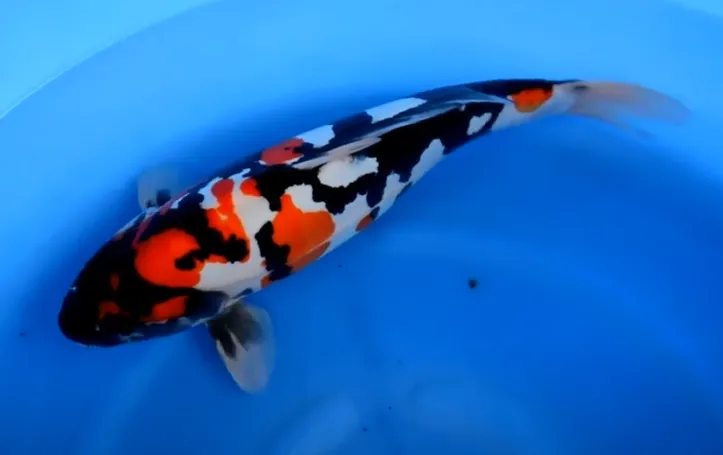
Koi fish price by grade — pond to championship
| Grade | Price range | Typical buyer | What you get |
|---|---|---|---|
| Pond / pet grade | $10 – $100 | Backyard pond owners | Healthy, attractive fish with no show aspirations; great for beginners |
| Select grade | $100 – $500 | Hobbyists | Better color and pattern; good body shape; no significant defects |
| High grade / import | $500 – $5,000 | Serious hobbyists | Japanese import quality; excellent color depth; near-show conformation |
| Competition grade | $5,000 – $30,000 | Competition koi keepers | Can place in regional shows; from reputable Japanese breeders; excellent lineage |
| Show / champion grade | $30,000 – $200,000 | Serious collectors | Can win major shows; elite bloodline; near-flawless color and body |
| World-class | $200,000 – $1,800,000+ | Wealthy international collectors | All Japan Koi Show contenders; generational bloodlines; living investment |

What makes a koi fish so expensive — 6 key factors
Understanding what drives koi prices requires thinking like a koi judge. At auction, every koi is evaluated on six primary criteria — and the world’s most expensive koi score near-perfectly on all six simultaneously.
-
Bloodline and breeder reputation
The single most important price driver. Koi from Sakai Fish Farm, Dainichi, Momotaro, and Marudo command premium prices because generations of expert selection have produced predictably superior offspring. A Kohaku from Sakai sells for 5–10x the price of an identical-looking fish from an unknown breeder — because the lineage guarantees future quality. I have seen this firsthand: two visually similar koi with very different bloodlines can differ in value by $50,000 or more at show level.
-
Body size
Larger koi are rarer and more valuable. Champion koi typically exceed 30 inches (75 cm). S Legend was 101 cm — exceptionally large even for a champion. As koi grow, their color patterns become more defined, their bodies more impressive, and their breeding potential greater. A 60 cm Kohaku can be worth 10x the same fish at 40 cm, with no other change in quality.
-
Color and pattern quality
Color must be intense, evenly distributed, and precisely demarcated. For Kohaku, the white (shiro) must be paper-white with no yellowing, and the red Hi must be deep, consistent, and sharply edged — not bleeding or fading. A single blemish on a $100,000 fish can drop its value to $20,000. Color quality can also change with water conditions, temperature, and diet — which is why the world’s best koi keepers obsess over water chemistry.
-
Skin quality (lustre)
Top koi have skin that catches light like fine porcelain — a quality the Japanese call “Tsuya” (lustre) or “Fukurin” (scale reticulation in Gosanke varieties). This luminous quality is partly genetic, partly environmental. It cannot be faked or developed after the fact — it is either there or it isn’t. A koi with exceptional lustre commands a significant premium over one with dull skin regardless of pattern.
-
Gender
Female koi are consistently more valuable than males at show level. Females grow larger, have broader, deeper bodies that display color patterns more impressively, and have better long-term color retention. Almost all of the world’s most expensive koi — including S Legend — are female. Male show koi typically sell for 30–50% less than equivalent females.
-
Competition history
Winning a major show — particularly the All Japan Koi Show or the ZNA All Japan Show — can multiply a koi’s value overnight. S Legend won the All Japan Koi Show in 2017, and that single win is estimated to have contributed hundreds of thousands of dollars to her eventual $1.8 million auction price. Competition history is independently verifiable and gives buyers confidence that experts have already validated the fish’s quality.
World’s top koi breeders and farms
| Breeder / farm | Location | Known for | Notable achievement |
|---|---|---|---|
| Sakai Fish Farm | Hiroshima | Kohaku; world-record auctions | Bred S Legend ($1.8M); multiple All Japan Show champions |
| Dainichi Koi Farm | Niigata | Kohaku, Sanke; exceptional skin quality | $1.1M Kohaku sale in 2025; decades of All Japan wins |
| Momotaro Koi Farm | Niigata | Showa, Kohaku; vibrant color | Multiple Grand Champion titles; US market favorite |
| Marudo Koi Farm | Niigata | Sanke, Showa; bold patterns | Consistent show placement across multiple varieties |
| Ogata Koi Farm | Niigata | Kohaku; delicate Hi patterns | Known for producing koi with exceptional white ground quality |
Niigata Prefecture — particularly Ojiya City — remains the global center of championship koi breeding, a tradition spanning over 200 years. The region’s cold, mineral-rich mountain water produces exceptional color depth and skin quality in koi raised there.

How to value your own koi fish
Whether you are buying, selling, or simply curious about what your pond fish are worth, these are the criteria every experienced koi evaluator uses:
How to spot a quality koi visually — quick checklist
Before spending serious money on any koi, apply this visual inspection checklist. These are the same criteria koi show judges use, simplified for buyers:
| What to check | Good sign ✅ | Red flag ⚠️ |
|---|---|---|
| White ground (shiro) | Paper-white, no yellowing or grey cast | Yellow tinge, cloudy appearance |
| Red Hi markings | Deep, even red with sharp clean edges | Fading at edges, uneven pigmentation |
| Skin lustre | Catches light like porcelain; luminous | Dull, matt appearance; no natural sheen |
| Body shape | Wide mid-section, torpedo shape, symmetrical | Bent spine, pinched tail, misshapen head |
| Eyes | Clear, bright, alert | Cloudy, sunken, or protruding |
| Fins | Fully intact, smooth edges, no splits | Split, frayed, clamped, or missing rays |
| Behavior | Alert, surfaces eagerly, active swimming | Lethargic, bottom-sitting, gasping |
| Scale condition | Flat, even, no missing or raised scales | Raised, missing, or discolored scales |
- Identify the variety: Kohaku, Sanke, Showa, Ogon, Asagi — each has a different price ceiling. A koi cannot exceed the show potential of its variety.
- Measure the fish: Length is a reliable proxy for age and development. A 50 cm Kohaku is worth substantially more than a 30 cm Kohaku of the same quality.
- Assess white ground (for two and three-color koi): Is it paper-white? Any yellowing, grey cast, or blemish significantly reduces value.
- Evaluate color intensity: Are the Hi markings deep and saturated? Do they fade at the edges? Fading Hi is a red flag at any grade.
- Check body conformation: Wide mid-section, torpedo shape, well-proportioned head and tail, no bent spine or asymmetry.
- Verify bloodline if possible: Purchase from a breeder who can provide the lineage — a koi from a documented bloodline is always worth more than one of unknown origin.
- Observe behavior: A healthy, alert koi that surfaces eagerly for food commands a premium. A lethargic or bottom-sitting fish is a risk, regardless of appearance.
From the pond keeper
In the Philippines, I have seen very good locally-bred koi that rival import quality in color and body — and sell for a fraction of the Japanese price because the bloodline documentation does not exist. If you are breeding koi seriously, document everything: parentage, spawn date, pond conditions, diet. This documentation adds real monetary value to your fish over time.

Are koi fish a good investment?
For most koi enthusiasts, the honest answer is: koi are a passion investment, not a financial one. The holding costs — pond infrastructure, filtration, quality food, veterinary care, water testing — are significant, and the market for high-quality koi is specialized and requires expertise to navigate.
However, at the championship level, the investment case is real:
- Breeding value: A champion female Kohaku can produce 100,000+ eggs per season. Even at 1% show-quality yield, that is 1,000 valuable fry per spawn — potentially worth $50,000–$500,000 combined from a single champion fish per year.
- Show wins compound value: A koi that wins the All Japan Show can double or triple in value overnight and continues to appreciate with each subsequent win.
- Global demand is rising: The international koi market has grown significantly, particularly in the US, UK, China, and Southeast Asia. Championship koi are being treated increasingly like art — as status symbols and genuine collectibles.
- The entry barrier: To invest in koi seriously, you need the facilities, expertise, and connections within the Japanese breeding industry. This is not a passive investment — it requires deep involvement in the koi world.
Frequently asked questions
What is the most expensive koi fish ever sold?
S Legend — a female Kohaku koi from Sakai Fish Farm, Hiroshima, Japan. She sold for $1.8 million (203 million yen) at auction in October 2018, setting the world record for the most expensive fish ever sold. She was 101 cm long, had won the All Japan Koi Show in 2017, and was purchased by collector Ms. Ying Ying Chung.
How much does a koi fish cost?
Koi range from $10–$100 for pond-grade fish, $100–$5,000 for quality hobby koi, $5,000–$200,000 for competition-grade specimens, and $200,000 to $1.8 million for world-class championship fish. Most backyard koi keepers spend $50–$500 per fish.
What type of koi is the most expensive?
Kohaku is consistently the most expensive variety at show level. The Gosanke group — Kohaku, Taisho Sanke, and Showa — produces the world’s highest-priced koi. Yamabuki Ogon and Tancho varieties also command exceptional premiums in their categories.
What makes koi fish so expensive?
Six factors: bloodline (elite breeders like Sakai, Dainichi, Momotaro), body size (larger = rarer = more valuable), color and pattern quality (intensity and precision of demarcation), skin lustre (the luminous quality called Tsuya), gender (females are always worth more), and show history (winning the All Japan Show multiplies value dramatically).
Who bought the most expensive koi?
Ms. Ying Ying Chung, a highly respected koi collector and enthusiast, purchased S Legend for $1.8 million at the Sakai Fish Farm auction in Hiroshima in October 2018. S Legend died in 2019, reportedly from complications after international transport.
How much is a champion koi worth in 2025–2026?
In 2025, high-grade Kohaku from Dainichi and Sakai fetch $75,000–$100,000 at international auctions. Elite Sanke sell for $50,000–$85,000. Jumbo Showa from famous bloodlines have crossed $90,000. A Dainichi Kohaku female sold for $1.1 million at a Japanese farm auction in 2025 — showing the market continues to reach extraordinary heights.
Are koi fish a good investment?
At championship level, yes — a winning female can produce hundreds of thousands in breeding revenue per season. For most hobbyists, koi are a passion investment: the joy, the beauty, and the cultural connection are the return. Financial investment requires deep expertise, proper facilities, and strong connections within the Japanese breeding industry.
Related koi fish guides
- 30 koi fish varieties — complete identification guide
- Koi fish meaning — complete symbolism guide
- How to breed koi fish — step-by-step guide
- Koi pond water quality — pH, ammonia and nitrate guide
- Koi food guide — best feeds for growth and color
- Goshiki koi — the five-color variety guide
- Why are koi fish so expensive?
- Koi fish worth — how to value your koi
Giovanni Carlo Bagayas
Founder, Giobel Koi Center · Koi keeper since the 1980s · Labangan, Zamboanga del Sur, Philippines
Giovanni has been keeping and breeding ornamental koi since the 1980s — over 40 years of hands-on valuation and breeding experience across hundreds of koi. He has personally evaluated fish across the full price spectrum from $10 pond koi to show-grade imports, and follows the global championship koi market closely. He founded Giobel Koi Center to share practical koi knowledge with enthusiasts worldwide.

Passionate about fish keeping since elementary school in the 1980s, Giovanni Carlo has dedicated countless hours to collecting and breeding a diverse array of ornamental freshwater fish. From vibrant guppies and majestic koi to striking bettas and classic goldfish, he continues to explore the fascinating world of aquatics, sharing knowledge and enthusiasm with fellow fish enthusiasts.