


Matsuba Koi: Complete Guide to Varieties, Care, Price & Identification
By Giovanni Carlo · Koi keeper & founder, Giobel Koi Center · Updated June 8, 2026


Quick Answer
Matsuba koi are single-colored metallic koi with a distinctive pinecone-like scale pattern — each scale has a dark center surrounded by a lighter edge, creating a striking net or reticulation effect across the body. The name means “pine needle” in Japanese. Main varieties include Gin Matsuba (silver), Aka Matsuba (red), Ki Matsuba (yellow), Orange Matsuba, and Doitsu Matsuba (scaleless). Hardy, peaceful, and visually dramatic in any pond.
In This Guide
- What Is a Matsuba Koi?
- The Pinecone Pattern: What to Look For
- All Matsuba Koi Varieties Explained
- How to Identify a High-Quality Matsuba
- Matsuba Koi Care Guide
- Pond Setup and Requirements
- Feeding and Diet
- Matsuba Koi Price Guide
- Where to Buy Matsuba Koi
- Best Pond Companions
- Frequently Asked Questions
What Is a Matsuba Koi?
Matsuba koi are a variety of Japanese ornamental carp belonging to the Hikari-Muji group — the single-colored metallic koi. What sets Matsuba apart from every other koi in this group is their extraordinary scale pattern: a dark, pinecone-like reticulation that covers the body from behind the head to the tail, giving each fish the appearance of being draped in a metallic net.
The word Matsuba (松葉) translates directly from Japanese as “pine needle” — a name that captures the appearance perfectly. Each scale has a dark center that bleeds outward toward the scale’s edges, which are lighter, creating a pattern that closely resembles the overlapping needles of a pine cone when viewed across the full body.
Matsuba koi are descended from the Asagi bloodline — one of the oldest and most respected koi lineages in Japan. Through generations of selective breeding, the Asagi’s blue-grey reticulation was reimagined on metallic, single-color bases to create the range of Matsuba varieties we recognize today. The Aka Matsuba, for example, was developed by crossing Hi Asagi with high-red Kohaku, combining the reticulation of one lineage with the intense color of the other.
Koi Keeper’s Note
I have kept Matsuba koi on my farm in Labangan for many years. Among all the metallic varieties, Gin Matsuba is the one that generates the most conversation from visitors — the silver base paired with black reticulation catches light in a way that makes the fish look almost three-dimensional as it moves. If you want one koi that will draw eyes in any pond, Gin Matsuba is hard to beat.
The Pinecone Pattern: What to Look For
The reticulation pattern is the defining quality marker for any Matsuba koi — it is what separates a high-value specimen from an ordinary metallic koi. Understanding what a good pattern looks like is essential before purchasing.
Here is what the ideal Matsuba reticulation looks like and how to assess it:
- Coverage: The pattern should begin just behind the head and extend consistently to the base of the tail. Gaps or patches with no reticulation reduce the quality significantly.
- Consistency: Each scale should show the same dark-center, lighter-edge structure. Uneven patterns where some scales are fully dark and others show little reticulation are considered a flaw.
- Definition: The boundary between the dark scale centers and the lighter metallic edges should be crisp — not blurry or washed out. Well-defined “pine needles” indicate strong genetics.
- Base color clarity: The metallic base (silver, red, yellow) should be clean and bright, with no muddy discoloration between scales. The contrast between base and reticulation should be vivid.
- Head: The head should be clear of the dark reticulation — a Matsuba’s head is typically the purest expression of the base color, without scale patterns crowding the face.
| Feature | High Quality ✅ | Poor Quality ❌ |
|---|---|---|
| Pattern coverage | Head to tail, no gaps | Patchy, inconsistent |
| Scale definition | Crisp, well-defined edges | Blurry, washed out |
| Base color | Bright, clean, metallic | Dull, muddy, faded |
| Head clarity | Clean, free of reticulation | Dark patches on head |
| Body shape | Deep, torpedo-shaped, symmetrical | Thin, curved spine, asymmetrical |
All Matsuba Koi Varieties Explained
The Matsuba family includes five main varieties, each sharing the defining pinecone reticulation but differing in base color, metallic quality, and rarity. Here is a complete breakdown:
Gin Matsuba — Metallic Silver

Gin Matsuba is widely considered the most striking of all Matsuba varieties. “Gin” means “silver” in Japanese, and the bright metallic silver base paired with sharp black reticulation creates a contrast that is unlike anything else in the koi world. In sunlight, a high-quality Gin Matsuba appears almost to shimmer — the metallic luster catches light differently as the fish changes angle, making it one of the most dynamic-looking varieties in any pond.
Gin Matsuba are also among the rarer Matsuba varieties, which contributes to their higher price point. When evaluating a Gin Matsuba, pay particular attention to the purity of the silver — any yellow or brown tinting in the base color reduces quality significantly.
Ki Matsuba — Bright Yellow

Ki Matsuba features a bright yellow base color with the classic black reticulation. “Ki” means “yellow” in Japanese. The yellow base gives Ki Matsuba a warm, almost golden appearance that is immediately visible across a pond — it is one of the most eye-catching varieties for outdoor pond display. The contrast between the saturated yellow and the black pattern is particularly vivid in natural light.
Quality Ki Matsuba should show a pure, evenly distributed yellow with no orange bleeding — if the yellow starts shifting toward orange or red, the fish is trending toward Aka Matsuba territory. The metallic sheen on a top-quality Ki Matsuba will give it a burnished, jewel-like quality.
Aka Matsuba — Deep Red

Aka Matsuba has a deep red or orange-red base color with the signature black reticulation. “Aka” means “red” in Japanese. This variety was developed through crossbreeding with high-red Kohaku and Hi Asagi lines, giving it exceptional depth of color. A well-developed Aka Matsuba has a rich, warm base that deepens as the fish matures — juvenile specimens often appear orange and darken to a true red over their first few years.
Aka Matsuba are popular with hobbyists who want the drama of the Matsuba pattern combined with the energetic, auspicious symbolism of red koi. They are also one of the more common Matsuba varieties, making them accessible at a wider range of price points.
Orange Matsuba

Orange Matsuba occupies the warm middle ground between Ki Matsuba (yellow) and Aka Matsuba (red). The base is a vibrant, warm orange with the standard black pinecone reticulation. Orange Matsuba are sometimes classified under Aka Matsuba by breeders, but dedicated Orange Matsuba specimens with a true, consistent orange base color are considered their own variety by many enthusiasts.
In pond environments, Orange Matsuba are highly visible and create striking contrast — the warm orange against the black pattern stands out in both clear water and against dark pond liners. They are a strong choice for hobbyists who want a bright, warm-toned Matsuba that isn’t as saturated as a full red.
Doitsu Matsuba — Scaleless Variety

Doitsu Matsuba is a scaleless or partially scaled version of any Matsuba variety. “Doitsu” refers to the German carp lineage introduced to Japan in the early 20th century, which carries a gene for reduced scaling. Doitsu Matsuba have either no scales at all or a single row of enlarged mirror scales along the dorsal and lateral lines.
The result is a dramatically different visual effect — the pinecone reticulation appears only where scales are present, creating a linear, architectural look rather than the all-over net pattern of scaled varieties. Doitsu Ki Matsuba (yellow, scaleless) is particularly sought after for its rarity — the combination of the Doitsu scaleless trait with the Ki yellow base is unusual, and high-quality specimens command premium prices.
| Variety | Base Color | Rarity | Best Feature |
|---|---|---|---|
| Gin Matsuba | Metallic silver/white | Rare | Most dramatic silver-black contrast |
| Ki Matsuba | Bright yellow | Uncommon | Vivid warm-tone pond display |
| Aka Matsuba | Deep red / orange-red | Common | Deepens beautifully with age |
| Orange Matsuba | Warm orange | Common | High pond visibility, warm tone |
| Doitsu Matsuba | Any (scaleless) | Rare (esp. Ki) | Unique linear pattern, smooth body |
How to Identify a High-Quality Matsuba Koi
Whether you are buying from a local dealer or a specialist koi farm, these are the specific things to look for when evaluating any Matsuba koi for purchase:
- Reticulation first. This is the Matsuba’s defining characteristic. Look for complete, even coverage with well-defined dark centers and lighter edges on every visible scale. Ask to see the fish from above — the pattern should be uniform from head to tail.
- Base color quality. The metallic base should be deep, clean, and consistent. Avoid fish with faded patches, color bleed between varieties (e.g., yellow turning red), or any brown or grey discoloration in the base.
- Body shape and size. A good Matsuba koi has a deep, torpedo-shaped body — wide at the shoulders and tapering smoothly to the tail. Thin fish, bent spines, or asymmetrical body shapes are red flags regardless of pattern quality.
- Fin condition. All fins should be intact, fully extended, and free of tears, spots, or clamped posture. Clamped fins indicate stress or disease.
- Behavior. A healthy Matsuba is active, curious, and swims at mid-depth. Fish hugging the bottom or surface, gasping, or showing erratic swimming are unwell.
- Head clarity. The head should be clean, with no dark reticulation crowding the face, no lesions, and clear, bright eyes.
Matsuba Koi Care Guide
Matsuba koi are considered a hardy variety, well-suited to intermediate hobbyists with established ponds. They share the same core care requirements as other Japanese koi — clean water, space, a quality diet, and regular monitoring — but their metallic scales can fade if water quality or nutrition is poor, making consistent care especially important for maintaining their best appearance.
| Parameter | Ideal Range | Notes |
|---|---|---|
| Water temperature | 59–77°F (15–25°C) | Growth slows below 50°F; reduce feeding under 10°C |
| pH | 7.0–8.5 | Avoid swings — stable pH is more important than exact value |
| Ammonia | 0 ppm | Any detectable ammonia is an emergency |
| Nitrite | 0 ppm | Toxic above 0.5 ppm; improve filtration |
| Nitrate | Below 40 ppm | Regular water changes keep nitrate low |
| Dissolved oxygen | Above 7 mg/L | Run aeration, especially in summer |
| Lifespan | 25–35 years | With good care; some reach 40+ years |
Pond Setup and Requirements
Matsuba koi are active swimmers that grow large — adults typically reach 24–30 inches. They need space to move, good filtration to handle their waste load, and depth to protect them from temperature extremes and predators.
- Minimum pond size: 1,000 gallons for a small group of Matsuba. For a proper collection of 5–9 fish, aim for 2,500–5,000 gallons. The more volume, the more stable the water chemistry — which directly benefits fish health and color.
- Depth: At least 3–4 feet (90–120 cm). Depth protects against predators (herons are the primary threat), provides temperature buffering in summer and winter, and gives fish space to swim at depth — which they prefer.
- Filtration: A quality biological filter rated for at least 1.5× your pond volume is essential. Matsuba produce significant waste and their metallic scales will dull in poor water. A combination of mechanical filtration (to remove solids) and biological filtration (to convert ammonia) is standard practice.
- Pond shape: Oval or kidney shapes are preferred — they avoid dead spots where waste accumulates in corners. Smooth internal surfaces are easier to clean.
- Water changes: 10–20% weekly is the baseline. In warmer months when feeding increases, more frequent changes help control nitrate.
For detailed pond building guidance, see: Koi Pond Philippines — Building Guide and Koi Pond Filter Guide.
Feeding Matsuba Koi: Diet and Schedule
A quality diet is especially important for Matsuba koi because their metallic color intensity is directly tied to nutrition. Poor diet leads to dull, faded scales and reduced reticulation contrast. Here is how to feed Matsuba effectively:
| Season / Temperature | Feed Type | Frequency |
|---|---|---|
| Summer (above 68°F / 20°C) | High-protein growth pellets | 2–4 times daily |
| Spring / Autumn (50–68°F / 10–20°C) | Wheat germ (easy to digest) | Once daily or less |
| Winter (below 50°F / 10°C) | Stop feeding entirely | None — fish enter torpor |
For enhancing and maintaining color, choose pellets that include spirulina and astaxanthin — these natural pigment sources intensify the red and orange tones in Aka and Orange Matsuba while supporting the overall metallic quality of all Matsuba varieties. Feed only what the fish consume within 5 minutes; remove any uneaten food promptly to avoid water quality issues.
For a full feeding guide see: Koi Fish Food — What to Feed and When.
Matsuba Koi Price Guide
Matsuba koi prices vary considerably based on variety, size, reticulation quality, and whether the fish comes from a hobby breeder or a dedicated Japanese koi farm. Here is what to expect across the market:
| Quality Tier | Size | Price Range (USD) | Where to Find |
|---|---|---|---|
| Juvenile / starter | 3–6 inches | $20–$80 | Local dealers, pet stores |
| Mid-grade | 8–14 inches | $80–$300 | Specialist koi retailers |
| High-grade | 14–20 inches | $300–$700 | Koi farms, importers |
| Premium / Japanese import | 20+ inches | $700–$2,000+ | Japanese breeders, specialist importers |
Among the varieties, Gin Matsuba and Doitsu Ki Matsuba consistently command the highest prices due to their rarity and the difficulty of producing exceptional specimens. Aka Matsuba and Orange Matsuba are more widely available and offer excellent value for hobbyists who want the Matsuba pattern without the premium price.
Key factors that raise price within any variety: exceptional reticulation definition, large size, Japanese bloodline certification, and competition-grade color intensity. Buying from established koi farms rather than general pet stores generally yields fish with better long-term color development.
Where to Buy Matsuba Koi
Finding quality Matsuba koi requires buying from the right sources. Here is what to look for and where to look:
- Specialist koi farms: The best source for quality Matsuba. Farms that specialize in koi (rather than general aquatic stores) will have a wider selection, better genetic quality, and staff who can answer questions about the fish’s history and care.
- Koi shows and auctions: Excellent opportunities to buy directly from breeders and see champion-grade specimens in person. You can evaluate reticulation quality directly rather than relying on photographs.
- Reputable online importers: For US and UK hobbyists, specialist importers who travel to Japan and hand-select fish offer access to Japanese-bred Matsuba that would otherwise be unavailable locally. Check for live arrival guarantees and quarantine protocols.
- What to avoid: General pet stores rarely stock quality Matsuba. Chain stores that sell koi as “assorted pond fish” are unlikely to have true, well-bred Matsuba specimens. The pattern quality will generally be poor and the fish may not develop properly.
Always quarantine new Matsuba koi for 2–4 weeks in a separate tank or quarantine pond before introducing them to your main pond. This protects your existing fish from any disease the new fish may be carrying, even if they appear healthy on arrival.
Best Pond Companions for Matsuba Koi
Matsuba koi have a calm, peaceful temperament and coexist well with virtually all other koi varieties. Their metallic scales create a beautiful visual contrast when paired with varieties of different body types and patterns. Here are the best pond companions:
| Companion Variety | Why It Works |
|---|---|
| Kohaku | Classic red-and-white creates vivid contrast against Matsuba’s metallic reticulation |
| Showa | Black, red, and white complement the Matsuba’s darker tones beautifully |
| Yamabuki Ogon | Solid gold metallic pairs naturally with Ki Matsuba — creates a warm, golden pond feel |
| Platinum Ogon | Pure white metallic makes Gin Matsuba’s pattern stand out even more dramatically |
| Chagoi | Calm, large fish that tames the whole pond — makes all fish easier to hand-feed |
| Asagi | Shares the reticulation ancestry — complementary patterning, mutual hardiness |
Related Reading on Giobel Koi Center
- Types of Koi Fish: Complete Visual Variety Guide
- Most Expensive Koi Fish in the World
- Koi Fish Lifespan: How Long Do Koi Live?
- Koi Fish Food: Complete Feeding Guide
- Koi Pond Filter: How to Choose and Set Up
- Deterring Herons from Your Koi Pond
- Platinum Ogon Koi: Complete Guide
- Yamabuki Ogon Koi: Complete Guide
Frequently Asked Questions
What is a Matsuba koi?
What are the main varieties of Matsuba koi?
How much does a Matsuba koi cost?
How big do Matsuba koi get?
Are Matsuba koi easy to care for?
What does ‘Matsuba’ mean in Japanese?
What is the difference between Gin Matsuba and Ki Matsuba?
What is a Doitsu Matsuba koi?

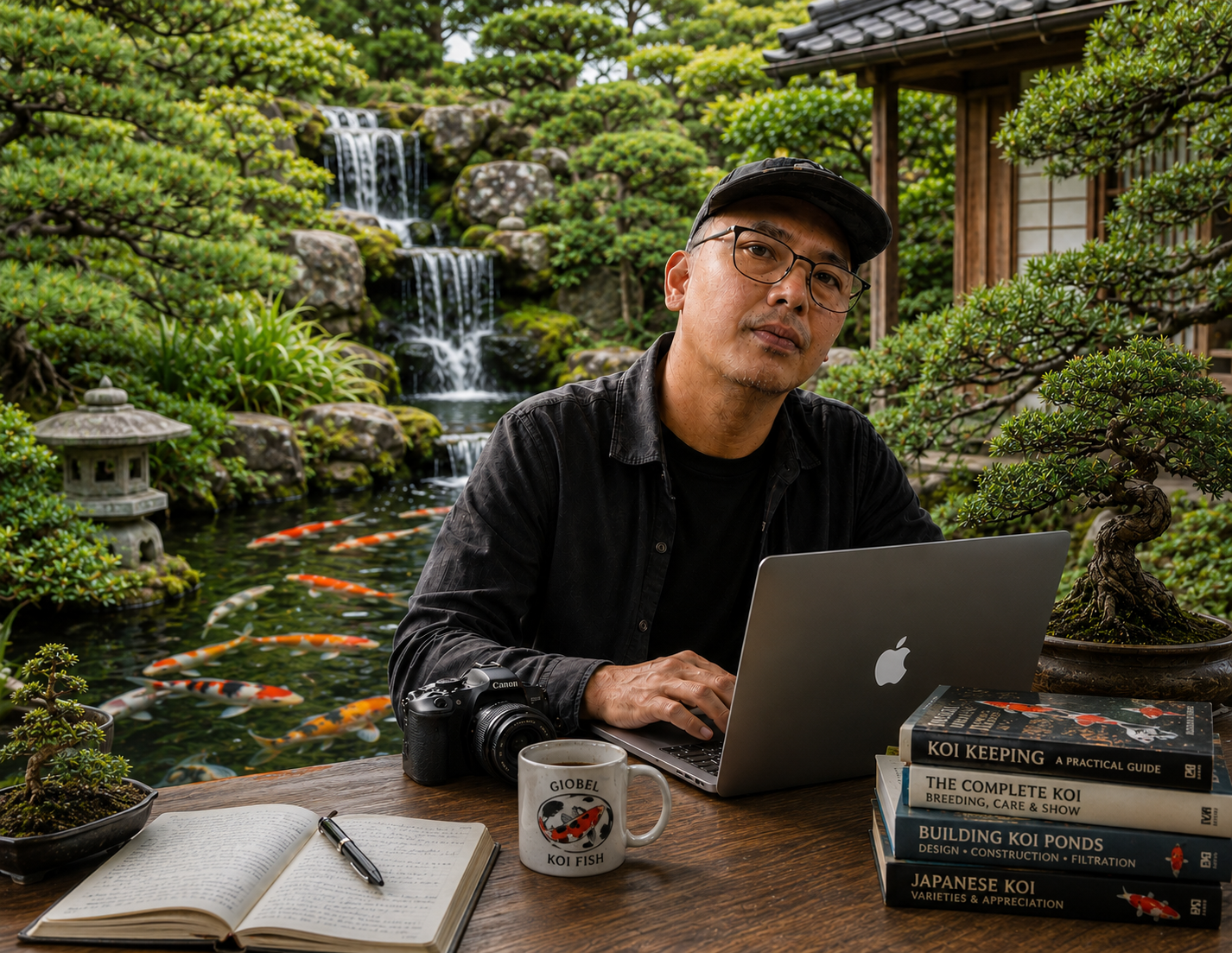
Giovanni Carlo
Koi keeper & founder, Giobel Koi Center · Labangan, Zamboanga del Sur
Giovanni has been keeping koi since the 1980s and runs one of the Philippines’ most widely read koi fish resources. He breeds and raises Japanese koi varieties — including several Matsuba lines — on his farm in Mindanao, and writes from decades of hands-on experience with pond management, koi varieties, and fish care.


Passionate about fish keeping since elementary school in the 1980s, Giovanni Carlo has dedicated countless hours to collecting and breeding a diverse array of ornamental freshwater fish. From vibrant guppies and majestic koi to striking bettas and classic goldfish, he continues to explore the fascinating world of aquatics, sharing knowledge and enthusiasm with fellow fish enthusiasts.