Quick Answer
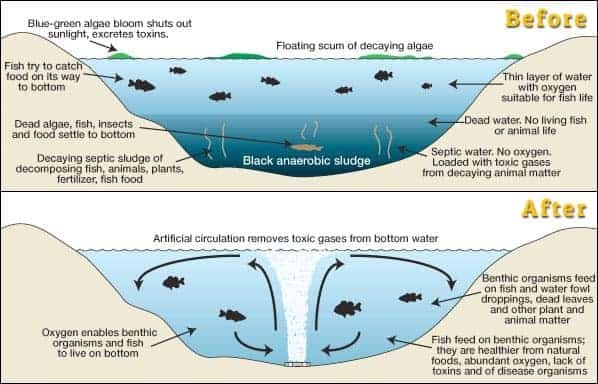
Koi need dissolved oxygen to breathe, and a pond without adequate aeration can run short of it fast — especially in summer heat, dense stocking, or algae overgrowth. Waterfalls, fountains, and dedicated air pumps with a diffuser stone are the three main ways to keep oxygen levels up, and a pump is the only one that also aerates the pond’s deeper water, not just the surface.
Why Koi Ponds Need Aeration
Koi need oxygen to breathe, just like any animal — aeration puts dissolved oxygen into the water so it can pass across their gills. Without enough of it, fish will struggle and, in serious cases, die. Oxygen depletes faster than most people expect: overstocking a small pond, an algae bloom, or a hot summer stretch (warm water holds less dissolved oxygen than cool water) can all push levels down quickly.
Waterfalls and Fountains
A koi pond waterfall isn’t just there for looks — the constantly moving, splashing water pulls oxygen from the air into the pond, doubling as a functional aerator. A fountain does something similar, agitating the surface. Both work well for shallower ponds, but there’s a real limitation: a fountain only draws and aerates water from near the surface, so if your pond is deeper than about 6 feet, the bottom layer stays largely untouched. That’s exactly where a dedicated air pump earns its place.
Air Pumps and Diffuser Stones

An air pump paired with a submerged diffuser stone releases a steady stream of fine bubbles from the bottom of the pond, oxygenating the entire water column rather than just the surface — this is the setup most keepers rely on for deeper ponds or heavily stocked koi populations. For a reliable electric option with a proven track record, the Hiblow HP-80 linear air pump is a commercial-grade unit designed for continuous, quiet operation and can handle ponds up to about half an acre.
If you don’t have easy access to an electrical outlet near your pond, a solar-powered setup is a practical alternative. The AEO Solar Powered Air Pump Kit includes a small solar panel and two air stones, and works well on smaller ponds (roughly up to 800 gallons) — it only runs while there’s sunlight, so it suits ponds that need daytime oxygen support rather than round-the-clock aeration. For continuous overnight coverage, look for a solar kit with a battery backup instead.
Calculate Your Pond Volume First
Every sizing recommendation below is based on gallons, so it’s worth knowing your pond’s actual volume before you buy anything. For a simple rectangular pond, multiply length × width × average depth (in feet), then multiply by 7.48 to convert cubic feet to gallons. For a round pond, multiply 3.14 × radius² × average depth (in feet), then multiply by 7.48. Irregular shapes are trickier to eyeball accurately, and average depth is easy to misjudge on a pond with sloped sides or varying deep spots.
Skip the manual math — use our Pond Volume Calculator to get an accurate gallon count for your specific pond shape, then use that number to size the aerator recommendations below.
Sizing Your Aeration System
A commonly used rule of thumb for larger ponds: aim to fully displace roughly one acre-foot (about 325,900 gallons) of water every 24 to 48 hours, using a minimum of about 1.5 HP of aeration per surface acre. For a typical backyard koi pond, a simpler starting point works better: roughly 1 to 2 liters of air per minute for every 1,000 gallons of pond volume, scaling up to 2 to 3 liters per minute per 1,000 gallons for heavily stocked ponds or hot climates. As a rough diffuser count, one diffuser per 2,000 gallons is a common baseline — a 6,000-gallon koi pond would typically run two to three diffusers spread across the pond rather than one large unit in a single spot.
Diffuser Placement and Common Mistakes
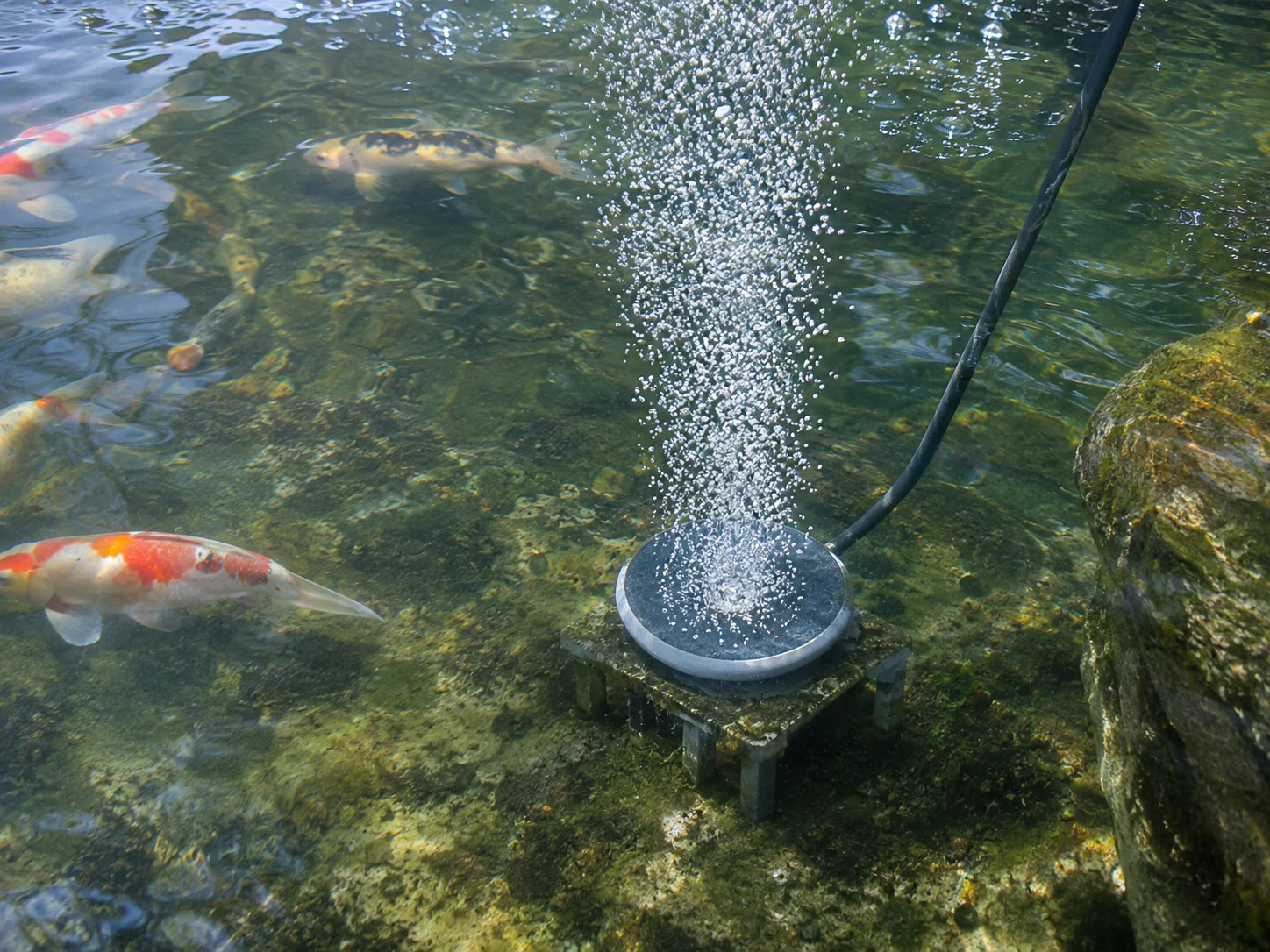
Where you put the diffuser matters almost as much as which pump you buy:
- Spread multiple diffusers across an irregular pond shape rather than running one unit — coves and corners away from a single diffuser can stay as unaerated dead zones otherwise.
- Elevate the diffuser slightly off the bare bottom (many detailed guides suggest around 12 inches, resting on a brick or small platform) — a diffuser sitting directly in bottom sediment can stir up muck and reduce clarity rather than improve it. Note this is genuinely debated among pond professionals, with some arguing bottom placement without elevation is fine; if your water gets cloudier after adding a diffuser, try elevating it slightly.
- Consider raising the diffuser in winter — several detailed koi-specific guides recommend moving deep-summer placement up to mid-depth in cold weather, since bottom placement can disrupt the slightly warmer thermal layer koi rely on for shelter during winter dormancy.
- Install a check valve between the pump and airline — without one, a power outage can let pond water siphon backward into the pump and ruin it. This is reportedly one of the most common causes of air pump failure.
- Match pump type to pond depth — standard diaphragm pumps work well down to roughly 6 to 8 feet; ponds deeper than that need a piston or rocking-piston compressor, since diaphragm pumps can’t push air against the water pressure at greater depths.
Signs Your Pond Needs More Aeration
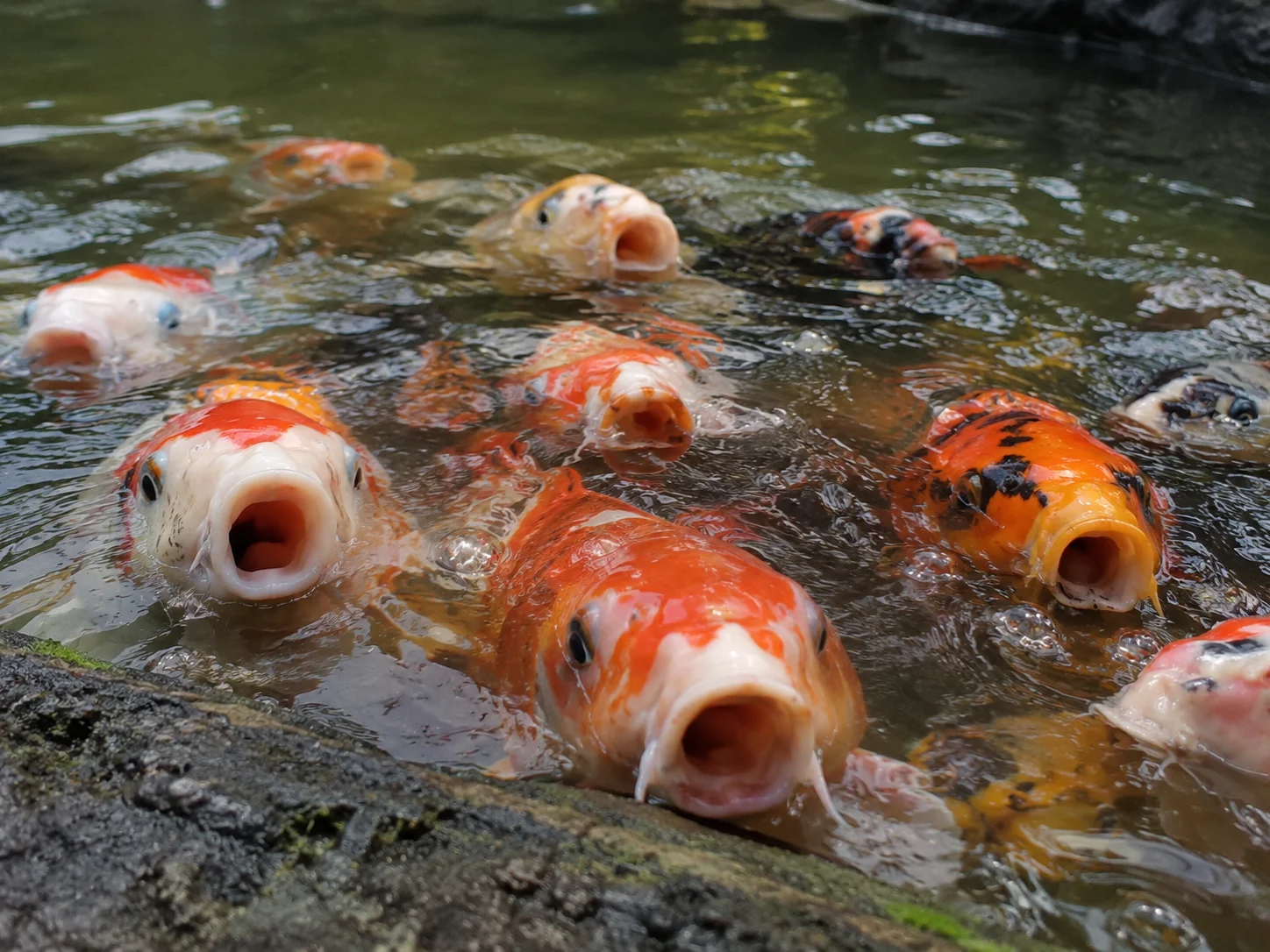
- Koi gulping at the surface — this usually means dissolved oxygen has dropped too low, and the fish are trying to get what oxygen they can from the air-water interface.
- Increasing muck at the pond bottom — a well-aerated pond breaks down debris naturally; a buildup of muck often signals insufficient bottom-water circulation.
- Fish clustering under a waterfall — if koi consistently gather right where the water enters, it’s often because that’s the highest-oxygen spot in the pond, suggesting the rest of it needs help.
Frequently Asked Questions
Do pond aerators really work?
Yes — a surface aerator or fountain draws pond water up and releases it back down, adding oxygen at the surface, while a subsurface diffuser continuously releases air bubbles from the pond bottom, aerating the deeper water a surface unit can’t reach.
Can you aerate a pond too much?

It’s uncommon, but technically possible to waste energy running more aeration than a pond needs. That said, err on the side of more rather than less if your pond is heavily stocked with koi — under-aeration is a far more frequent and more serious problem than over-aeration.
Should I run my pond aerator in the winter?
Yes — keep aeration running year-round. Fish still need dissolved oxygen in cold weather, and aeration also helps prevent full ice-over, which can trap harmful gases under the surface.
Do plants oxygenate a pond?
Yes, to a degree — submerged plants and microscopic algae (phytoplankton) release oxygen through photosynthesis during daylight. It’s a genuine contribution, but generally not enough on its own for a heavily stocked koi pond, which is why most keepers still add a fountain, waterfall, or air pump.
You may also like


Passionate about fish keeping since elementary school in the 1980s, Giovanni Carlo has dedicated countless hours to collecting and breeding a diverse array of ornamental freshwater fish. From vibrant guppies and majestic koi to striking bettas and classic goldfish, he continues to explore the fascinating world of aquatics, sharing knowledge and enthusiasm with fellow fish enthusiasts.