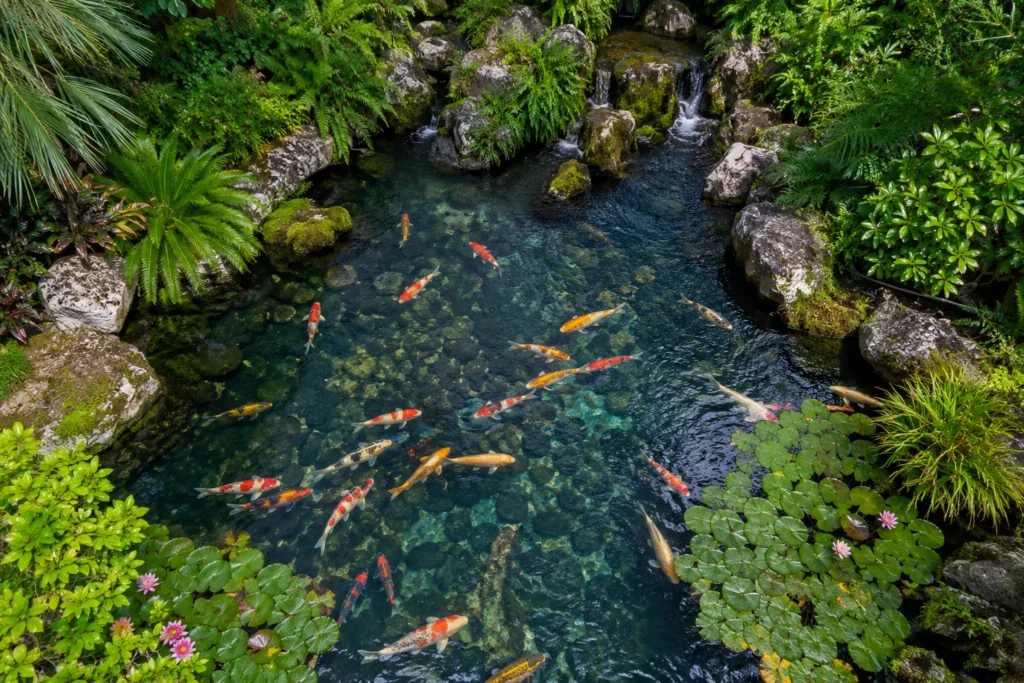
Knowing your pond’s water volume is the single most important number in koi keeping. Every decision you make — how many koi to stock, what size filter to buy, how much treatment to add, how often to do water changes — depends on it. Get it wrong and you’re either overcrowding your fish or wasting money on an oversized setup.
Use our free calculator below to find your pond volume in seconds. Just enter your pond’s length, width, and depth — we’ll do the rest.
🐟 Koi Pond Volume Calculator
Volume in liters
—
Main result
Volume in gallons
—
US gallons
Koi you can keep
—
At 500L per adult koi
Filter size needed
—
Liters per hour flow
Koi stocking guide — by pond volume
Why Pond Volume Matters for Koi
Most koi problems — poor water quality, sick fish, algae blooms, and stunted growth — trace back to one root cause: too many fish in too little water. Unlike garden fish like goldfish, koi are large, fast-growing, and produce a significant amount of waste. A koi that starts at 15cm can grow to 60–70cm within a few years, and its waste output grows with it.
Understanding your pond volume gives you the power to:
- Stock correctly — the right number of koi for your pond size means healthy fish and stable water chemistry
- Size your filter properly — an undersized filter is the number one cause of water quality problems in koi ponds
- Dose treatments accurately — pond treatments, salt, and medications are measured per volume; the wrong dose can harm or kill your fish
- Plan water changes effectively — knowing your volume tells you exactly how much new water you need to add and how often
- Monitor water chemistry — parameters like ammonia, nitrite, and pH all behave differently depending on the volume of water they're diluted in
How to Calculate Koi Pond Volume
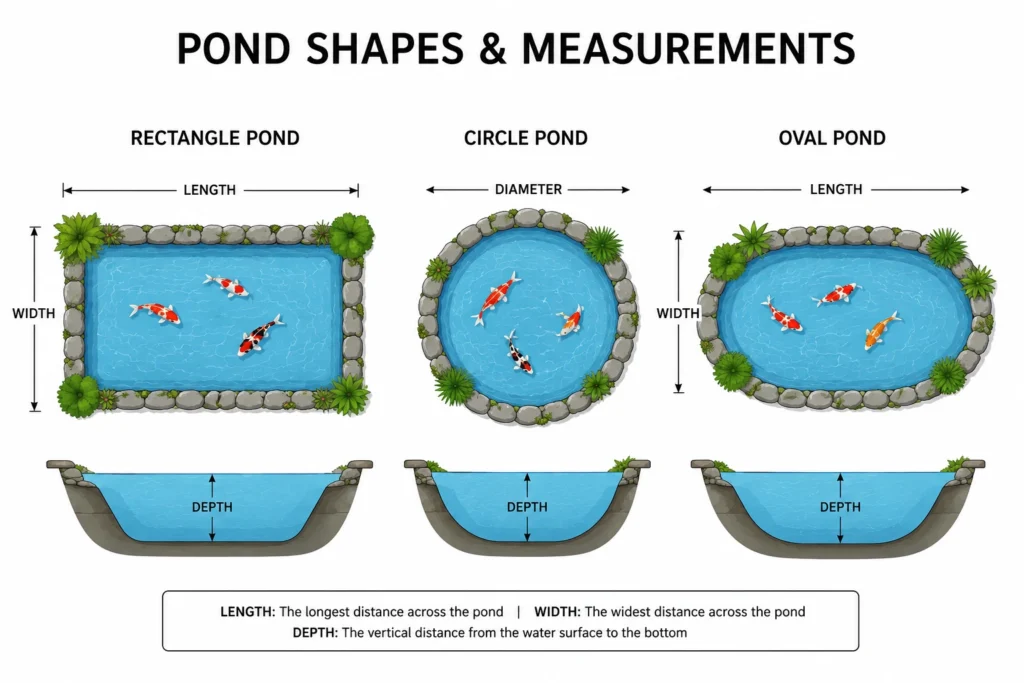
The formula depends on the shape of your pond. Here is how to calculate volume for each common pond shape:
Rectangular or Square Pond
This is the simplest calculation:
Volume (liters) = Length (cm) × Width (cm) × Depth (cm) ÷ 1,000
Example: A pond that is 300cm long × 150cm wide × 120cm deep = 300 × 150 × 120 ÷ 1,000 = 5,400 liters
In feet and gallons: Volume (gallons) = Length (ft) × Width (ft) × Depth (ft) × 7.48
Circular Pond
Volume (liters) = π × Radius² × Depth (cm) ÷ 1,000
Where radius = diameter ÷ 2, and π = 3.14159
Example: A circular pond with a 200cm diameter and 100cm depth Radius = 100cm = 3.14159 × 100² × 100 ÷ 1,000 = 3,142 liters
Oval Pond
Volume (liters) = π × (Long axis ÷ 2) × (Short axis ÷ 2) × Depth ÷ 1,000
Irregular Shaped Pond
For ponds with irregular shapes — kidney-shaped, free-form, or naturalistic designs — use the length and width of the longest and widest points, then multiply the result by 0.8 to account for the irregular edges.
Volume (liters) = Length × Width × Depth ÷ 1,000 × 0.8
This gives you a conservative estimate that is always better than overestimating your volume.
Koi Stocking Guide — How Many Koi Can Your Pond Hold?
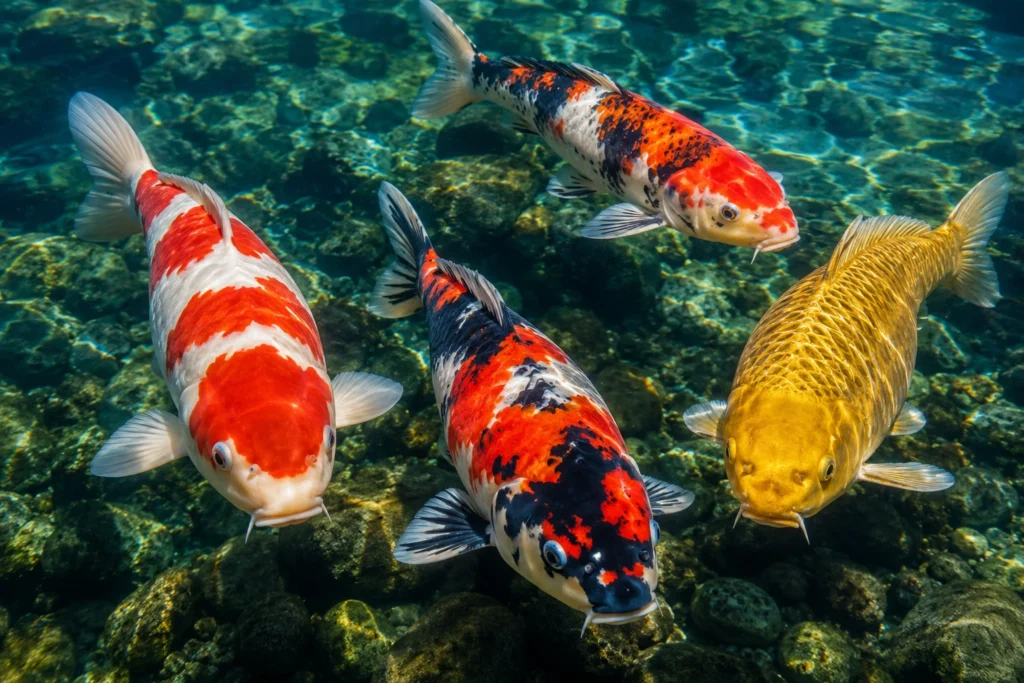
This is the question every koi keeper asks, and the honest answer is: it depends on your filtration as much as your volume. The general rule used by experienced koi keepers is:
500 liters (110 gallons) of water per adult koi
This assumes your filtration system is correctly sized and running efficiently. Here is a practical breakdown by pond size:
| Pond Volume | Adult Koi Capacity | Notes |
|---|---|---|
| Under 1,000L (220 gal) | Not recommended | Too small for koi — consider goldfish instead |
| 1,000–2,000L (220–440 gal) | 1–2 small koi | Requires diligent water testing and management |
| 2,000–5,000L (440–1,100 gal) | 4–10 adult koi | Good starter pond size |
| 5,000–10,000L (1,100–2,200 gal) | 10–20 adult koi | Excellent for a diverse koi collection |
| 10,000–20,000L (2,200–4,400 gal) | 20–40 adult koi | Semi-professional level; show grade koi possible |
| 20,000L+ (4,400+ gal) | 40+ adult koi | Professional or serious hobbyist pond |
Important: These numbers are for adult koi at full size (50–70cm). If you are stocking juvenile koi (15–20cm), you can start with more fish — but always plan for their adult size, not their current size. Koi grow quickly in a well-maintained pond.
The "Inch Per Gallon" Rule — and Why Koi Keepers Ignore It
You may have heard the aquarium rule of "one inch of fish per gallon of water." This rule does not apply to koi. Koi grow too large, produce too much waste, and need too much oxygen for this guideline to be meaningful. Always use the 500L per adult koi rule for pond planning.
How to Size Your Koi Pond Filter
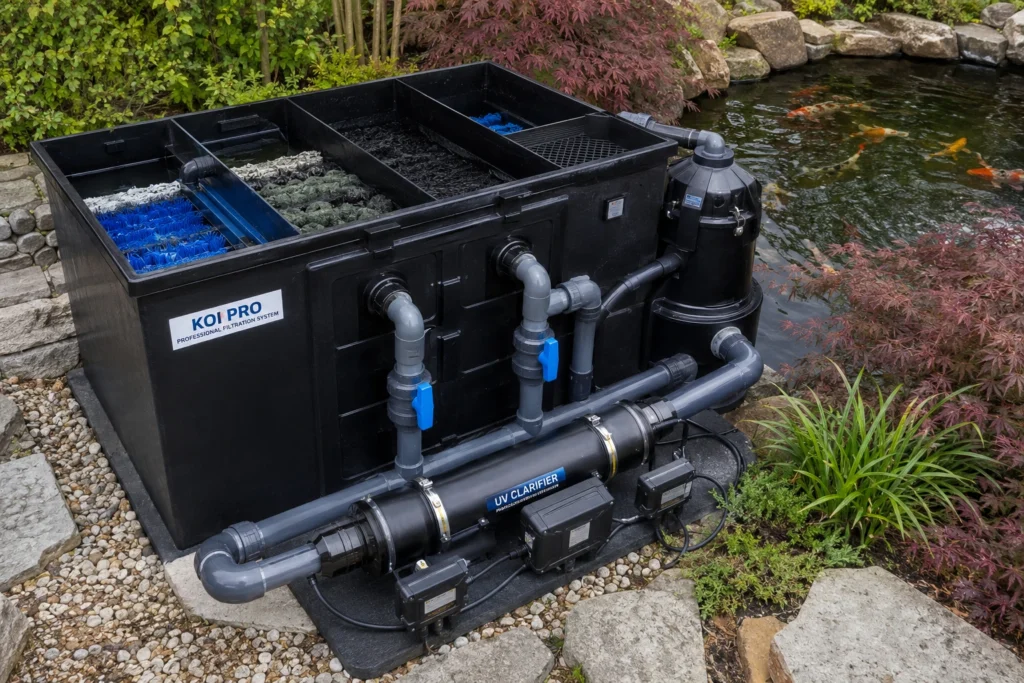
Your filter is just as important as your pond volume — in fact, experienced koi keepers say your filter is more important than the size of your pond. A large pond with poor filtration will have sicker fish than a smaller pond with an excellent filter.
The basic filter sizing rule: Your filter should be capable of turning over the entire pond volume at least once per hour — ideally 1.5 times per hour for koi ponds.
Filter flow rate (L/h) = Pond volume (L) × 1.5
Example: A 5,000L pond needs a filter with at least 7,500 liters per hour (L/h) flow rate.
Types of Koi Pond Filters
Pressurized filters are compact and easy to install, best for ponds up to 5,000L. They sit outside the pond and work under pressure, which allows them to be placed above or below the waterline.
Gravity-fed / flow-through filters are the preferred choice for serious koi keepers and larger ponds. They use multiple chambers — typically a settlement chamber, biological media chamber, and brush chamber — to provide superior mechanical and biological filtration.
UV clarifiers are not filters themselves but should be used alongside any filter system. UV light kills suspended algae and harmful bacteria, keeping the water crystal clear. Size your UV clarifier to match your pump flow rate.
Biological Filtration: The Most Important Part
The biological filter is home to the beneficial bacteria that convert toxic ammonia (from fish waste) into nitrite and then into the less harmful nitrate. These bacteria need time to establish — a process called cycling — which typically takes 4–8 weeks in a new pond.
Never rush the cycling process by adding too many fish too quickly. This is the single most common mistake new koi keepers make.
Water Volume and Water Quality
Once you know your pond volume, you can monitor and maintain water quality with precision. Here are the key parameters and how volume affects them:
Ammonia
Ammonia is produced continuously by fish waste and decaying organic matter. In smaller volumes, ammonia builds up faster and to more dangerous levels. The safe level for koi is 0 ppm — any detectable ammonia is harmful. Test weekly in new ponds and monthly in established ponds.
Nitrite
Nitrite is produced during the cycling process as bacteria convert ammonia. Like ammonia, even low levels are toxic to koi. Safe level: 0 ppm. During pond cycling, nitrite spikes are normal — do not add more fish until it returns to zero.
Nitrate
Nitrate is the end product of the nitrogen cycle and is far less toxic than ammonia or nitrite. However, high nitrate levels over time stress koi and suppress their immune system. Keep nitrate below 40 ppm through regular water changes.
pH
Koi thrive in a pH range of 7.0–8.5. Larger water volumes tend to be more pH-stable than smaller ones, which is another reason bigger ponds are easier to manage. Test pH weekly — sudden swings of more than 0.5 in 24 hours can cause pH shock in koi.
Dissolved Oxygen
Koi need well-oxygenated water, especially in warmer months when oxygen levels naturally drop. A good rule: add an air pump or waterfall if your pond volume is over 2,000L. In hot Philippine summers, low oxygen is one of the leading causes of koi stress and disease.
How Often Should You Do Water Changes?
Regular water changes are the foundation of koi pond health. They dilute nitrates, replenish minerals, and refresh the water that your filter cannot fully clean.
Recommended water change schedule by pond size:
| Pond Volume | Water Change | Frequency |
|---|---|---|
| Under 2,000L | 20–30% | Twice weekly |
| 2,000–5,000L | 10–20% | Once weekly |
| 5,000–10,000L | 10–15% | Every 1–2 weeks |
| 10,000L+ | 10% | Every 2–4 weeks |
Always dechlorinate tap water before adding it to your pond. In the Philippines, Metro Manila tap water contains chlorine and sometimes chloramines — use a quality dechlorinator and let new water reach pond temperature before adding it, especially during the cold months of December to February.
Pond Volume Conversion Reference
Use this quick reference table to convert between measurement units:
| To convert | Multiply by |
|---|---|
| Liters → US gallons | × 0.264 |
| US gallons → liters | × 3.785 |
| Liters → UK gallons | × 0.220 |
| UK gallons → liters | × 4.546 |
| Cubic meters → liters | × 1,000 |
| Cubic feet → liters | × 28.317 |
| Cubic feet → US gallons | × 7.481 |
Tips for Measuring an Existing Pond Accurately
If you have an irregularly shaped pond and aren't sure how to measure it accurately, here are practical tips:
Measure the average depth, not the maximum. Many ponds are deeper in the center than at the edges. Take depth measurements at five points (four corners and center) and average them. This gives you a much more accurate volume than using the deepest point alone.
For kidney or free-form shapes, divide the pond into rough rectangles and circles, calculate each section separately, then add them together. This is more accurate than trying to measure the whole shape at once.
Use a flow meter method for precise results. Fill your pond from empty using a hose with a known flow rate (most garden hoses flow at about 15–20 liters per minute). Time how long it takes to fill completely, then multiply: volume = flow rate × minutes. This is the most accurate method for irregular ponds.
Mark your measurements. Once you know your pond volume, write it down and keep it somewhere accessible — your phone notes, a waterproof label near the pond, or a pond keeping journal. You'll reference this number every time you add treatments, salt, or medications.
FAQ: Koi Pond Volume Calculator
How do I calculate the volume of my koi pond?
For a rectangular pond, multiply length × width × depth in centimeters, then divide by 1,000 to get liters. For a circular pond, use π × radius² × depth ÷ 1,000. For irregular shapes, measure the longest and widest points, calculate as a rectangle, then multiply by 0.8 to account for the irregular edges. Our calculator above handles all shapes automatically.
How many liters does a koi pond need?
The minimum recommended pond size for koi is 1,000 liters, but 2,000–5,000 liters is a much more practical and manageable size for beginners. Larger ponds are actually easier to maintain than smaller ones because the greater water volume creates a more stable environment that is more forgiving of mistakes.
How many koi can I keep per liter of water?
The standard rule is 500 liters of pond water per adult koi. This assumes good filtration. Some experienced keepers push to 300 liters per koi with exceptional filtration systems, but 500L per fish is the safe, practical guideline for most pond keepers.
What size filter do I need for my koi pond?
Your filter should turn over your entire pond volume at least once per hour — 1.5 times per hour is ideal for koi. Multiply your pond volume in liters by 1.5 to get the minimum filter flow rate you need in liters per hour (L/h). Never undersize your filter — it is better to have more filtration capacity than you think you need.
How deep should a koi pond be?
A minimum depth of 1 meter (100cm) is recommended for koi in the Philippines. Depth provides temperature stability — deep water stays cooler in summer and warmer in the cold season. For serious koi keeping, 1.5–2 meters is ideal. Deeper ponds also give koi more room to swim vertically and are less susceptible to predators like herons.
Can I keep koi in a 500-liter pond?
A 500-liter pond is too small for koi. At this volume, waste builds up too quickly, oxygen levels fluctuate dangerously, and there is not enough space for koi to grow and behave naturally. A 500-liter container is suitable for goldfish or small ornamental fish but not koi. The absolute minimum for even one koi is 1,000 liters, with 2,000 liters strongly recommended.
How much salt should I add to my koi pond?
The standard salt dose for koi ponds is 1–3 grams of non-iodized salt per liter of pond water. At the mild end (1g/L), salt helps koi produce their protective slime coat. At the treatment end (3g/L), it helps treat parasites and reduce nitrite toxicity. Always calculate your dose based on your exact pond volume — this is why knowing your pond's water volume is so important.
How do I convert my pond volume from liters to gallons?
To convert liters to US gallons, multiply by 0.264. To convert to UK gallons, multiply by 0.220. Our calculator above shows both automatically.
Ready to Stock Your Pond?
Now that you know your pond volume and how many koi it can support, browse our selection of high-quality koi available here at Giobel Koi Center. We breed and sell a wide range of varieties — from Gosanke (Kohaku, Sanke, Showa) to Chagoi, Butterfly Koi, and more — all raised right here in the Philippines.
Related Guides
- Types of Koi Fish: Complete Variety Guide →
- Best Koi Fish Food: Feeding Guide →
- Koi Fish Meaning & Symbolism →
- How Long Do Koi Fish Live? →
Published: [May 23, 2026] By Giovanni Carlo — koi fish specialist based in the Philippines, keeping and breeding koi since the 1980s.

Passionate about fish keeping since elementary school in the 1980s, Giovanni Carlo has dedicated countless hours to collecting and breeding a diverse array of ornamental freshwater fish. From vibrant guppies and majestic koi to striking bettas and classic goldfish, he continues to explore the fascinating world of aquatics, sharing knowledge and enthusiasm with fellow fish enthusiasts.