Indoor Koi Pond: Complete Setup Guide (Cost, Size & Tips)
By Giovanni Carlo · Koi keeper & founder, Giobel Koi Center · Updated June 9, 2026
Quick Answer
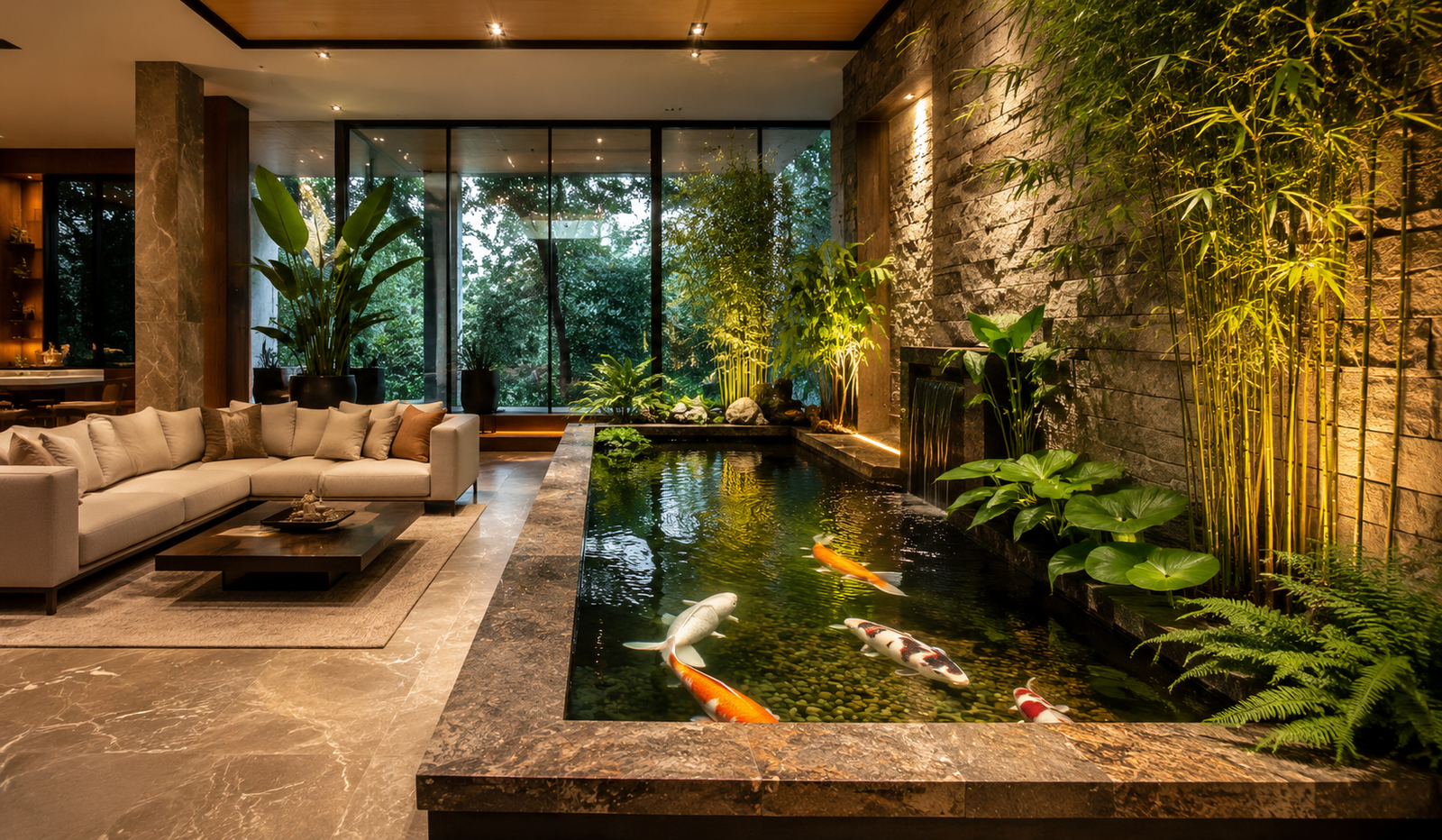
Yes — koi can thrive in indoor ponds with proper setup. The non-negotiables: 500 gallons minimum (1,000+ ideal), 3 feet deep, strong biological filtration, adequate lighting, and a dehumidifier to manage moisture. Before building, always check structural load capacity — a 1,000-gallon pond weighs over 4 tonnes. The biggest indoor koi pond mistakes are undersizing, inadequate filtration, and ignoring humidity.
In This Guide
- Is an Indoor Koi Pond Worth It?
- Structural Load — The Most Important First Step
- Size Guide: How Big Should an Indoor Koi Pond Be?
- Choosing the Right Location
- Indoor Pond Types: Which Build Method Is Best?
- Filtration: The Most Critical Component
- Lighting for Indoor Koi Ponds
- Humidity & Ventilation Management
- Temperature Control
- Step-by-Step Build Guide
- Best Koi Varieties for Indoor Ponds
- Cost Breakdown
- Maintenance Schedule
- 5 Common Indoor Koi Pond Mistakes
- Frequently Asked Questions
Is an Indoor Koi Pond Worth It?
An indoor koi pond is one of the most dramatic and rewarding home features you can create — but it is also one of the most demanding. Before committing to the project, it helps to go in with clear eyes about both the rewards and the realities.
Why people build indoor koi ponds
- Year-round koi keeping in cold climates
- No outdoor space available
- Extraordinary visual focal point in a home
- Protection from herons and predators
- Closer observation of fish — hand-feeding daily
- Therapeutic, calming presence in the home
The real challenges to prepare for
- Structural load — can weigh several tonnes
- Humidity damage to home fabric
- Higher maintenance than outdoor ponds
- Noise from pump and filtration
- Evaporation requires regular top-up
- Drainage needed for water changes
The honest assessment: an indoor koi pond is a wonderful project for someone who plans carefully, respects the structural and humidity requirements, and commits to regular maintenance. It is a problematic project for someone who underestimates the weight, installs inadequate filtration, or ignores humidity control. The difference between a stunning indoor pond and a costly disaster is almost entirely in the planning stage.
Structural Load — The Most Important First Step
This section is first for a reason: structural failure is the most catastrophic possible outcome of an indoor koi pond — and it is entirely preventable with proper planning.
Water weighs 8.34 lbs per US gallon (1 kg per litre). This means:
| Pond Volume | Water Weight | + Pond Structure | Total Approx. Load |
|---|---|---|---|
| 200 gallons | 1,668 lbs / 757 kg | +200–400 lbs | ~900–1,000 kg |
| 500 gallons | 4,170 lbs / 1,890 kg | +400–800 lbs | ~2,100–2,500 kg |
| 1,000 gallons | 8,340 lbs / 3,780 kg | +800–2,000 lbs | ~4,500–5,000 kg ⚠ |
| 2,000 gallons | 16,680 lbs / 7,560 kg | +1,500–4,000 lbs | ~9,000–10,000 kg ⚠⚠ |
Critical Safety Rule
Consult a structural engineer before placing any pond over 200 gallons on an upper floor, any suspended floor, or any building over 20 years old. Most residential floors are designed for 40–50 lbs per square foot of live load. A 500-gallon pond on a 10 sq ft footprint imposes 417 lbs per square foot — roughly 10× the design load. Ground floor concrete slabs can typically handle large ponds; suspended timber or composite floors often cannot without reinforcement.
Size Guide: How Big Should an Indoor Koi Pond Be?
The same sizing rules apply indoors as outdoors — but indoor ponds have additional constraints from room dimensions, structural load limits, and the difficulty of water changes at scale.
| Pond Size | Volume | Max Koi | Notes |
|---|---|---|---|
| Too small | Under 300 gal | 1 only | Water quality crashes fast — not recommended |
| Minimum viable | 300–600 gal | 2–3 small koi | Requires excellent filtration and frequent water changes |
| Recommended | 600–1,500 gal | 3–6 koi | Good balance of visual impact and manageability |
| Ideal ✦ | 1,500–3,000 gal | 6–12 koi | Stable water quality, genuine show-pond experience indoors |
Depth rule — same as outdoors: minimum 3 feet (90 cm), ideally 4 feet. Shallow indoor ponds are even more problematic than shallow outdoor ponds because you cannot rely on natural temperature buffering from soil depth. A shallow indoor pond overheats quickly in summer and has no buffer against temperature swings.
Free Tool
Calculate your pond volume before you build
Enter your planned length, width, and depth to instantly get volume, weight, stocking numbers, and filter sizing requirements.
Choosing the Right Location
Location is the second most critical planning decision after structural load. The ideal indoor pond location checks all of these boxes:
- Ground floor or basement — structural preference. Ground-level concrete slabs can support almost any practical pond size. Basements are ideal: cool, dark, and structurally solid. Upper floors require structural assessment and usually reinforcement for anything over 300 gallons.
- Near a window or glass door — for natural light. Koi benefit from some natural light for color development and natural circadian rhythms. A pond near a large south or east-facing window is ideal. North-facing windows provide insufficient light; full south-facing windows in summer may require shade to prevent overheating.
- Access to a drain. Indoor ponds require regular partial water changes — 20% weekly is standard. You need a floor drain, a sump pump outlet, or a hose run to a drain nearby. Carrying buckets of water from a large indoor pond is impractical and messy.
- GFCI electrical outlets within reach. All electrical connections near water must be GFCI (ground fault circuit interrupter) protected. Plan your pond position around existing GFCI outlets or factor in having new ones installed by a licensed electrician.
- Away from HVAC vents, boilers, and heat sources. Temperature stability is critical for koi — placing a pond near a heating vent or boiler creates hot spots and temperature swings.
- Not under water pipes. A burst pipe overhead can deposit chlorinated or treated water directly into your pond and kill your fish.
Indoor Pond Types: Which Build Method Is Best?
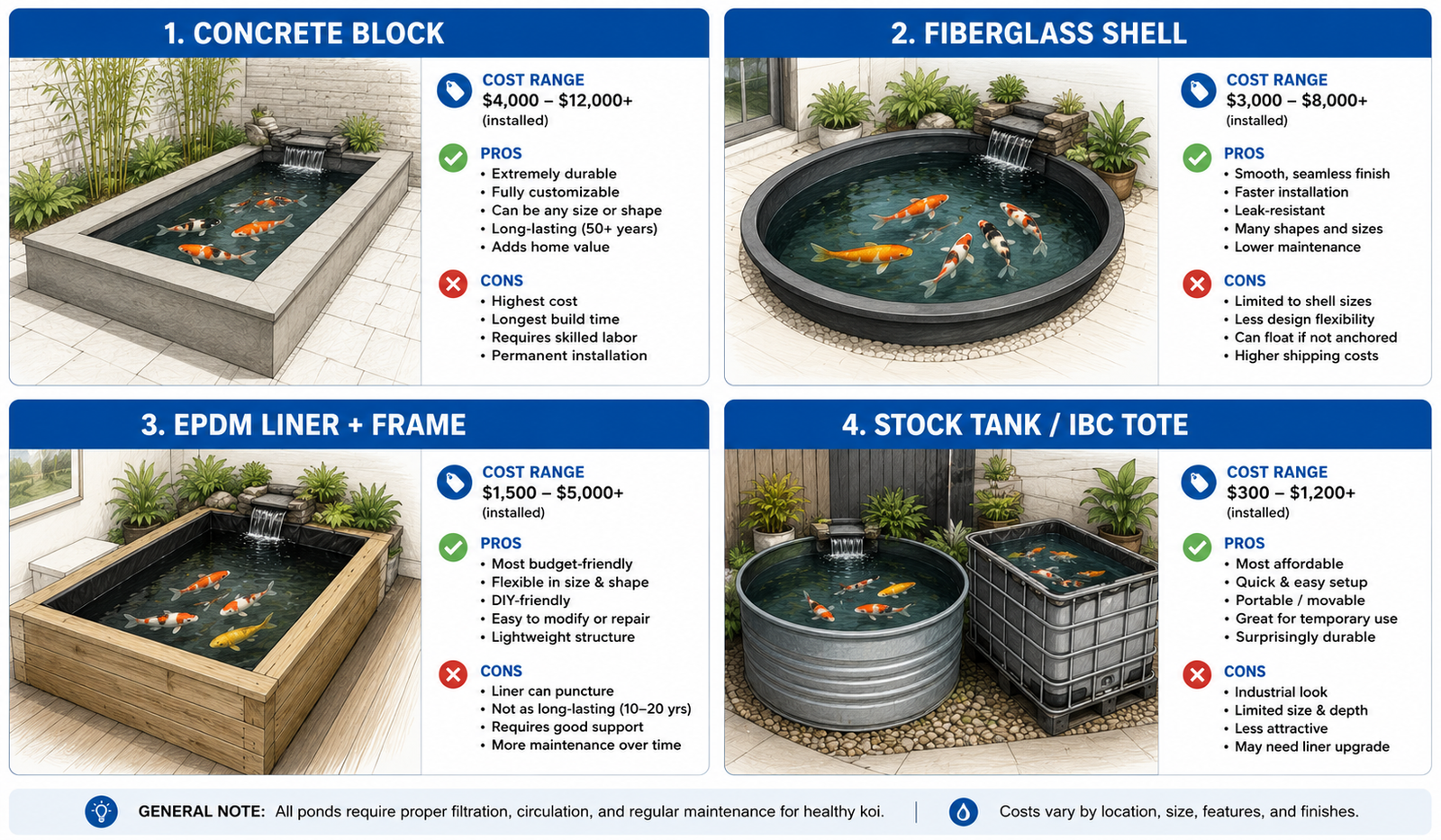
| Build Type | Pros | Cons | Cost Range | Best For |
|---|---|---|---|---|
| Concrete block + render | Permanent, any shape, durable | Heavy, messy build, long cure time | $2,000–$8,000 | Permanent installs, basements |
| Fiberglass shell | Smooth, clean, pre-formed sizes | Fixed shapes, can crack if unsupported | $1,500–$5,000 | Smaller volumes, clean aesthetic |
| EPDM liner + timber frame | Flexible, DIY-friendly, any shape | Liner can puncture, less permanent look | $800–$3,000 | DIY builds, budget-conscious |
| IBC tote / stock tank | Cheap, quick, portable | Industrial appearance, limited size | $200–$800 | Trial ponds, basements, utility spaces |
| In-floor concrete ✦ | Stunning, permanent, large volumes | Very expensive, requires specialist construction | $10,000–$50,000+ | Luxury homes, purpose-built rooms |
For most hobbyists building their first indoor koi pond, an EPDM liner on a timber or steel frame offers the best balance of flexibility, cost, and buildability. For a permanent feature in a home, concrete block with waterproof render is the most durable and visually versatile option.
Filtration: The Most Critical Component
Filtration is even more important for indoor ponds than outdoor ones. Outdoor ponds benefit from natural processes — rain diluting nitrates, wind oxygenating the surface, birds, insects, and plants contributing to the biological community. Indoor ponds have none of this. Everything depends on your filtration system.
| Component | Function | Sizing Rule |
|---|---|---|
| Biological filter | Converts ammonia → nitrite → nitrate via bacteria | Rated for 1.5–2× pond volume |
| Mechanical filter / drum filter | Removes solid waste before it breaks down | Flow rate matches pump output |
| Pump | Circulates water through filtration system | Turn over full volume every 1–2 hours |
| UV clarifier | Kills free-floating algae (green water) | Strongly recommended indoors |
| Bottom drain | Draws settled waste from pond floor | Essential for ponds over 500 gal |
| Aeration / air stones | Oxygenates water — critical indoors | Run continuously; position at deepest point |
The UV clarifier is especially important indoors. While it does not kill string algae, it eliminates the single-celled planktonic algae (green water) that develops rapidly in enclosed spaces with artificial or glass-filtered natural light. Without a UV clarifier, indoor ponds frequently turn into opaque green water within weeks.
For filter noise management — a significant consideration indoors — look for submersible pumps rated for quiet operation, and house the filter in a cabinet or enclosure to muffle the sound of water flow.
Lighting for Indoor Koi Ponds
Koi are not deep-sea fish — they evolved in ponds with natural sunlight, and light plays a real role in their health, color development, and behavioral patterns. Indoor ponds need to address this carefully.
Natural Light
A pond near a large window or glass door is the best scenario. South or east-facing windows provide the most usable natural light in the northern hemisphere. However, direct summer sun through south-facing glass can overheat a pond — use blinds or a shade cloth in summer to reduce heat load.
Artificial Lighting Options
| Light Type | Best For | Notes |
|---|---|---|
| Metal halide (HID) | Large ponds, serious setups | Replicates sunlight spectrum; promotes color; runs hot |
| Full-spectrum LED grow lights | Most indoor setups | Energy-efficient, cool-running, good color rendering |
| Underwater LED pond lights | Evening feature lighting | Dramatic evening effect; not a substitute for overhead light |
| Standard fluorescent / CFL | Budget option | Acceptable for fish health; poor color rendering |
Light schedule: Give koi 10–12 hours of light per day — mimicking natural daylight cycles. Use a timer. More than 14 hours of light stimulates excessive algae growth; less than 8 hours can suppress koi color development.
Humidity & Ventilation Management
Humidity is the indoor koi pond challenge that most beginners underestimate — and one of the most damaging if ignored. An open water surface continuously evaporates moisture into the surrounding air. In a sealed or poorly ventilated room, this creates persistently high humidity that causes:
- Condensation on walls, windows, and ceilings — leading to mold growth and structural damage
- Warping and swelling of timber floors, door frames, and furniture
- Corrosion of metal fixtures, fittings, and electronics
- Musty odors throughout adjacent rooms
- Health issues for people with respiratory sensitivities
Essential humidity management measures:
- Dehumidifier: Install a dehumidifier rated for at least 1.5× the room volume. Run it continuously during warm months when evaporation is highest. Target relative humidity: 50–60%.
- Ventilation: An exhaust fan or ventilation opening that draws moist air out of the pond room and exhausts it outside prevents moisture buildup. In rooms adjacent to living spaces, positive pressure ventilation keeps moist air from migrating into the rest of the house.
- Ceiling fan: Keeps air moving over the water surface — reduces static moisture buildup and helps regulate pond temperature.
- Waterproof finishes: Paint all walls and ceilings in the pond room with moisture-resistant paint. Use waterproof sealant around any joints, skirting boards, and windows.
- 6-inch freeboard: Maintain a minimum 6-inch gap between the water surface and the top of the pond walls — this reduces splash and aerosol generation significantly.
Temperature Control
Indoor environments typically stay within the acceptable koi temperature range (59–77°F / 15–25°C) naturally in a heated home, which is one advantage of indoor keeping — koi don’t experience the dramatic seasonal temperature swings of outdoor ponds.
| Scenario | Risk | Solution |
|---|---|---|
| Room below 50°F (10°C) in winter | Koi enter torpor, digestive problems | Aquatic heater or in-line heater |
| Room above 85°F (30°C) in summer | Oxygen depletion, heat stress, disease | Pond chiller, fans, shade glass |
| Sudden temperature swing (>5°F) | Immune stress, susceptibility to disease | Heater with thermostat, insulate pond walls |
| AC/heating vent directly above pond | Localised hot/cold spots at water surface | Redirect vent or move pond away |
Step-by-Step Indoor Koi Pond Build Guide
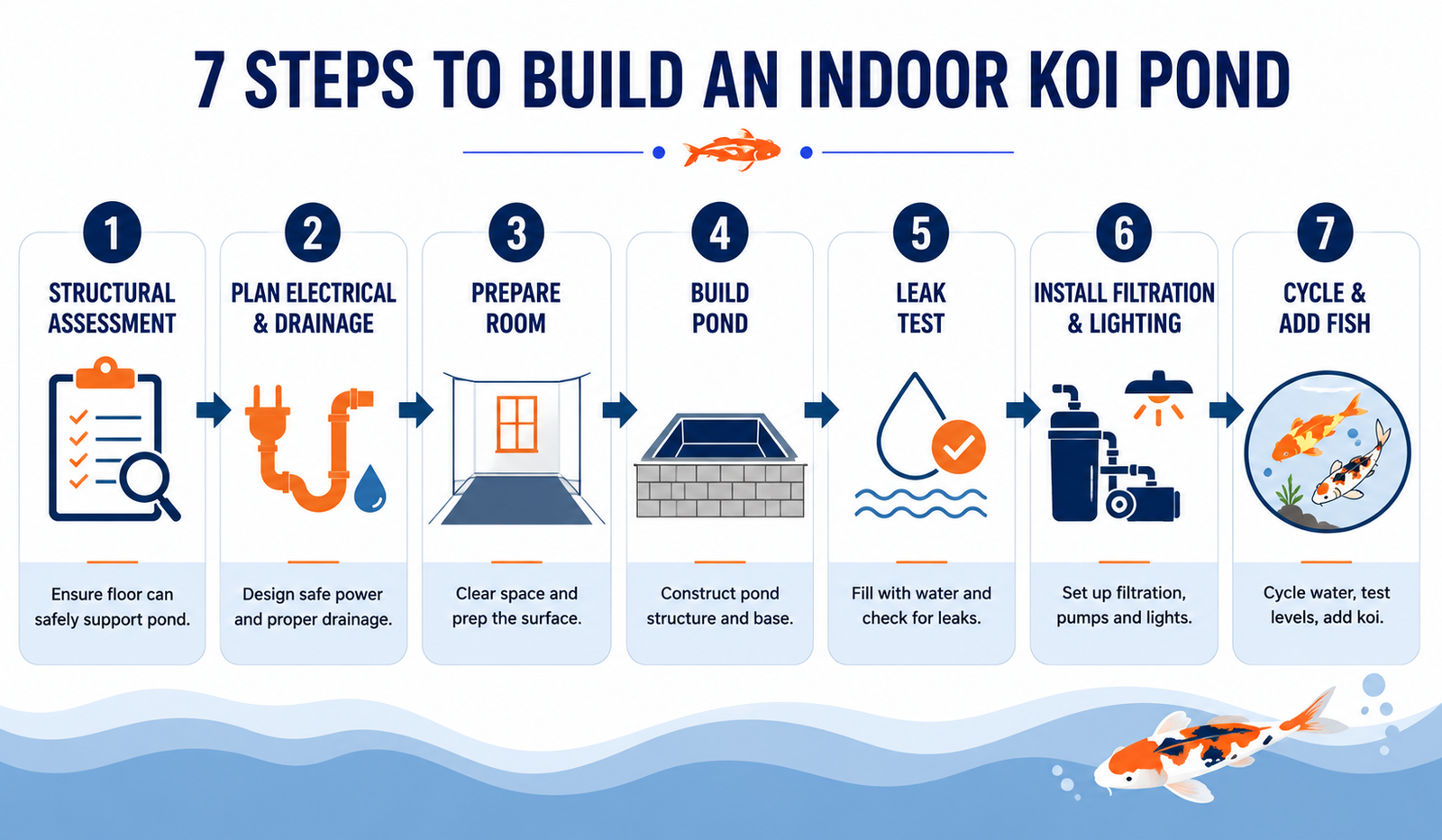
Structural assessment
Calculate the water weight for your planned volume. If placing on an upper floor or older building — consult a structural engineer before proceeding. For ground-floor concrete slabs, this step is usually a formality.
Plan electrical and drainage
Identify GFCI outlet positions. Plan drainage for water changes — a floor drain, sump pump, or dedicated hose run. Have a licensed electrician install any new circuits needed for pump, UV clarifier, grow lights, and dehumidifier. Use our free Pond Volume Calculator to confirm exact volume, weight, and filter sizing before ordering equipment.
Prepare the room
Apply moisture-resistant paint or membrane to walls and ceiling in the pond area. Waterproof the floor around the pond perimeter. Install ventilation or exhaust fan before the pond is filled.
Build the pond vessel
Construct your chosen pond type. For concrete: build block walls, render with waterproof render, allow 28 days full cure before filling. For EPDM liner: build the frame, lay underlayment, then liner — leaving generous overlap at the top. For stock tank: position and level on a solid base.
Leak test before finishing
Fill the pond with plain water and wait 48 hours. Check every joint, the base, and the walls for any seeping or dampness. Fix any leaks before adding filtration equipment or finishing the surrounding area. This step is critical — far easier to repair an empty pond than a filled and landscaped one.
Install filtration, pump, UV, and lighting
Install the biological filter, mechanical filter, pump, UV clarifier, aeration, and grow lights. Run all equipment and check for correct flow rates and water circulation. The water should complete one full circuit through all filtration every 1–2 hours.
Dechlorinate and cycle the pond
Add dechlorinator for the full pond volume. Add a quality beneficial bacteria starter. Run the system with no fish for 4–6 weeks. Test ammonia, nitrite, and nitrate every few days. The pond is ready for fish when ammonia and nitrite consistently read 0 ppm with nitrate beginning to accumulate.
Introduce koi gradually
Float transport bags in the pond for 20–30 minutes before releasing fish. Start with 2–3 koi maximum. Monitor daily for the first 2 weeks — test water every 2 days. Add additional fish only after confirming stable water parameters over at least 2 weeks.
Best Koi Varieties for Indoor Ponds
Not all koi varieties are equally suited to indoor ponds. In general, choose smaller-growing varieties with high visual impact per inch of body length — the varieties that look extraordinary even at 12–18 inches rather than needing to be 30 inches long to make an impression.
| Variety | Why It Works Indoors | Indoor Rating |
|---|---|---|
| Butterfly Koi ✦ Best | Flowing fins create extraordinary visual impact at small size; dramatic under artificial lighting | Excellent |
| Platinum Ogon | White metallic sheen reflects artificial light beautifully; highly visible in clear water | Excellent |
| Yamabuki Ogon | Golden metallic color glows under grow lights; highly visible from all angles | Excellent |
| Kohaku | Classic red and white pattern is highly visible; works at all sizes | Very good |
| Showa / Shiro Utsuri | Bold black patterns visible from above through glass-topped viewing ponds | Very good |
| Kikokuryu / Beni Kikokuryu | Metallic sheen + black patterns + dramatic color shifting — stunning under artificial light | Excellent |
| Chagoi / Karashigoi ⚠ | Grow very large — can outgrow all but the largest indoor ponds quickly | Poor for small ponds |
Indoor Koi Pond Cost Breakdown
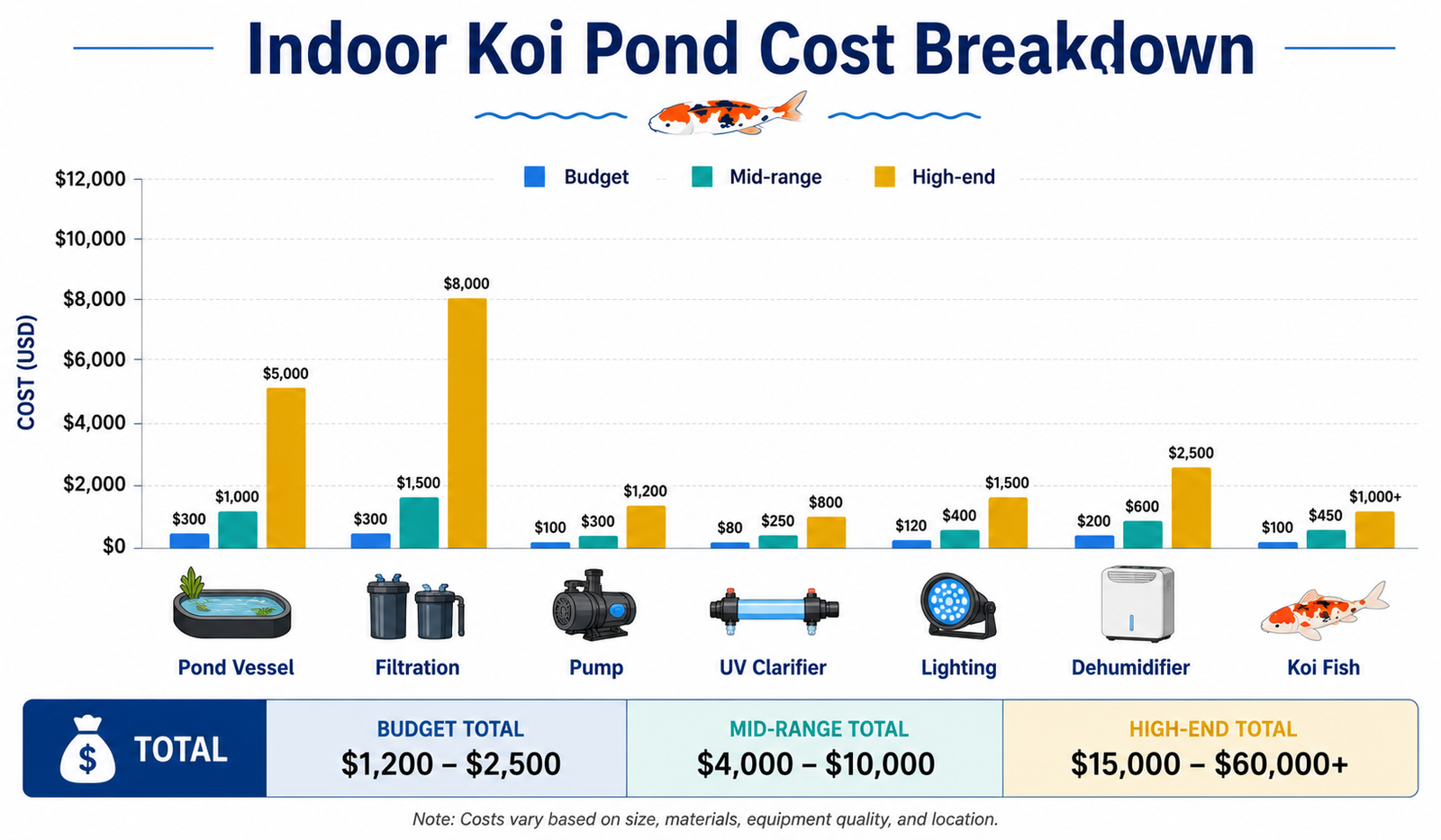
| Component | Budget Setup | Mid-Range | High-End |
|---|---|---|---|
| Pond vessel | $300–$800 (stock tank / IBC) | $1,500–$4,000 (liner build / fiberglass) | $5,000–$30,000 (concrete / in-floor) |
| Filtration system | $300–$600 | $800–$2,000 | $2,000–$6,000+ |
| Pump | $80–$200 | $200–$500 | $500–$1,500 |
| UV clarifier | $60–$120 | $120–$300 | $300–$800 |
| Lighting | $50–$150 (LED grow lights) | $200–$600 | $600–$2,000 (metal halide) |
| Dehumidifier | $150–$300 | $300–$600 | $600–$1,500 |
| Electrical / plumbing | $200–$400 | $500–$1,500 | $1,500–$5,000 |
| Koi fish (3–6 fish) | $100–$300 | $300–$1,000 | $1,000–$10,000+ |
| Total estimate | $1,200–$2,500 | $4,000–$10,000 | $15,000–$60,000+ |
Ongoing monthly costs: electricity ($50–$200/month for pump + lighting + dehumidifier), water (top-up and changes), food ($20–$60/month), water treatments and test kits ($20–$40/month).
Indoor Koi Pond Maintenance Schedule
| Frequency | Task |
|---|---|
| Daily | Feed fish (5-minute rule). Observe koi behavior for health signs. Check dehumidifier and empty water reservoir. Top up evaporation loss with dechlorinated water. |
| Weekly | 20% water change with dechlorinated water. Test ammonia, nitrite, nitrate, and pH. Clean mechanical filter media. Check UV clarifier output. |
| Monthly | Clean biological filter media gently (rinse in pond water — never tap water). Inspect all electrical connections. Check pump impeller for blockage. Inspect pond walls for algae or biofilm buildup. |
| Quarterly / Annually | Replace UV clarifier bulb (typically annually). Deep clean filter chambers. Inspect pond liner or walls for any cracks or seepage. Review and adjust stocking levels as fish grow. |
5 Common Indoor Koi Pond Mistakes
1. Ignoring structural load
The most dangerous mistake. Always calculate the total weight before committing to a size and location. A floor collapse is catastrophic and expensive. Never place a large pond on a suspended floor without structural assessment.
2. No humidity management
Installing an indoor pond without a dehumidifier and ventilation is the second most common serious error. The moisture damage to walls, flooring, and furniture begins within weeks and can cost thousands to repair.
3. Undersized filtration
Indoor ponds have no natural buffering — they depend 100% on filtration. A filter rated for half your pond volume will chronically struggle. Always overspecify filtration indoors.
4. Adding fish before cycling is complete
New pond syndrome — ammonia spike killing newly introduced koi — is extremely common in indoor ponds where impatient builders add fish before the nitrogen cycle is established. Wait the full 4–6 weeks and confirm with water testing.
5. Not planning for drainage
Regular water changes are essential for indoor koi health. Discovering that you have nowhere to drain the water after the pond is built leads to carrying buckets — a labor-intensive, messy, and demotivating process that results in water changes being skipped. Plan drainage before you build.
Related Reading on Giobel Koi Center
- Koi Pond Volume Calculator — Free Tool
- Koi Pond Design Ideas: 12 Styles for Every Budget
- Koi Pond Filter: How to Choose and Set Up
- How to Get Rid of String Algae in a Koi Pond
- Butterfly Koi: Complete Guide — Best for Indoor Ponds
- Koi Fish Food: Complete Feeding Guide
- Bloated Koi Fish: Causes, Diagnosis & Treatment
- Deterring Herons from Your Koi Pond
Frequently Asked Questions
Can you keep koi fish in an indoor pond?
How big should an indoor koi pond be?
What are the biggest challenges of an indoor koi pond?
What koi are best for indoor ponds?
How much does an indoor koi pond cost?
Do indoor koi ponds need a heater?
How often do you need to change water in an indoor koi pond?
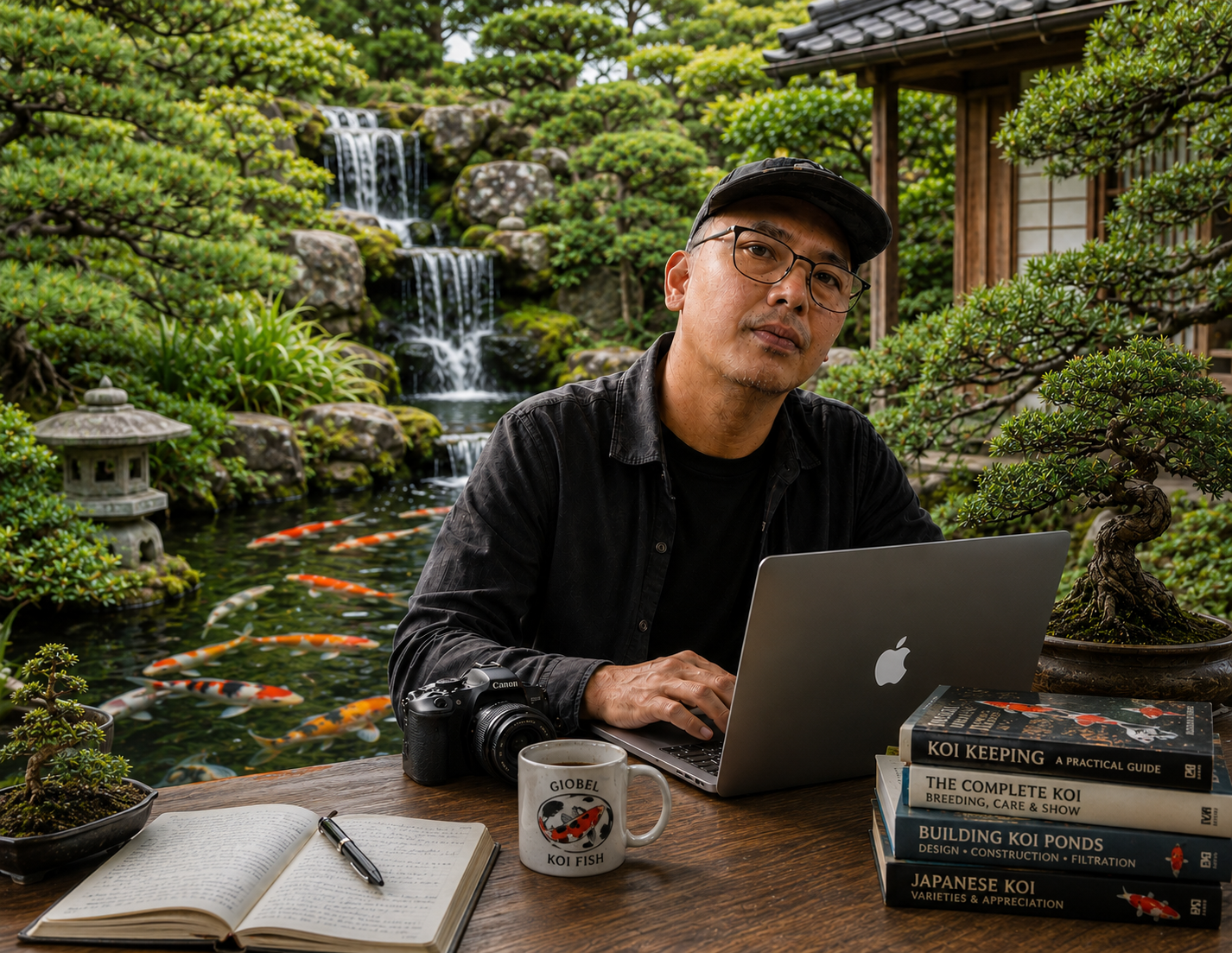
Giovanni Carlo
Koi keeper & founder, Giobel Koi Center · Labangan, Zamboanga del Sur
Giovanni has been keeping and building koi ponds since the 1980s on his farm in Mindanao. He has designed and maintained both outdoor and indoor koi setups across a range of sizes and budgets, and writes from decades of hands-on experience with pond construction, filtration, and koi husbandry.

Passionate about fish keeping since elementary school in the 1980s, Giovanni Carlo has dedicated countless hours to collecting and breeding a diverse array of ornamental freshwater fish. From vibrant guppies and majestic koi to striking bettas and classic goldfish, he continues to explore the fascinating world of aquatics, sharing knowledge and enthusiasm with fellow fish enthusiasts.