Benigoi Koi: Complete Guide to the Deep Red Koi Fish
By Giovanni Carlo · Koi keeper & founder, Giobel Koi Center · Updated June 9, 2026

Quick Answer
Benigoi (緋鯉, “scarlet carp”) are single-colored, non-metallic red koi from the Kawarimono group — prized for the purity, depth, and uniformity of their crimson coloration. No patterns. No markings. Just the most intense red in the koi world. They are hardy, beginner-friendly, highly visible in ponds, and one of the original koi varieties. Quality is judged almost entirely on color depth and consistency.
In This Guide
- What Is a Benigoi Koi?
- Benigoi vs Aka Muji — The Key Difference
- Benigoi Color Range: From Pink-Red to Deep Crimson
- How to Identify High-Quality Benigoi
- History & Classification
- Symbolism: What Red Means in Japanese Culture
- Benigoi Care Guide
- How to Maintain Deep Red Color
- Size & Growth
- Best Pond Companions
- Buying Guide
- Frequently Asked Questions
What Is a Benigoi Koi?
Benigoi (緋鯉) is one of the most visually striking koi varieties in the hobby — not because of pattern complexity or multiple colors, but precisely because of the opposite: a single, pure, intensely saturated red that covers the entire fish from nose to tail without interruption.
The name breaks down simply: Beni (緋) means crimson or scarlet — a vivid, deep red — and goi is a colloquial contraction of koi (鯉), carp. Benigoi means scarlet carp. It belongs to the Kawarimono classification group — the “different” category for non-metallic, non-patterned koi that don’t fit the standard variety groups — specifically within the Higoi (red koi) sub-group.
What makes Benigoi extraordinary is the purity of their presentation. In a pond of patterned koi, a quality Benigoi stands out not by competing with the color complexity of its neighbors but by offering something those fish cannot: a single uninterrupted statement of color that is both visually restful and intensely vivid simultaneously.
Classification at a Glance
Benigoi vs Aka Muji — The Key Difference
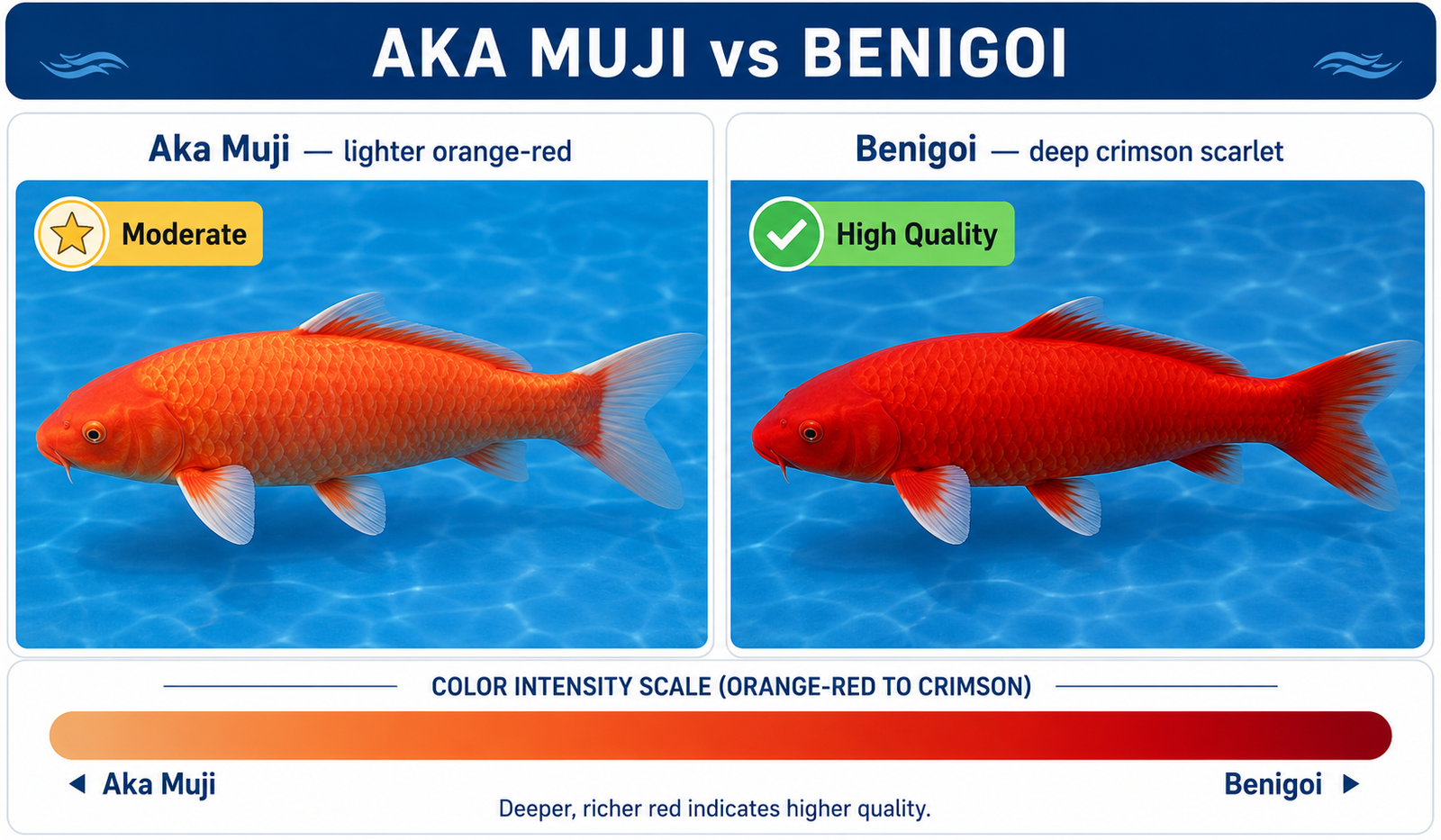
The most common point of confusion for hobbyists encountering solid red koi is the relationship between Benigoi and Aka Muji. The two terms are frequently used interchangeably by sellers and even by some breeders — but strict koi evaluation distinguishes them by color depth and saturation.
| Feature | Benigoi | Aka Muji |
|---|---|---|
| Color depth | Deep, rich crimson — the most saturated red | Lighter red to orange-red |
| Name meaning | Scarlet / crimson carp | Red plain (Aka = red, Muji = plain/solid) |
| Tone | Cool-leaning deep red — approaches lacquer | Warm red — closer to orange |
| Value / prestige | Higher — deeper color is more valued | Lower — considered less refined |
| Use in competition | Entered as Benigoi in Kawarimono class | Sometimes entered as Aka Muji / Benigoi |
The practical takeaway: if a seller offers you “Aka Muji,” ask to see the color in natural light. If the fish is a pale, washed-out, or orange-leaning red, it is Aka Muji at best. A rich, deep, saturated crimson approaching the color of a ripe pomegranate or fresh lacquer — that is a quality Benigoi.
Benigoi Color Range: From Pink-Red to Deep Crimson
Benigoi are not a single shade of red — the color varies considerably between individual fish, bloodlines, age, diet, and water conditions. Understanding this spectrum helps when selecting and evaluating fish:
| Color Grade | Description | Quality | Cause |
|---|---|---|---|
| Pale pink-red | Washed-out, faint, almost salmon | Poor | Poor diet, young fish, color fading |
| Orange-red | Warm, bright — trending orange | Moderate (Aka Muji territory) | Genetics, carotenoid-dominant diet |
| Vivid red | Strong, clear red — neither orange nor purple | Good | Quality genetics + color-enhancing diet |
| Deep crimson ✦ Best | Rich, saturated, almost lacquer-like | Excellent | Premium bloodlines + optimal husbandry |
The ideal Benigoi color is often described by Japanese breeders as beni — a specific deep red that references the traditional Japanese red used in lacquerware and shrine architecture. This color has a slightly cool, darker quality rather than the bright orange-warmth of lesser specimens.
How to Identify High-Quality Benigoi
Unlike Go-Sanke varieties where pattern evaluation requires years of trained eye development, Benigoi quality assessment is beautifully simple — almost entirely about color. Here is what to look for:
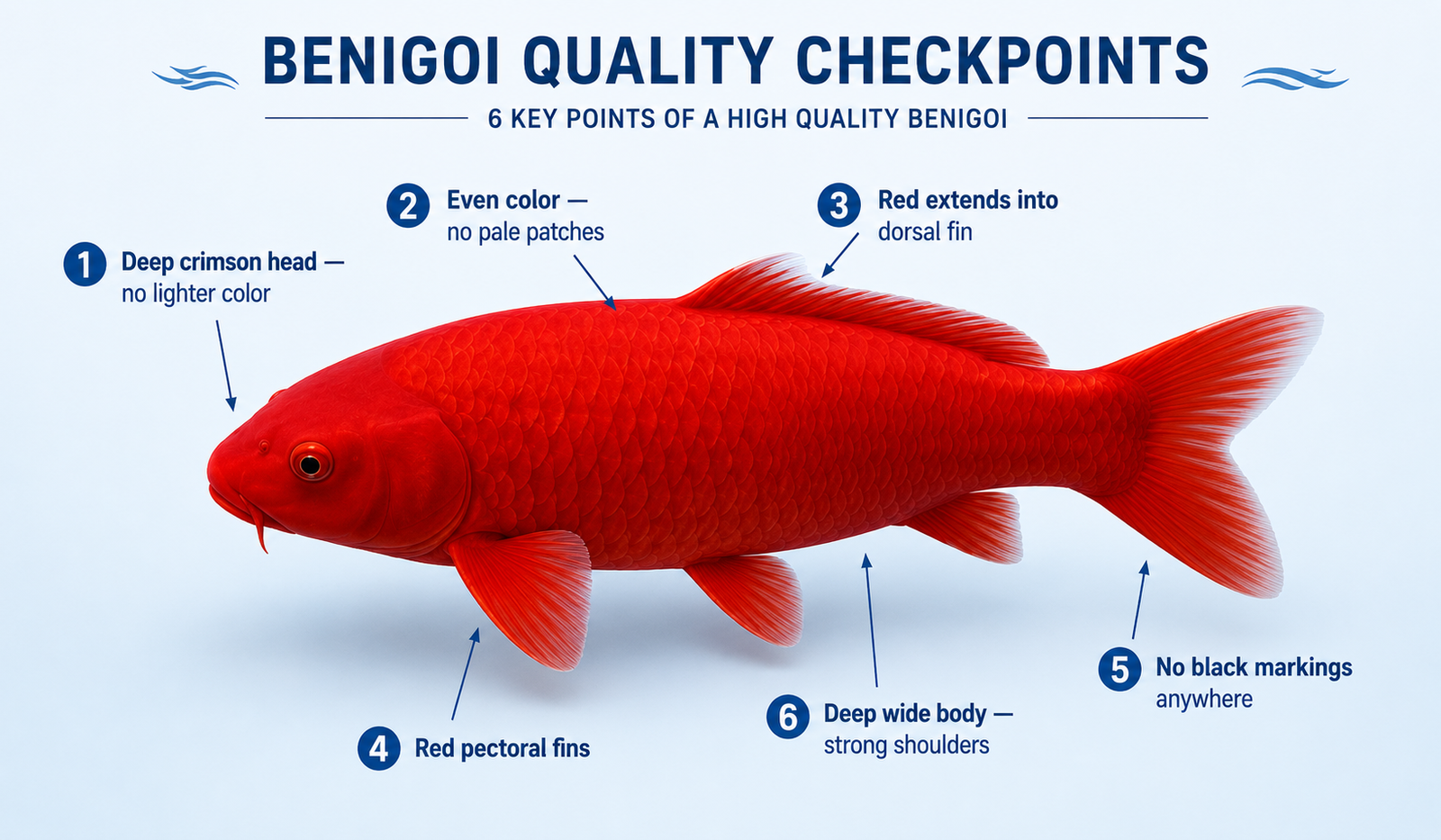
- Color depth — the primary criterion. The red must be deep, rich, and saturated. Pale, faded, or orange-leaning color indicates lower genetic quality or poor diet. The benchmark: if the red looks vivid even in shade or overcast light, it is a good Benigoi. If it only looks impressive in direct sunlight, be cautious.
- Color uniformity. The red must be perfectly even from the tip of the nose to the base of the tail — same depth across the back, belly, and sides. Any lighter patches, streaks, or color fade toward the tail is a flaw.
- Head clarity. The head must be as deeply red as the body — lighter red on the head than the body is a common flaw in lower-quality Benigoi. A clean, uniformly red head is a mark of quality.
- Fin color. Red should extend uniformly into all fins — dorsal, pectoral, ventral, anal, and caudal. White or pale fin tips are acceptable and can be an attractive feature; transparent or colorless fins where red is expected indicate poor color penetration.
- No markings. Any black spots, patches, or irregular discoloration immediately disqualify a Benigoi from high-quality status. The body must be entirely, uniformly red.
- Body conformation. A deep, torpedo-shaped body with wide shoulders and strong tail peduncle indicates growth potential and genetic quality. A thin, narrow body will not grow impressively regardless of color.
- Skin lustre. A quality Benigoi has a slight natural sheen to the skin — not metallic, but not dull or chalky. The skin should appear alive and vibrant, almost glowing from within.
| Feature | High Quality ✅ | Poor Quality ❌ |
|---|---|---|
| Color depth | Deep crimson, rich even in shade | Pale, washed-out, orange-leaning |
| Color uniformity | Even head to tail, no patches | Lighter head, faded toward tail |
| Fins | Red throughout, possibly white tips | Pale or transparent fins |
| Markings | None — perfectly clean | Any black spots or patches |
| Body shape | Deep, wide shoulders, strong peduncle | Thin, narrow, tapered quickly |
History & Classification
Benigoi are one of the oldest koi varieties — predating many of the elaborate patterned varieties that dominate today’s show circuit. Their lineage traces directly to the red color mutations that first appeared in the common black Magoi carp farmed by Niigata rice farmers in the early 19th century.
When early Niigata farmers began noticing red and orange color mutations in their black food carp, these were among the first selectively bred colored specimens. The solid red fish — ancestors of today’s Benigoi — were among the earliest ornamental koi to be intentionally cultivated for their color rather than their meat.
In the Japanese koi classification system, Benigoi belong to the Kawarimono group — specifically within the Higoi (red koi) sub-category. The Kawarimono group is judged at separate classes in competition, where Benigoi are evaluated primarily on the purity, depth, and uniformity of their red coloration.
There is some historical claim — debated among koi enthusiasts — that Benigoi should be considered one of the foundational varieties alongside Kohaku and Showa as the “Big Three” original koi. While this designation is not universally accepted (the traditional Big Three are the Go-Sanke: Kohaku, Sanke, and Showa), it reflects how seriously dedicated Benigoi enthusiasts take their chosen variety.
Symbolism: What Red Means in Koi Culture
Red koi — and Benigoi specifically — carry deeply resonant symbolism in both Japanese and Chinese culture:
- Love and passion: Red koi represent romantic love and deep emotional bonds in Chinese cultural tradition — the most intense color for the most intense emotion
- Strength and motherhood: In Japanese tradition, red koi symbolize strong feminine energy and the power of motherhood — the red fish in a Koinobori streamer (Children’s Day) typically represents the mother
- Perseverance: Red koi swimming upstream in the Dragon Gate legend embody the determination and strength required to achieve transformation
- Good fortune: In feng shui, red koi are powerful symbols of vitality and positive energy — their presence in a pond is believed to attract strong life force and fortunate circumstances
For hobbyists who want their koi to carry symbolic weight as well as visual beauty, a quality Benigoi is one of the most symbolically loaded fish you can keep. See: What Do Koi Fish Represent? Full Symbolism Guide.
Benigoi Care Guide
Benigoi have the same care requirements as other koi varieties — their needs are standard and they are considered one of the hardier varieties, making them well-suited for beginners.
| Parameter | Ideal Range | Notes |
|---|---|---|
| Water temperature | 59–77°F (15–25°C) | Stop feeding below 50°F / 10°C |
| pH | 7.0–8.5 | Stable pH more important than exact value |
| Ammonia / Nitrite | 0 ppm both | Test weekly; act immediately if detectable |
| Pond size | 1,000 gal min; 250 gal per adult | Larger ponds = better color and growth |
| Pond depth | 3–4 feet minimum | Depth protects from herons and temperature swings |
| Filtration | Biological + mechanical; rated 1.5× pond volume | Strong filtration essential for water clarity and fish health |
| Lifespan | 25–35 years | Well-kept Benigoi can match this lifespan fully |
How to Maintain Deep Red Color in Benigoi
Color maintenance is the most important ongoing care consideration for Benigoi owners — a fish that arrives with vivid crimson can lose that depth through poor husbandry, and a fish with adequate genetics can be significantly enhanced with proper care. Here is how to protect and deepen that red:
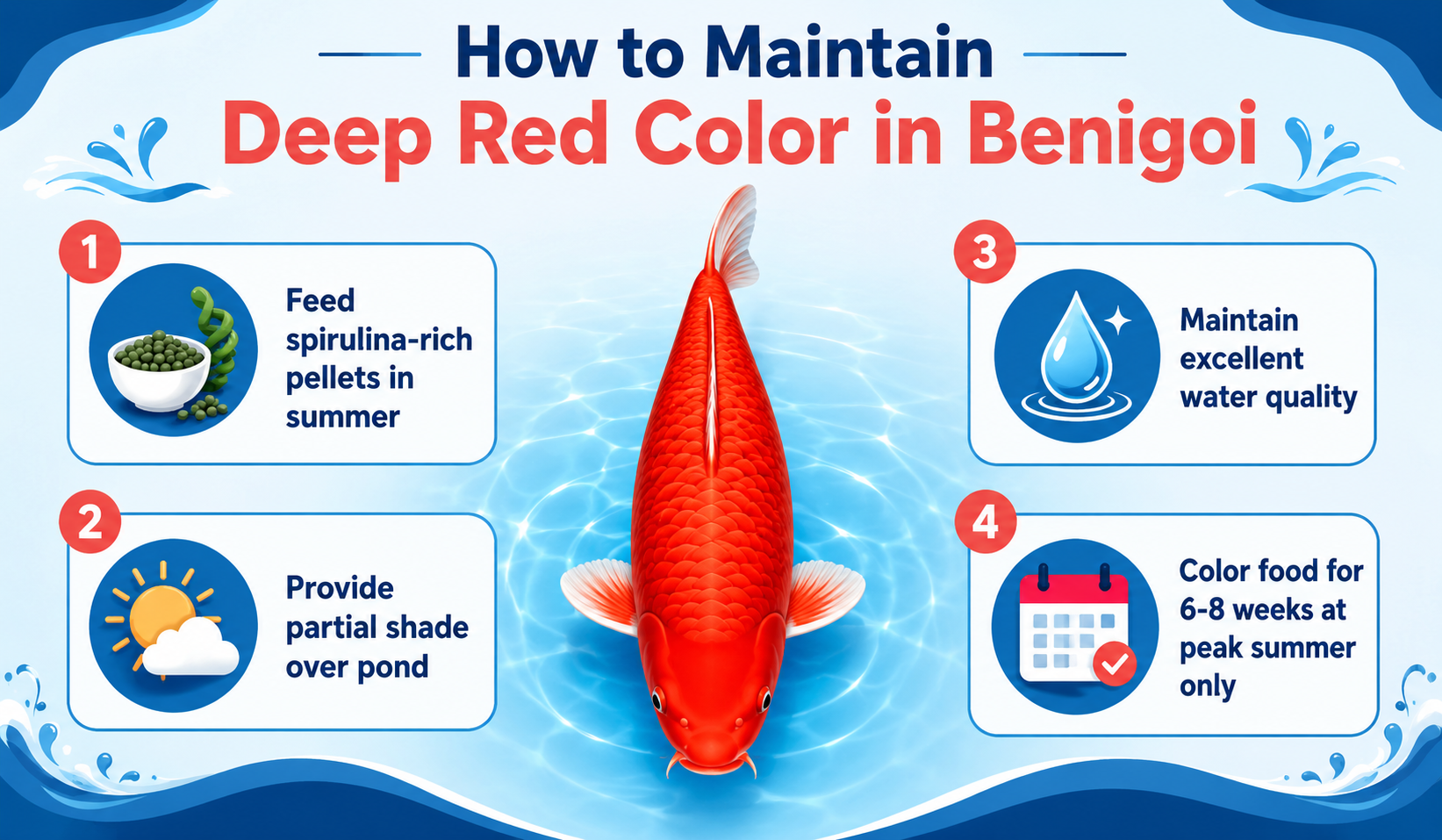
- Feed color-enhancing food seasonally. High-quality koi pellets containing spirulina and astaxanthin provide the carotenoid pigments that koi cannot synthesize themselves — these are essential for maintaining and deepening red. Use color food for 6–8 weeks at the peak of summer (water above 68°F) when the fish’s metabolism is fastest. Continuous year-round use can cause red to bleed into white areas on other fish in the same pond, so targeted seasonal use is the preferred approach.
- Avoid excessive UV exposure. Prolonged direct sunlight fades koi colors generally. While some sunlight is important, a pond with partial shading via aquatic plants or shade cloth maintains color better than one exposed to full sun all day.
- Maintain excellent water quality. Water quality stress — high ammonia, nitrate, or pH swings — causes color to fade rapidly in all koi but is especially visible on solid-color varieties like Benigoi where there is nowhere to hide a flaw.
- Avoid overfeeding. Overfeeding leads to water quality deterioration, which affects color. Strict 5-minute feeding rule at every feeding.
- The color naturally deepens with age. Young Benigoi are often lighter and more orange-red than they will ultimately become. A fish that looks only moderately red at 12 inches may develop into a rich crimson at 20+ inches. This is part of why experienced buyers evaluate body conformation and skin quality alongside current color when purchasing young Benigoi.
Size & Growth
Benigoi can grow to impressive sizes — particularly bloodlines with Chagoi or Karashigoi genetic influence, which carry genes for exceptional growth. Under ideal conditions, mature Benigoi commonly reach 24–30 inches (60–75 cm). Some exceptional specimens in very large ponds exceed 30 inches.
Factors that maximize Benigoi growth
- Large pond (3,000+ gallons ideal)
- High-protein summer diet (35–40%)
- Warm water temperature (above 68°F)
- Quality genetics / jumbo bloodline
- Strong biological filtration
Factors that stunt growth
- Pond too small (under 500 gallons)
- Poor water quality / high nitrates
- Overcrowding
- Cold climate with short warm season
- Low-quality or insufficient diet
Best Pond Companions for Benigoi
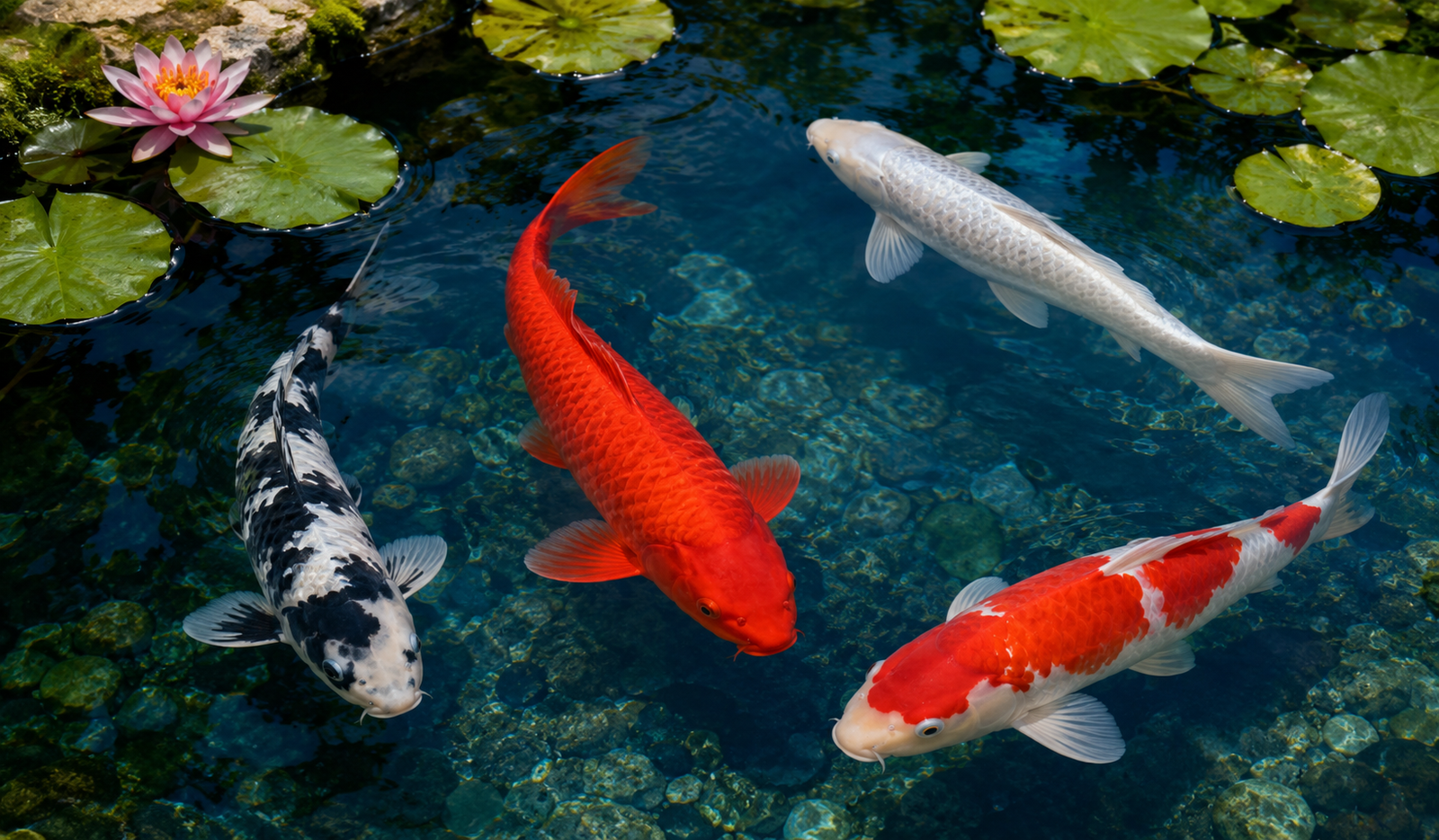
Benigoi are entirely peaceful and coexist well with all koi varieties. Their vivid single-color red creates extraordinary visual contrast with certain companion varieties — here are the best pairings:
| Companion | Why It Works |
|---|---|
| Platinum Ogon | Pure white metallic against deep red — the most striking contrast in the pond |
| Kohaku | Red-and-white Kohaku pattern echoes the Benigoi’s red while adding the elegance of pattern |
| Shiro Utsuri | Bold black and white graphic contrast alongside vivid red — dramatic three-color pond effect |
| Chagoi | The Chagoi’s pond-calming effect tames the pond; warm tea-brown complements red beautifully |
| Karashigoi | Pale yellow-gold Karashigoi next to deep crimson Benigoi — warm complementary contrast |
| Soragoi | Sky-grey against crimson red — cool-meets-warm that creates a sophisticated, understated pond |
The Benigoi’s vivid, solid color makes it an anchor fish — around which you build a pond’s visual composition. The single-color red draws the eye without competing with neighboring fish, making every other variety it is kept with look more defined and dramatic by contrast.
Buying Guide: What to Look For
Benigoi selection is more straightforward than patterned varieties — the evaluation is simpler, but the stakes are just as high. Here is the buying checklist:
- Evaluate color in natural daylight — not aquarium lighting. Dealer tank lighting enhances red dramatically. Ask to see the fish in a white bowl or natural outdoor light before committing.
- Look at the head first. A common flaw in lower-grade Benigoi is lighter color on the head than the body. The head must be as deeply red as the back.
- Check the fins. Red should penetrate well into all fins. Pale or white fins indicate limited color penetration — the fish may not deepen as well with age.
- Evaluate body shape. Wide, deep body with strong shoulders = growth potential. This matters as much for Benigoi as for any variety — you want a fish that will grow into an impressive specimen, not plateau at a modest size.
- Ask about the bloodline. Benigoi from known Niigata bloodlines, or from breeders who specifically focus on solid red varieties, are more likely to develop the deep, rich color over time than pond-bred fish of unknown origin.
- Younger fish are OK — color deepens. A juvenile Benigoi that appears orange-red at 8 inches may become a rich crimson at 20 inches, especially with good diet. Body shape and skin quality matter more than current color intensity in young fish.
- Quarantine for 2–4 weeks before introducing to your main pond — standard protocol for any new koi.
Related Reading on Giobel Koi Center
Frequently Asked Questions
What is a Benigoi koi?
What is the difference between Benigoi and Aka Muji?
How do you identify a high-quality Benigoi?
Are Benigoi good for beginners?
Does Benigoi red color fade?
What pond companions are best for Benigoi?
How big do Benigoi koi get?
Giovanni Carlo
Koi keeper & founder, Giobel Koi Center · Labangan, Zamboanga del Sur
Giovanni has been keeping koi since the 1980s and runs one of the Philippines’ most widely read koi resources. He breeds and raises multiple koi varieties on his farm in Mindanao — including Kawarimono single-color varieties — and writes from decades of hands-on experience with variety identification, color evaluation, and koi care.

Passionate about fish keeping since elementary school in the 1980s, Giovanni Carlo has dedicated countless hours to collecting and breeding a diverse array of ornamental freshwater fish. From vibrant guppies and majestic koi to striking bettas and classic goldfish, he continues to explore the fascinating world of aquatics, sharing knowledge and enthusiasm with fellow fish enthusiasts.