Quick Answer
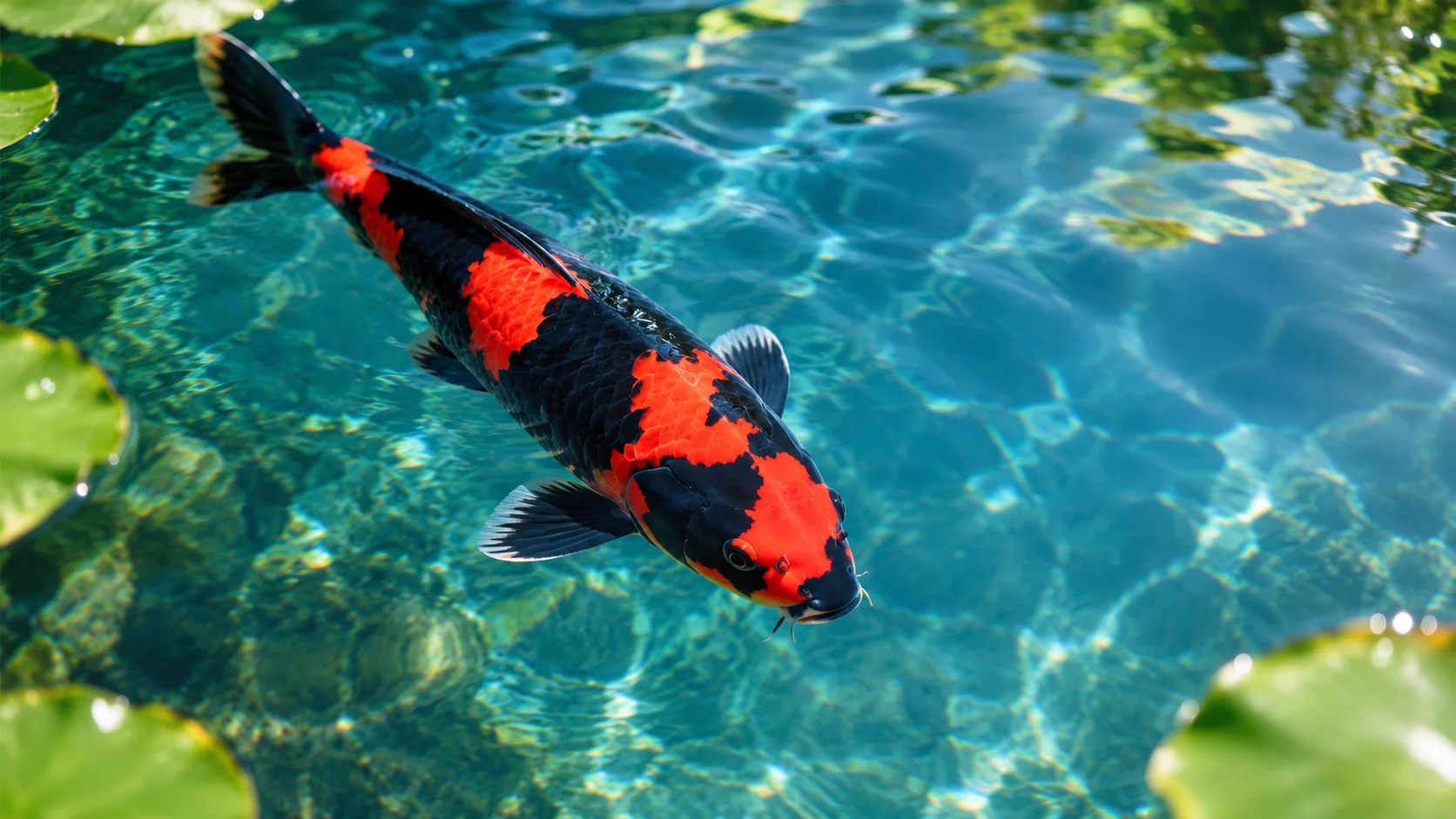
Hi Utsuri is a Japanese koi variety with a jet-black (sumi) base overlaid with bold red (hi) markings. It’s part of the Utsurimono family alongside Shiro Utsuri (white) and Ki Utsuri (yellow), and is prized for sharp kiwa (the edge where red meets black) and clean, unbroken sumi that wraps the body rather than sitting in isolated patches.
Hi Utsuri Koi: The Complete Guide to Japan’s Red-and-Black Koi
I. Introduction to Hi Utsuri Koi
Few koi varieties command a pond the way Hi Utsuri does. Where a Kohaku’s white ground softens its red pattern, Hi Utsuri sets its red directly against jet black — a combination that reads as bold from across a garden and rewards close inspection with the fine detail collectors look for. This guide covers where the variety came from, how to tell a good one from a mediocre one, what it costs to keep, and how it’s judged.
What Does “Hi Utsuri” Mean and Where Did It Come From?
“Hi Utsuri” translates roughly to “red reflection” — hi for the red markings, utsuri (“reflection” or “shiny”) describing the way color sits against the black base. Hi Utsuri belongs to the Utsurimono group, alongside Shiro Utsuri (black and white) and Ki Utsuri (black and yellow). Utsurimono trace back to crosses between Ki Utsuri stock and Kohaku over a century of Japanese breeding, with the group emerging from the same lineage work that produced Showa koi. Shiro Utsuri was standardized first; Hi Utsuri and Ki Utsuri followed as breeders pushed to lock in red and yellow patterning against the same reliable black base.
What Does a High-Quality Hi Utsuri Look Like?
A strong Hi Utsuri has a deep, lacquer-black base (sumi) that wraps around the body rather than sitting as flat patches on top of it, with red markings that are thick, even, and free of speckling. No two fish share the same pattern, but judges and serious buyers are looking for the same handful of traits every time.
Kiwa, Motoguro, and What Judges Actually Look For
Two terms come up constantly once you’re evaluating Hi Utsuri beyond “it looks nice”:
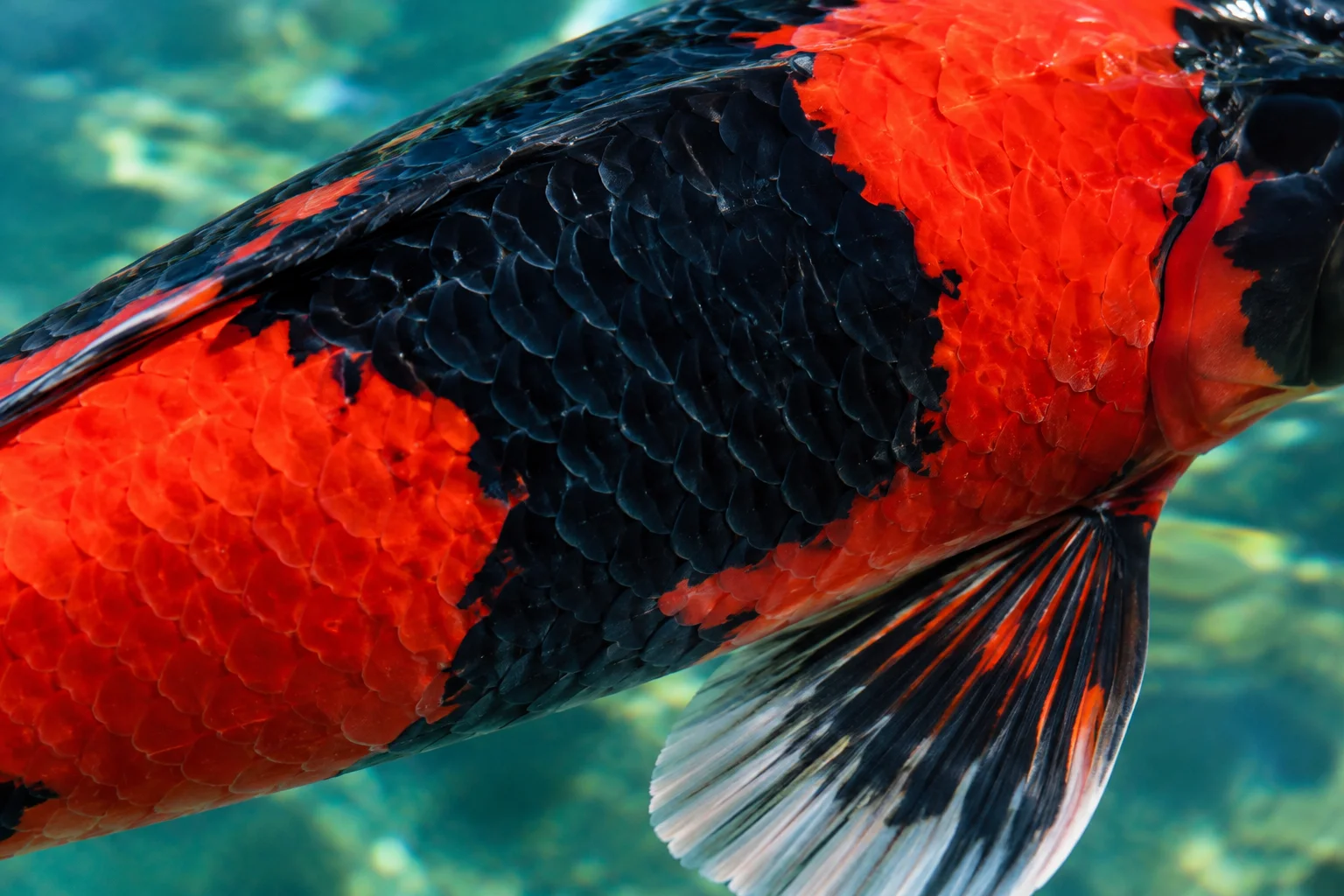
- Kiwa — the boundary line where red meets black. This is the single detail most likely to separate a good Hi Utsuri from an expensive one: a sharp, crisp kiwa reads as intentional and clean, while a blurred or feathered edge (where the colors bleed into each other) is treated as a fault.
- Motoguro — black pigment at the base of the pectoral fins. On Showa and Ki Utsuri, motoguro often shows as a solid black patch. On Hi Utsuri, the fin bases are typically striped rather than solid — a full solid motoguro patch on a Hi Utsuri is unusual and worth double-checking with the seller.
Beyond those two, sumi distribution matters: black should run the length of the body rather than piling up at the head or tail, and the head pattern (sometimes split by a thin band called menware) should look deliberate rather than accidental. A head with no black at all, or a head that’s entirely black, is generally scored as a fault.
Why Hi Utsuri Matters to Koi Keepers
Hi Utsuri sit just outside koi’s “Big Three” (Kohaku, Sanke, Showa) but are shown often enough in Utsurimono classes that a well-marked specimen can hold its own against them. For hobbyists, the appeal is more straightforward: a fish that looks striking in a modestly sized backyard pond, not just in a show tank, because the black-and-red contrast reads well even from a distance.
II. Varieties and Types
Kin Hi Utsuri
Kin Hi Utsuri adds a metallic (gin-rin or platinum-influenced) shimmer over the standard black-and-red pattern. The metallic sheen catches light differently depending on viewing angle, which is part of why these command a premium over standard-scaled Hi Utsuri of similar pattern quality.
Hi Utsuri Butterfly Koi
Crossing Hi Utsuri with long-finned (butterfly/Dragon Carp) bloodlines produces a fish with the same red-and-black contrast but flowing, extended fins. It’s a hybrid rather than a recognized show variety, so it’s judged more on personal appeal than competition standards — a good option if you want the look without needing show-grade pattern precision.
Hi Utsuri vs. Shiro Utsuri vs. Ki Utsuri
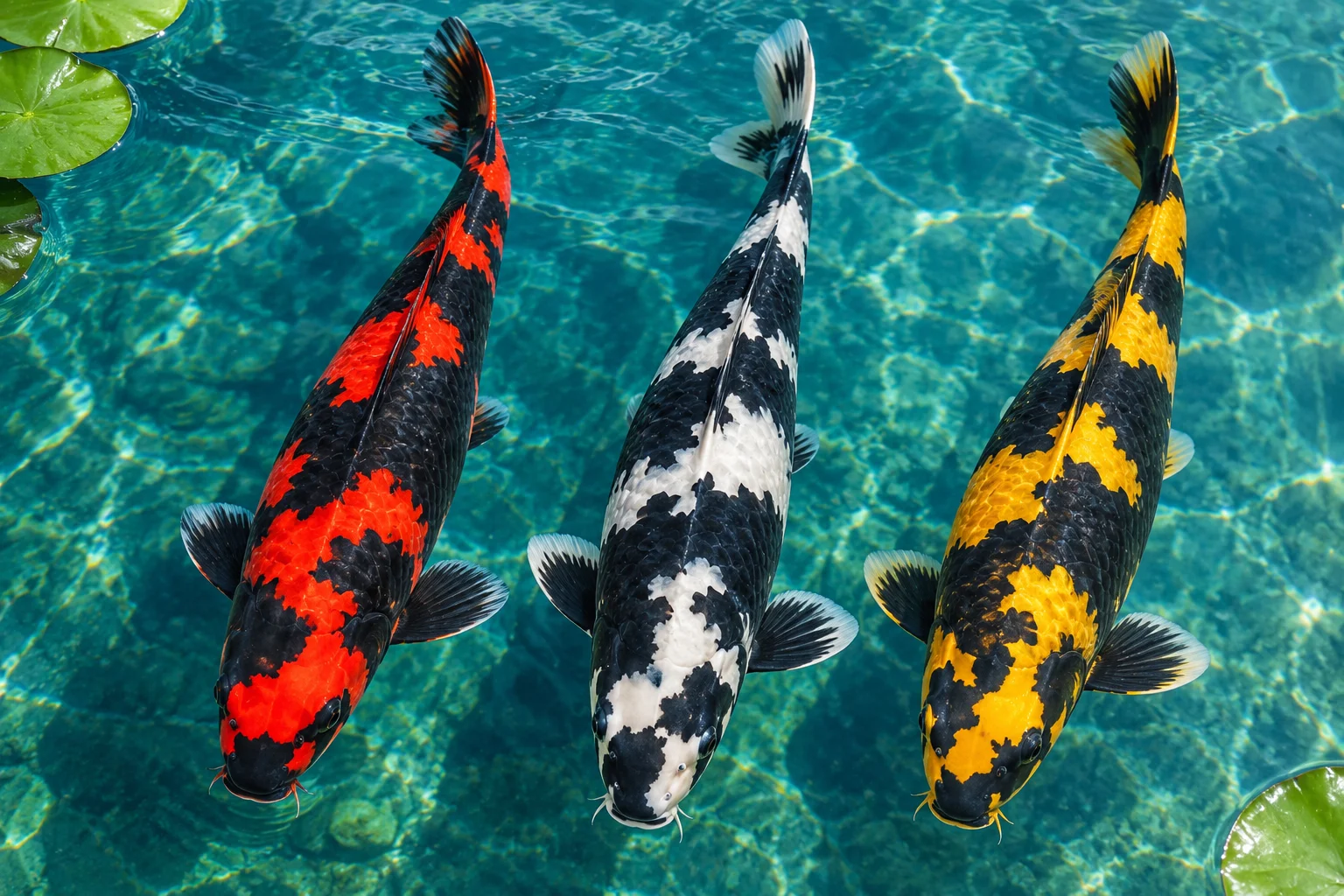
All three Utsurimono share the same black base and judging logic (kiwa clarity, sumi distribution, motoguro), differing mainly in the second color:
| Variety | Secondary Color | Distinguishing Notes |
|---|---|---|
| Hi Utsuri | Red | Most commonly seen Utsuri variety; fin-base sumi usually striped, not solid |
| Shiro Utsuri | White | The original, most standardized Utsuri; often confused with Bekko — check whether black wraps the body (Utsuri) or sits as separate spots (Bekko) |
| Ki Utsuri | Yellow | Rarest of the three; solid motoguro at the pectoral fin base is more typical here than on Hi Utsuri |
The most common mix-up isn’t between these three — it’s mistaking any black-and-white koi for Shiro Utsuri when it’s actually a Bekko. The tell is whether the black wraps around the body in connected plates (Utsuri) or sits as isolated spots on a solid ground color (Bekko).
III. Hi Utsuri Koi Care
How Big Do Hi Utsuri Koi Get, and How Fast?
| Age | Typical Size | Notes |
|---|---|---|
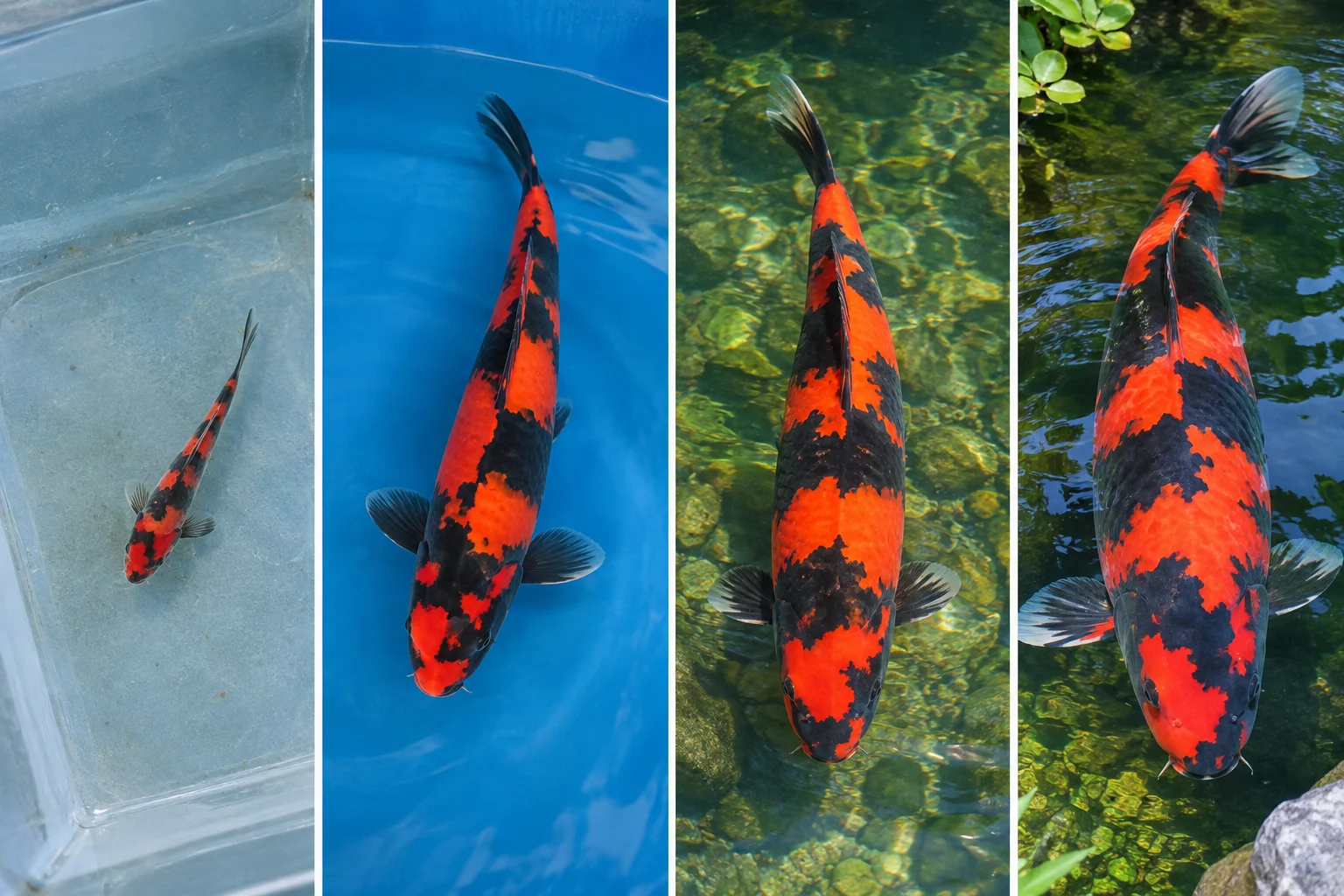
| Fry (0–6 months) | Under 3 in | Coloration still developing; pattern not fully reliable yet |
| 1–2 years | 8–14 in | Kiwa and sumi pattern begin to stabilize |
| 3–5 years | 16–22 in | Pattern generally considered “set” by breeders |
| Mature (well-kept pond) | 24–36 in | Upper end requires a large, well-filtered pond and years of consistent care |
Growth slows with age but rarely stops outright — a Hi Utsuri in a spacious, well-filtered pond with good nutrition can keep adding length slowly for decades, which is one reason pond size is the real limiting factor, not the fish’s genetics alone.
Hi Utsuri Koi Price Range
Price tracks pattern quality more than size. A young fish with promising but unsettled pattern is inexpensive; a mature fish with sharp kiwa, clean sumi distribution, and no motoguro faults costs substantially more, with show-quality specimens from named Japanese breeders reaching into the thousands of dollars.
Where to Find Hi Utsuri Koi for Sale
Reputable koi farms, specialty koi shops, and established online sellers are the safer routes over general marketplace listings. Ask for recent photos from multiple angles (pattern that looks clean from above can hide a poor kiwa from the side), and ask directly about lineage — a seller who can’t speak to breeding history is a seller you should be cautious with.
Hi Utsuri Koi Fry Development and Growth
Fry coloration is unreliable — many Hi Utsuri fry look plain or unevenly marked in their first months, with kiwa and sumi pattern only becoming trustworthy after the first year or two. Clean water, stable temperature, and consistent nutrition during this window matter more for how the adult pattern turns out than anything you can do later.
Hi Utsuri Koi Yellowing: Causes and Solutions
Red pigment drifting toward orange or yellow is usually a water quality or nutrition issue rather than a permanent genetic trait. Common causes: prolonged poor water quality, inadequate color-enhancing nutrition (spirulina- or carotenoid-based foods help maintain hi intensity), and stress from overcrowding. Improving filtration and switching to a color-enhancing diet typically restores depth of red over several weeks, though severe or long-term fading may not fully reverse.
Hi Utsuri Koi Health Issues
Like any koi, Hi Utsuri are susceptible to bacterial infections, parasites (flukes, ich, trichodina), and metabolic issues tied to overfeeding or poor water quality. Watch for clamped fins, flashing (rubbing against surfaces), appetite loss, or visible discoloration — early treatment and clean water prevent most issues from becoming serious.
Feeding and Nutrition
A high-quality koi pellet as the base diet, supplemented with color-enhancing foods (spirulina, krill, or other carotenoid sources) to maintain the hi’s depth, plus occasional treats like blanched vegetables. Feed according to size, age, and water temperature — koi barely eat below roughly 50°F (10°C) and overfeeding in cold water is a common cause of preventable illness.
IV. Understanding Hi Utsuri Koi Behavior
Growth Patterns and Lifespan
Growth is fastest in the first few years and slows steadily afterward, but well-kept koi can live several decades — some documented individuals have lived past 50 years. Genetics, pond size, water quality, and diet all influence both growth rate and lifespan.
Do Koi Fish Stop Growing?
Not entirely — growth rate declines with age but rarely stops completely in a healthy fish. Water temperature, diet, and available pond space are the main levers hobbyists can control to support continued healthy growth.
Koi Fish Going Up Meaning
Koi rising to the surface is commonly linked to feeding time, but it can also signal gas exchange, social behavior, or — if it happens outside normal feeding and the fish seem to be gasping — low dissolved oxygen, which is worth checking rather than ignoring.
Common Sayings and Idioms
Koi feature widely in Japanese language and folklore, most famously in expressions tied to perseverance — the image of a koi swimming upstream against a waterfall, sometimes said to transform into a dragon, underpins much of the fish’s symbolic weight in art and business gift-giving.
V. Hi Utsuri Koi in Culture and Art
Symbolism and Meanings
Koi broadly symbolize perseverance, strength, and good fortune in Japanese culture, tied to the fish’s ability to swim against strong currents. Utsurimono specifically, with their stark black base, are sometimes read as representing resilience through contrast — light persisting against dark.
Sayings and Expressions
Phrases like koi no taki-nobori (“koi climbing the waterfall”) and koi o suru (a play on words meaning “to fall in love”) use koi imagery to talk about ambition and affection — a reminder that koi symbolism sits as much in everyday language as in ponds.
Depictions in Art and Literature
Koi appear throughout Japanese woodblock prints, tattoo art (irezumi), and contemporary design, almost always leaning on the same themes of perseverance and transformation. Utsurimono’s high-contrast coloring makes them a particularly graphic subject compared to softer-patterned varieties like Kohaku.
VI. Hi Utsuri Koi in the Market
Notable Breeders and Farms
Established Japanese koi farms with dedicated Utsurimono breeding programs are generally the most reliable source for show-quality Hi Utsuri, though reputable farms outside Japan increasingly produce solid pattern quality at lower cost. Ask any breeder directly about their Utsurimono lineage rather than assuming reputation alone guarantees pattern quality.
Purchasing Guide
Before buying, check: kiwa sharpness (from multiple angles, not just from above), sumi distribution across the full body, whether the fin-base pattern looks right for a Hi Utsuri (striped, not a solid motoguro block), general body condition, and swimming behavior. Ask about breeding history and, where possible, see the parent stock or littermates.
Price Factors
Size, age, kiwa clarity, sumi quality, and lineage all move price. A young fish with an unsettled but promising pattern is the entry point for most hobbyists; mature, pattern-set fish from known bloodlines are where prices climb fastest.
VII. Conclusion
Hi Utsuri rewards a slightly more technical eye than most beginner-friendly koi: the difference between an average specimen and a genuinely good one usually comes down to kiwa sharpness and sumi distribution rather than anything obvious at a glance. Whether you’re buying your first Utsuri or building out a collection, that’s the detail worth learning to spot first.
Frequently Asked Questions (FAQs)
What is Utsuri koi?
Utsuri (short for Utsurimono) is a group of koi varieties with a black (sumi) base and a contrasting second color — white (Shiro Utsuri), red (Hi Utsuri), or yellow (Ki Utsuri). The group is judged on how cleanly the black wraps the body and how sharp the boundary (kiwa) is between the two colors.
What type of koi is the most expensive?
Record prices tend to go to top-quality Kohaku, Showa, and Sanke rather than Utsurimono — the grand champion at the 2017 All Japan Koi Show reportedly sold for roughly $1.8 million, reflecting decades of selective koi breeding that began in Japan in the 1700s.
Why is my koi turning black?
Filtered pond systems break down fish waste into nitrite and then nitrate over time, and koi kept in harder water often develop more black pigmentation than owners expect or want. If unwanted black is spreading, check water hardness and nitrate levels first.
What does Hi Utsuri koi mean?
“Hi Utsuri” translates to roughly “red reflection” — describing the vivid red (hi) markings set against a deep black (utsuri) base.
What makes a good Hi Utsuri koi?
A sharp, clean kiwa (the boundary between red and black); sumi that wraps the body rather than sitting as flat patches; a deliberate, balanced head pattern; fin-base striping rather than a solid motoguro block; and healthy, lustrous skin with no discoloration.
What is a Ki Utsuri koi?
Ki Utsuri is the rarest of the three Utsurimono varieties, pairing the same black base with yellow (ki) markings instead of red or white. Solid motoguro at the pectoral fin base is more common on Ki Utsuri than on Hi Utsuri.
What is kiwa in koi judging?
Kiwa is the boundary line where two colors meet on a koi’s pattern. On Hi Utsuri, it’s the edge between the red and black — a sharp, crisp kiwa is one of the most heavily weighted traits in judging, while a blurred or feathered edge is treated as a fault.
Which koi is the rarest?
Rarity is somewhat subjective and shifts with breeding trends, but varieties commonly cited as rare include Doitsu Kohaku (scaleless, red-and-white), Kumonryu (black-and-white patterns that shift with water temperature), and Ai Goromo (blue-gray netting over a red-and-white base). Within Utsurimono specifically, Ki Utsuri is considered the rarest of the three.
You may also like
- Koi Fish Meaning
- Most Expensive Koi Fish Ever Sold
- Matsuba Koi Guide
- Hi Utsuri Butterfly Koi
- Koi Breeding Basics
- Koi Egg Bound: Causes and Fixes

Passionate about fish keeping since elementary school in the 1980s, Giovanni Carlo has dedicated countless hours to collecting and breeding a diverse array of ornamental freshwater fish. From vibrant guppies and majestic koi to striking bettas and classic goldfish, he continues to explore the fascinating world of aquatics, sharing knowledge and enthusiasm with fellow fish enthusiasts.