Lucky Number of Koi Fish in a Pond: Feng Shui Guide to 1, 2, 6, 8, 9 and More
By Giovanni Carlo Bagayas | Updated: June 2026 | 10 min read
Quick Answer
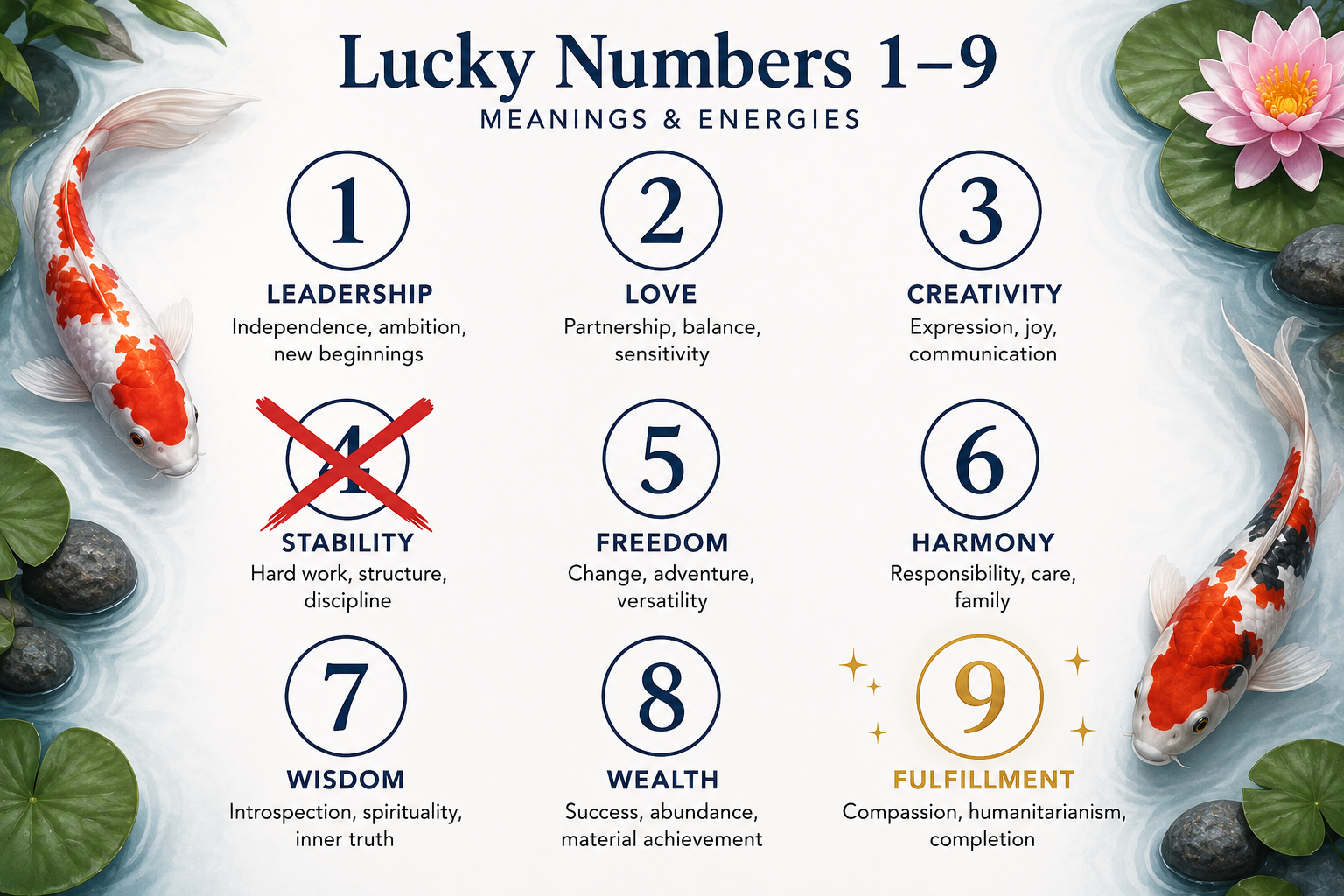
The luckiest number of koi fish in a pond is 9 — specifically eight red or gold koi plus one black koi. The number nine (九, jiǔ) represents completeness and eternal abundance in Chinese numerology. Eight attracts wealth (八, bā sounds like prosper, 发, fā). The single black koi absorbs negative energy and protects the fortune. Other auspicious numbers: 2 (love and partnership), 6 (heaven luck and career), 8 (wealth), and 1 (new beginnings). Place your koi pond in the southeast sector (wealth corner) or north sector (career) for maximum feng shui benefit.
Why the number of koi fish matters in feng shui
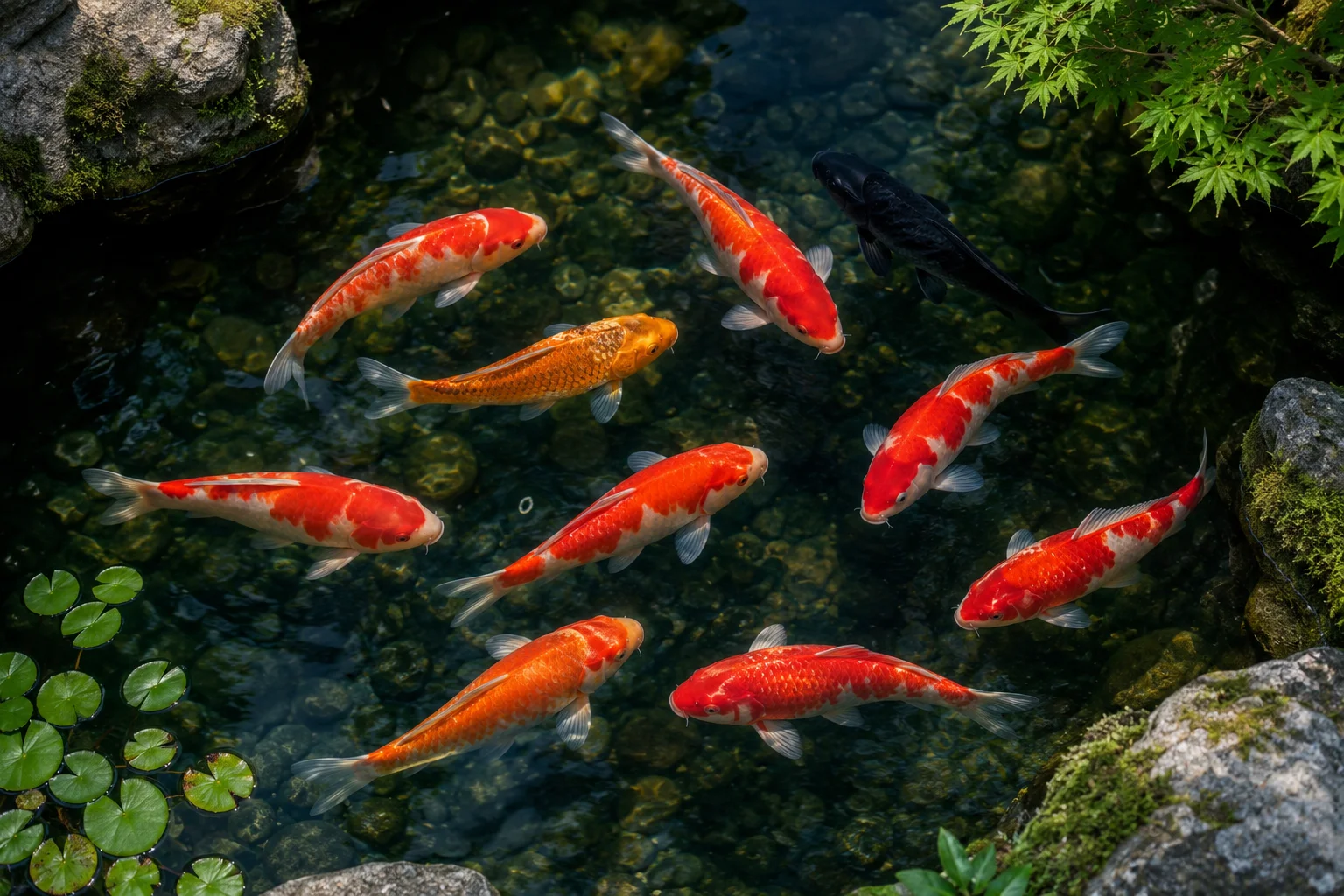
In feng shui and Chinese cultural tradition, numbers are never neutral. Every number carries a specific energetic signature — based on its sound in Chinese, its visual form, and its historical associations — that influences the quality of chi (life energy) it generates. When that number is applied to koi fish — themselves one of the most powerful feng shui symbols — the number amplifies the specific intention behind the arrangement.
Think of it this way: koi are the vehicle, and the number is the destination you program into it. Eight koi are pointed at wealth. Two koi are pointed at love. Nine koi are pointed at complete, protected, eternal abundance.
From 40+ years of koi keeping
I have kept koi since the 1980s and my personal pond has held nine koi for years. Not because I plan my life around feng shui numerology, but because nine koi in a well-maintained pond is genuinely one of the most beautiful and dynamic arrangements — they school together, feed together, and interact in a way that a smaller or less purposeful group does not. The aesthetic and the philosophy happen to align perfectly.
Lucky koi number guide — complete table
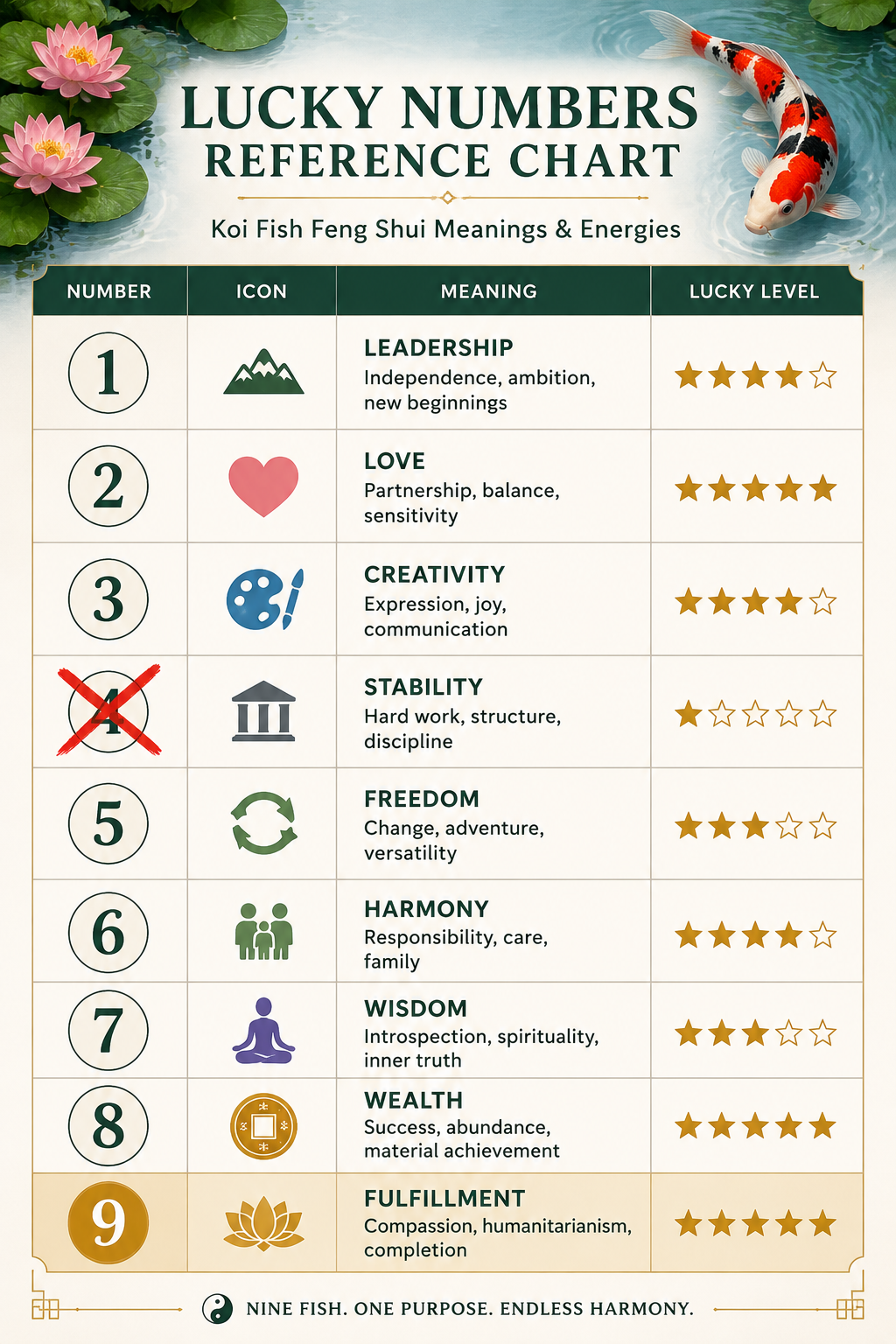
| Number of koi | Core meaning | Best koi color(s) | Best for | Auspicious level |
|---|---|---|---|---|
| 1 koi | New beginnings, independence, personal transformation | White or gold | Starting fresh; personal growth goals | ⭐⭐⭐ |
| 2 koi | Love, partnership, yin-yang balance | Red + white, or black + white | Relationships, marriage, love intentions | ⭐⭐⭐⭐ |
| 3 koi | Growth, creativity, new family energy | Mixed colors | Young families, creative projects, growth phases | ⭐⭐⭐ |
| 6 koi | Heaven luck, smooth progress, helpful people | Gold, white, or silver | Career advancement, travel luck, mentors | ⭐⭐⭐⭐ |
| 7 koi | Spiritual luck (Western), children’s luck | Mixed, including blue | Western contexts; spiritual practice | ⭐⭐⭐ |
| 8 koi | Wealth, prosperity, financial abundance | Red or gold | Business success, income growth, wealth goals | ⭐⭐⭐⭐⭐ |
| 9 koi (8+1) 🏆 | Completeness, eternal abundance, protected wealth | 8 red/gold + 1 black | Maximum feng shui prosperity remedy | ⭐⭐⭐⭐⭐ |
| Any number | Healthy, thriving koi always outrank a specific count | Varies | Fish health and happiness first — always | The foundation |
1 koi fish — new beginnings and individuality
A single koi in a pond carries the energy of individuality, independence, and focused intention. In Chinese numerology, one represents unity and the beginning of all things — before there is duality, there is singularity.
A solitary koi is ideal for someone in a major transition — starting a new chapter, recovering from a setback, or committing to a singular personal goal. The single koi swims with no distractions, no competing energies, its entire life force pointed in one direction.
Best color for 1 koi: White (new beginnings and spiritual clarity) or Gold (a fresh financial start, ambition directed toward a single goal).
Practical note: Koi are social fish and do better with companions. If you choose to keep a single koi, ensure the pond is large enough and that you provide significant human interaction — which a single Chagoi or Karashigoi will seek out readily.
2 koi fish — love, yin-yang, and partnership
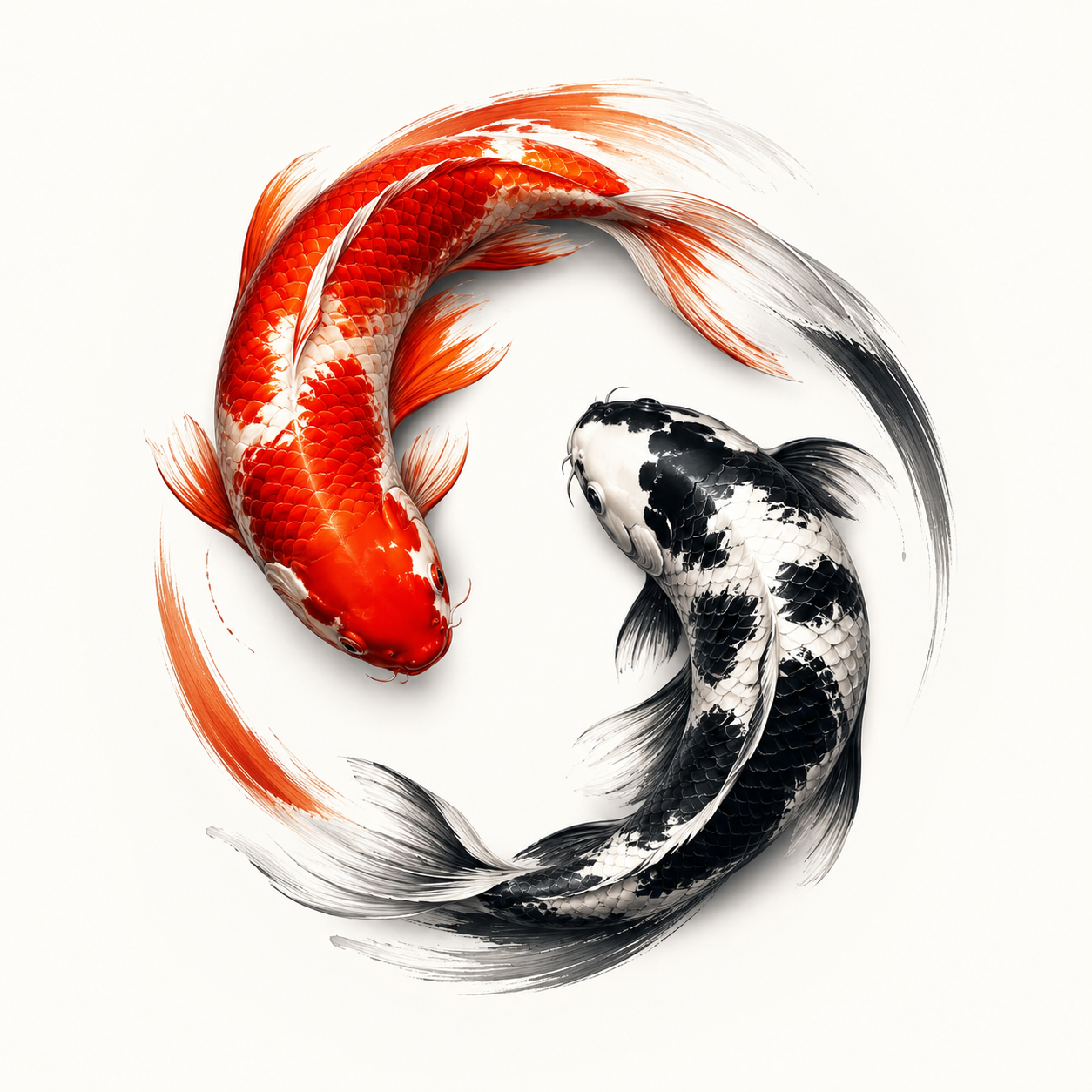
Two koi fish represent love, partnership, and the perfect balance of yin and yang. The pairing is one of the Eight Auspicious Symbols in Buddhism — specifically representing conjugal happiness and marital fidelity. The yin-yang symbol itself (☯) is believed to have originated from two koi swimming together in eternal circles: one black (yin, feminine, moon) and one white (yang, masculine, sun).
Best color combinations for 2 koi:
- Red + white: Love and purity — the classic romantic pairing; passion and spiritual clarity together
- Black + white: The direct yin-yang pairing — balance, duality, two forces that complete each other
- Gold + black: Wealth and protection — abundance and its guardian together
Best for: Couples, newlyweds, anyone seeking to attract or strengthen love and partnership. A two-koi arrangement is one of the most meaningful wedding gifts in Chinese tradition.
Deep dive: 2 koi fish meaning — complete yin-yang and partnership guide
3 koi fish — growth and creative energy
Three koi represent growth, creativity, and expanding family energy. The number three has auspicious associations across multiple Asian cultures — in Japanese tradition, three is considered lucky and associated with harmony and completeness of a kind different from nine (past, present, future; father, mother, child; beginning, middle, end).
Three koi is particularly suited to young families, new homeowners establishing their first pond, and anyone in an active growth phase — a new business, a creative project, a period of rapid personal development.
Best colors for 3 koi: Mixed colors representing different energies working together — a classic combination is red (love/energy), white (clarity), and gold (abundance).
6 koi fish — heaven luck and smooth progress
Six koi fish activate heaven luck (天運, tiān yùn) — the feng shui concept of divine support, serendipitous opportunity, and the feeling that life is flowing in your favor. In Chinese numerology, six (六, liù) sounds like “road” or “flowing,” associated with smooth progress, travel luck, and the support of helpful people (貴人, guì rén — “noble people” who assist your journey).
Six koi is particularly powerful for:
- Career advancement — opportunities appearing through mentors or powerful connections
- Business development — smooth deal-making and favorable circumstances
- Travel and mobility — physical and metaphorical movement in life
- Anyone who feels stuck and needs the energy of smooth forward motion
Best colors for 6 koi: Gold or platinum (metallic prosperity moving smoothly forward), white (clarity of path), or a mix of complementary colors.
8 koi fish — wealth and financial abundance
Eight koi fish activate the most powerful wealth energy in Chinese numerology. The number eight (八, bā) is considered the luckiest number in Chinese culture because it sounds nearly identical to the word for prosperity and financial success (发, fā). This linguistic connection is so deeply embedded in Chinese business culture that the number eight commands premium prices — phone numbers, license plates, apartment floors, and business addresses featuring multiple eights sell for significantly more.
Eight red or gold koi in your pond is a direct, intentional invitation for financial abundance. The color red or gold amplifies the wealth signal: red carries the fire energy of success and achievement; gold is the color of money, the sun, and material prosperity.
The 8-koi arrangement in practice: Eight identical gold koi (Yamabuki Ogon, for example) in a well-maintained pond is one of the most visually stunning feng shui arrangements possible — a golden school of eight moving in formation is breathtaking. Eight red Kohaku is equally powerful and adds the visual drama of the Hi plate.
Tip
Many experienced feng shui practitioners start with eight koi and add one black koi after the pond is established and stable — creating the 9-koi arrangement gradually rather than all at once. The eighth gold koi settling in before the ninth black is added can help you observe each fish’s health and behavior individually before introducing the protective black koi.
9 koi fish — completeness and eternal wealth (the most auspicious)
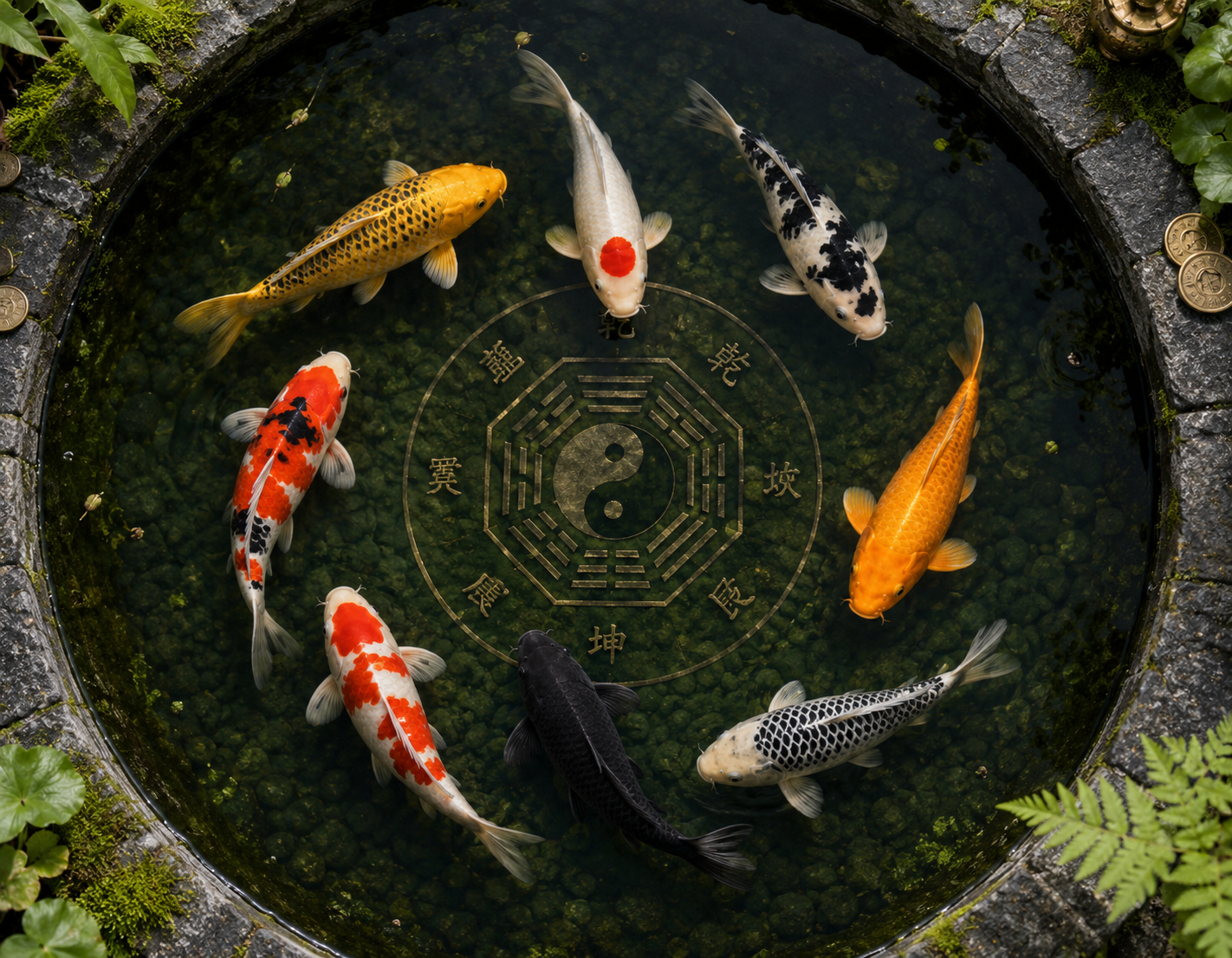
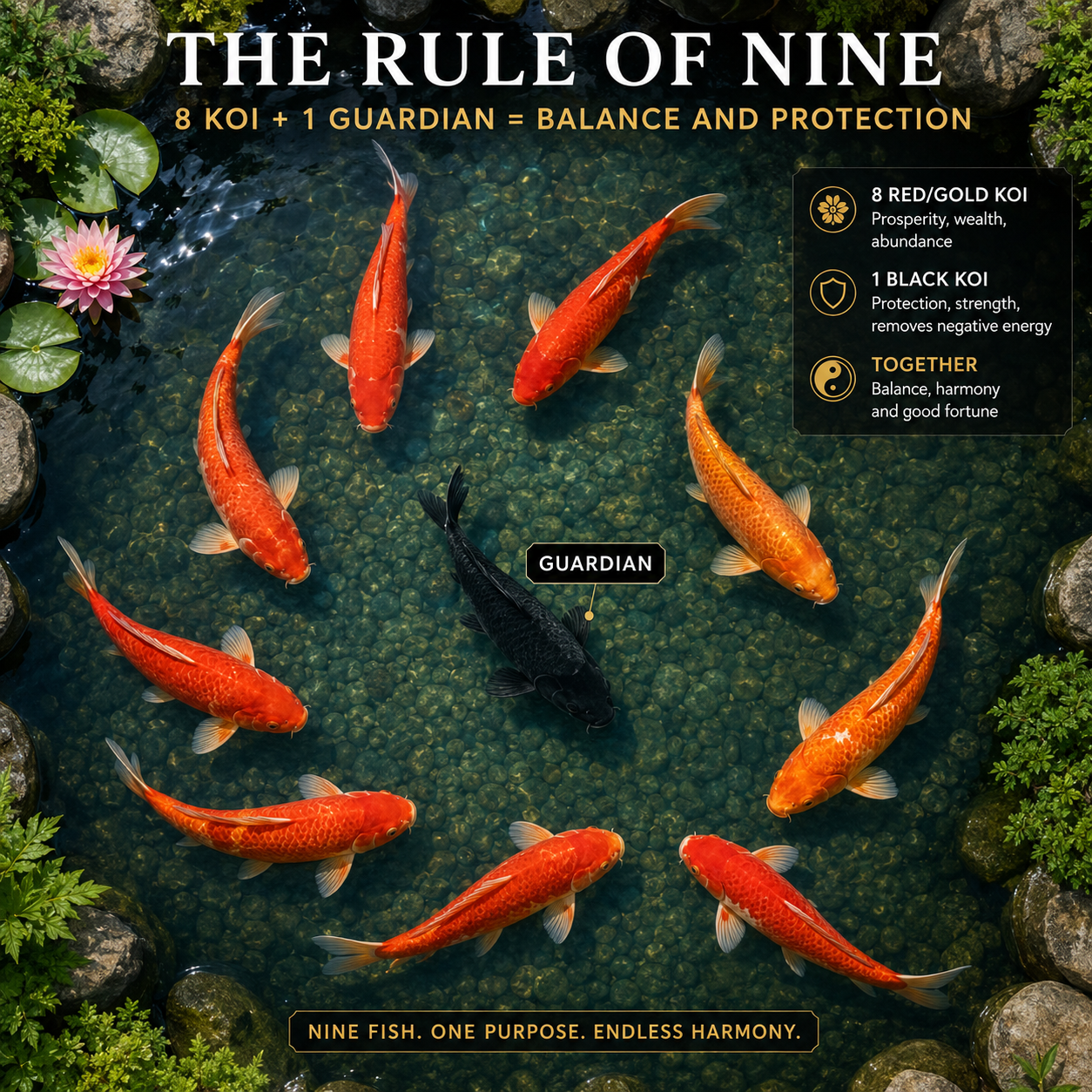
Nine koi fish — eight red or gold plus one black — is the single most auspicious koi arrangement in all of feng shui. It combines three powerful numerical energies:
- Nine (九, jiǔ): Sounds like the Chinese word for long-lasting (久, jiǔ) — representing eternity, completeness, and the end of a cycle that begins again. Nine is the highest single-digit number, symbolizing the fullness of heaven and earth together.
- Eight (八, bā): The wealth number — sounds like prosper (发, fā). Eight colored koi continuously generate and attract positive financial chi.
- One black koi: The protector. Black absorbs negative energy, bad luck, and obstacles. The black koi is the guardian of the wealth the eight fish attract — without it, accumulated fortune is vulnerable.
This is why the 9-koi arrangement is not just nine fish of any color — the specific combination of eight wealth-colored koi and one black protective koi is the formula. Mix up the colors or remove the black koi and you change the energetic intention significantly.
For the complete deep-dive on this arrangement: 9 koi fish meaning — complete feng shui guide with placement and color instructions
Which koi colors are luckiest in feng shui?
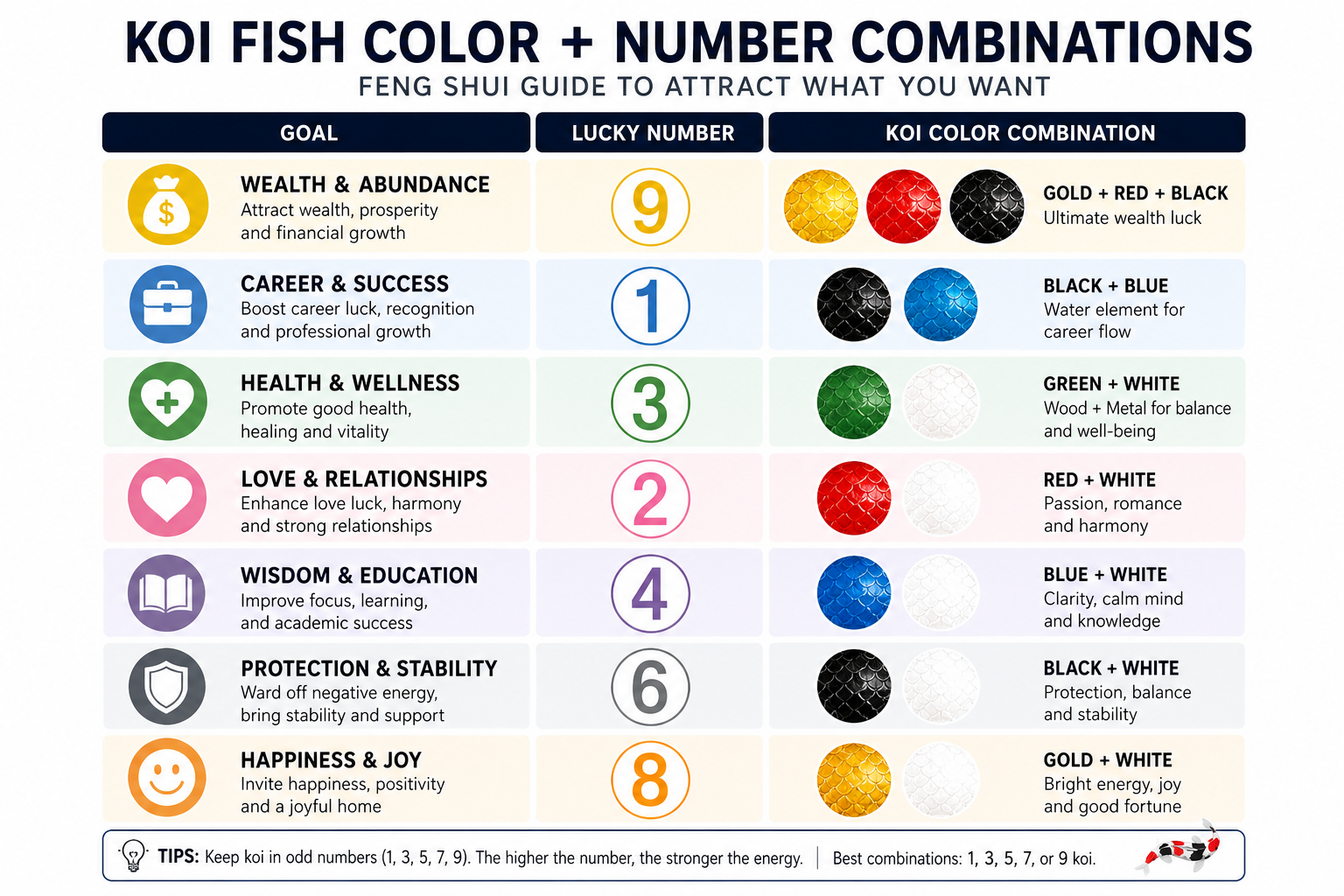
| Koi color | Feng shui energy | Best number | What it attracts |
|---|---|---|---|
| Gold / yellow | Metal element, wealth, sun energy | 8 or 9 (8+1) | Financial abundance, career success |
| Red | Fire element, fame, strong yang energy | 8 or 9 (8+1) | Recognition, success, good fortune |
| Black | Water element, protection, absorbs negativity | 1 (in the 9-koi formula) | Protection, career luck, absorbs bad chi |
| White | Metal element, clarity, purity | 1 or 2 | Spiritual growth, new beginnings, clarity |
| Blue | Water element, wisdom, career | 1 or 6 | Career path, knowledge, inner calm |
| Mixed colors | Balanced chi across multiple life areas | 3, 6, or 9 | Overall life harmony; all sectors activated |
Feng shui bagua placement guide for koi ponds
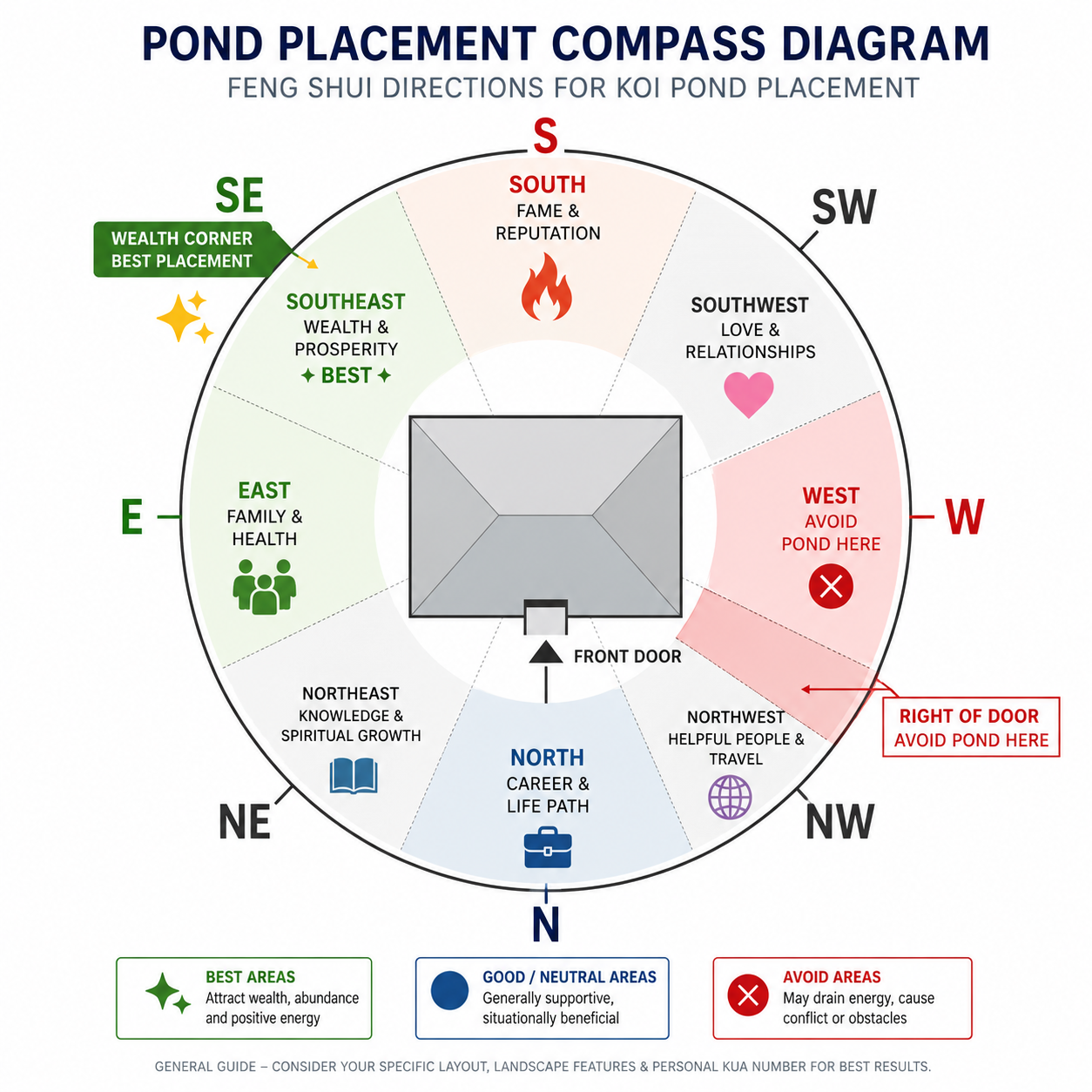
The bagua map (八卦, bā guà) is the feng shui energy map overlaid on any space — home, garden, office — to identify which sectors govern which areas of life. Placing your koi pond or koi painting in the correct bagua sector dramatically amplifies its specific benefit.
| Bagua sector | Direction | Life area governed | Best koi arrangement |
|---|---|---|---|
| Xun (巽) ⭐ | Southeast | Wealth & prosperity | 9 koi (8 gold/red + 1 black) — primary wealth remedy |
| Kan (坎) ⭐ | North | Career & life path | 1 or 6 black or blue koi — water element doubles career energy |
| Kun (坤) | Southwest | Love & relationships | 2 koi (red + white or black + white) — relationship harmony |
| Zhen (震) | East | Health & family | 3 koi in green or blue — wood element, family harmony |
| Qian (乾) | Northwest | Helpful people & travel | 6 koi in gold or white — heaven luck, mentor energy |
| Bedroom ✗ | Any | Avoid | Strong water energy disturbs rest and sleep |
| Kitchen ✗ | Any | Avoid | Water element conflicts with the kitchen’s fire element |
How to apply the bagua map to your home or garden
- Stand at your front door facing inward — this is the starting reference point.
- The area directly ahead and to the left is typically the southeast (Xun — wealth sector) in the simplified BTB bagua used by most Western feng shui practitioners.
- For your garden: use a compass to identify the true southeast corner of your property — this is the most auspicious location for a koi pond.
- Koi should swim toward the center of the space — facing the fish toward the home’s interior symbolizes wealth flowing inward rather than outward.
Indoor koi aquarium feng shui — southeast corner placement
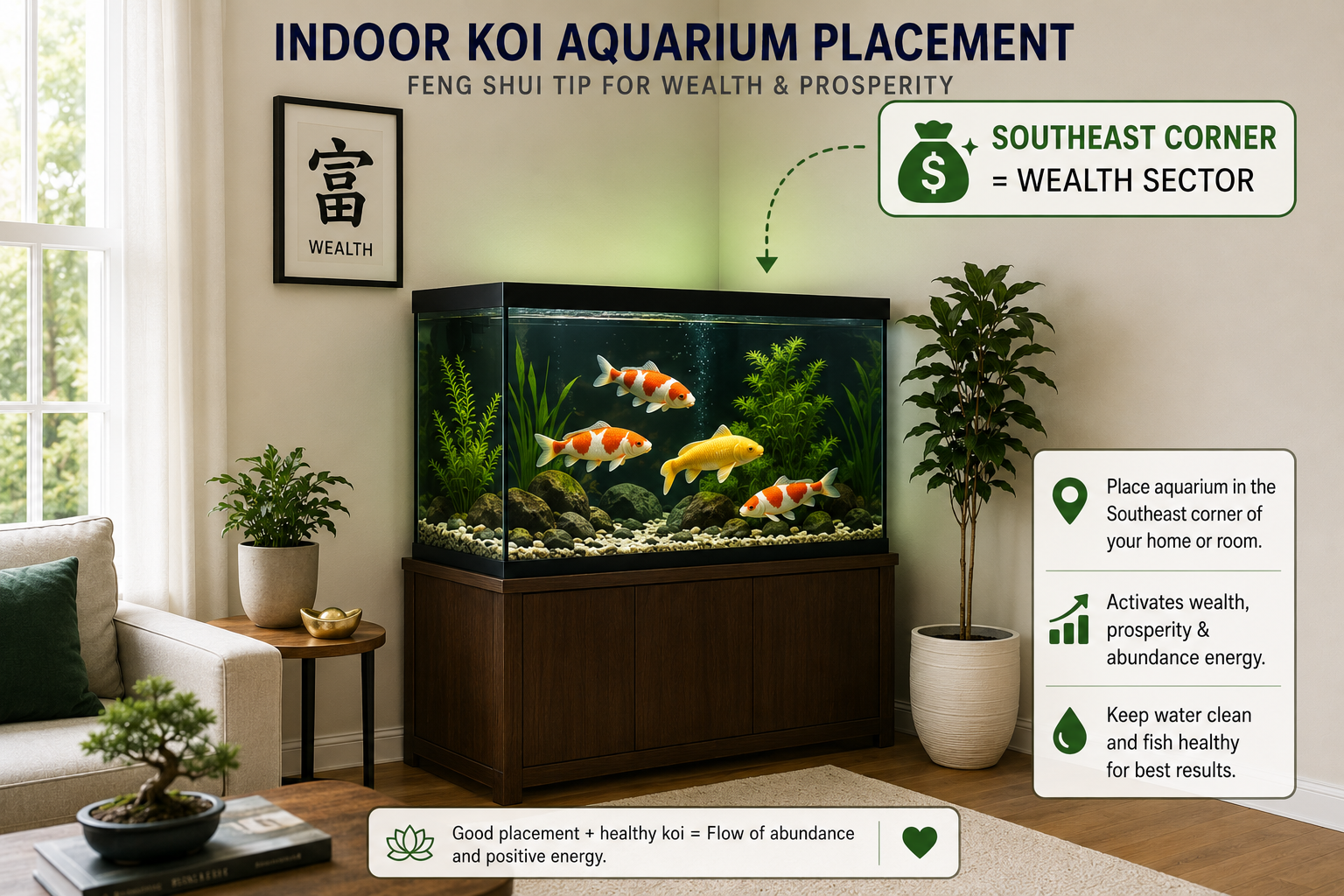
Not everyone can build an outdoor pond. An indoor koi aquarium — properly set up and placed — carries the same feng shui power as a pond. Here is how to maximize it:
- Placement: Southeast corner of your living room, home office, or business — the Xun (wealth) sector of the bagua. If southeast is not possible, the north sector (Kan — career) is the second-best choice.
- Number: Apply the same lucky numbers — 9 koi (8 red/gold + 1 black) for maximum wealth energy. For smaller tanks, 2 (love) or 6 (career) work well.
- Size matters: The larger the water volume, the stronger the water element’s feng shui energy. A 100-gallon tank is significantly more energetically powerful than a 30-gallon one.
- Keep water moving: A filter return or small powerhead keeps water in constant motion — representing the continuous flow of wealth energy. Still water in feng shui represents stagnant chi.
- Keep it clean: Cloudy, dirty water in a feng shui aquarium is considered extremely inauspicious — it represents polluted fortune. Maintain crystal-clear water at all times.
- Lighting: A well-lit aquarium is more auspicious than a dim one — light represents Yang energy and activity. Use full-spectrum LED lighting that makes your koi colors pop.
What to do when a koi fish dies — feng shui guidance
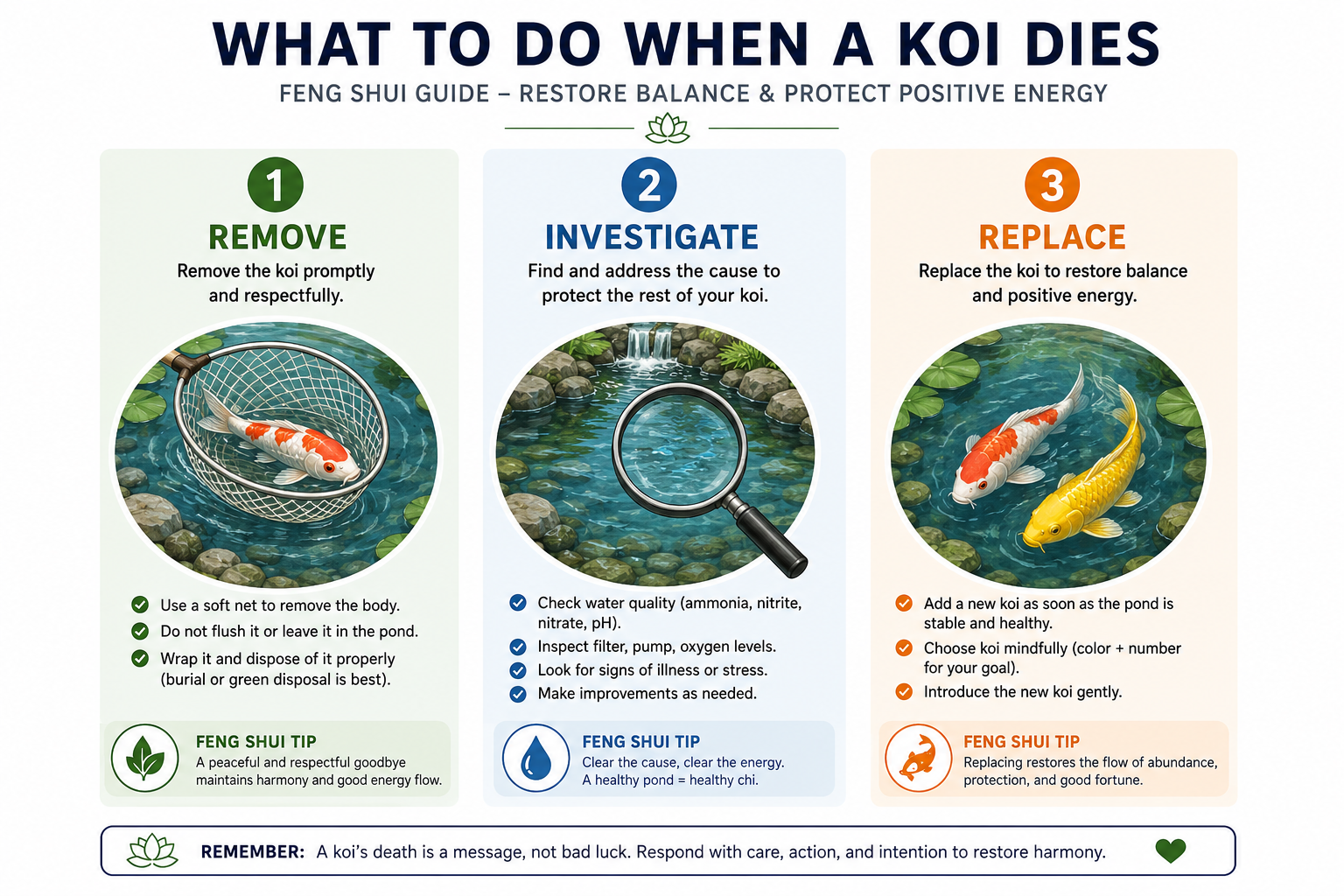
One of the most frequently asked feng shui questions about koi is: what does it mean when a koi fish dies, and what should I do?
In Chinese and feng shui tradition, the death of a koi fish is not considered straightforwardly bad luck. Instead, it carries a specific and reassuring interpretation: the koi absorbed negative energy or misfortune that was headed toward your household, and sacrificed itself in the process. The fish took the blow so you did not have to.
This is especially believed when the black koi in a 9-fish arrangement dies — the protector fish absorbs enough negative energy that it cannot survive. Its death is considered the ultimate act of protection.
What to do when a koi dies in feng shui
- Remove the fish promptly. A dead fish in the pond generates negative energy — remove it as soon as it is found.
- Check water quality immediately. A koi death is often a water quality signal. Test ammonia, nitrite, pH, and dissolved oxygen. Address any issues before adding a replacement.
- Express gratitude. In Chinese tradition, acknowledge the koi’s sacrifice — it protected you. Some practitioners burn incense near the pond as a gesture of respect.
- Replace the fish to restore the lucky number. The feng shui arrangement is incomplete until the number is restored. Replace with the same color as the fish that died — if your black koi died, replace with another black koi.
- Do not be afraid. The death of a koi is considered protective, not ominous. Focus on maintaining the health of the remaining fish and restoring the arrangement.
Practical guide — stocking for luck AND fish health
Lucky numbers mean nothing if your koi are sick, stressed, or overcrowded. The feng shui intention behind your pond is always best supported by fish that are thriving. Here is how to balance the symbolic with the practical:
| Lucky number | Minimum pond size | Assumes koi size | Notes |
|---|---|---|---|
| 1–2 koi | 500 gallons | Adult 12–18 inch koi | Comfortable for a pair; allows growth room |
| 3–6 koi | 1,000–1,500 gallons | Adult 12–18 inch koi | Standard home pond range; good filtration essential |
| 8–9 koi | 2,000–3,000 gallons | Adult 12–18 inch koi | The classic lucky arrangement needs significant water volume |
| 9 koi (jumbo) | 5,000+ gallons | Large koi 24–36 inch | For premium show fish; museum-quality pond required |
The golden rule: 10 gallons of water per 1 inch of fish length. A 9-koi pond of medium-sized fish (15 inches each = 135 total inches) requires a minimum of 1,350 gallons just for the fish — plus filter buffer, water changes, and growth room. Plan for at least 2,000–3,000 gallons for a healthy 9-koi pond.
The most important feng shui rule
Sick koi carry negative energy regardless of their number or color. A sick fish is the opposite of an auspicious feng shui symbol — it represents failing fortune, not rising fortune. The most powerful thing you can do for the feng shui of your pond is maintain excellent water quality, feed well, and prevent disease. A thriving pond of three healthy koi outperforms a struggling pond of nine stressed ones every time.
Frequently asked questions
What is the lucky number of koi fish in a pond?
The luckiest number is 9 — eight red or gold koi plus one black koi. Nine represents completeness and eternal abundance in Chinese numerology. Eight attracts wealth; the black koi protects it. Other auspicious numbers: 2 (love and partnership), 6 (heaven luck), and 8 (wealth).
Why is 9 koi fish lucky?
Nine (九, jiǔ) sounds like the Chinese word for long-lasting (久, jiǔ) — representing eternity and completeness. The formula of 8+1 combines the wealth energy of eight (sounds like prosper, 发, fā) with the protective power of the black koi that absorbs negative energy. Together they create a complete, protected prosperity arrangement.
Is 8 koi fish lucky?
Yes — eight is the luckiest number in Chinese numerology because it sounds like the word for prosperity (发, fā). Eight red or gold koi is one of the most powerful wealth feng shui arrangements. Adding one black koi to complete nine is considered even more auspicious — it protects the wealth the eight fish attract.
What does 2 koi fish mean in feng shui?
Two koi represent love, partnership, and yin-yang balance. The yin-yang symbol is believed to originate from two koi swimming together — one black (yin), one white (yang). Two koi is the classic relationship feng shui symbol. Best placed in the southwest sector (Kun — love and relationships) of your home or garden.
Where should I place koi fish for good feng shui?
Southeast sector (Xun) = wealth and prosperity — the primary placement for 9 koi. North sector (Kan) = career and life path — place 1 or 6 blue or black koi here. Avoid: bedroom (disrupts sleep) and kitchen (water conflicts with fire). Koi should always swim toward the center of your space — symbolizing wealth flowing inward.
What is the luckiest color of koi fish?
Gold and red are the luckiest koi colors in feng shui — they represent financial wealth, the sun, fire energy, and achievement. In the classic 9-koi arrangement, eight red or gold koi attract wealth while one black koi provides protection.
Can I have an odd number of koi fish?
Yes — odd numbers are considered yang (active, positive) energy in Chinese and Japanese tradition. The most auspicious odd numbers are 1, 3, 7, and especially 9. Even numbers are also auspicious — particularly 2 (love) and 8 (wealth). The most important consideration is always fish health and pond capacity.
Does the number of koi fish actually matter?
In feng shui and Chinese tradition, yes — specific numbers carry specific energetic intentions. But fish health always comes first. A thriving pond of three healthy koi generates better energy than an overcrowded pond of nine stressed ones. Fortune follows fish that thrive.
Related koi feng shui and meaning guides
- 9 koi fish meaning — the complete feng shui prosperity guide
- 2 koi fish meaning — yin-yang and partnership symbolism
- Koi fish meaning — complete symbolism guide
- Koi fish color meaning — what each color symbolizes
- Black koi fish meaning — why the black koi protects your pond
- Why koi fish are symbols of good luck and prosperity
- Koi pond water quality guide — keeping your lucky koi healthy
- Koi pond design guide — building the perfect feng shui pond
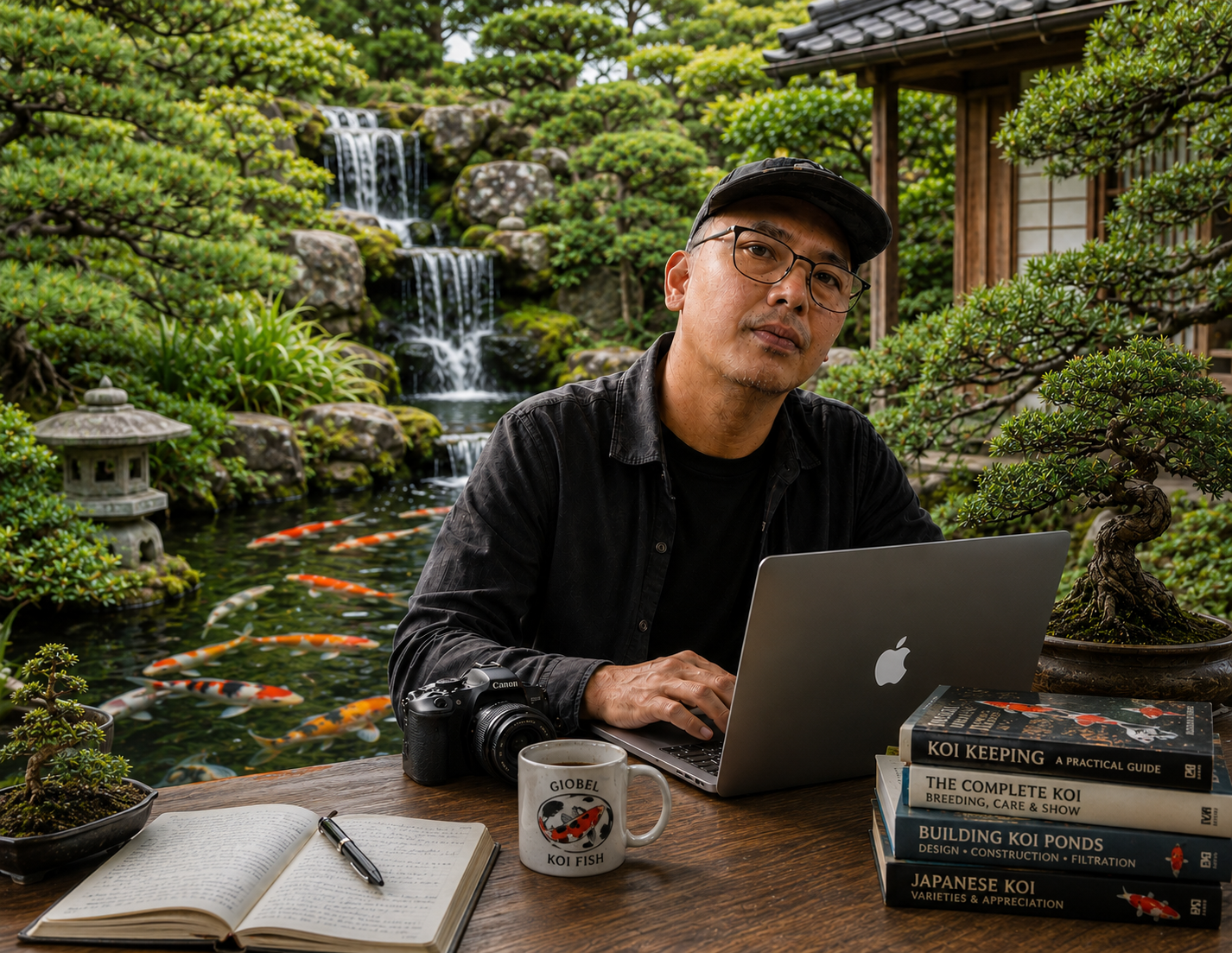
Giovanni Carlo Bagayas
Founder, Giobel Koi Center · Koi keeper since the 1980s · Labangan, Zamboanga del Sur, Philippines
Giovanni has been keeping and breeding ornamental koi since the 1980s — over 40 years of experience. His personal pond has featured the 9-koi feng shui arrangement for years, and he writes from lived experience about how number, color, and placement work together in a real koi pond rather than as abstract theory.

Passionate about fish keeping since elementary school in the 1980s, Giovanni Carlo has dedicated countless hours to collecting and breeding a diverse array of ornamental freshwater fish. From vibrant guppies and majestic koi to striking bettas and classic goldfish, he continues to explore the fascinating world of aquatics, sharing knowledge and enthusiasm with fellow fish enthusiasts.