By Giovanni Carlo Bagayas | Updated: June 2026 | 16 min read
Quick Answer
To breed goldfish: condition a pair with live foods for 2–3 weeks → set up a 20–30 gallon breeding tank with spawning mops → gradually raise temperature to 68–74°F to trigger spawning → males chase female until she releases eggs → remove adults immediately → treat with methylene blue → eggs hatch in 4–7 days → feed fry infusoria then baby brine shrimp. The entire process from setup to free-swimming fry takes about 3–4 weeks. The most common mistake: leaving adults in the tank after spawning — they will eat every egg.
Watch Giovanni’s complete goldfish breeding video — covering hand-breeding technique, sexing, spawning, and fry care from his own breeding program.
What you need to breed goldfish
| Item | Specification | Why it matters |
|---|---|---|
| Breeding pair | 1 female + 2–3 males; aged 1–3 years | Multiple males increase fertilization rate; peak reproductive age is 1–3 years |
| Breeding tank | 20–30 gallons minimum | Enough space for chasing behavior without stressing fish into walls |
| Filter | Sponge filter only | Power filters will suck up eggs and fry — sponge filter provides gentle circulation safely |
| Spawning mops / plants | Yarn mops, Anacharis, Java moss, or hornwort | Sticky eggs need something to adhere to — bare tank walls produce poor results |
| Thermometer | Accurate digital preferred | Temperature control is the primary spawning trigger — precision matters |
| Methylene blue | Antifungal treatment | Prevents fungal infection spreading from dead eggs to live eggs — critical |
| Fry food | Infusoria / liquid fry food → baby brine shrimp | Fry mouths are too tiny for regular food — wrong food at this stage = starvation |
| Fry tank | Separate 10–20 gallon grow-out tank | Move fry once large enough — keeps grow-out conditions optimal |
How to sex goldfish — male vs female
Sexing goldfish accurately is only reliable during breeding season (spring). Outside of spawning condition, the differences are subtle and easy to misread. Here is what to look for:
| Feature | Male goldfish | Female goldfish |
|---|---|---|
| ⭐ Breeding tubercles | White pimple-like dots on gill covers and pectoral fin leading rays — look like grains of salt. Present during breeding season only. | No tubercles — ever |
| Body shape (from above) | Slimmer, more streamlined when viewed from above | Noticeably rounder and plumper — especially when carrying eggs |
| Vent (near anal fin) | Concave (pushed inward) | Convex (pushed slightly outward) when full of eggs |
| Behavior | Chases female persistently; nudges her belly | Swims more slowly; retreats from male chasing |
| Reliability outside breeding season | Very low — tubercles disappear | Low — belly roundness varies and is not definitive |

Male goldfish breeding tubercles — white pimple-like dots on gill covers and pectoral fins. Run your finger over the gill cover; rough sandpaper texture = male in breeding condition.

Gravid female goldfish — visibly swollen, rounded belly when viewed from above or the side. This is the signal she is carrying eggs and ready to spawn.
From 40+ years of goldfish breeding
The tubercle check is the only method I trust 100%. I run my finger lightly along the gill covers — if I feel a rough, sandpaper-like texture with tiny white bumps, that’s a male in breeding condition. Smooth gill covers in spring almost certainly means female. Outside of breeding season I don’t try to sex my goldfish at all — body shape alone has fooled me too many times over the years.
Step-by-step breeding guide (8 steps)
Select and condition your breeding pair
Choose healthy goldfish aged 1–3 years — this is their reproductive prime. Select 1 female and 2–3 males (multiple males increase fertilization rate significantly). For 2–3 weeks before breeding, feed high-protein live or frozen foods: brine shrimp, bloodworms, and daphnia. This conditioning builds egg quality in the female and increases milt production in males. Do 20% daily water changes during conditioning to maintain peak water quality.
Separate males and females for 3 days
Before moving them to the breeding tank, separate males and females into different tanks for 3 days. This builds reproductive urgency — when reunited, both sexes show stronger spawning drive. This is a professional breeders’ technique that significantly improves spawning success rates.
Set up the breeding tank
Fill a 20–30 gallon tank with aged, dechlorinated water at 65–68°F (18–20°C). Install a sponge filter — power filters will suck up eggs and fry. Add spawning mops or fine-leaf plants (Anacharis, Java moss, hornwort) for egg attachment. A bare bottom is ideal for easy cleaning. Set up a timer for 12–14 hours of light daily to simulate spring.

Trigger spawning with temperature and water changes
Gradually raise water temperature by 2°F per day until reaching 68–74°F (20–23°C). Do daily 20% water changes using water that is 2–3°F cooler than the tank — this simulates spring rain and is a powerful spawning trigger. Continue high-protein feeding. Most goldfish begin spawning within 3–7 days of these conditions being established.
Introduce the breeding pair — early morning
Add the female first, then the males a few hours later — or add all together early in the morning when goldfish are most active. Males will begin chasing the female immediately, nudging her sides and belly to stimulate egg release. This chasing behavior can last several hours and may look aggressive — it is normal. The spawn typically occurs in the early morning hours.

Remove adults immediately after spawning ⚠️
This is the single most critical step. The moment you see eggs on the spawning mops — remove all adult goldfish from the tank immediately. Goldfish have no parental instinct and will eat every egg they can find. Even a few minutes of adults left with eggs can result in total egg loss. Move adults back to their main tank as soon as spawning is confirmed.
Care for the eggs
Add a few drops of methylene blue to prevent fungal infection spreading from dead eggs to live ones. Keep temperature stable at 68–72°F (20–22°C). Remove any white cloudy eggs immediately — these are infertile and will spread fungus. Clear or slightly yellowish eggs are fertile. Eggs hatch in 4–7 days. Do not do water changes or disturb the tank during this period.
Raise the fry
Newly hatched fry (“wrigglers”) attach to tank surfaces and absorb their yolk sac for 24–48 hours. Once they become free-swimming, begin feeding. Feed 4–6 times daily in tiny amounts — overfeeding is the number one fry killer because uneaten food rots and crashes water quality. See the full fry feeding schedule below.
Giovanni’s hand-breeding method
Personal technique — 40+ years of goldfish breeding
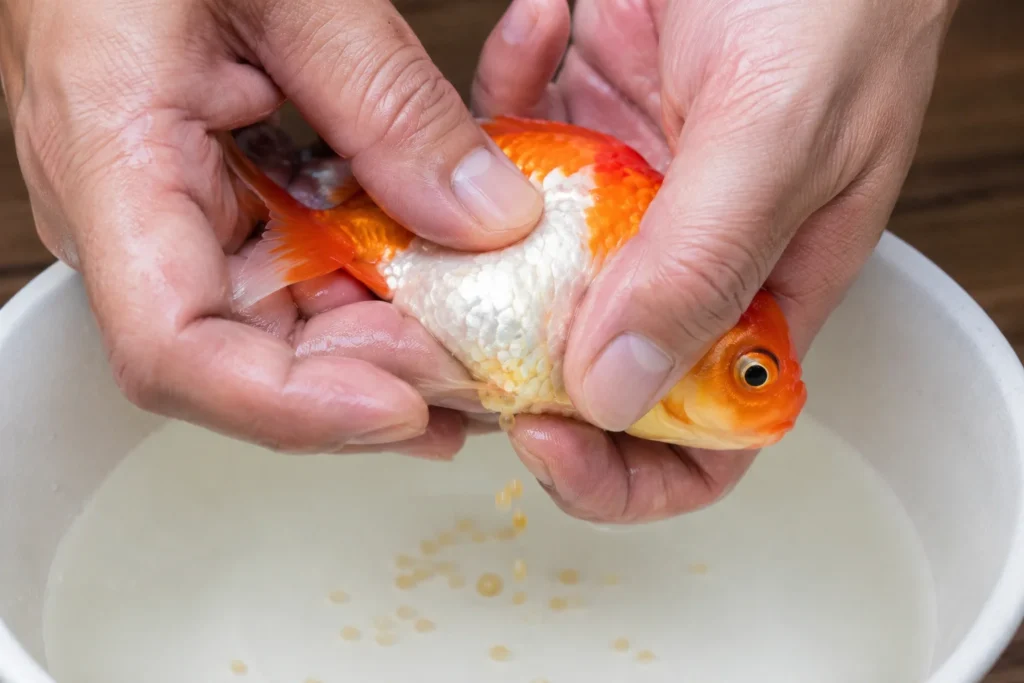
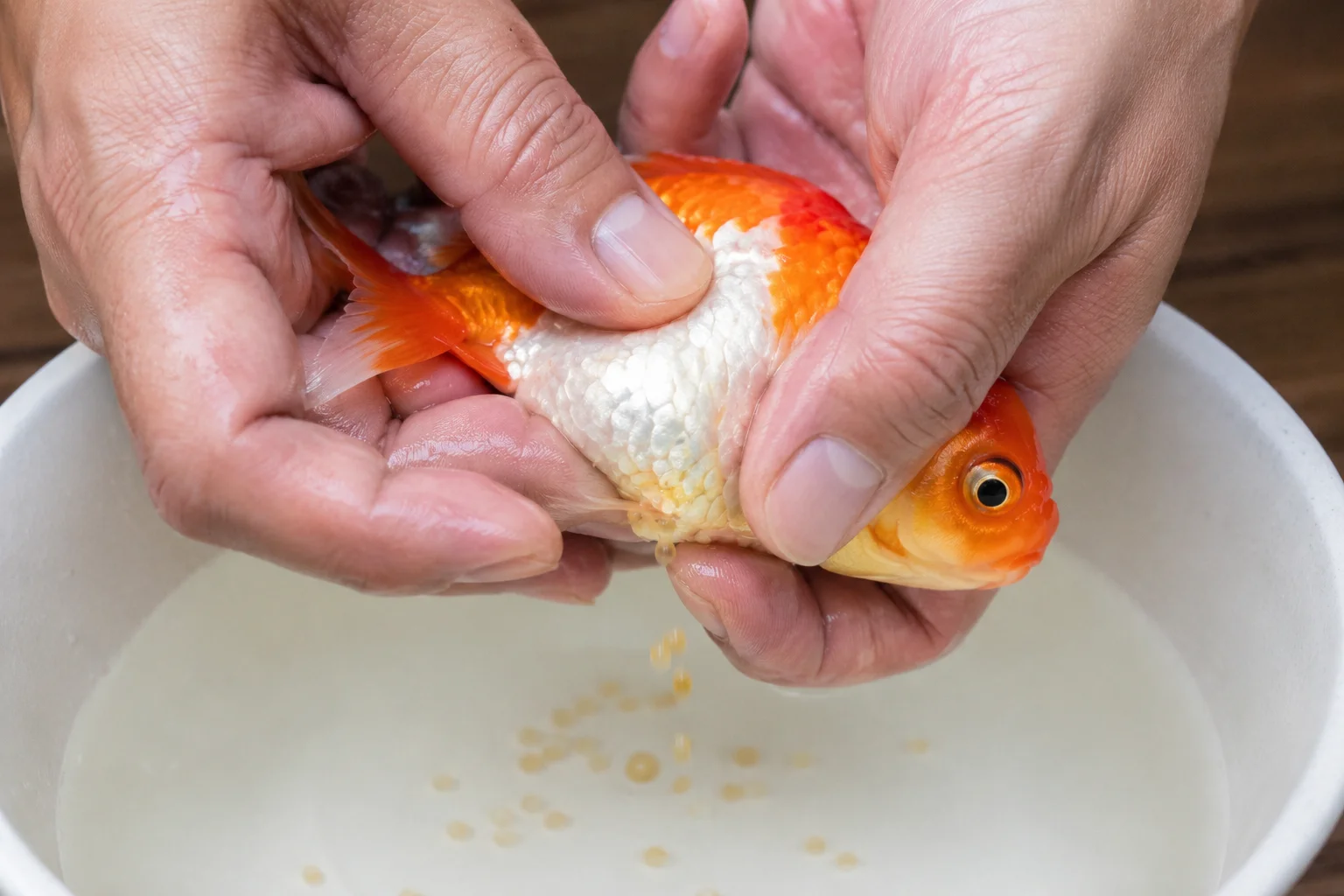
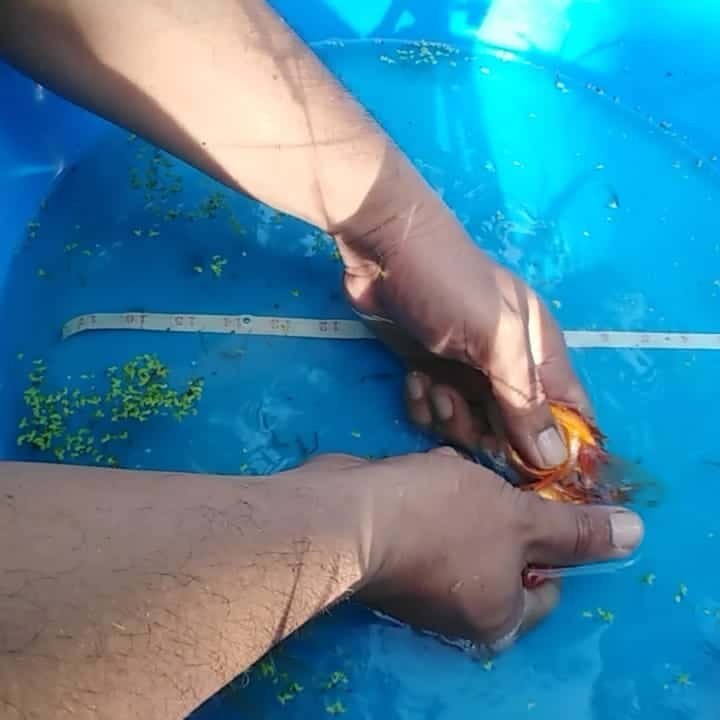
I breed my goldfish using hand breeding — a method that gives me direct control over fertilization and significantly improves success rates over passive pond breeding. Here is exactly how I do it:
- Identify and separate the sexes — I check for tubercles to confirm males and females, then separate them into different tanks.
- Watch the female’s abdomen — when her belly is visibly swollen and rounded, she is ready. This is the signal to proceed.
- Add 2 males to the breeding tank — I check every morning. When I see the males actively chasing the female, I know spawning is imminent.
- Collect the eggs on spawning mops — the sticky eggs attach to the mops within hours of the chase beginning.
- Transfer mops to the fry tank immediately — I move the egg-covered mops to a separate tank that has been prepared with clean aged water and a sponge filter. This completely eliminates the risk of adults eating eggs.
- Feed fry from day 4 — I start feeding 4 days after hatching when the digestive system is fully developed. My preferred first food is hard-boiled egg yolk, daphnia magna, or baby brine shrimp.


This hand-breeding approach is more work than leaving fish to breed naturally in a pond but the results are far more consistent. I have used this method successfully with Comets, Shubunkins, Orandas, and Ryukin.
Spawning triggers — how to simulate spring
Goldfish in the wild breed in spring because of a combination of environmental signals — not just temperature alone. Replicating all three triggers simultaneously produces the fastest and most reliable results:
| Trigger | What to do | Why it works |
|---|---|---|
| ⭐ Rising temperature | Gradually raise 2°F per day from 60°F to 68–74°F over 1–2 weeks | The gradual rise — not just the final temperature — is the primary spawning signal in cyprinids |
| Spring rain simulation | Daily 20% water changes using water 2–3°F cooler than the tank | Mimics cool spring rainfall diluting pond water — a powerful natural breeding trigger |
| Extended daylight | Increase lighting to 12–14 hours daily using a timer | Lengthening days signal spring arrival — photoperiod affects reproductive hormones |
| High-protein conditioning diet | Live brine shrimp, bloodworms, daphnia 2–3 weeks before breeding | Mimics the spring increase in insect and crustacean food availability — conditions reproductive organs |
Egg care — fertile vs infertile, fungus prevention
| Egg appearance | What it means | What to do |
|---|---|---|
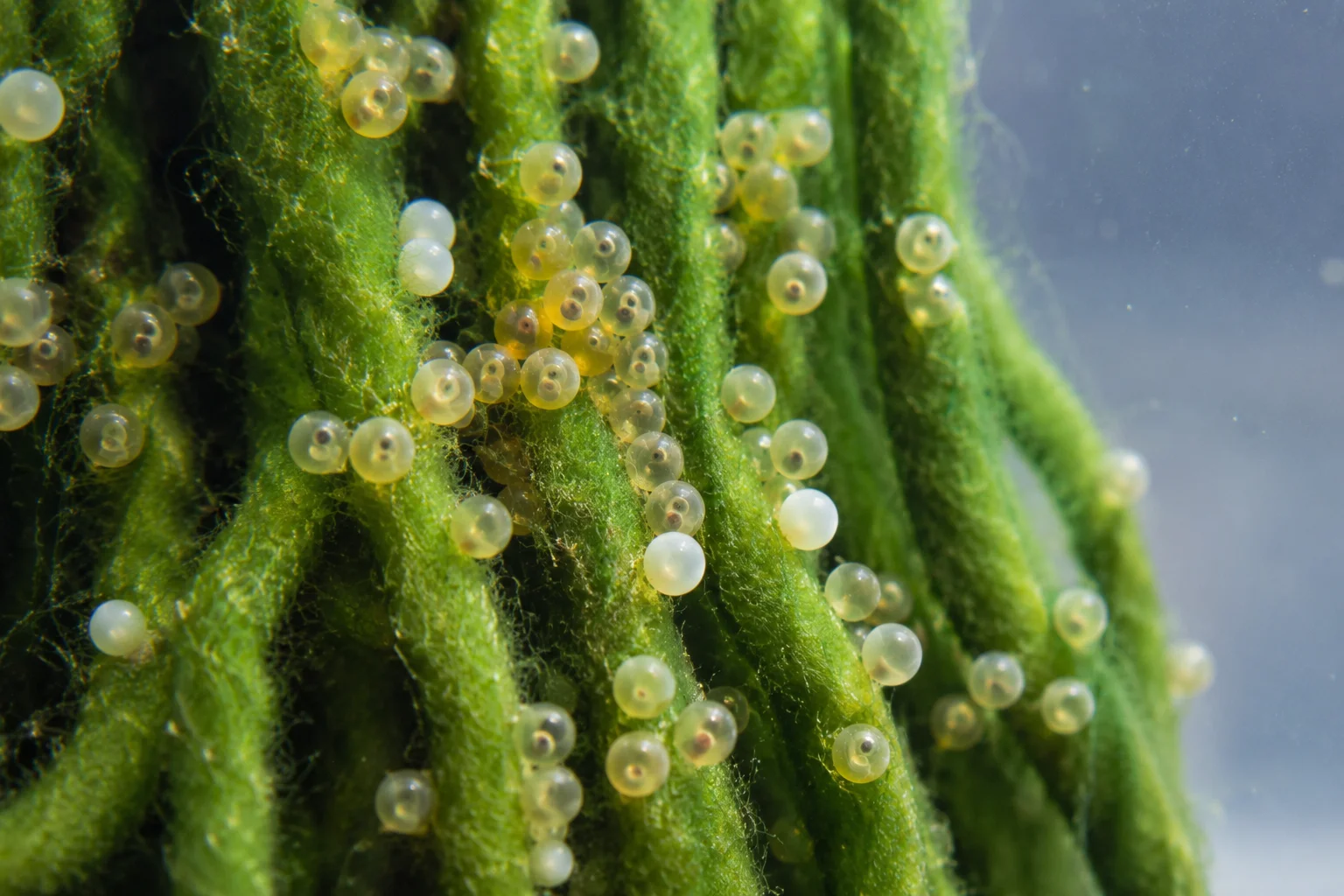
| Clear to yellowish, round | Fertile — healthy egg | Leave undisturbed; maintain stable temperature and gentle aeration |
| White / opaque / cloudy | Infertile — dead egg | Remove immediately using a pipette or fine net — will spread fungus to healthy eggs |
| White with fuzzy growth | Fungal infection | Remove immediately; add methylene blue; check if spreading to nearby eggs |
| Darkening center visible inside | Developing embryo — hatching soon | Leave undisturbed; hatch expected within 24–48 hours |
Methylene blue dosage: Add 1–2 drops per gallon of tank water. The water should turn a light blue color — dark blue means too much. Re-dose every 48 hours until eggs hatch. Methylene blue is safe for developing eggs and will not affect hatching.
| Temperature | Days to hatch | Notes |
|---|---|---|
| 64°F / 18°C | 7–8 days | Slower development — lower deformity risk |
| 68°F / 20°C | 5–7 days | Ideal hatching temperature |
| 72°F / 22°C | 4–5 days | Faster but monitor carefully for deformities |
| 76°F+ / 24°C+ | 3–4 days | Higher deformity rate — avoid if possible |
Fry care — feeding schedule by week
| Stage | What to feed | Frequency | Notes |
|---|---|---|---|
| Days 1–2 (just hatched) | Nothing — absorbing yolk sac | — | Fry attach to tank walls and plants; do not disturb |
| Days 3–7 (free-swimming) | Infusoria, green water, liquid fry food, or boiled egg yolk water | 4–6x daily | Mouths are tiny — only microscopic food works; overfeeding kills via water quality crash |
| Week 2 | Baby brine shrimp (newly hatched), micro worms, daphnia | 4–5x daily | Baby brine shrimp is the gold standard at this stage — high protein, live, appropriately sized |
| Weeks 3–4 | Finely crushed pellets or flakes alongside live foods | 3–4x daily | Begin transitioning to dry food; continue some live food for growth |
| Month 2+ | High-quality goldfish pellets (crushed fine), bloodworms, brine shrimp | 2–3x daily | Fry now look like miniature goldfish; begin culling deformed fish |
| Month 3+ | Standard goldfish diet — quality pellets | 2x daily | Move to grow-out tank or pond when large enough to not be eaten by adults |
⚠️ Number one fry killer — overfeeding
Uneaten food in a fry tank decomposes rapidly, causing ammonia spikes that kill fry within hours. Feed only what fry can consume in 5 minutes. If food remains after 5 minutes — you fed too much. Siphon out any uneaten food immediately after each feeding using a fine pipette or airline tubing.
Breeding fancy goldfish — special considerations
Fancy goldfish (Oranda, Ranchu, Ryukin, Lionhead) can be bred using the same methods above, but require additional considerations:
- Larger breeding tank: Fancy goldfish need more space due to their slower, less agile swimming — use a 30+ gallon tank for fancy varieties.
- Gentler water flow: Fancy goldfish stress easily with strong currents — keep sponge filter flow very gentle.
- Cull aggressively: Fancy goldfish breeding produces a high percentage of single-tailed fish or fish with body shape defects. Professional breeders cull at 3–4 weeks, keeping only fish that show correct body conformation for their variety.
- Wen protection: In Oranda and Lionhead breeding, monitor for wen infections in fry as the head growth develops. Keep water quality spotless.
- Ranchu viewing: Ranchu fry should be evaluated from above — their back arch and absence of dorsal fin are the defining characteristics to select for.
Related: Oranda goldfish complete guide | Ryukin goldfish complete guide
Troubleshooting — why goldfish won’t spawn
| Problem | Likely cause | Fix |
|---|---|---|
| No chasing behavior | Temperature not warm enough OR fish not in breeding condition | Continue raising temperature; increase conditioning period to 3–4 weeks; check that you have confirmed males and females |
| Chasing but no eggs | Female not ready; no suitable egg-laying surface; stress | Add more spawning mops; reduce disturbance around the tank; wait longer — chasing can precede spawning by 1–2 days |
| All eggs turn white | No males OR males not releasing milt (too cold, poor condition) | Verify males with tubercle check; improve male conditioning; check temperature is in spawning range |
| Eggs hatch but fry die within days | Overfeeding causing ammonia spike; wrong food size; temperature fluctuation | Feed less; use infusoria or liquid food only; stabilize temperature; check ammonia daily |
| Female being harassed excessively | Too many males; female not ready; spawning going on too long | Separate female for 24 hours rest; reduce to 1–2 males; ensure female has hiding spots |
Frequently asked questions
How do you breed goldfish?
Condition a pair with live foods for 2–3 weeks → set up a 20–30 gallon breeding tank with spawning mops and a sponge filter → gradually raise temperature to 68–74°F → introduce 1 female and 2–3 males → remove adults immediately after eggs are laid → treat with methylene blue → eggs hatch in 4–7 days → feed fry infusoria then baby brine shrimp.
How can you tell if a goldfish is male or female?
During breeding season: males develop white tubercles (pimple-like dots) on gill covers and pectoral fins. Females appear rounder from above when full of eggs. Run your finger along the gill cover — rough sandpaper texture = male, smooth = likely female. Sexing is very unreliable outside of breeding season.
What temperature do goldfish breed at?
68–74°F (20–23°C) is the ideal breeding temperature. Start cooler at 60–65°F and gradually raise by 2°F per day — the rising temperature itself is the spawning trigger, not just the final temperature. At 72°F eggs hatch in 4–5 days; at 68°F they take 5–7 days.
How many eggs do goldfish lay?
200–1,000 eggs per spawning event typically; large mature females can release up to 10,000 eggs. Clear to yellowish eggs are fertile. White cloudy eggs are infertile — remove immediately as they spread fungus to healthy eggs.
How long does it take for goldfish eggs to hatch?
4–7 days depending on temperature. At 72°F — 4–5 days. At 68°F — 5–7 days. Keep temperature stable throughout incubation. Temperatures above 76°F increase the risk of developmental deformities.
What do you feed goldfish fry?
Days 1–2: nothing (yolk sac). Days 3–7: infusoria, green water, or liquid fry food. Week 2: baby brine shrimp or micro worms. Week 3–4: finely crushed pellets. Feed 4–6 times daily in tiny amounts — overfeeding is the #1 fry killer because uneaten food crashes water quality.
What is a spawning mop and how do you make one?
A bundle of soft yarn or artificial fibers that mimics aquatic plants for egg attachment. Wrap dark green acrylic yarn around a book 50 times, tie the middle, cut the loops, attach a cork to float it. Alternatively use Anacharis, Java moss, or hornwort — goldfish readily lay eggs on all of these.
How often do goldfish breed?
Every 2–4 weeks during breeding season (April–August in Northern Hemisphere). In tropical climates like the Philippines, goldfish can breed more frequently year-round with proper water temperature and light management.
Related goldfish guides
- Types of goldfish — which variety to breed
- Koi vs goldfish — breeding comparison
- Oranda goldfish — breeding the fancy king
- Ryukin goldfish — breeding guide
- Lionhead goldfish — breeding considerations
- Shubunkin goldfish — easiest goldfish to breed
- Best food for conditioning goldfish before breeding
- Water quality guide — critical for fry survival

Giovanni Carlo Bagayas
Founder, Giobel Koi Center · Goldfish breeder since the 1980s · Labangan, Zamboanga del Sur, Philippines
Giovanni has bred goldfish for over 40 years using his personal hand-breeding method — separating sexes, monitoring female condition, and transferring egg-covered spawning mops to dedicated fry tanks for maximum survival rates. He has bred Comets, Shubunkins, Orandas, and Ryukin successfully and shares the exact techniques he uses in his own breeding program.

Passionate about fish keeping since elementary school in the 1980s, Giovanni Carlo has dedicated countless hours to collecting and breeding a diverse array of ornamental freshwater fish. From vibrant guppies and majestic koi to striking bettas and classic goldfish, he continues to explore the fascinating world of aquatics, sharing knowledge and enthusiasm with fellow fish enthusiasts.