Koi Fish Meaning: Complete Guide to Symbolism, Colors, and Cultural Significance
By Giovanni Carlo Bagayas | Updated: June 2026 | 18 min read
Quick Answer
Koi fish symbolize perseverance, good luck, wealth, love, courage, and transformation. In Japanese culture they represent the Dragon Gate legend — a koi that swims upstream through impossible obstacles and transforms into a dragon. In Chinese culture the word for fish (鱼, yú) is a homophone for abundance (余, yú), making koi a universal wealth symbol. In feng shui, nine koi (8 red + 1 black) attract lasting prosperity. Each koi color carries a different meaning — red for love, gold for wealth, black for overcoming adversity, white for purity — and the direction a koi swims (upstream vs downstream) adds another layer of meaning in tattoos and art.
What koi fish mean — 12 core symbols
Koi fish carry one of the richest symbolic vocabularies of any animal in human culture. Below are the 12 core meanings that koi have represented across centuries and cultures — the foundation of everything else in this guide.
| # | Symbol | Origin | Why koi represent this |
|---|---|---|---|
| 1 | Perseverance | Japanese / Chinese | Koi swim against strong currents; the Dragon Gate legend makes them the ultimate symbol of not giving up |
| 2 | Good luck | Chinese / Pan-Asian | Fish (鱼, yú) is a homophone for abundance (余, yú) — keeping or displaying koi literally invites surplus into your life |
| 3 | Wealth and prosperity | Chinese / Feng Shui | Gold koi and koi in water amplify the water element’s wealth energy in feng shui; nine koi is the classic prosperity remedy |
| 4 | Transformation | Japanese / Chinese | The koi that becomes a dragon at the Dragon Gate is the most powerful transformation metaphor in East Asian mythology |
| 5 | Love and partnership | Chinese / Buddhist | Two koi together = yin and yang in living form; one of the Eight Auspicious Symbols for conjugal happiness |
| 6 | Courage and bravery | Japanese (Samurai) | Koi face the current without flinching — samurai culture made the koi a symbol of the bushido warrior spirit |
| 7 | Longevity | Japanese / Chinese | Koi live 25–200+ years; a 226-year-old koi named Hanako is historically documented |
| 8 | Abundance and fertility | Chinese / Pan-Asian | Koi spawn hundreds of thousands of eggs; they are among nature’s most prolific fish — making them fertility symbols |
| 9 | Balance and harmony | Taoist / Buddhist | The yin-yang symbol derives from two koi — black and white — swimming in perfect, endless balance |
| 10 | Strength and resilience | Universal | Koi thrive in nearly every condition, survive harsh winters, and live for generations — embodying quiet, enduring strength |
| 11 | Freedom and independence | Universal / Buddhist | Fish move freely in all directions without obstacles — in Buddhism, fish represent freedom from the ocean of suffering |
| 12 | Success and achievement | Chinese / Japanese | The koi that reaches the Dragon Gate achieves the ultimate prize — transformation into the most powerful creature in mythology |
From 40+ years of keeping koi
I started keeping koi in the 1980s as a young boy in Cebu, Philippines. What I did not understand then — but understand deeply now — is that koi are not merely beautiful fish. They are living philosophy. Every time a koi swims against the current in my pond, I am reminded of that ancient story. The fish does not know the legend about itself. It simply keeps swimming. That is the meaning.
The Dragon Gate legend — the origin of koi symbolism
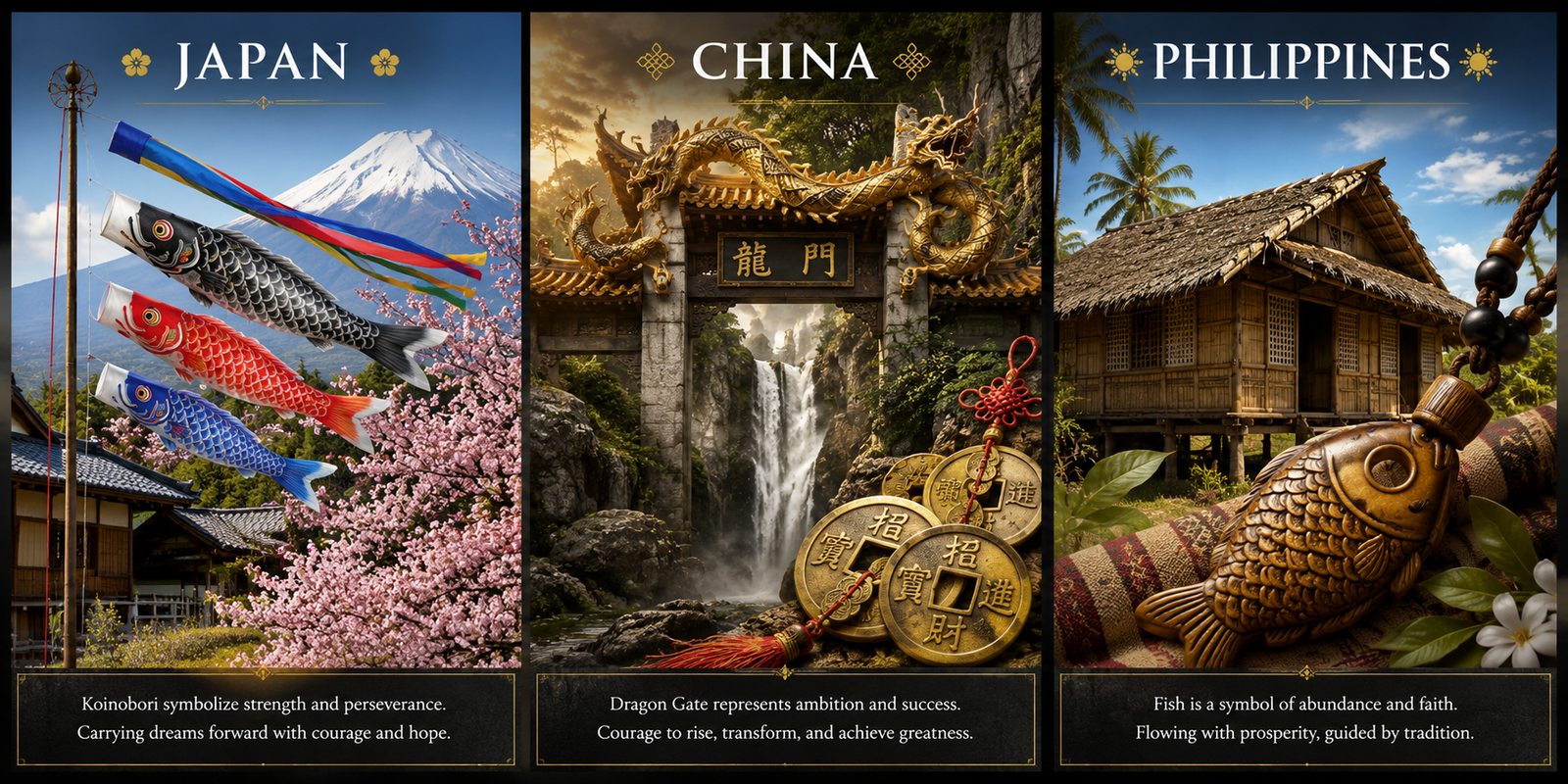
To understand what koi fish truly mean, you must know the Dragon Gate legend. Every piece of koi symbolism — perseverance, transformation, achievement, courage — flows from this single ancient story.
The legend originates in ancient China and is set on the Yellow River (黄河, Huáng Hé). A great school of koi swims upstream against the powerful current — “shining like polished jewels,” according to the oldest texts. After climbing a long series of rapids, the koi reach a great waterfall called the Dragon Gate (龍門, Lóng Mén) at the top of a mountain.
The waterfall is enormous. Most of the koi, exhausted from the journey, turn back and return downstream. But some remain. They leap again and again, hurling themselves against the falling water. According to one version of the legend, local deities — seeing the koi’s determination — made the waterfall even higher out of spite, testing whether the fish would quit.
One koi does not quit. After years of effort, it gathers everything it has and leaps — and clears the Dragon Gate. The gods, watching from above, are moved by its extraordinary perseverance. They reach down and transform the koi — not back into a fish, but into a golden dragon: the most powerful, most auspicious creature in all of Chinese mythology.
This legend is why koi are displayed in homes, temples, and gardens across East Asia. It is why koi tattoos cover the arms of people who have survived something enormous. It is why a koi pond in a business brings good fortune. The koi is not just a fish — it is the physical embodiment of the human experience of struggle, persistence, and the transformation that only comes from refusing to give up.
For the full story with all variations: Koi Fish Dragon Legend — Full Story and Symbolism.
Koi fish color meaning — complete color chart
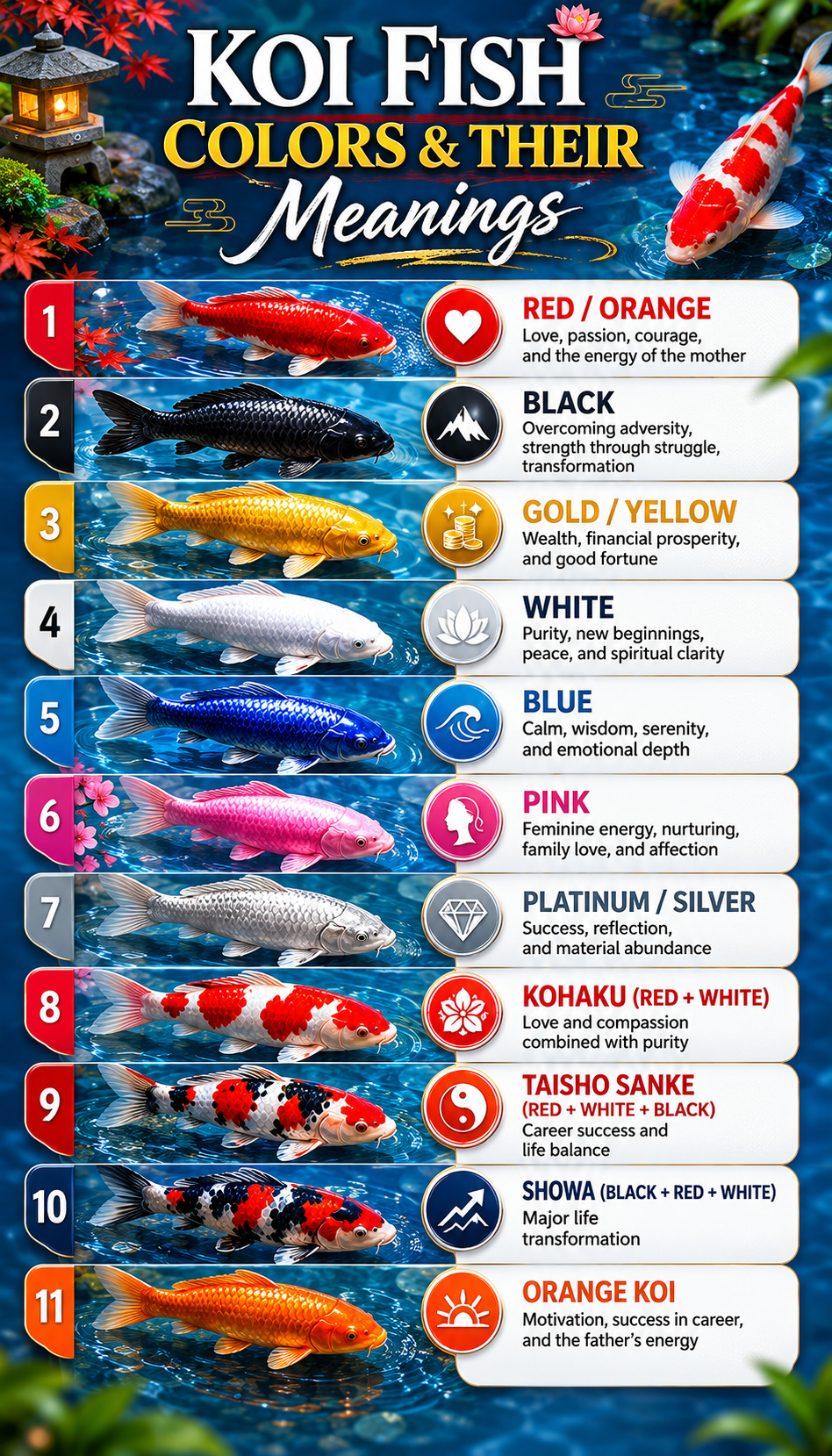
Color is the primary language of koi symbolism. In Japanese, Chinese, and feng shui traditions, the color of a koi is not just aesthetic — it defines what the fish represents, what energy it carries, and what intentions it serves. Here is the complete color meaning reference:
| Koi color | Primary meaning | Japanese meaning | Feng shui / Chinese meaning | Family symbol |
|---|---|---|---|---|
| 🔴 Red koi | Love, passion, courage, bravery | Power, strength, intense emotion | Fire element, success, fame | Mother of the family |
| ⬜ White koi | Purity, spirituality, new beginnings | Career success, spiritual enlightenment | Metal element, clarity, fresh starts | Son (firstborn) |
| 🟡 Gold / yellow koi | Wealth, prosperity, financial success | Fortune, riches (Yamabuki Ogon) | Metal element, gold, abundance | — |
| ⬛ Black koi | Overcoming adversity, transformation | Strength through struggle, rebirth | Water element, protection, absorbs negativity | Father of the family |
| 🔵 Blue koi | Calmness, serenity, tranquility | Peace, reproduction (Asagi) | Water element, wisdom, career | Son (second) |
| 🟠 Orange koi | Vitality, energy, enthusiasm | Zest for life, optimism | Fire element, passion, relationships | Mother (alternate) |
| 🩷 Pink koi | Femininity, tenderness, love | Daughter symbol in koinobori | — | Daughter |
| 🤍 Platinum / cream koi | Success, elegance, achievement | Refinement, high status (Platinum Ogon) | Metal element, prestige | — |
| 🟢 Green koi | Growth, nature, harmony | Wood element energy, renewal | Wood element, health, family | — |
For a deep dive into each color: The Meaning Behind Koi Fish Colors — Complete Guide.
Koi fish meaning in Japanese culture
Japan’s relationship with koi is deeper than any other culture. Koi (Nishikigoi — “brocaded carp” or “living jewels”) were declared a living national treasure of Japan in the 1960s. No other fish in the world holds this designation.
Koi in Japanese legend — the samurai connection
When the Dragon Gate legend arrived in Japan from China, Japanese culture gave it a distinctly samurai dimension. The koi’s upstream struggle became synonymous with the bushido code — the way of the warrior. A koi does not turn back when the current is strong. It does not stop when the waterfall is higher than it can leap. It faces each obstacle without flinching, keeps moving forward, and never surrenders. This is the essence of bushido, and why koi were painted on samurai armor, weapons, and battle standards.
Koinobori — Children’s Day koi windsocks
Every year on May 5 — Children’s Day (Kodomo no Hi) — Japanese families fly koinobori: colorful, koi-shaped windsocks that billow in the wind like koi swimming upstream. The tradition is a direct invocation of the Dragon Gate legend — parents wish their children the perseverance, courage, and determination of the koi:
- The largest koinobori (black or dark blue) represents the father
- The second koinobori (red) represents the mother
- Smaller koinobori represent each child in descending size order
Koi as national identity
The center of koi breeding remains Ojiya City in Niigata Prefecture — a region that has produced championship Nishikigoi for over 200 years. Koi bred here — particularly Kohaku, Sanke, and Showa varieties — sell for tens to hundreds of thousands of dollars at auction. The most expensive koi ever sold — a 101cm Kohaku — was purchased for $1.8 million USD in 2018 at a Japanese koi show.
Related: Koi Fish in Japanese Culture — Full History and Tradition
Koi fish meaning in Chinese culture
China is where koi symbolism was born. The earliest selective breeding of ornamental carp began in China over 2,000 years ago, and the cultural and spiritual meanings attached to koi fish originated in Chinese philosophy, mythology, and language.
The linguistic root — fish = abundance
The single most important reason koi are lucky in Chinese culture is linguistic: the Chinese word for fish — 鱼 (yú) — is a perfect homophone for the word meaning surplus, abundance, and plenty — 余 (yú). Because the words sound identical, displaying a fish literally invokes the word “abundance” into your space. This linguistic luck is so powerful that fish imagery appears in virtually every Chinese celebration — New Year, weddings, birthdays, and business openings — as an explicit verbal and visual wish for surplus.
Koi in Chinese New Year
During Chinese New Year, koi imagery is ubiquitous — paintings, silk art, lanterns, ceramics, and fabric patterns all feature koi because their presence is an explicit wish for financial abundance in the coming year. Gold koi are particularly favored because gold amplifies the fish’s wealth energy with the color of money and the sun.
Koi in Chinese art and feng shui
In traditional Chinese brush painting, koi appear in pairs or groups swimming among lotus flowers — combining three of the most auspicious symbols in Chinese art: the koi (abundance), the lotus (purity and spiritual perfection), and flowing water (continuous wealth). These compositions are among the most popular feng shui artworks for businesses and homes.
Koi fish meaning in feng shui
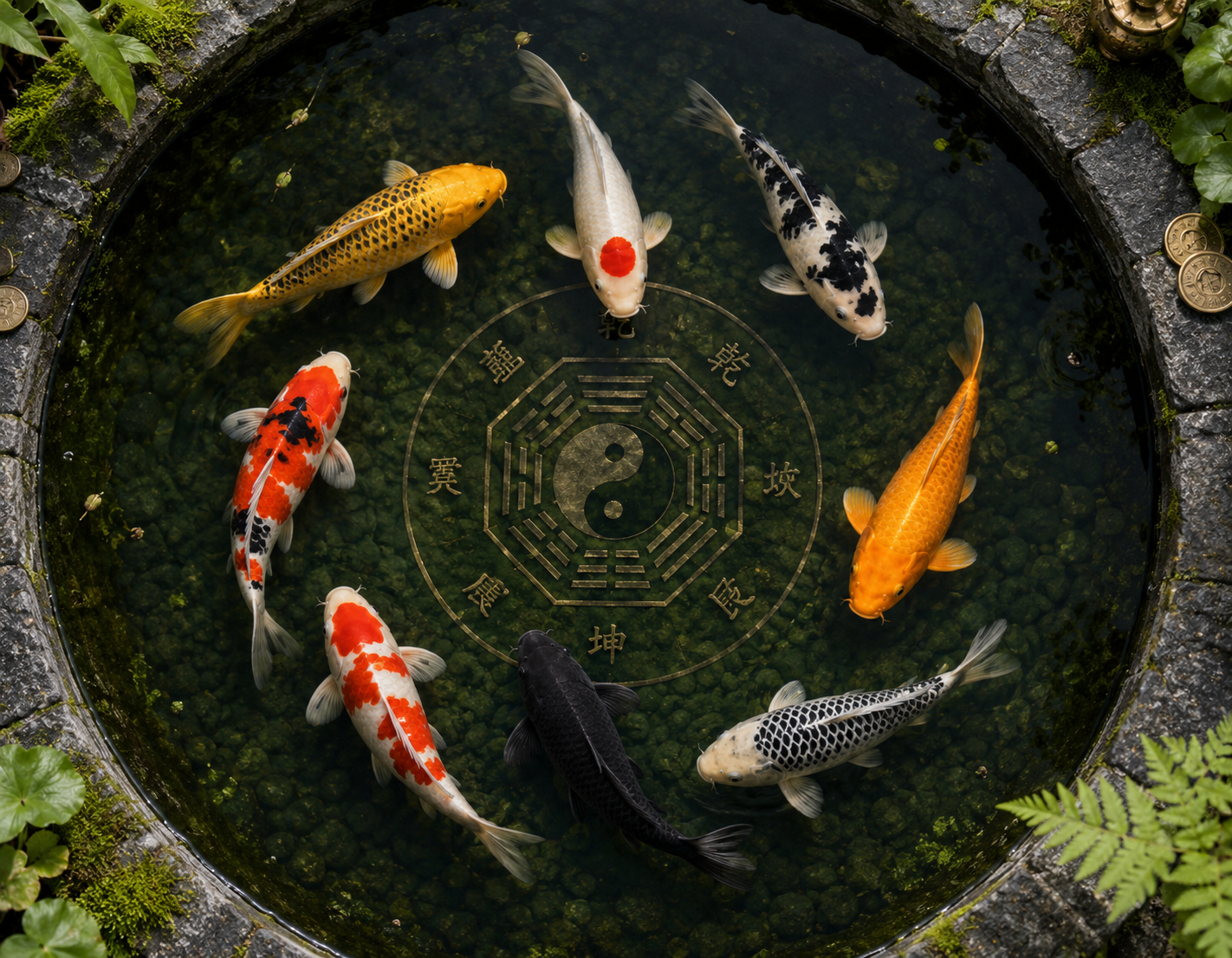
In feng shui — the ancient Chinese practice of harmonizing spaces with natural energy (chi/qi) — koi fish are among the most powerful symbols available. They combine two of feng shui’s most auspicious forces: the water element (which governs wealth, career, and opportunity) and the fish symbol (which represents abundance through the linguistic homophone yú = surplus).
Feng shui koi placement guide
| Location | Bagua sector | Benefit | Best koi color |
|---|---|---|---|
| Southeast | Wealth & prosperity (Xun) | Financial abundance, income growth | Gold, red, or 8 red + 1 black |
| North | Career & life path (Kan) | Career advancement, business success | Black, blue, or gold |
| Living room / entryway | Center / Tai Chi | General abundance, family harmony | Gold or mixed varieties |
| Home office / study | Career / Knowledge | Focus, ambition, career luck | Blue or gold |
| Bedroom ✗ | — | Avoid — strong water energy disrupts sleep and rest | — |
| Kitchen ✗ | — | Avoid — water element conflicts with fire element of stove | — |
The 9 koi feng shui formula
The single most powerful koi arrangement in feng shui is 9 koi — 8 red or gold + 1 black:
- The 8 colored koi attract wealth, success, and positive chi — eight is the luckiest number in Chinese numerology (八, bā sounds like prosperity 发, fā)
- The 1 black koi absorbs negative energy, bad luck, and obstacles — acting as a shield that protects the wealth the eight fish attract
- Together they make 9 — the number of completeness and eternity (九, jiǔ sounds like long-lasting 久, jiǔ)
Related: 9 Koi Fish Meaning — Feng Shui Prosperity Guide
Upstream vs downstream — koi swimming direction meaning
| Direction | Core meaning | In tattoos | In feng shui / décor |
|---|---|---|---|
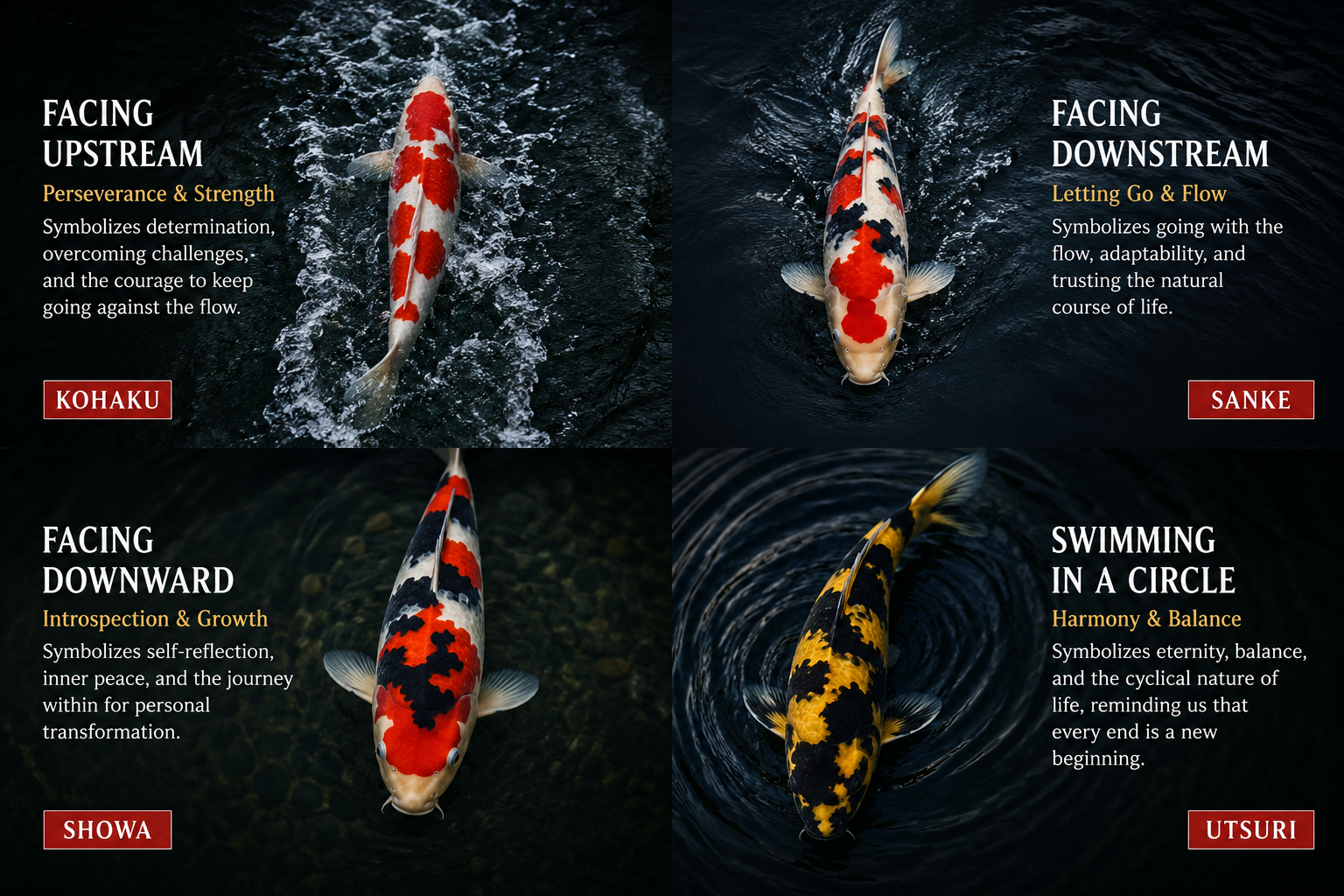
| ⬆ Upstream (swimming up) | Courage, ambition, active struggle, fighting toward a goal | Still on the journey — in the middle of the transformation, fighting through challenges | Facing koi toward the home’s interior draws energy inward; represents drive and aspiration |
| ⬇ Downstream (swimming down) | Achievement, grace, earned success, receiving abundance | Transformation complete — obstacles overcome, operating from strength and grace | Also acceptable — represents having earned your luck and receiving abundance with ease |
There is no universally “better” direction — upstream and downstream both carry positive meanings. The choice depends on where you are in life. During struggle and transformation: upstream. After achievement and in a period of receiving: downstream.
Number of koi — what each quantity means
| Number | Meaning | Best for |
|---|---|---|
| 1 koi | New beginnings, individual strength, focused ambition | Starting a project or business, personal growth |
| 2 koi | Love, partnership, yin-yang balance, marital happiness | Couples, weddings, anniversaries, relationship intentions |
| 3 koi | Growth, creativity, new family energy | Young families, creative endeavors |
| 6 koi | Smooth progress, heaven luck, mentorship | Career advancement, smooth business operations |
| 8 koi | Wealth, prosperity, great fortune (8 = luckiest number in Chinese numerology) | Business wealth, financial goals |
| 9 koi (8+1) | Completeness, eternal abundance, protected wealth — the most auspicious combination | Maximum feng shui wealth remedy |
Koi fish and the yin-yang symbol
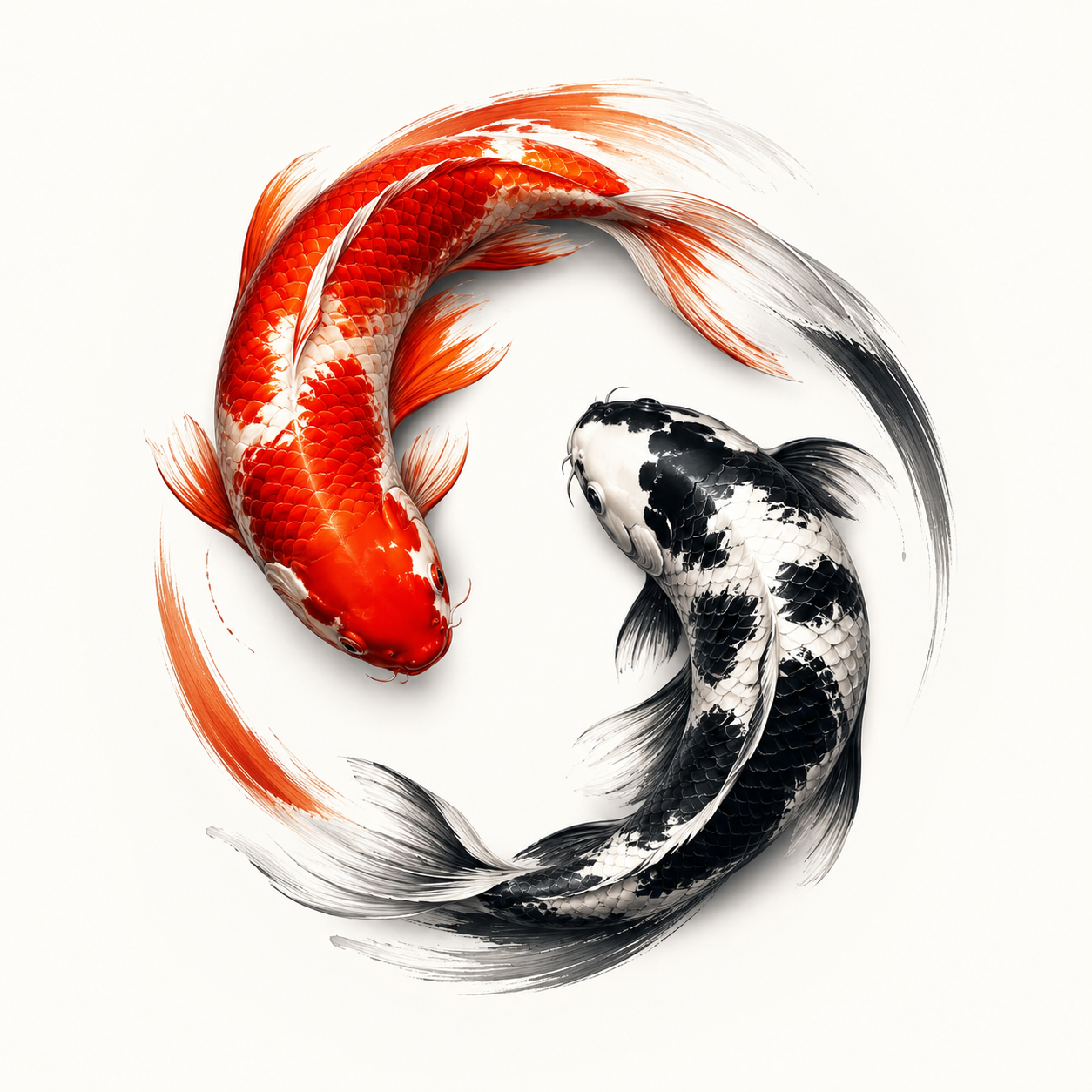
The connection between koi and the yin-yang (☯) is one of the most profound in all of Chinese philosophy. The black and white teardrop shapes of the yin-yang symbol are said to originate from two koi — one black (yin, female, moon, passive) and one white (yang, male, sun, active) — swimming together in perfect, continuous balance.
This connection means that koi carry the full weight of yin-yang philosophy:
- Balance — opposing forces in perfect harmony
- Duality — light contains darkness, strength contains softness
- Continuous flow — life is not static; the koi keep swimming, and the cycle continues
- Interdependence — neither koi can exist fully without the other
This is why a koi fish swimming with the yin-yang symbol is one of the most popular and meaningful tattoo designs in the world — it combines two of East Asia’s most powerful symbols into a single, unified image of balance and perpetual motion.
Koi fish tattoo meaning
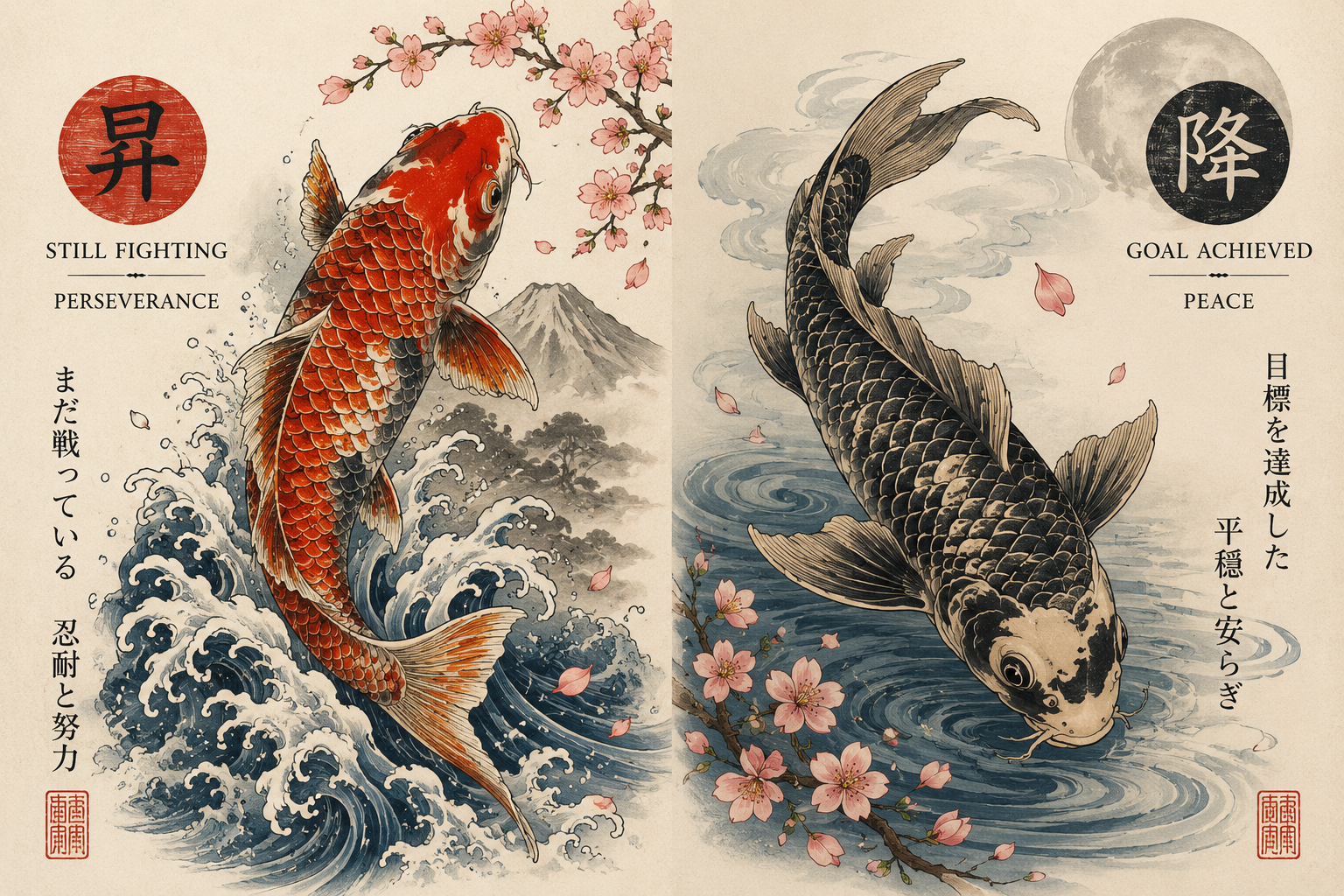
Koi fish tattoos are among the most requested designs in Japanese tattooing (irezumi) and have become globally popular for their rich visual language. The meaning of a koi tattoo is determined by three factors working together:
| Factor | Variations | Meaning |
|---|---|---|
| Color | Red, black, gold, blue, white, pink | See full color chart above |
| Direction | Upstream / downstream | Upstream = still fighting; downstream = achieved and receiving |
| Quantity | Single / paired / group | 1 = individual strength; 2 = partnership and balance; many = abundance |
| Elements added | Lotus, water, dragon, yin-yang, waves | Lotus = purity; dragon = achieved transformation; waves = life’s turbulence |
For the complete tattoo guide with placement and design options: Koi Fish Tattoo Meaning — Color, Direction, and Designs
Koi fish spiritual meaning
Beyond culture and feng shui, koi carry deep spiritual meaning across several traditions:
- Buddhism: The fish is one of the Eight Auspicious Symbols (Ashtamangala). Fish swim freely without fear of drowning — representing fearlessness and liberation from the ocean of suffering. A pair of golden fish represents freedom and happiness.
- Taoism: Koi embody the flow of the Tao — effortless movement through life’s currents, neither resisting nor being swept away, but moving with purpose and awareness.
- Shintoism: Koi are associated with several Japanese kami (deities). Koi ponds at Shinto shrines are common — the fish are considered sacred messengers between the physical and spiritual worlds.
- Spirit animal / totem: In modern spiritual practice, the koi as a spirit animal represents the ability to navigate difficult emotional currents — to feel everything deeply without being overwhelmed. Koi people are persistent, perceptive, and ultimately transformative.
Koi fish in dreams — what it means
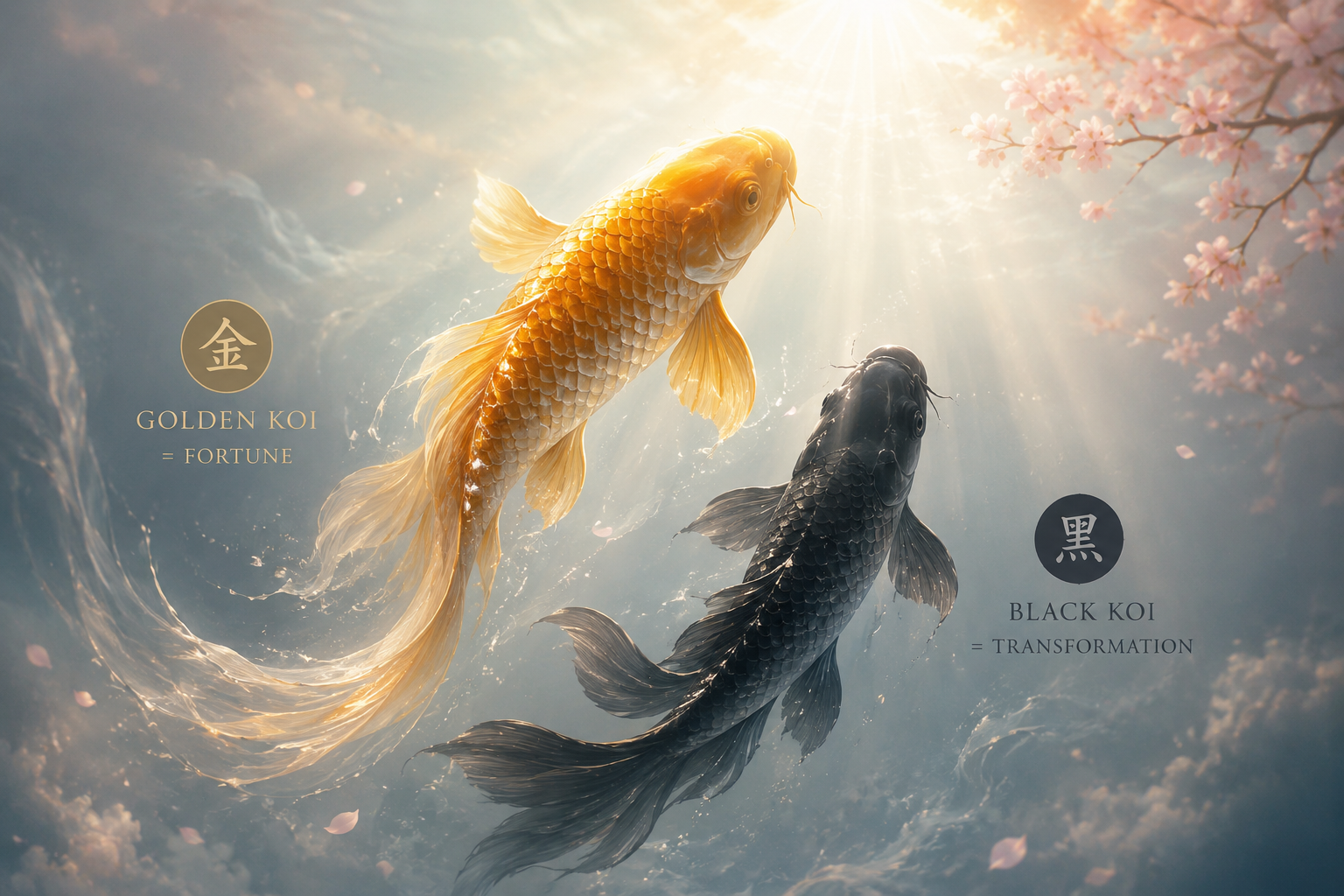
Dreaming of koi fish is generally considered highly auspicious across Japanese, Chinese, and modern dream interpretation traditions:
| Dream scenario | Meaning |
|---|---|
| Seeing koi in clear water | Good fortune approaching, clarity of purpose, positive life changes ahead |
| Seeing koi in murky or dirty water | Confusion, unresolved emotions, or a situation that needs to be cleared before progress is made |
| Red koi in a dream | Love, passion, or a significant romantic development; also courage needed for a coming challenge |
| Gold koi in a dream | Financial opportunity or windfall approaching; strong wealth energy present |
| Black koi in a dream | A major transformation underway; overcoming a significant obstacle; rebirth of some aspect of the self |
| Koi swimming upstream in a dream | You are in a period of challenge and growth; your perseverance will be rewarded |
| Catching a koi in a dream | Successful achievement of a goal; luck captured; good fortune secured |
| Koi jumping out of water | Breakthrough moment approaching; transcending current limitations; Dragon Gate energy |
For the full dream interpretation guide: Koi Fish Dreams — Complete Meaning Guide
Frequently asked questions about koi fish meaning
What is the meaning of koi fish?
Koi fish symbolize perseverance, good luck, wealth, love, courage, and transformation. The specific meaning depends on the cultural context, the koi’s color, and the direction it swims. At the core, koi represent the universal human experience of struggling through adversity and being transformed by it.
What does koi fish mean in Japanese culture?
In Japanese culture koi represent perseverance, courage, and transformation through adversity — rooted in the Dragon Gate legend. Koi (Nishikigoi) are a living national treasure of Japan. They are celebrated on Children’s Day through koinobori windsocks and were adopted by samurai culture as a symbol of the bushido warrior spirit.
What does koi fish mean in Chinese culture?
In Chinese culture koi symbolize wealth and abundance — the word for fish (鱼, yú) is a homophone for surplus (余, yú). Gold and red koi are highly auspicious and widely used in feng shui to attract money. Nine koi (eight red + one black) is the most powerful Chinese prosperity symbol.
What is the koi fish color meaning?
Red = love and courage. White = purity and new beginnings. Gold = wealth and prosperity. Black = overcoming adversity and transformation. Blue = calmness and serenity. Orange = vitality and family energy. Pink = femininity and daughters. Platinum = success and elegance.
What does a koi fish swimming upstream mean?
A koi swimming upstream symbolizes courage, ambition, and the willingness to face challenges head-on. In tattoos it means the wearer is still on their transformation journey. In feng shui, a koi facing toward the interior of a home draws wealth and positive energy inward.
What does the Dragon Gate legend mean?
The Dragon Gate legend is an ancient Chinese myth where a koi swims upstream against impossible currents and, upon leaping the Dragon Gate waterfall, is transformed by the gods into a golden dragon. It represents the idea that sustained effort through adversity leads to complete transformation — the foundational meaning behind all koi symbolism.
What is the feng shui meaning of koi fish?
In feng shui, koi attract wealth and positive chi. Place koi art or a pond in the southeast sector (wealth corner) or north sector (career). The most powerful arrangement is nine koi — eight red or gold (attract wealth) and one black (absorbs negative energy and protects fortune).
What does 2 koi fish mean?
Two koi represent yin and yang — perfect balance, duality, and harmonious partnership. They symbolize conjugal happiness and marital fidelity. The black and white teardrops of the yin-yang symbol are said to originate from two koi swimming together in eternal, balanced motion.
What does 9 koi fish mean?
Nine koi (8 red/gold + 1 black) is the most auspicious feng shui combination. The number nine represents completeness and eternity. The eight colored fish attract wealth; the black fish absorbs negative energy. Placing a nine-koi painting in the southeast wealth corner is one of the most powerful feng shui prosperity remedies.
Complete koi fish meaning guides on Giobel Koi Center
- Koi fish color meaning — complete guide to every color
- Koi fish Dragon Gate legend — full story and symbolism
- 9 koi fish meaning — feng shui prosperity guide
- Koi fish tattoo meaning — color, direction, and designs
- Koi fish in dreams — complete meaning guide
- 2 koi fish meaning — yin yang and partnership symbolism
- Black koi fish meaning — overcoming adversity
- Koi fish in Japanese culture — full history
- Lucky number of koi fish in a pond — feng shui guide
- Benefits of wearing a fish pendant — luck and symbolism
- Koi fish meaning by color — tattoo and feng shui chart

Giovanni Carlo Bagayas
Founder, Giobel Koi Center · Koi keeper since the 1980s · Born in Cebu, raised in Dumaguete, based in Labangan, Zamboanga del Sur, Philippines
Giovanni has been keeping and breeding ornamental koi since the 1980s — over 40 years of hands-on experience with koi varieties, pond management, and the rich cultural heritage surrounding these fish. He founded Giobel Koi Center to share both practical koi knowledge and the deep symbolism, art, and philosophy that make koi the most meaningful ornamental fish in the world.

Passionate about fish keeping since elementary school in the 1980s, Giovanni Carlo has dedicated countless hours to collecting and breeding a diverse array of ornamental freshwater fish. From vibrant guppies and majestic koi to striking bettas and classic goldfish, he continues to explore the fascinating world of aquatics, sharing knowledge and enthusiasm with fellow fish enthusiasts.