How to Get Rid of String Algae in a Koi Pond (For Good)
By Giovanni Carlo · Koi keeper & founder, Giobel Koi Center · Updated June 9, 2026

Quick Answer
To get rid of string algae: (1) manually remove the bulk with a pond brush or rake, (2) fix the nutrient cause — reduce feeding, increase water changes, test for excess nitrates and phosphates, (3) add aquatic plants to shade the water and compete for nutrients, (4) dose beneficial bacteria, and (5) use barley straw as prevention. Important: UV clarifiers do NOT kill string algae — this is one of the most common misconceptions.
In This Guide
- What Is String Algae?
- What Causes String Algae in Koi Ponds?
- Is String Algae Harmful to Koi?
- Step-by-Step: How to Get Rid of String Algae
- Method 1 — Manual Removal
- Method 2 — Reduce Nutrients
- Method 3 — Aquatic Plants
- Method 4 — Beneficial Bacteria
- Method 5 — Barley Straw
- Method 6 — Reduce Sunlight
- Do UV Clarifiers Kill String Algae?
- Hydrogen Peroxide Treatment (Spot Treatment)
- Long-Term Prevention Plan
- All Methods Compared
- Frequently Asked Questions
What Is String Algae?
String algae — also called filamentous algae, blanketweed, or hair algae — is a type of algae that grows in long, thread-like strands rather than as a free-floating suspension (like green water algae). In koi ponds, it typically appears as green, slimy, cotton-wool-like mats that attach to rocks, pond walls, waterfalls, filter intakes, and plant pots. When pulled, the strands stretch and feel slippery.
Unlike green water (planktonic algae), string algae is filamentous — it grows anchored to surfaces. This distinction matters enormously when choosing a treatment method, because the two types respond to completely different interventions.
| Feature | String Algae (Filamentous) | Green Water (Planktonic) |
|---|---|---|
| Appearance | Stringy mats, attached to surfaces | Water turns uniformly green or pea soup |
| Growth type | Surface-attached filaments | Free-floating single cells |
| UV clarifier works? | ❌ No — not effective | ✅ Yes — very effective |
| Best removal method | Manual + nutrient reduction | UV clarifier + filtration |
| Worst growth time | Spring and early summer (high sun + cool water) | Summer (high sun + warm water) |

What Causes String Algae in Koi Ponds?
String algae doesn’t appear randomly — it thrives when specific conditions align. Understanding the root causes is what separates a permanent solution from a seasonal battle. The main drivers are:
- Excess nutrients — the primary cause. Nitrates and phosphates are algae’s food source. In a koi pond, they accumulate from fish waste, uneaten food, decomposing leaves and organic matter, and runoff from fertilized gardens or lawns. When nitrates exceed 20 ppm or phosphates exceed 0.03 mg/L, you have a nutrient loading problem.
- Sunlight. String algae requires sustained direct sunlight to photosynthesize and grow rapidly. Ponds with no shade, in open garden positions, experience far worse string algae than partially shaded ponds.
- Spring water temperatures. String algae is often worst in spring — the water is still cool (which slows the beneficial bacteria that compete with algae) while sunlight is intensifying. This is when the algae has a competitive advantage.
- Inadequate biological filtration. Undersized or poorly maintained filters allow nitrates to build up, fueling algae. If your filter cannot handle your fish load, nutrients accumulate faster than they can be processed.
- Overstocking. Too many fish for the pond volume means proportionally more waste, which means more nutrients, which means more algae.
- Overfeeding. Uneaten food that sinks and decomposes is a significant nutrient source. It also bypasses biological filtration entirely — the nutrients go straight into the water.
Is String Algae Harmful to Koi?
The honest answer is: in small amounts, no — in large amounts, yes, and potentially fatally.
In small quantities, string algae is actually a natural component of a pond ecosystem. Koi will graze on it actively, and it produces oxygen through photosynthesis during the day. A thin layer of algae on rocks and surfaces is normal and indicates a functioning biological community.
The problems begin when growth becomes uncontrolled:
- Oxygen depletion overnight: Algae photosynthesizes during the day (producing oxygen) but reverses at night, consuming oxygen. Large algae mats in a warm pond can crash dissolved oxygen levels overnight — enough to kill koi by morning. This is the most dangerous scenario.
- Filter and pump clogging: String algae clogs filter intakes, mechanical filter pads, and pump impellers — reducing flow rates and allowing water quality to deteriorate rapidly.
- Physical entanglement: Large mats of string algae can trap koi, particularly smaller fish, and can entangle koi barbels. Fish that cannot free themselves will exhaust themselves and die.
- When dying algae decomposes: A sudden die-off of a large algae bloom — from a treatment or rapid temperature change — releases a massive surge of organic matter that spikes ammonia and dramatically reduces oxygen. This is when most algae-related fish deaths occur.
Critical Warning
Never treat a pond with a large algae bloom using a chemical algaecide that kills everything at once. The rapid decomposition of a sudden mass die-off can consume all available oxygen in hours and kill your entire koi collection. Always remove algae gradually and physically before applying any chemical treatment.
Step-by-Step: How to Get Rid of String Algae
Follow this sequence. The order matters — especially starting with manual removal before any treatment.
Manual removal first — always
Use a pond brush, stick, or rake to physically twist out as much string algae as you can. Remove it from the pond entirely and dispose of it away from the water. No treatment works well if the bulk of the algae is still present — and removing large amounts gradually is safer than a rapid chemical kill.
Test water for nutrients
Test nitrates (target: below 20 ppm) and phosphates (target: below 0.03 mg/L). High readings tell you the root cause — and no surface treatment will work long-term if the nutrient source isn’t fixed. Also test pH — algae thrives in alkaline water above 8.5.
Fix nutrient inputs
Reduce feeding (the 5-minute rule — remove uneaten food promptly), increase water change frequency to 20–25% weekly, remove decaying leaves and organic matter, check for garden runoff entering the pond, and verify your filter is correctly sized for your fish load.
Dose beneficial bacteria
Add a quality pond bacteria product to establish a strong biological community that competes with algae for nutrients. Dose as directed for your pond volume. Continue dosing weekly for at least 4–6 weeks. Bacteria are most effective when water is above 55°F.
Add aquatic plants
Aim to cover 40–60% of the pond surface with floating plants (water lilies, water lettuce, water hyacinth). They compete with algae for the same nutrients and block sunlight from penetrating the water. This is the most effective long-term structural solution.
Apply barley straw (preventive)
Place barley straw bundles or barley extract in the pond after manual removal. As it decomposes in sunlit water, it releases compounds that inhibit algae regrowth. Takes 2–6 weeks to begin working. Use at the correct dose — overdosing depletes oxygen. Replace bundles every 6 months.
Reduce sunlight on the pond
Add shade cloth or a shade sail over part of the pond, plant trees or shrubs on the south/west side, or add more floating plants. Reducing direct sunlight exposure by 30–50% dramatically reduces string algae growth rates.
Method 1 — Manual Removal: The Essential First Step
No matter which other methods you use, manual removal must always come first. There is no treatment — chemical, biological, or natural — that works efficiently through a thick mat of established string algae. Removing the bulk physically also prevents the oxygen crash that a sudden large-scale algae die-off can cause.
Tools that work well:
- Pond brush or algae brush: A long-handled brush with stiff nylon bristles. Twist into algae mats and pull — the algae wraps around the bristles and comes out in large clumps.
- Bamboo cane or stick: Poke into algae and twist — cheap, surprisingly effective, and reusable.
- Pond rake or net: Good for skimming loose surface algae.
- Your hands (with gloves): Honestly the most effective method for waterfall areas and tight spaces where tools can’t reach.
Remove algae gradually over several sessions if the infestation is heavy — pulling out too much at once and leaving it to decompose can spike ammonia. Always remove collected algae away from the pond immediately. It makes excellent compost.
Method 2 — Reduce Nutrients: Fix the Root Cause
If you only do one thing beyond manual removal, make it this: find and fix the nutrient source. String algae is a symptom. Excess nitrates and phosphates are the disease. Without addressing nutrients, algae will return every season regardless of how many treatments you apply.
| Nutrient Source | Fix |
|---|---|
| Overfeeding koi | Apply the 5-minute rule strictly — remove all uneaten food promptly |
| Fish waste accumulation | Increase water changes to 20–25% weekly; vacuum pond bottom |
| Decaying leaves / organic matter | Use a pond net cover in autumn; skim debris regularly |
| Garden / lawn runoff | Create a buffer zone of plants; direct runoff away from pond |
| Undersized biological filter | Upgrade to a filter rated for at least 1.5× your pond volume |
| Excess koi for pond size | Rehome some fish or expand the pond — 250 gallons per adult koi |
Method 3 — Aquatic Plants: The Most Sustainable Solution
Aquatic plants are the most ecologically sound long-term solution to string algae — and the one most hobbyists underuse. Plants and algae compete for the same nutrients. When plants win, algae loses. The goal is to cover at least 40–60% of your pond’s surface with plants, which also shades the water and reduces sunlight penetration.
| Plant Type | Examples | Why It Helps |
|---|---|---|
| Floating plants | Water lily, water lettuce, water hyacinth | Block sunlight and absorb nutrients directly from water |
| Submerged / oxygenating | Hornwort, anacharis, waterweed | Absorb nitrates and phosphates; add oxygen; shade bottom |
| Marginal plants | Iris, cattail, rushes, water mint | Filter runoff nutrients at pond edges; create biological buffer |
| Bog filter plants | Umbrella grass, taro, cannas | Extremely efficient nutrient absorbers when placed in a bog filter system |
One practical tip: if koi keep uprooting plants, use heavy pots with gravel on top rather than soil, which also prevents soil nutrients from leaching into the water.
Method 4 — Beneficial Bacteria: Compete from Within
Beneficial pond bacteria work by competing with algae for the very nutrients that fuel its growth — nitrates, phosphates, and dissolved organic compounds. A thriving bacterial colony in a well-established biological filter consumes nutrients before algae can, creating a natural biological suppression.
Bacterial treatments are most effective when:
- Water temperature is above 55°F (13°C) — bacteria are essentially inactive below this temperature
- Applied consistently over 4–6 weeks, not as a single dose
- Used after, not instead of, manual removal
- The pond is not simultaneously being treated with algaecides that would kill the bacteria along with the algae
Look for products that specify “pond bacteria” with multiple strains of Bacillus and Nitrosomonas bacteria. Follow the dosing instructions for your pond volume exactly.
Method 5 — Barley Straw: Natural Prevention
Barley straw is one of the most widely used and researched natural algae control methods for garden ponds. As barley straw decomposes in sunlit, oxygenated water, it releases polyphenols and low concentrations of hydrogen peroxide — compounds that inhibit algae cell growth without harming fish, beneficial bacteria, or plants when used at correct doses.
Key facts about barley straw:
- It is preventive, not curative. Barley will slow and prevent new algae growth but will not clear an existing heavy bloom quickly. Use it after manual removal.
- It takes time. Expect 2–6 weeks before results are visible. Add it at the start of spring, before algae season, for best effect.
- Barley extract works faster than whole straw but requires more precise dosing — overdosing can be harmful to fish.
- Never overdose. Too much barley straw decomposes and depletes oxygen. Follow dosage guidelines: typically 2–3 oz of straw per 1,000 gallons.
- Replace every 6 months. Once the straw has fully decomposed it stops working — replace it to maintain the effect.
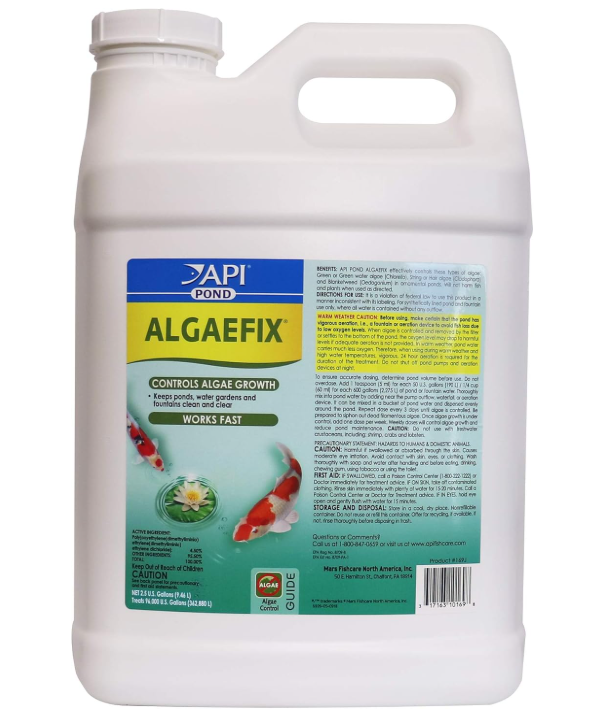
API Pond AlgaeFix — Pond Algae Control (2.5 Gallons)
API · EPA-registered · Copper-free formula
Controls string algae (Cladophora), blanket weed (Oedogonium) & green water
Safe for fish, plants & beneficial bacteria when used as directed
Dose every 3 days until controlled, then weekly maintenance
As an Amazon Associate I earn from qualifying purchases. This does not affect the price you pay.
Method 6 — Reduce Sunlight Exposure
String algae cannot survive without sustained sunlight. Reducing the amount of direct sun reaching the pond water is one of the most effective structural interventions you can make — and unlike chemical treatments, it works permanently without any ongoing cost or effort once installed.
- Shade cloth or shade sail: Position over the sun-facing side of the pond to block 30–50% of direct sunlight during peak hours. Choose a breathable mesh rather than solid cover to allow rainfall and prevent condensation issues.
- Pond dye: Natural pond dyes (blue or black) tint the water to limit sunlight penetration depth. They are fish-safe when used at correct doses and gradually break down over weeks.
- Floating plant cover: The most natural shading method — water lilies and water lettuce at 40–60% coverage reduce sunlight penetration dramatically while adding oxygen and absorbing nutrients.
- Strategic planting: Deciduous trees or tall shrubs on the west side of the pond provide afternoon shade without creating excessive leaf drop (a leaf net handles autumn shedding).
Do UV Clarifiers Kill String Algae? (The Most Common Misconception)
⚠ UV clarifiers do NOT kill string algae.
This is one of the most widespread misconceptions in koi pond keeping. UV clarifiers work by exposing free-floating single-celled algae (which cause green water) to ultraviolet radiation as they pass through the UV unit. String algae is filamentous — it grows attached to rocks, walls, and surfaces and never passes through the UV clarifier. The UV light has zero direct effect on it.
UV clarifiers are excellent investments for controlling green water (planktonic algae) and for reducing the number of free-floating algae spores in the water, which can marginally reduce the rate at which string algae establishes new growth points. But if you have string algae and no green water, a UV clarifier will do nothing to address it.
The correct tools for string algae are: manual removal + nutrient reduction + plants + bacteria + barley straw.
That said, if you are also battling green water alongside string algae, a UV clarifier is a worthwhile addition to your filtration setup — it will clear the green water completely while you tackle the string algae with the methods above.
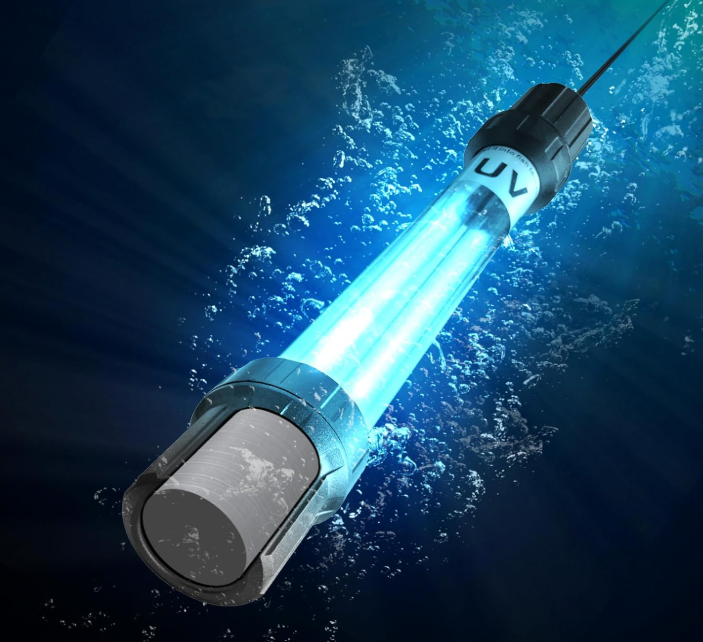
UV Pond Water Clarifier — 18W–100W for Koi Ponds
UL Listed · EPA EST NO.: 96998-CHN-1 · 1-year warranty
18W — up to 1,000 gal · $59.99
32W — up to 3,000 gal · $79.99
55W — up to 5,500 gal · $109.99
100W — up to 10,000 gal · $169.99
Dual-tube UV-C · 17ft cable · 8,000-hour lifespan
As an Amazon Associate I earn from qualifying purchases. This does not affect the price you pay.
Hydrogen Peroxide Spot Treatment
For stubborn patches of string algae — particularly on waterfalls, rocks, and surfaces where manual removal is difficult — a targeted hydrogen peroxide spot treatment can be effective. This is an advanced technique that requires care.
How to do it safely:
- Turn off the pond pump and wait 15–20 minutes for water movement to calm.
- Use food-grade 3% hydrogen peroxide — available at pharmacies. Do not use higher concentrations.
- Apply directly to algae patches using a syringe or paint brush. Do not pour it into the pond water.
- Wait 10–15 minutes, then turn the pump back on to dilute.
- Monitor fish behavior for 30 minutes after treatment. Any sign of distress — gasping, erratic swimming — do a 30% water change immediately.
Important
Hydrogen peroxide also kills beneficial bacteria. After treatment, dose with a quality pond bacteria product to re-establish your biological filter. Do not use this method more than once every 2 weeks. Many experienced koi keepers prefer natural methods to avoid any risk of harm.
Long-Term Prevention Plan
Getting rid of string algae once is achievable. Keeping it from returning every spring requires an ongoing, proactive approach built into your regular pond maintenance routine.
| Season | Prevention Action |
|---|---|
| Late winter / early spring | Add barley straw BEFORE algae season begins · Clean filters · Test water parameters |
| Spring | Start weekly bacteria doses as water warms · Add floating plants early · Manual remove any new growth immediately |
| Summer | Maintain 40–60% plant cover · 20–25% weekly water changes · Strict 5-minute feeding rule · Test nitrates monthly |
| Autumn | Install pond net to catch leaves · Remove and compost dying plants · Replace barley straw bundles |
| Year-round | Never overfeed · Remove uneaten food · Keep filtration maintained · Test pH and nutrients monthly |
All Methods Compared
| Method | Removes existing algae? | Prevents regrowth? | Safe for koi? | Speed |
|---|---|---|---|---|
| Manual removal ✦ | ✅ Yes — immediately | ❌ Not alone | ✅ Yes | Immediate |
| Nutrient reduction | ⚠ Slowly | ✅ Yes — root cause fix | ✅ Yes | 2–6 weeks |
| Aquatic plants | ⚠ Slowly | ✅ Yes — structural fix | ✅ Yes | 4–8 weeks |
| Beneficial bacteria | ⚠ Partially | ✅ Yes — ongoing | ✅ Yes | 2–4 weeks |
| Barley straw | ❌ Not curative | ✅ Yes — preventive | ✅ Yes (correct dose) | 2–6 weeks |
| Shade reduction | ❌ Not curative | ✅ Yes — permanent | ✅ Yes | Ongoing |
| Hydrogen peroxide (spot) | ✅ Yes — targeted | ❌ Not alone | ⚠ Caution needed | Hours |
| UV clarifier | ❌ No effect on string algae | ❌ No direct effect | ✅ Yes | Not applicable |
Related Reading on Giobel Koi Center
Frequently Asked Questions
What causes string algae in a koi pond?
Does UV clarifier kill string algae?
Is string algae harmful to koi?
Does barley straw work for string algae?
How do I prevent string algae from coming back?
What is the fastest way to remove string algae?
Can I use hydrogen peroxide to kill string algae?
How long does it take to get rid of string algae?

Giovanni Carlo
Koi keeper & founder, Giobel Koi Center · Labangan, Zamboanga del Sur
Giovanni has been keeping koi since the 1980s and manages koi ponds and a tilapia farm in Mindanao. He writes from decades of hands-on experience dealing with every common pond maintenance challenge — including the seasonal battle with string algae that every serious pond keeper knows well.

Passionate about fish keeping since elementary school in the 1980s, Giovanni Carlo has dedicated countless hours to collecting and breeding a diverse array of ornamental freshwater fish. From vibrant guppies and majestic koi to striking bettas and classic goldfish, he continues to explore the fascinating world of aquatics, sharing knowledge and enthusiasm with fellow fish enthusiasts.