How to Tell If a Koi Fish Is Male or Female: 6 Reliable Signs
By Giovanni Carlo · Koi keeper & founder, Giobel Koi Center · Updated June 9, 2026
Quick Answer
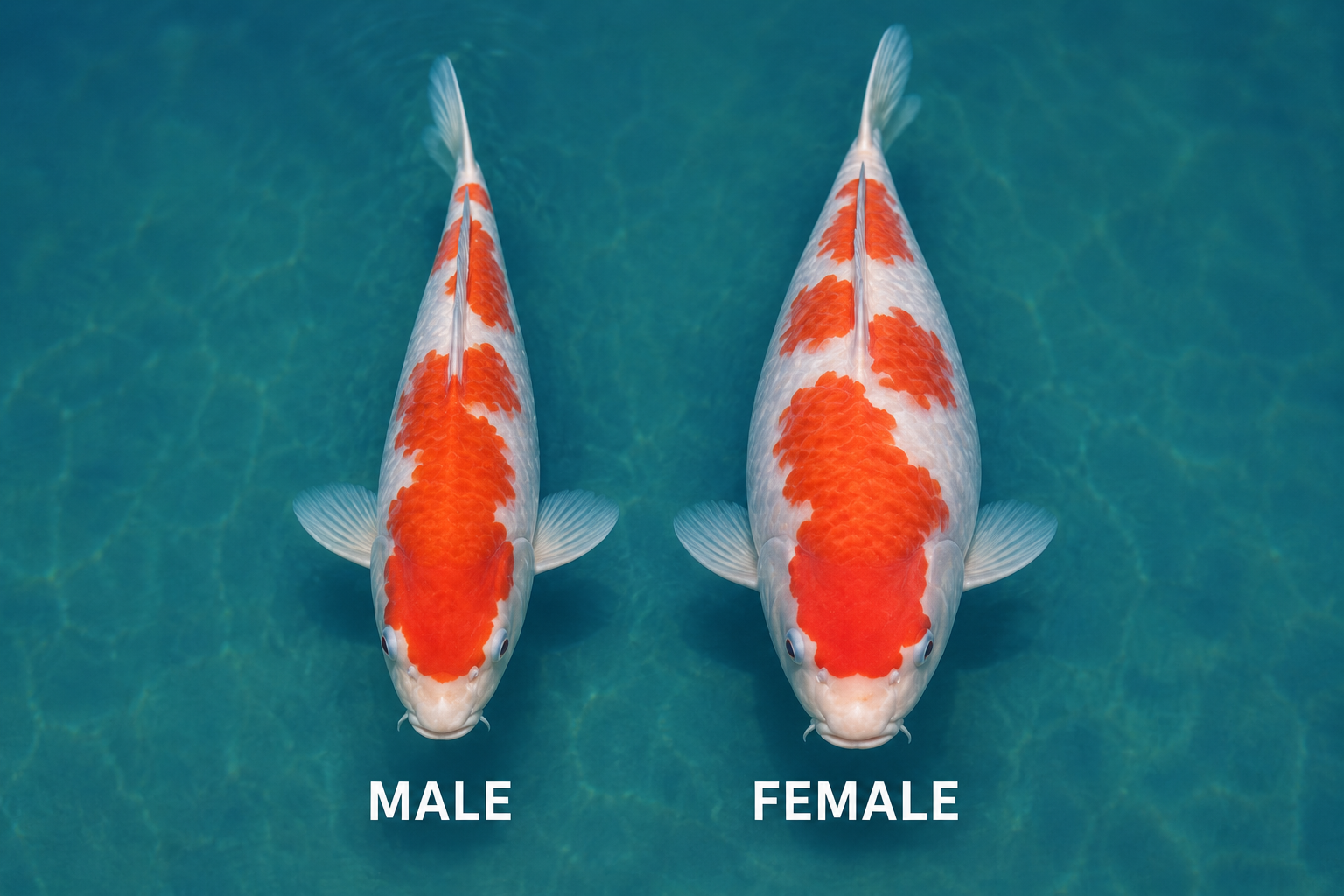
The 6 most reliable ways to tell male from female koi: (1) Body shape — males are slender; females are rounder. (2) Pectoral fins — male fins are longer and more pointed. (3) Tubercles — white bumps on males during breeding season only. (4) Vent — male vent is flat; female vent is slightly raised and pink. (5) Behavior — males chase during spawning; females are chased. (6) Size — mature females are larger. No single sign is 100% reliable — use at least 3 for confident identification.
In This Guide
- Male vs Female Koi — Side-by-Side Comparison
- When Can You Sex Koi? Age & Size Requirements
- Sign 1 — Body Shape
- Sign 2 — Pectoral Fins
- Sign 3 — Breeding Tubercles
- Sign 4 — Vent Examination
- Sign 5 — Breeding Behavior
- Sign 6 — Size & Growth
- Is My Koi Pregnant or Just Fat?
- Koi Breeding Season: What to Expect
- Frequently Asked Questions
Male vs Female Koi — Side-by-Side Comparison
Use this table as your quick reference. No single sign is definitive — use at least 3 matching indicators for confident sexing.
| Sign | ♂ Male | ♀ Female | Reliability |
|---|---|---|---|
| Body shape | Slim, streamlined | Rounder, fuller abdomen | ⭐⭐⭐⭐ Good (best in spring) |
| Pectoral fins | Longer, pointed, thick first ray | Shorter, rounded, softer | ⭐⭐⭐⭐ Good year-round |
| Tubercles | White bumps on gills & pectoral fins | None — smooth | ⭐⭐⭐⭐⭐ Definitive (breeding season only) |
| Vent | Flat, narrow, slit-like | Slightly raised, rounder, pale pink | ⭐⭐⭐⭐⭐ Most reliable method |
| Breeding behavior | Chases female aggressively | Is chased; hides near plants | ⭐⭐⭐⭐ Good (breeding season only) |
| Size at maturity | Typically 18–24 inches max | Can reach 24–36+ inches | ⭐⭐⭐ Moderate (overlaps in youth) |
| Feeding behavior | Nibbles, dives between bites | Surface feeds continuously | ⭐⭐ Low (varies by individual) |
When Can You Sex Koi? Age & Size Requirements
This is the most important thing to understand before trying to sex your koi: it is very difficult to accurately determine gender in koi under 2 years of age or under 12 inches in length. Before this point, the physical differences between male and female koi are minimal or absent — even experienced breeders can be wrong on juveniles.
| Age / Size | Sexing Accuracy | Best Methods Available |
|---|---|---|
| Tosai (under 1 year / under 8 inches) | Very unreliable | None reliable — wait |
| Nisai (1–2 years / 8–12 inches) | Moderate | Body shape + fin shape starting to differ |
| Sansai+ (2–3 years / 12+ inches) | Good | Body, fins, vent all becoming clear |
| Mature (3+ years / breeding season) | Excellent | All 6 signs available including tubercles |
Koi become sexually mature at different ages: males typically at 2 years, females at 3 years. Both sexes are usually at least 12 inches before physical differences become reliably visible. If you are trying to sex very young or small koi, accept that any identification is a best guess.
Sign 1 — Body Shape: The Most Visible Difference

Male koi — slender, streamlined body

Female koi — rounder, fuller abdomen
Body shape is the first thing most experienced koi keepers look for — and it is most visible when viewing the fish from directly above. The difference becomes increasingly obvious as koi mature and is most dramatic in late spring when females are carrying eggs.
- Male koi: Slim, streamlined body with an even, torpedo-like profile from head to tail. The abdomen does not bulge noticeably wider than the head and shoulders. Males maintain this slender profile year-round.
- Female koi: Rounder, fuller body — particularly in the abdomen. Viewed from above, a mature female is noticeably wider mid-body than a male of the same length. In spring before spawning, females can appear distinctly swollen on one or both sides as eggs develop.
Important caveat: a healthy, well-fed male koi can appear rounder than usual, and a female not carrying eggs can look deceptively slim. This is why body shape alone is not conclusive — always combine it with at least one other indicator.
Sign 2 — Pectoral Fins: The Year-Round Reliable Sign
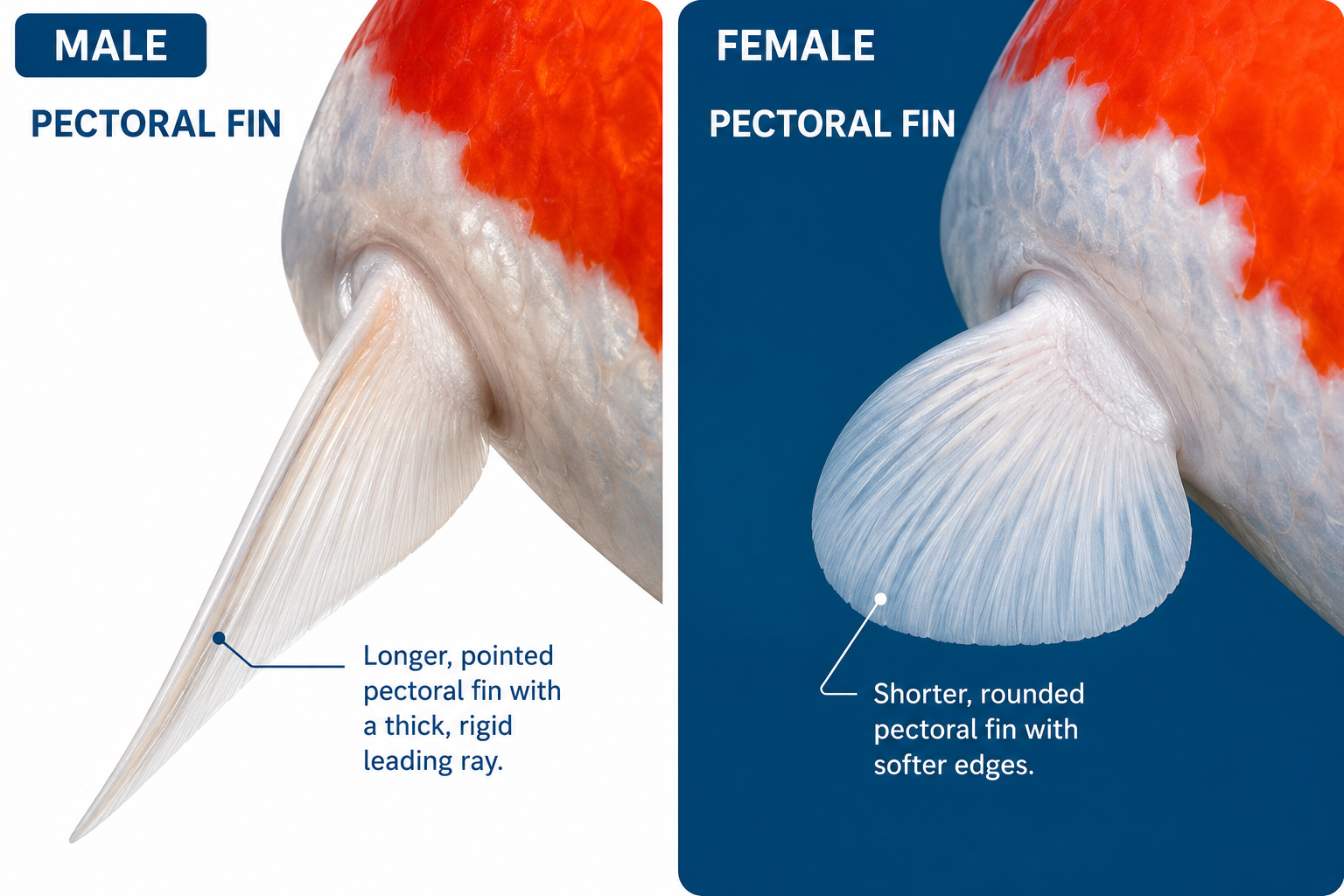
Pectoral fin shape is considered the most reliable year-round sexing indicator — it doesn’t require breeding season to be visible. The pectoral fins are the paired fins located just behind and below the gill plates on each side of the fish.
♂ Male pectoral fins
- Longer relative to body size
- More pointed at the tip
- First (leading) ray is noticeably thicker and more rigid
- Appear more solid and structured
- May be held more erect during breeding season
♀ Female pectoral fins
- Shorter relative to body size
- More rounded and softer at the tip
- First ray is similar in thickness to the others
- Appear gentler and more uniformly shaped
- Consistent appearance throughout the year
To examine pectoral fins, observe the fish from the side or from slightly above while it is stationary or moving slowly. The difference becomes clear with practice. Run the fin between your thumb and index finger (on a fish you’ve netted gently) — the male’s first ray feels distinctly harder and more ridged.
Sign 3 — Breeding Tubercles: The Definitive Seasonal Indicator
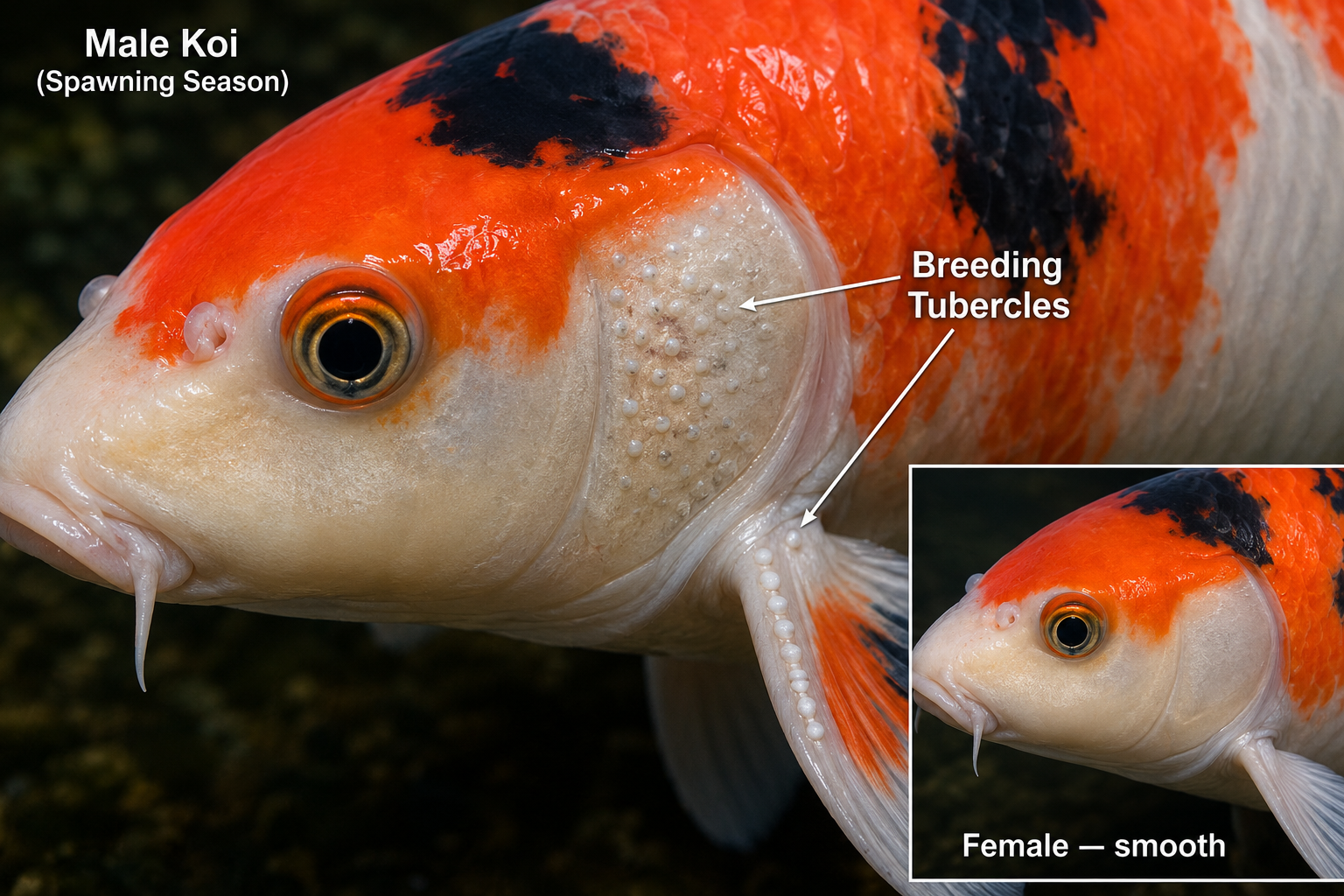
Breeding tubercles are the most definitive sexing indicator available — when present, they confirm male sex with near 100% certainty. They are small, hard white or grey bumps that appear on the gill plates (operculum) and the leading ray of the pectoral fins of male koi during breeding season.
Tubercles appear when water temperature rises to 65–75°F (18–24°C) in spring or early summer, triggering spawning readiness. They feel like rough sandpaper when you gently run a fingertip across the gill plates. The function of tubercles is to increase traction during spawning — the rough surface helps the male maintain contact with the female as he nudges her to release eggs.
Important notes on tubercles
- Tubercles only appear during breeding season — outside of this window, male koi feel smooth and tubercles cannot be used
- They disappear after spawning is complete — don’t confuse a post-spawning male for a female
- Females never develop tubercles — if you feel them, the fish is male
- Do not confuse tubercles with disease: white spot (ich) appears as a powder coating all over the body; tubercles are limited to the head and pectoral fin leading ray
Sign 4 — Vent Examination: The Most Reliable Method
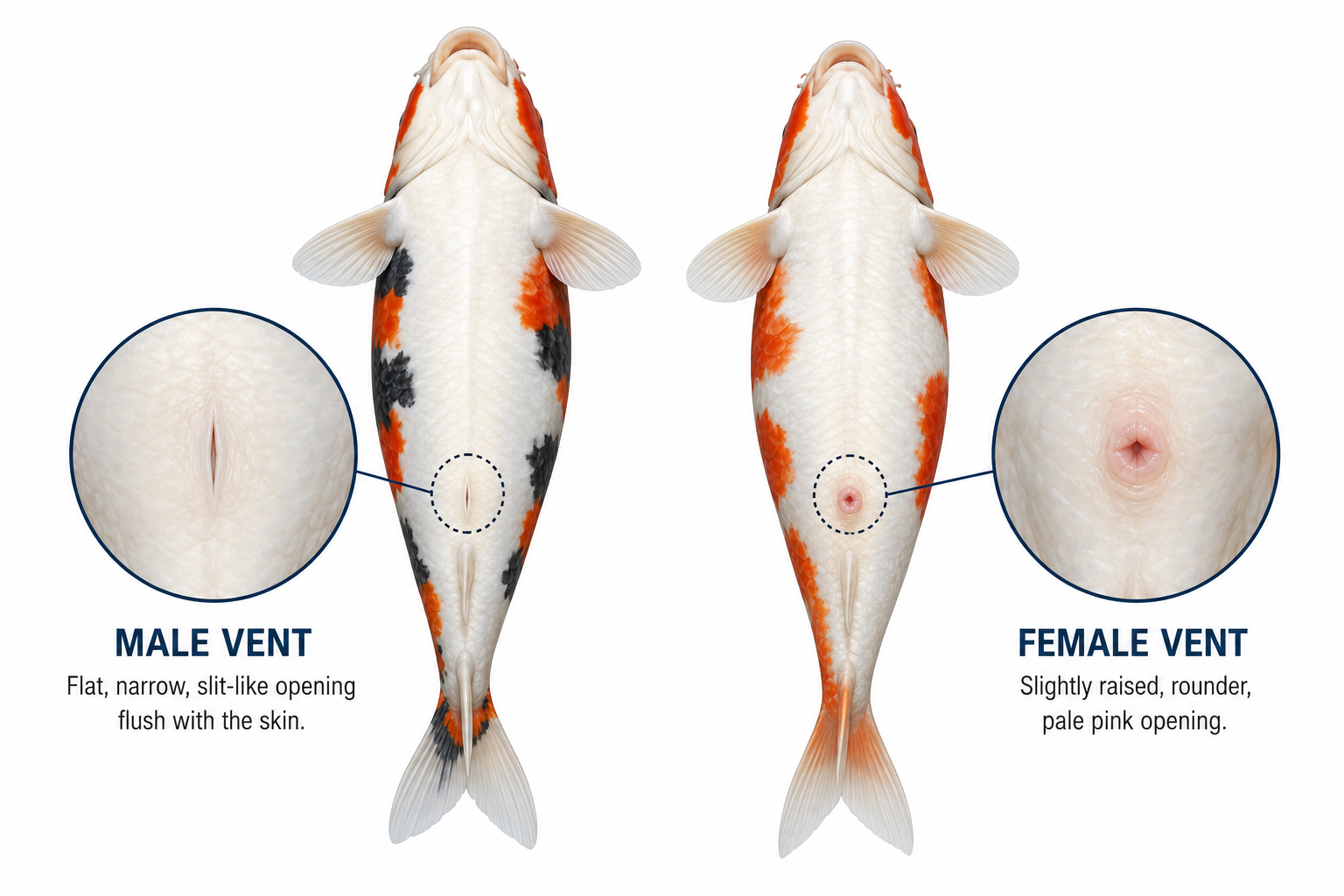
Vent examination is considered the single most reliable year-round sexing method for mature koi — more definitive than body shape or fin shape, and available outside of breeding season. The vent (also called the cloaca or genital papilla) is the small opening on the underside of the fish, located between the anal fin and the tail.
♂ Male vent
- Flat, narrow, slit-like opening
- Lies flush with the surrounding skin
- Slightly concave or indented appearance
- Appears uniform in color with surrounding skin
♀ Female vent
- Slightly raised, rounder opening
- Protrudes slightly above surrounding skin
- Often pale pink in color
- More prominent in fish approaching spawning
How to examine the vent: Net the fish gently and turn it on its back in the net or in a shallow container with water. Look at the underside between the anal fin and the tail. The difference is subtle in young fish and more obvious in mature adults. This method requires handling the fish, so minimize stress — have your examination done in under 30 seconds and return the fish to the water.
Best practice
Always wet your hands before handling koi. Keep the fish in water as much as possible during examination. For koi under 12 inches, the vent difference is very subtle and may not be reliable. The vent method works best on mature fish 14 inches and above.
Sign 5 — Breeding Behavior: Observable From Pondside
During breeding season, the behavioral differences between male and female koi become unmistakably obvious — no handling required. This is often the first sign pond keepers notice that their fish are sexually mature.
Spawning behavior
- Males chase females persistently and aggressively — nudging, bumping, and pushing the female toward plants and pond edges where she will release eggs. This can continue for hours and occasionally causes minor injuries to the female.
- Multiple males chase one female — if you see one fish being pursued by two or more others, the pursued fish is almost certainly female.
- Females seek shelter — a female approaching egg release will spend time near pond plants, shallow areas, or hiding spots. She moves more slowly and may appear lethargic.
- Males compete with each other — when no female is immediately available, males will chase and assert dominance over one another.
Feeding behavior differences
Outside of breeding season, feeding behavior can offer clues — though this is the least reliable indicator:
- Females tend to feed actively at the surface, staying near the top and eating continuously during feeding time
- Males tend to nibble and dive between bites — approaching the surface, taking food, and swimming back down more frequently
This feeding behavior difference is not consistent across all individuals or varieties and should only be used as a supporting indicator, never as a primary one.
Sign 6 — Size: Females Grow Larger
Mature female koi are generally larger and heavier than males of the same age and variety. Females can reach 24–36 inches (60–91 cm) or more under ideal conditions; males typically max out at 18–24 inches (45–61 cm). In a pond of koi all purchased at the same time, the largest fish are more likely to be female.
This size difference is partly a product of Japanese breeding history — breeders traditionally kept one large female with several smaller males to minimize spawning injuries. Generations of this practice selected for size differences between the sexes. It also has a biological basis: females need body mass to carry and produce eggs.
However, size alone is unreliable for sexing juveniles — in young fish under 2 years, males and females are similar in size. Size only becomes a useful indicator in mature adults, and even then it must be combined with other signs. A large male and a small female can be easily confused on size alone.
Is My Koi Pregnant or Just Fat? Or Is It Sick?
This is one of the most common questions from pond keepers in spring. A swollen koi belly can mean three very different things:
| Cause | What It Looks Like | Other Signs | Action |
|---|---|---|---|
| Eggs (female) | Symmetrical, even swelling — both sides equal | Spring timing, fish eating normally, males chasing | Normal — allow spawning or managed breeding |
| Overfeeding / obesity | General roundness — no obvious shape change | Year-round, fish eating enthusiastically | Reduce feeding — enforce 5-minute rule |
| Dropsy | Severe swelling + pine-cone raised scales | Lethargic, not eating, protruding eyes | Isolate immediately — serious illness |
| Constipation | Mild, general roundness | Reduced feces, slightly sluggish | Fast 2–3 days then offer shelled peas |
The key distinguishing factor between eggs and illness: scales. Raised, pine-cone-like scales = dropsy (serious, see our bloated koi guide). Flat scales + spring timing + normal behavior = almost certainly eggs.
Koi Breeding Season: What to Expect
Understanding breeding season helps you interpret what you’re seeing in the pond — and protect your fish if spawning becomes too aggressive.
- Trigger: Water temperature consistently reaching 65–75°F (18–24°C) — typically late spring to early summer in temperate climates
- Duration: Spawning activity typically lasts 2–5 days per cycle, with multiple cycles possible through the season
- Spawning location: Koi prefer to spawn near aquatic plants, pond edges, or any submerged surface where eggs can attach
- After spawning: Eggs hatch in 3–7 days depending on temperature. Adult koi — including parents — will eat eggs and fry if given the opportunity
- Injury risk: Spawning can be rough. Females sometimes sustain scrapes, fin tears, or scale damage from persistent male chasing. Monitor females after spawning and treat any wounds promptly
- Tuberculosis tubercles disappear: Male tubercles subside within 1–3 weeks after spawning is complete
Koi keeper note
On my farm in Mindanao we occasionally see multiple males pursuing a single female so aggressively that she is unable to feed or rest. If chasing becomes extreme — particularly if the female is being repeatedly driven into the pond walls — it is worth temporarily separating her into a separate pond to recover. After a day of rest she can be reintroduced when the males have calmed.
Related Reading on Giobel Koi Center
Frequently Asked Questions
How do you tell if a koi fish is male or female?
What age can you sex koi fish?
What are koi breeding tubercles?
Do female koi get bigger than males?
How can you tell male from female koi by the vent?
Is my koi pregnant or bloated?
When do koi fish breed?

Giovanni Carlo
Koi keeper & founder, Giobel Koi Center · Labangan, Zamboanga del Sur
Giovanni has been keeping and breeding koi since the 1980s on his farm in Mindanao. He has sexed hundreds of koi across dozens of varieties over the years and writes from decades of hands-on experience with koi breeding, pond management, and variety identification.

Passionate about fish keeping since elementary school in the 1980s, Giovanni Carlo has dedicated countless hours to collecting and breeding a diverse array of ornamental freshwater fish. From vibrant guppies and majestic koi to striking bettas and classic goldfish, he continues to explore the fascinating world of aquatics, sharing knowledge and enthusiasm with fellow fish enthusiasts.