Quick Answer
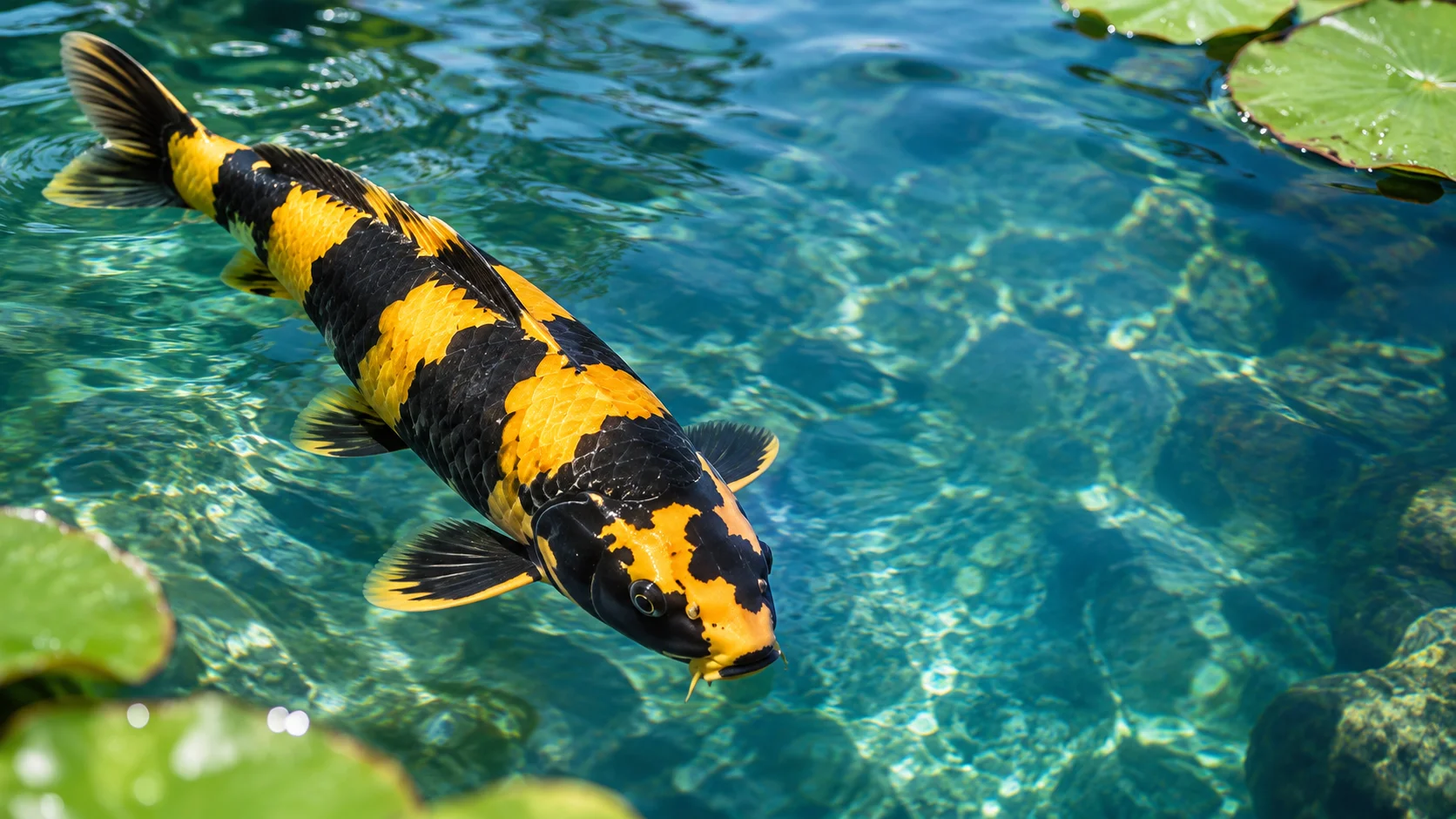
Ki Utsuri is the oldest and rarest of the three Utsurimono koi varieties, pairing a deep black (sumi) base with bright yellow (ki) markings. It was the first Utsuri type developed, but its yellow pigment is notoriously hard to breed consistently — which is why it’s rarer today than the later Hi Utsuri (red) and Shiro Utsuri (white).
Ki Utsuri Koi: The Complete Guide to the Rarest Utsuri Variety
What Is Ki Utsuri Koi?
Ki Utsuri pairs a jet-black sumi base with bold yellow markings — the same checkerboard, high-contrast look that makes Utsurimono koi stand out, but in gold rather than red or white. “Ki” means yellow in Japanese, and “Utsuri” translates to roughly “reflection.” It belongs to the same Utsurimono family as Hi Utsuri (red) and Shiro Utsuri (white), sharing the same judging logic: how cleanly the black wraps the body, and how sharp the boundary is between the two colors.
History and Origin
Ki Utsuri’s early history is less documented than Hi Utsuri’s or Shiro Utsuri’s, and sources don’t fully agree on exact dates. What’s broadly consistent across breeder accounts: Ki Utsuri was created by crossing Magoi (black wild carp) with Ki Bekko (a yellow koi with black sumi patterning), making it the first Utsuri variety established — earlier than Hi Utsuri or Shiro Utsuri. Early breeding attempts produced inconsistent results, since stabilizing bright, even yellow pigment alongside solid black proved far harder than working with red or white.
Once Hi Utsuri emerged and turned out easier to breed reliably, many breeders shifted their focus toward it, and Ki Utsuri numbers declined for decades. The variety’s modern revival is generally credited to a small number of dedicated Japanese breeders — Maruyo and Otsuka Koi Farms are the names that come up most often in breeder accounts of the comeback — who worked to rebuild consistent bloodlines from the 1990s onward. Maruhiro is one of the most recognized Ki Utsuri breeders working today, though it’s a current-day reputation for quality broodstock rather than the variety’s origin.
Sumi, Kiwa, and What Makes a High-Quality Ki Utsuri
A few specific traits separate a genuinely good Ki Utsuri from an average one:
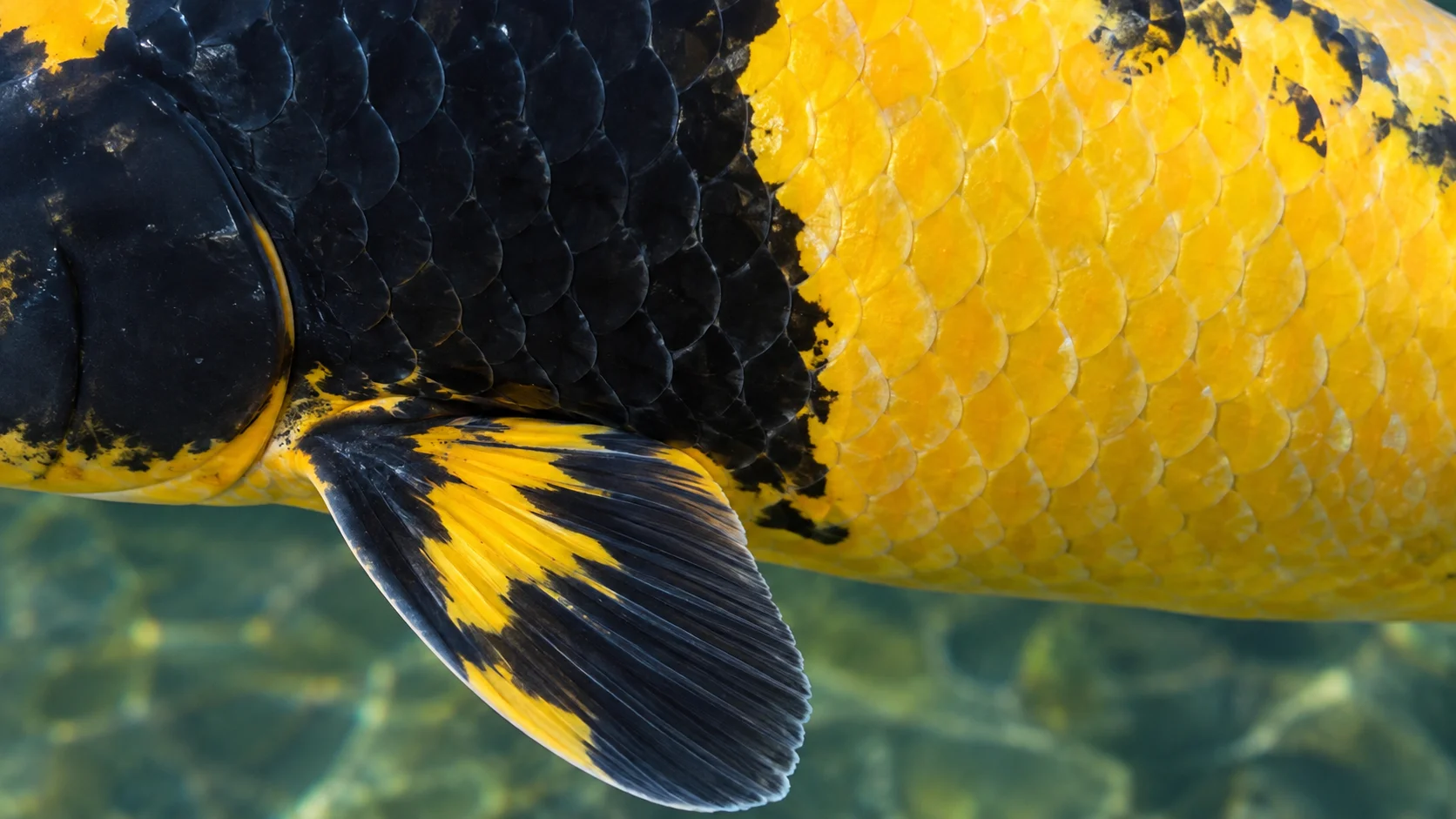
- Sumi depth — the black base should be deep and even, not patchy, dull, or tinged brown.
- Kiwa — the boundary where yellow meets black should be crisp and clean, without blurring or feathering where the colors bleed into each other.
- Sumi distribution — black should run evenly across the body rather than clumping at one end, giving the pattern a balanced, deliberate look rather than a random one.
- Menware — a distinct band of sumi splitting the head pattern; its presence and shape are part of what judges look for on a well-marked head.
- Motoguro — the sumi-and-yellow pattern at the base of the fins; ideally a clean, deliberate pattern rather than a solid, unbroken black patch.
- Yellow vibrancy — the ki color should read bright and consistent, not dull or muddy, and reasonably balanced in coverage against the black.
Judging koi is ultimately somewhat subjective, but these are the traits breeders and show judges consistently point to when separating a strong Ki Utsuri from a mediocre one.
Ki Utsuri vs. Hi Utsuri vs. Shiro Utsuri
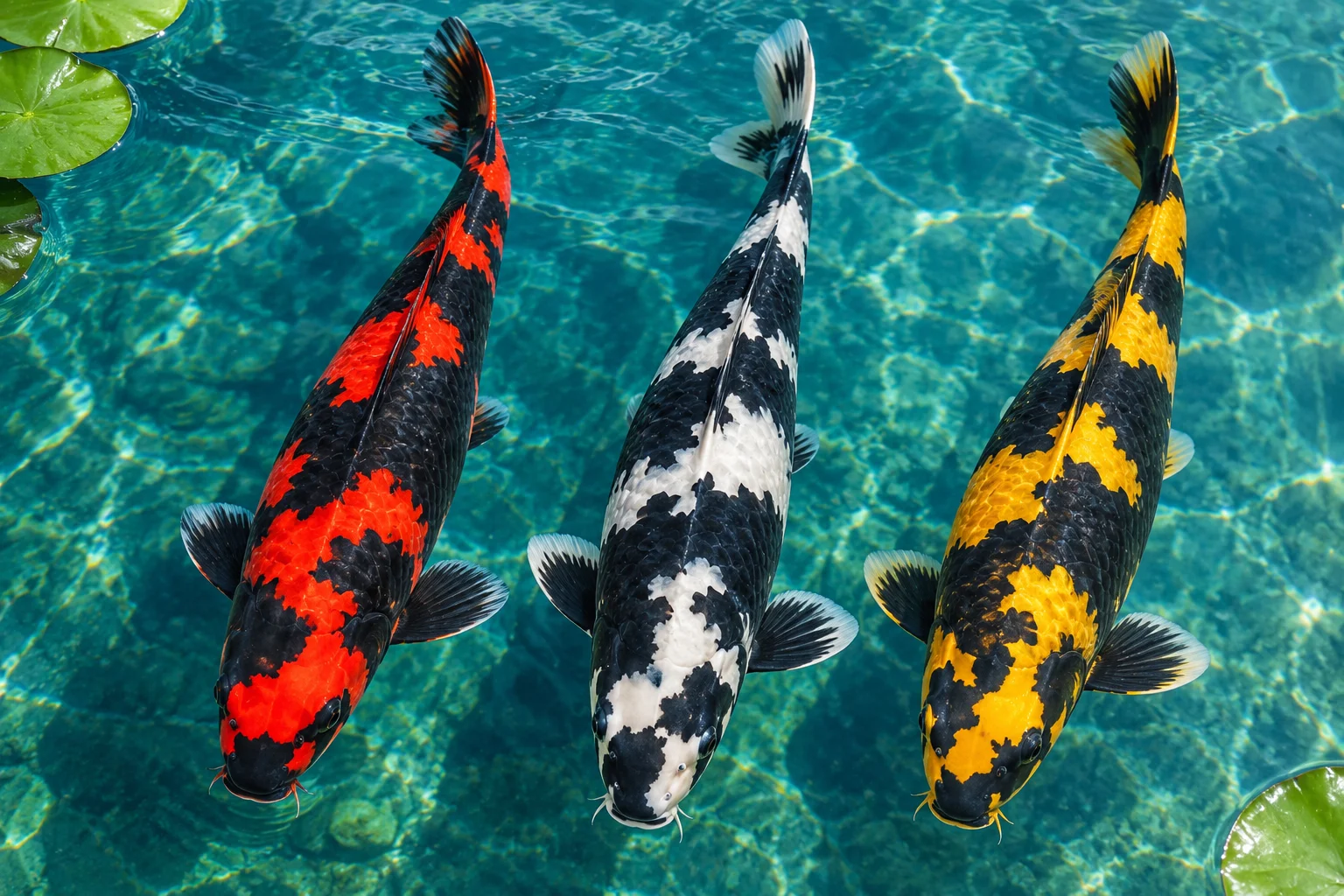
All three Utsurimono varieties share the same black base and judging criteria, differing in the second color — and, as a side effect of breeding difficulty, in how common each one is:
| Variety | Secondary Color | Rarity |
|---|---|---|
| Ki Utsuri | Yellow | Rarest — yellow pigment is the hardest of the three to stabilize |
| Hi Utsuri | Red | Most common — easier to breed consistently than Ki Utsuri |
| Shiro Utsuri | White | Most standardized and widely available of the three |
Ki Utsuri is sometimes confused with Yamabuki Ogon, a solid metallic-yellow koi with no black markings at all — if the fish has any black patterning, it’s not a Yamabuki Ogon.
Ki Utsuri Koi Care Guide
Ki Utsuri don’t need meaningfully different care from other koi varieties — the same water quality and nutrition fundamentals apply. A high-quality koi pellet as the base diet, with occasional live or frozen treats like bloodworms or brine shrimp, works well. Feed twice a day in warmer months, adjusting for appetite, and reduce or stop feeding as water temperatures drop toward winter — koi barely digest food in cold water, and overfeeding then is a common cause of preventable illness.
Keep ammonia and nitrite at zero and pH stable. Ki Utsuri tend to do well in typical koi pond temperatures, roughly 59–77°F (15–25°C), so most temperate and subtropical climates suit them with adequate filtration and aeration.
Breeding and Reproduction
Ki Utsuri spawn in spring as water warms, with the female releasing adhesive eggs that the male fertilizes externally. Because stable yellow-and-black offspring are genuinely harder to produce than red or white patterning, serious breeders select pairs carefully for color purity and pattern consistency rather than relying on chance pairings. A separate breeding tank with controlled conditions improves fry survival, and fry need close monitoring since their adult coloration and pattern aren’t reliable until they’re older.
Related Varieties and Pattern Types
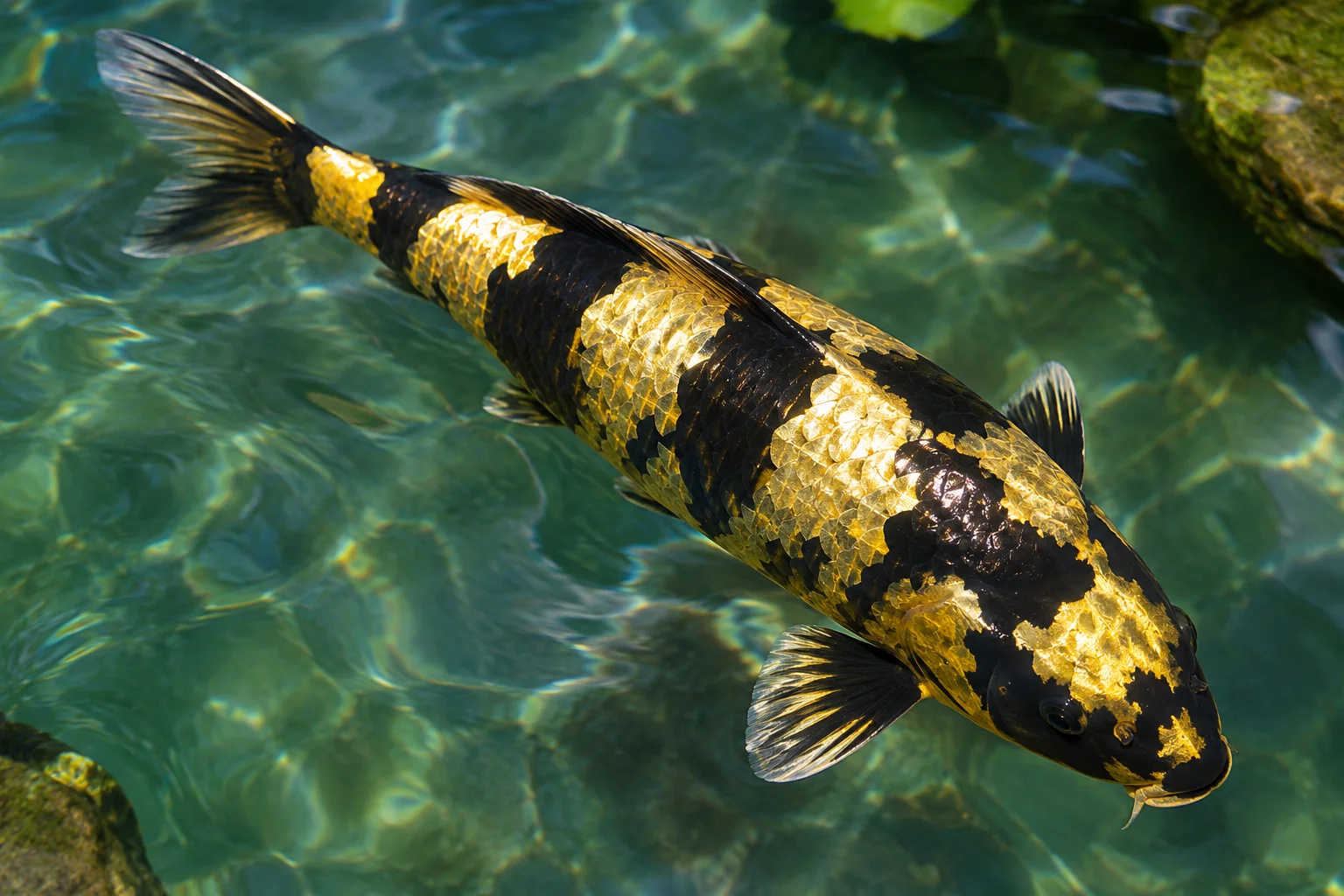
A few pattern variants show up within Ki Utsuri stock, the same way they do across other koi varieties: Kin Ki Utsuri adds a metallic sheen over the standard pattern; Tancho refers to any koi with a single round marking isolated on the head (a Tancho Ki Utsuri would need to still show its yellow-and-black body pattern, distinct from the more famous Tancho Kohaku); and Doitsu describes a scaleless or partially-scaled body type, which can occur in Ki Utsuri as in most other varieties.
Tips for Selecting and Purchasing Ki Utsuri Koi
Check kiwa sharpness from multiple angles, look for even sumi distribution rather than patchiness, and check that the yellow reads bright and consistent rather than dull. Buy from reputable breeders or established koi farms rather than general marketplace listings, and quarantine any new fish before introducing them to an existing pond — this protects your whole population from diseases like koi herpesvirus (KHV), which spreads easily between unquarantined new arrivals.
Ki Utsuri Koi Shows and Competitions
Ki Utsuri are shown in Utsurimono classes at koi competitions, including major events like the All Japan Koi Show. Because well-marked specimens are genuinely rare, a Ki Utsuri that places well tends to carry real prestige for the breeder — more so than a comparably-ranked Hi Utsuri, simply because there are far fewer strong Ki Utsuri to compete against.
Ki Utsuri in Japanese Culture
Koi broadly symbolize perseverance and good fortune in Japanese culture, and Utsurimono’s stark black-and-color contrast is often read as a visual expression of that idea — brightness persisting against a dark ground. Ki Utsuri specifically, given its rarity, is sometimes treated by collectors as a quiet status marker within the hobby rather than a widely recognized cultural symbol on its own.
Conclusion
Ki Utsuri’s appeal comes largely from what makes it hard to produce: stable, vivid yellow against clean black is a genuinely difficult combination to breed, which is exactly why a well-marked specimen is worth seeking out. If you’re comparing it against its siblings, start with the same eye you’d use for Hi Utsuri or Shiro Utsuri — sumi depth, kiwa sharpness, and balanced distribution — then weigh the yellow’s vibrancy on top.
Frequently Asked Questions (FAQs)
How long do Ki Utsuri koi live?
Like most well-kept koi, Ki Utsuri commonly live 20–30 years with good water quality and care, and some individuals live considerably longer. Lifespan depends heavily on pond conditions, diet, and genetics rather than being fixed by variety.
Can Ki Utsuri koi be kept with other koi varieties?
Yes — Ki Utsuri mix well with other koi varieties in a shared pond. The main considerations are adequate space and normal compatibility monitoring, not anything variety-specific.
Why is Ki Utsuri so rare?
Producing consistent, vibrant yellow pigment alongside a clean black base is genuinely harder than breeding red (Hi Utsuri) or white (Shiro Utsuri) patterning. When Hi Utsuri proved easier to breed reliably, most breeders shifted focus toward it, and Ki Utsuri numbers declined for decades before a small number of breeders revived stable bloodlines.
What is kiwa and motoguro on a Ki Utsuri?
Kiwa is the boundary line where the yellow meets the black — sharp and clean is considered high quality, blurred is a fault. Motoguro is the sumi-and-yellow pattern at the base of the fins, ideally deliberate and balanced rather than a single solid black patch.
How often should I feed my Ki Utsuri koi?
Twice a day in warmer months is typical, adjusted for appetite and water temperature. Reduce or stop feeding as temperatures drop in winter, since koi digest very little food in cold water.
Are there any specific pond requirements for Ki Utsuri koi?
No requirements beyond standard koi care — well-maintained filtration, aeration, stable water parameters, and a pond large enough for the fish to grow. Ki Utsuri generally tolerate the same 59–77°F (15–25°C) range as other koi varieties.
You may also like
- Hi Utsuri Koi: The Complete Guide
- Kigoi Koi
- Ogon Koi Fish
- Most Expensive Koi Fish Ever Sold
- Matsuba Koi Guide
- Koi Egg Bound: Causes and Fixes

Passionate about fish keeping since elementary school in the 1980s, Giovanni Carlo has dedicated countless hours to collecting and breeding a diverse array of ornamental freshwater fish. From vibrant guppies and majestic koi to striking bettas and classic goldfish, he continues to explore the fascinating world of aquatics, sharing knowledge and enthusiasm with fellow fish enthusiasts.