Koi Dragon Legend: The Full Story of the Koi Fish That Became a Dragon
The ancient Chinese legend of Dragon Gate — where one determined koi swam upstream, climbed an impossible waterfall, and was transformed into a golden dragon. The complete story, meaning, symbolism, and cultural significance.
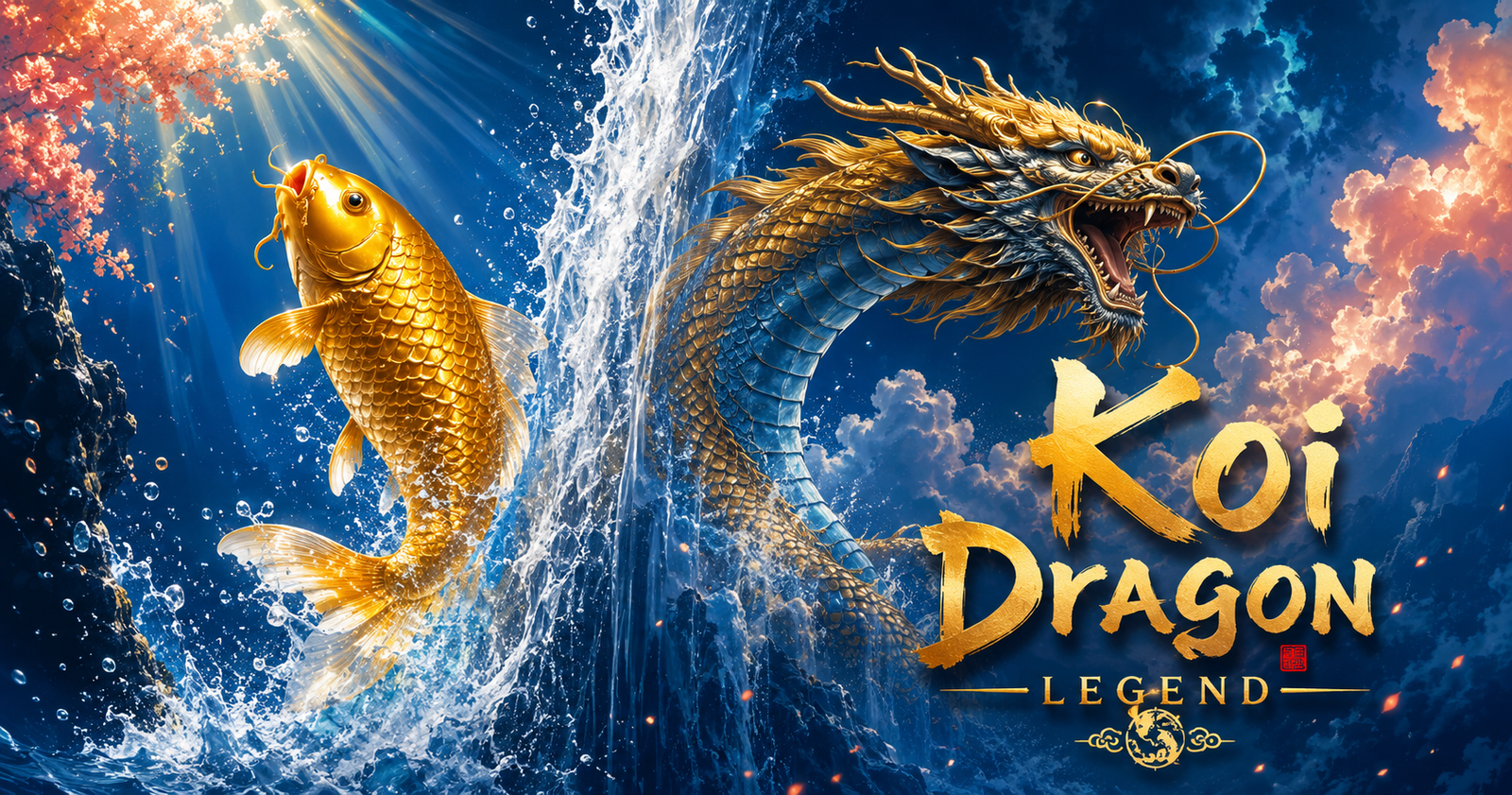
The koi dragon legend is an ancient Chinese myth in which a school of golden koi fish swam upstream the Yellow River and attempted to leap Dragon Gate Falls. After a hundred years, one koi finally cleared the waterfall. The gods recognized its extraordinary perseverance and transformed it into a powerful golden dragon. The legend is the origin of the koi’s worldwide symbolism as a symbol of perseverance, transformation, and the reward for enduring what others cannot.
Koi Dragon Legend at a Glance
- 🐉Origin: Ancient China — Dragon Gate (Longmen) on the Yellow River
- ⏳Age: Over 2,000 years old
- 🐟Core story: Koi swims upstream, clears impossible waterfall, becomes a dragon
- 🌏Spread: China → Japan → Korea → Vietnam → worldwide
- ✦Core meaning: Transformation is earned, not given — through persistent effort
- 🎨Modern uses: Tattoos, feng shui, business, sports, personal development
The Full Koi Dragon Legend
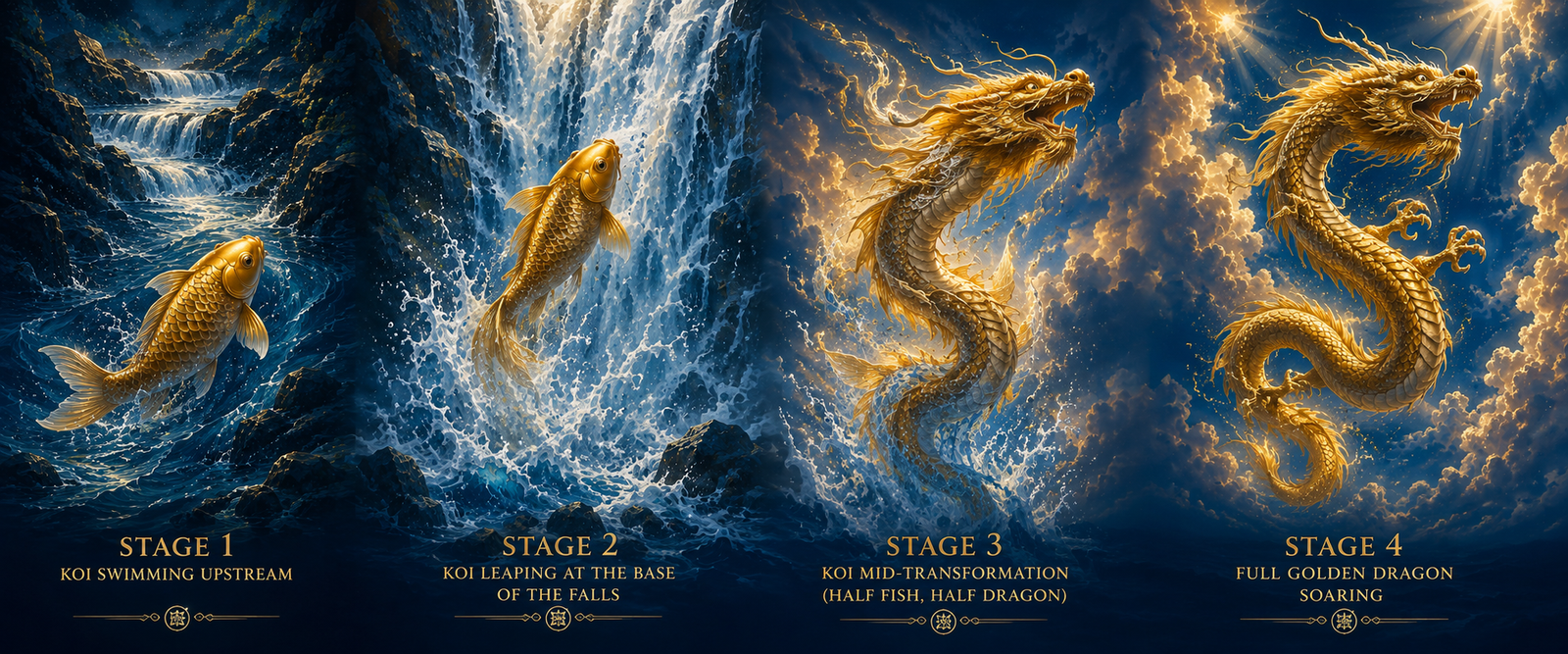
The koi dragon legend begins thousands of years ago on the Yellow River in ancient China. A great school of golden koi were swimming upstream — as koi do, naturally and powerfully, pushing against the current with every beat of their tails. Word had spread among the fish of a waterfall at the river’s end, a place called the Dragon Gate, where something extraordinary was said to await any koi with the will to reach the top.
A vast school of golden koi swam upstream the Yellow River, glimmering as they moved together against the current. At the end of the river, they reached the Dragon Gate — a massive, thundering waterfall that seemed impossible to climb.
Many koi, exhausted and discouraged, turned back. They let the current carry them away, choosing the familiar comfort of downstream life over the uncertain promise of the falls.
But a few refused to turn back. They leaped again and again at the base of the falls — battered by the torrent, bruised against the rocks, driven back repeatedly by the sheer force of the water. Local demons, watching from above, mocked their efforts. To make the challenge even harder, the demons raised the height of the waterfall.
Still, the koi kept leaping. For a hundred years, they persisted. One after another, they tried and failed, tried and failed. The school grew smaller. The falls seemed insurmountable.
Then, after a hundred years of effort, one koi finally reached the top. It breached the crest of the Dragon Gate and hung suspended for a moment above the thundering water.
The gods, who had been watching the entire time, recognized this extraordinary act of perseverance. In that moment, the koi was transformed — scales giving way to armored plates, fins becoming powerful claws, body elongating into the sinuous form of a great dragon. The waterfall, from that day forward, became known as the Dragon Gate, and the legend was written into the cultural memory of a civilization.
Dragon Gate — The Real Location Behind the Legend
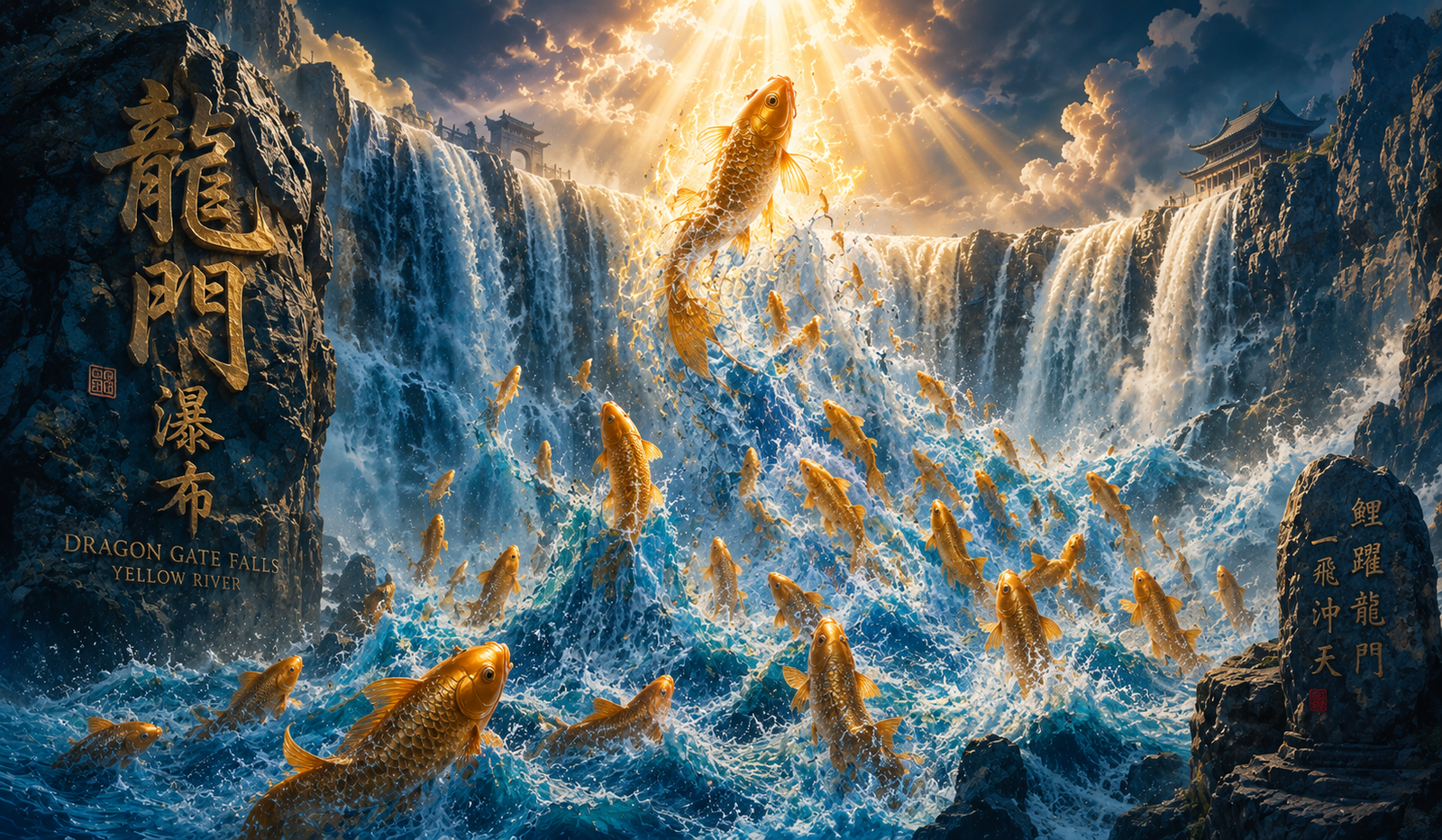
Unlike many myths, the Dragon Gate has a real geographic anchor. Longmen (龍門) — literally “Dragon Gate” — is a gorge on the Yellow River on the border of Shanxi and Shaanxi provinces in China. The Yellow River narrows dramatically at this point, creating powerful rapids that made it one of the most treacherous stretches of river in ancient China.
The gorge was famous for the annual spring run of carp that would swim upstream to spawn. Chinese observers noticed that the carp who made it through the gorge were exceptionally large and powerful — which gave rise to the belief that the river itself was testing them. The Longmen legend grew from this real observation: the fish that made it through Dragon Gate really were stronger, and the ones that didn’t turned back.
The legend became so culturally embedded that passing the imperial examination — the most difficult academic test in Chinese history, upon which entire careers and family fortunes depended — was described as jumping the Dragon Gate (跳龍門, tiào lóng mén). A student who passed was likened to the koi that finally cleared the falls and became a dragon.
What the Koi Dragon Legend Means
At its core, the legend teaches a single, powerful idea: transformation is not given — it is earned. The koi does not become a dragon because it was born special, or lucky, or more gifted than the others. It becomes a dragon because it refused to stop when every other koi turned back.
The layered meaning of the legend operates on several levels:
The Koi Dragon Legend Across Cultures
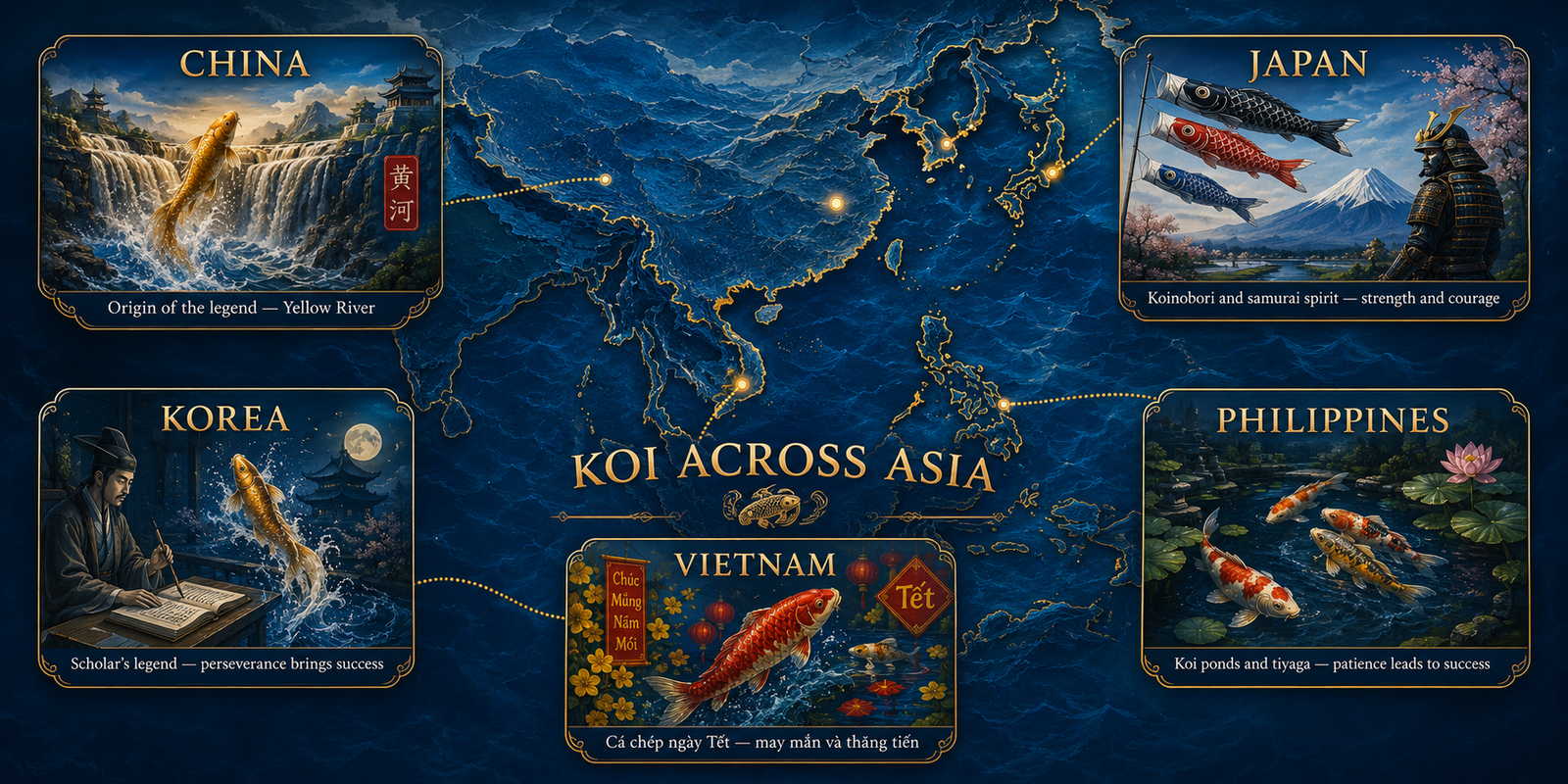
While the legend originates in China, it traveled across Asia over two millennia and found a permanent home in multiple cultures, each adding its own layer of meaning.
Koi Dragon Symbolism by Color
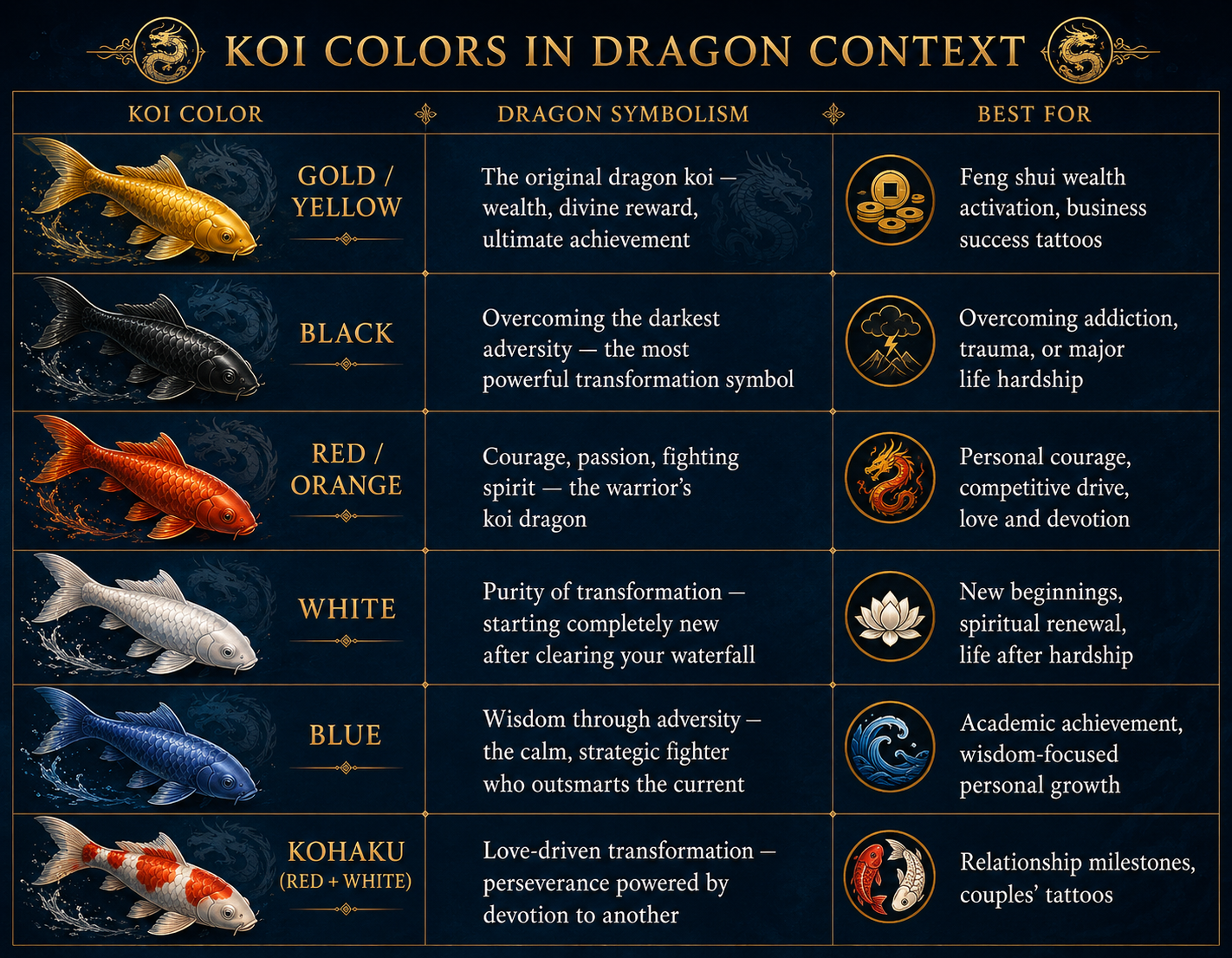
In the legend, the koi that transforms is described as golden — and color has remained central to koi dragon symbolism ever since. The color of the koi in artwork, tattoos, and dreams all add a distinct layer of meaning to the legend’s core message.
| Koi color | Dragon symbolism | Best for |
|---|---|---|
| Gold / Yellow | The original dragon koi — wealth, divine reward, ultimate achievement | Feng shui wealth activation, business success tattoos |
| Black | Overcoming the darkest adversity — the most powerful transformation symbol | Overcoming addiction, trauma, or major life hardship |
| Red / Orange | Courage, passion, fighting spirit — the warrior’s koi dragon | Personal courage, competitive drive, love and devotion |
| White | Purity of transformation — starting completely new after clearing your waterfall | New beginnings, spiritual renewal, life after hardship |
| Blue | Wisdom through adversity — the calm, strategic fighter who outsmarts the current | Academic achievement, wisdom-focused personal growth |
| Kohaku (Red + White) | Love-driven transformation — perseverance powered by devotion to another | Relationship milestones, couples’ tattoos |
Koi Dragon Tattoo Meaning
The koi dragon tattoo is one of the most requested tattoo concepts worldwide — and for good reason. It is a profoundly personal symbol, and its meaning is shaped by the specific design choices made by the wearer.
The Transformation Moment
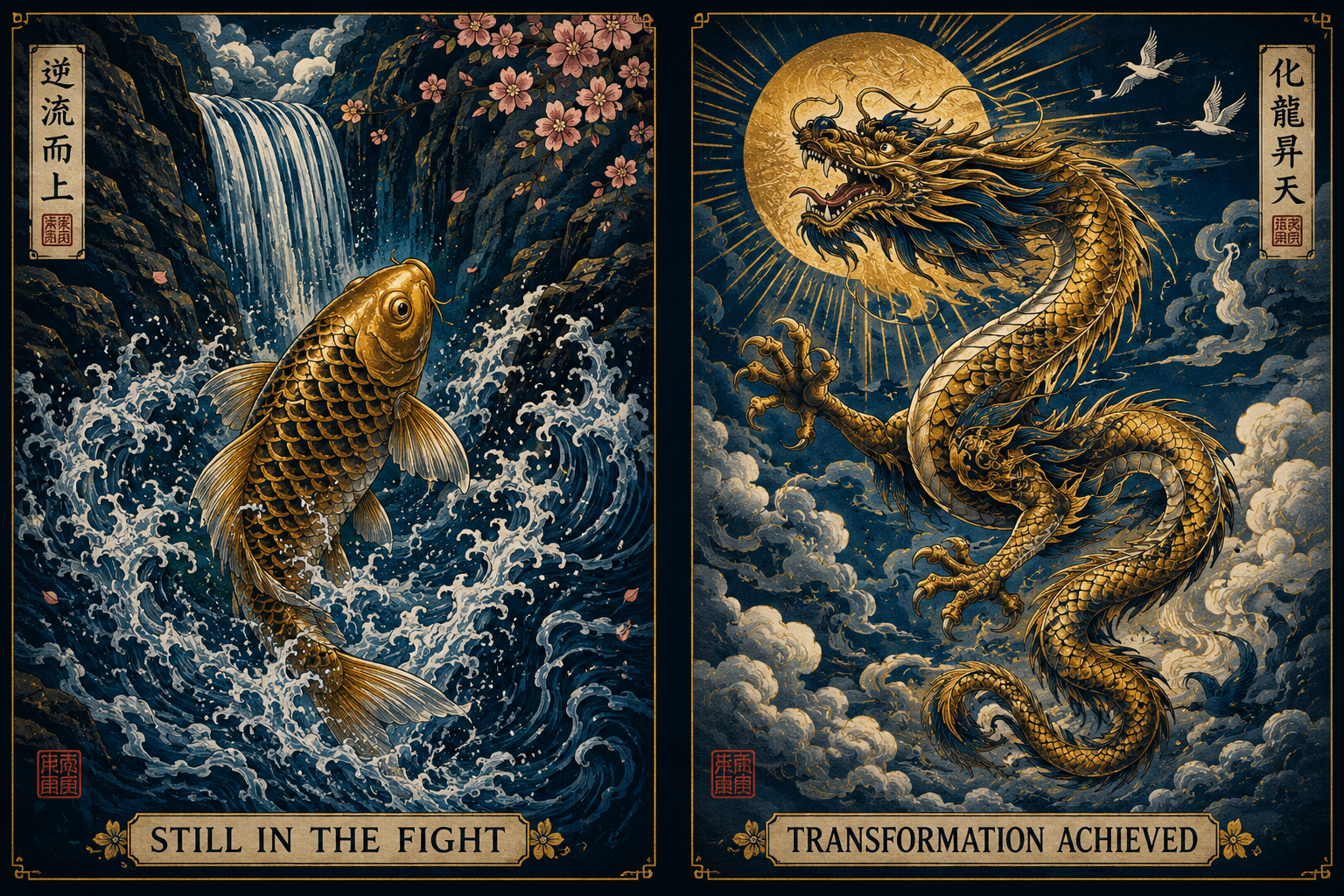
The most powerful koi dragon tattoo design captures the exact moment of transformation — the fish mid-leap, body beginning to elongate, scales shifting, the waterfall below. This design is the most visually striking and the most symbolically complete: it says I am in the middle of becoming something extraordinary.
Koi Below, Dragon Above
A popular sleeve or back tattoo design shows a koi at the bottom — swimming upward — and a dragon at the top, with a waterfall connecting them. This represents the full arc: the struggle at the bottom, the transformation in the middle, and the dragon freedom at the top. It is a life story told in ink.
Direction Matters
As with all koi tattoos, the swimming direction of the koi portion carries meaning:
- Koi swimming upstream — you are still in the fight; the waterfall hasn’t been cleared yet
- Koi swimming downstream / dragon flying upward — the battle is won; you have earned your transformation
Who Gets This Tattoo
The koi dragon tattoo is particularly meaningful for people who have overcome addiction, serious illness, financial collapse, trauma, or any sustained period of hardship. It is a permanent declaration — visible every day — that the leap was made. Many people get this tattoo at the moment of their breakthrough rather than during the struggle, as a marker of transformation completed.
The Koi Dragon Legend in Modern Culture
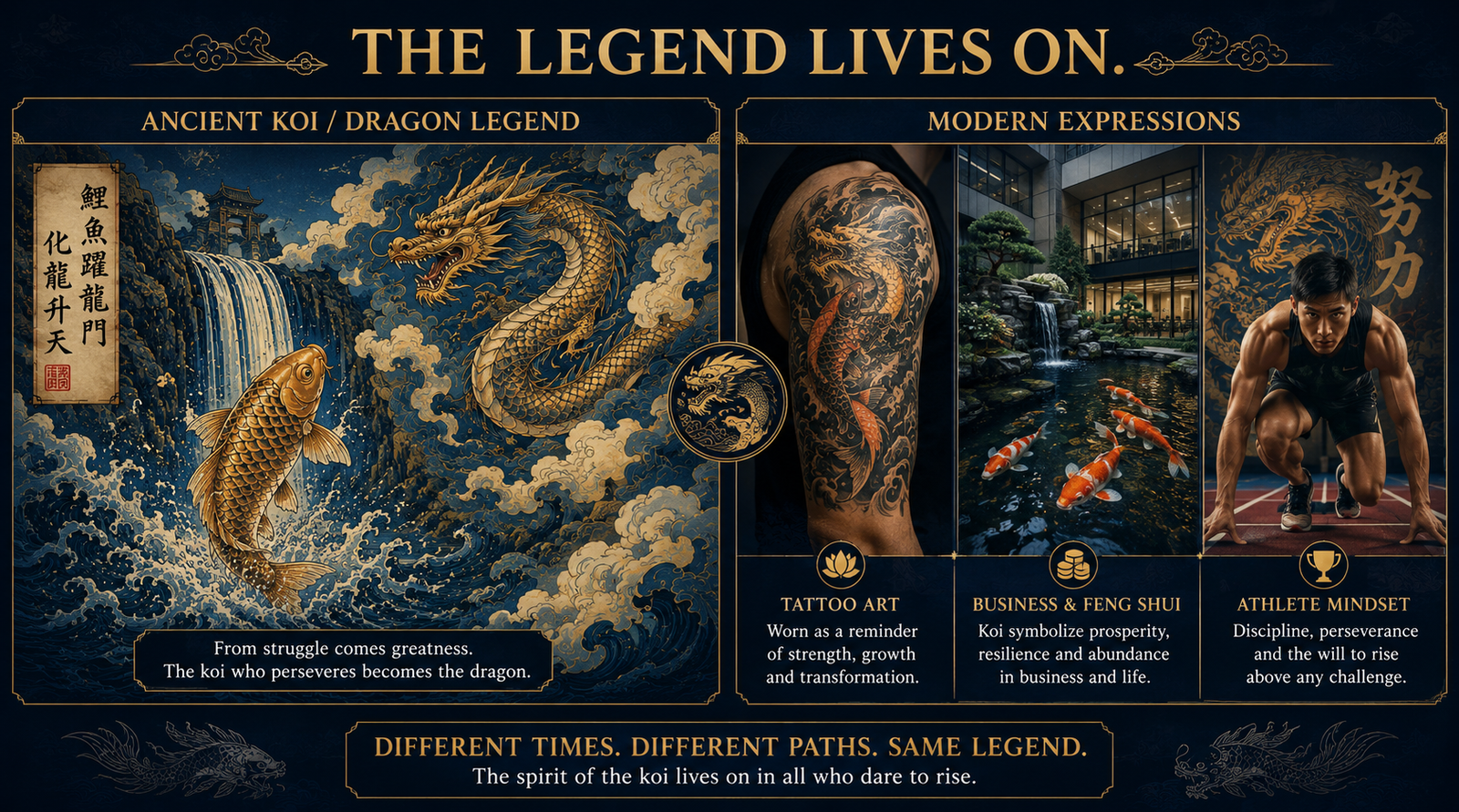
Few ancient myths have translated into modern life as seamlessly as the koi dragon legend. Its core message — that sustained effort leads to extraordinary transformation — fits naturally into nearly every domain of contemporary human striving.
Business and Entrepreneurship
Across Asia and increasingly in the West, entrepreneurs keep koi ponds in offices and display koi dragon artwork as a daily reminder of the upstream journey required before breakthrough success arrives. The legend maps perfectly onto the startup experience: years of grinding effort, constant setbacks, the temptation to turn back — and then, for those who persist, transformation.
Sports and Athletics
In Japan and across Asia, coaches use the koi dragon metaphor to motivate athletes through the unglamorous seasons of training that precede championship performance. The hundred years of leaping before the dragon emerges is a vivid image for any athlete who knows what sustained, often invisible preparation feels like.
Personal Development
The legend has become a staple in motivational literature, coaching, and self-development content worldwide. Its power lies in its specificity: it doesn’t promise that effort will be rewarded quickly or easily. It promises only that those who refuse to stop will eventually reach the top of their waterfall — and be transformed by it.
Pokémon — Magikarp and Gyarados
One of the most globally recognized modern expressions of the legend is Pokémon’s Magikarp and Gyarados. Magikarp is explicitly modeled on the koi fish — it is the weakest, most dismissed Pokémon in the game, capable of almost nothing useful. Through sustained effort (leveling), it evolves into Gyarados — a massive, fearsome sea dragon. The legend, reimagined for a global audience of hundreds of millions, carries exactly the same message: the most powerful transformations begin from the most humble starting points.
Frequently Asked Questions About the Koi Dragon Legend
The koi dragon legend is an ancient Chinese myth in which a school of golden koi fish swam upstream the Yellow River and attempted to leap a massive waterfall called Dragon Gate (Longmen). After a hundred years of trying, one koi finally cleared the falls. The gods, recognizing its extraordinary perseverance, rewarded it by transforming it into a golden dragon. The legend is the origin of the koi’s worldwide symbolism as a symbol of perseverance, transformation, and the reward of enduring struggle.
No — koi fish do not physically transform into dragons. The legend is a mythological allegory, not a biological fact. It originates in ancient Chinese mythology and uses the koi’s real behavior — swimming powerfully upstream — as the basis for a philosophical story about perseverance leading to extraordinary transformation.
The koi dragon legend originates in ancient China, centered on the Dragon Gate (Longmen) — a real waterfall gorge on the Yellow River in Shanxi and Shaanxi provinces. The legend dates back at least 2,000 years and became one of the most recognized symbols in Chinese culture. It later spread to Japan, Korea, Vietnam, and eventually worldwide through Asian diaspora communities.
The koi dragon symbolizes perseverance, transformation, strength, and the extraordinary reward that comes from enduring sustained effort. It represents the idea that transformation is not given — it is earned through struggle. The symbol appears in feng shui, tattoo art, business culture, and personal development as a reminder that the most difficult journeys lead to the greatest transformations.
A koi dragon tattoo represents personal transformation after struggle — the breakthrough moment when persistent effort finally produces extraordinary results. It is most meaningful for people who have overcome addiction, serious illness, trauma, or sustained hardship. It is a permanent declaration: I made the leap. Color and direction add further personal layers of meaning.
Dragon Gate (Longmen, 龍門) is a real waterfall gorge on the Yellow River in China. In the legend, it is the final, seemingly impossible obstacle the koi must clear to earn transformation into a dragon. It became a metaphor in Chinese culture for any great challenge that, once overcome, elevates a person to a higher state. Passing the imperial examination was historically compared to a koi leaping Dragon Gate.
The golden dragon koi represents the ultimate reward for perseverance — wealth, power, and divine recognition. Gold is the color of heaven, success, and imperial power in Chinese culture. A golden koi in a feng shui pond is associated with financial abundance and business prosperity. The golden dragon transformation in the legend represents a divine upgrade: from earthly struggle to heavenly power.
The koi dragon legend appears in tattoo culture as a symbol of personal transformation, in business as a metaphor for perseverance before breakthrough, in sports coaching for athlete motivation, in personal development literature, and in popular media including Pokémon’s Magikarp and Gyarados — which directly mirrors the legend’s koi-to-dragon transformation arc.
Explore More Koi Fish Guides
Last updated: · By Giovanni Carlo

Passionate about fish keeping since elementary school in the 1980s, Giovanni Carlo has dedicated countless hours to collecting and breeding a diverse array of ornamental freshwater fish. From vibrant guppies and majestic koi to striking bettas and classic goldfish, he continues to explore the fascinating world of aquatics, sharing knowledge and enthusiasm with fellow fish enthusiasts.