By Giovanni Carlo Bagayas | Updated: June 2026 | 14 min read
Quick Answer
The most effective heron deterrents are: pond netting (physical barrier — most reliable), pond depth of 3+ feet at the perimeter (permanent passive protection), fish caves (survival insurance for your koi), and motion-activated sprinklers (24/7 active deterrence). Never rely on a single method — herons are intelligent and adaptable. A layered approach using 3 or more methods together is always more effective. Decoys work short-term but must be moved every 2–3 days. Killing herons is illegal in the US, UK, and Australia.
Understanding heron behavior — why your pond is a target
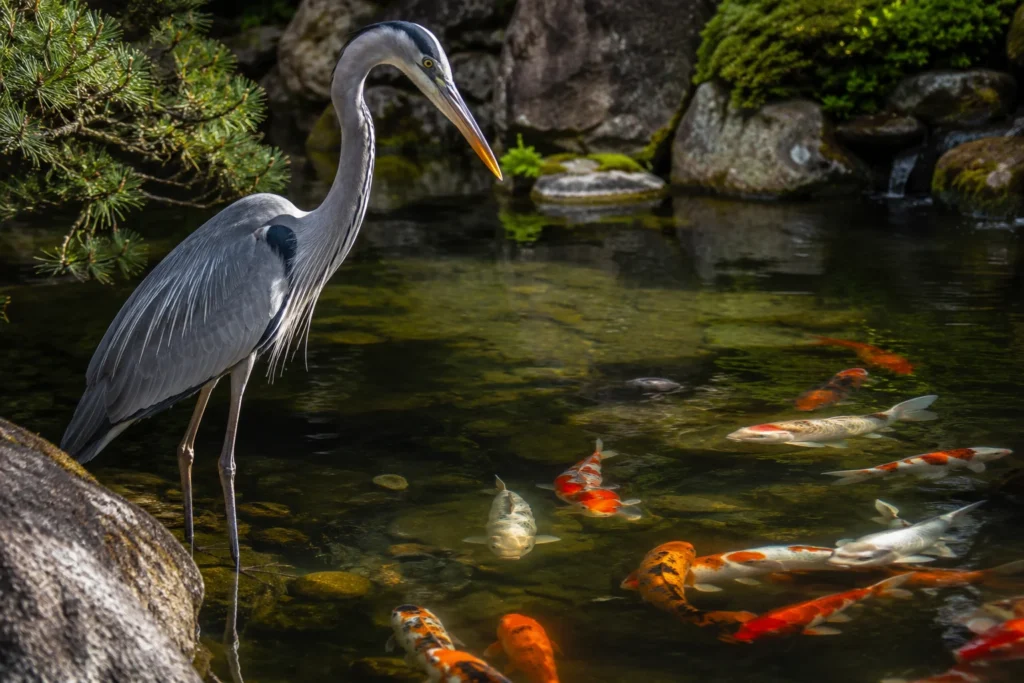
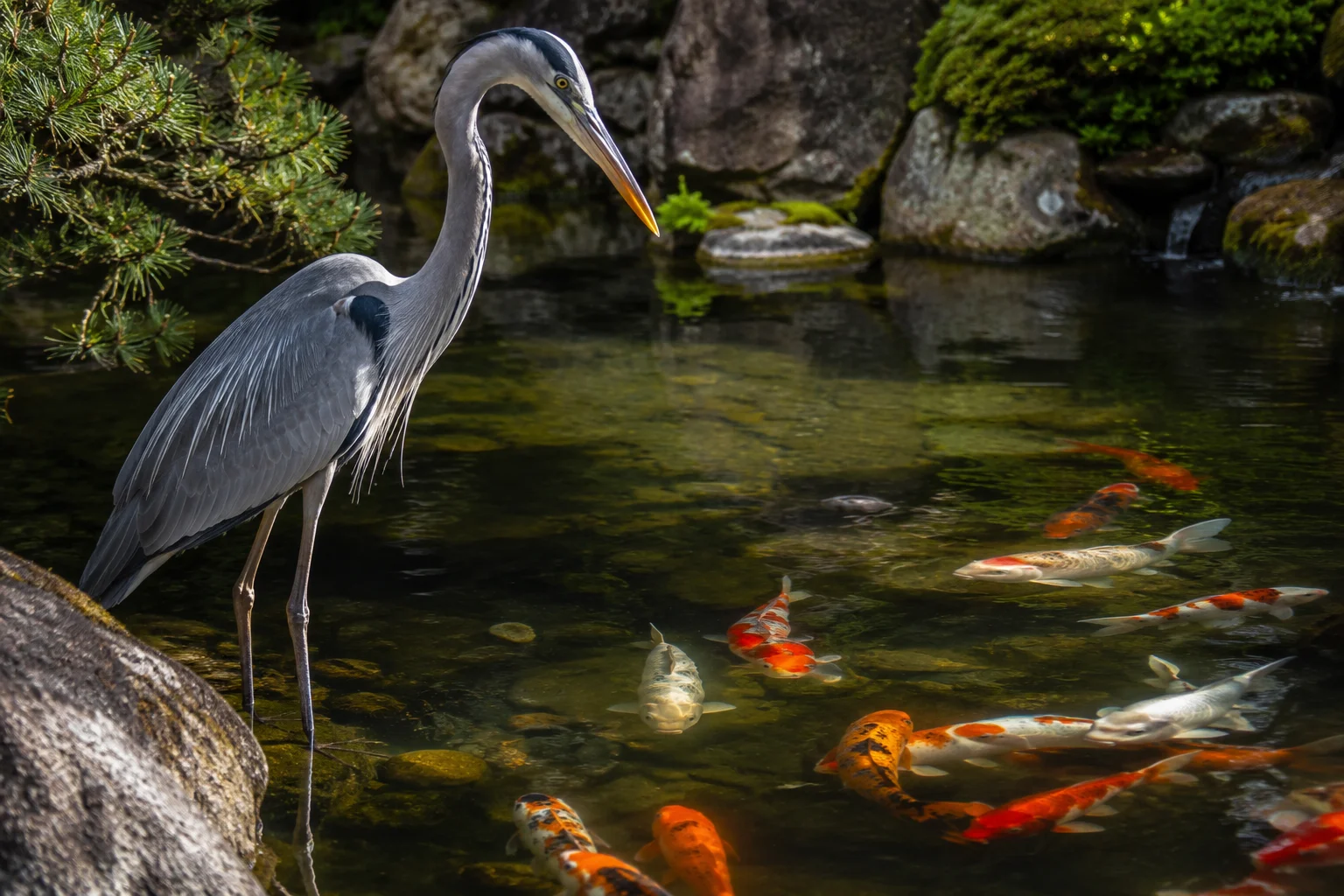
To effectively deter herons, you need to understand how they hunt. Herons are not random visitors — they are patient, intelligent, and highly efficient predators that use specific tactics to reach your koi.
| Heron behavior | What it means for your pond |
|---|---|
| Land at the perimeter and walk in | Herons do not dive — they land near the pond edge and wade in. This means perimeter barriers (fishing line, electric fence, plants) are effective deterrents. |
| Hunt at dawn, dusk, and night | Most pond losses happen when you are asleep. Motion-activated deterrents that work 24/7 are essential — human presence alone is not enough. |
| Stand motionless in shallow water | Herons wait for fish to come to them in shallow water. Deep-sided ponds where herons cannot stand are dramatically safer than shallow ones. |
| Return to reliable food sources | An adult heron needs ~13 oz of food daily (~3 medium koi). A pond that produced easy meals will be revisited every day. Once found, treat it as a permanent threat. |
| Adapt to static deterrents | Herons are intelligent and quickly learn that stationary decoys, string, and other non-moving deterrents are not genuine threats. Only physical barriers and active deterrents remain effective long-term. |
| Exceptional low-light vision | Herons have 5x the rod density of human eyes — they are excellent night hunters. Reflective and light-based deterrents only work during daylight. |
| Know your routine | Herons observe patterns and learn when you are typically absent. Varying your pond visit times and hours makes the heron’s planning more difficult. |

From 40+ years of koi keeping
I have lost koi to herons. Every koi keeper does if they keep ponds long enough. The mistake I made early was thinking that a single deterrent was enough — I put up a decoy heron and felt protected. Within two weeks the heron was back, completely ignoring the decoy. What I learned is that herons are problem solvers. They will work around any single obstacle if the reward is big enough. The only approach that has worked consistently for me across 40 years is making the pond genuinely inaccessible — deep enough that they cannot stand, netted when I cannot watch, and with caves so the fish have somewhere to retreat. Those three things together have saved far more koi than any gimmick ever could.
All 10 methods ranked by effectiveness
| Rank | Method | Effectiveness | Cost | Aesthetic impact |
|---|---|---|---|---|
| ⭐ 1 | Pond netting (raised) | Highest — physical barrier | $30–$150 | Moderate — visible but removable |
| ⭐ 2 | Pond depth 3+ feet | Very high — permanent passive | Pond redesign | None — improves pond |
| ⭐ 3 | Fish caves / hiding pipes | Very high — fish survival insurance | $10–$80 | None — underwater |
| 4 | Motion-activated sprinkler | High — active 24/7 deterrence | $50–$120 | Low — small device |
| 5 | Fishing line perimeter | High — disrupts walking approach | <$10 DIY | Very low — nearly invisible |
| 6 | Heron decoy | Medium — needs regular repositioning | $20–$60 | Low — decorative |
| 7 | Dense marginal plants | Medium — passive perimeter block | $20–$100 | Positive — beautifies pond |
| 8 | Electric perimeter fence | Medium — physical boundary | $80–$200 | Moderate — visible wire |
| 9 | Ultrasonic sound device | Low — herons adapt quickly | $40–$100 | Very low |
| 10 | Reflective tape / CDs / mirrors | Low — only works in daylight, herons adapt | <$5 | Poor — unattractive |
1. Pond netting — the most reliable barrier
Pond netting is the single most effective heron deterrent available. It creates a physical barrier that no heron can bypass regardless of intelligence, patience, or persistence. Key: the netting must be raised above the water surface — flat netting laid directly on the water allows herons to reach through to fish with their beaks.
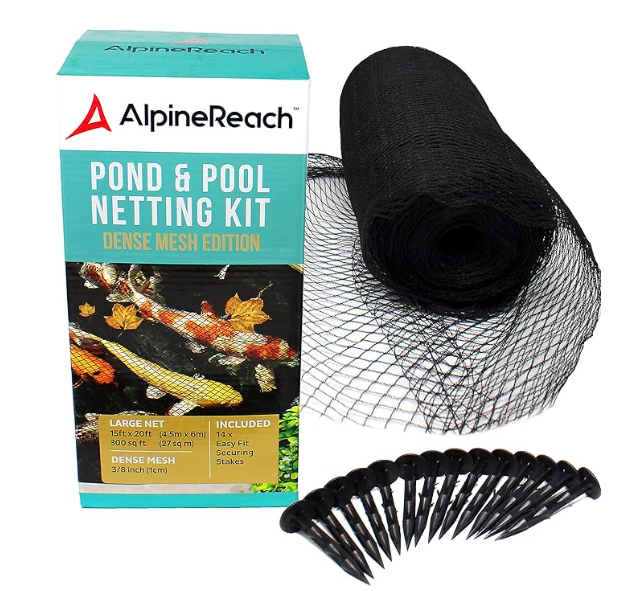
Alpinereach Koi Pond Netting
Heavy-duty fine mesh pond netting by Alpinereach — specifically designed for koi ponds to keep herons, leaves, and debris out. Easy to install, durable, and available in multiple sizes. Highly rated by koi keepers worldwide.
View on Amazon →How to install pond netting correctly
- Use posts or hoops to raise netting 12–18 inches above the water surface
- Secure netting tightly around the entire perimeter — no gaps at the edges
- Use fine mesh netting (½ inch or smaller) so herons cannot reach through
- Ensure posts are tall enough that a heron cannot stand outside and reach over the netting
- Check regularly for sagging, tears, or gaps — repair immediately
⚠️ Common netting mistake
Flat netting laid directly on the water surface does not work. A heron will simply walk around the edge and spear fish through the gaps, or stand on the netting and push it down to reach fish below. Always raise netting on posts so the heron cannot reach the water from any angle.
Pros: Most reliable barrier; works 24/7; protects against other predators (raccoons, cats, otters). Cons: Affects pond aesthetics; must be checked regularly for gaps.
2. Pond depth — the permanent passive solution
Pond depth is the most permanent and aesthetically neutral heron deterrent. Herons can only hunt by standing in water — if the pond is too deep to stand in at the perimeter, they cannot fish effectively.
| Pond depth at perimeter | Heron threat level | Notes |
|---|---|---|
| Under 18 inches (45 cm) | Very high — ideal heron wading depth | Herons can stand comfortably and reach fish easily |
| 18–24 inches (45–60 cm) | High — manageable for large herons | Large Great Blue Herons can still wade at this depth |
| 24–36 inches (60–90 cm) | Moderate — difficult but not impossible | Herons avoid if other easier ponds are available |
| 36–48 inches (90–120 cm) ⭐ | Low — beyond comfortable wading range | Recommended minimum for heron deterrence |
| 48+ inches (120+ cm) | Very low — herons cannot stand to fish | Ideal — also benefits koi health and temperature stability |
Critically: the depth at the pond edge matters most — not just the maximum depth. A pond that is 4 feet deep in the center but has shallow 12-inch shelves around the perimeter is still highly vulnerable. Steep-sided ponds that drop immediately to 3+ feet are far more heron-resistant than gradual-slope designs.
3. Fish caves and hiding places
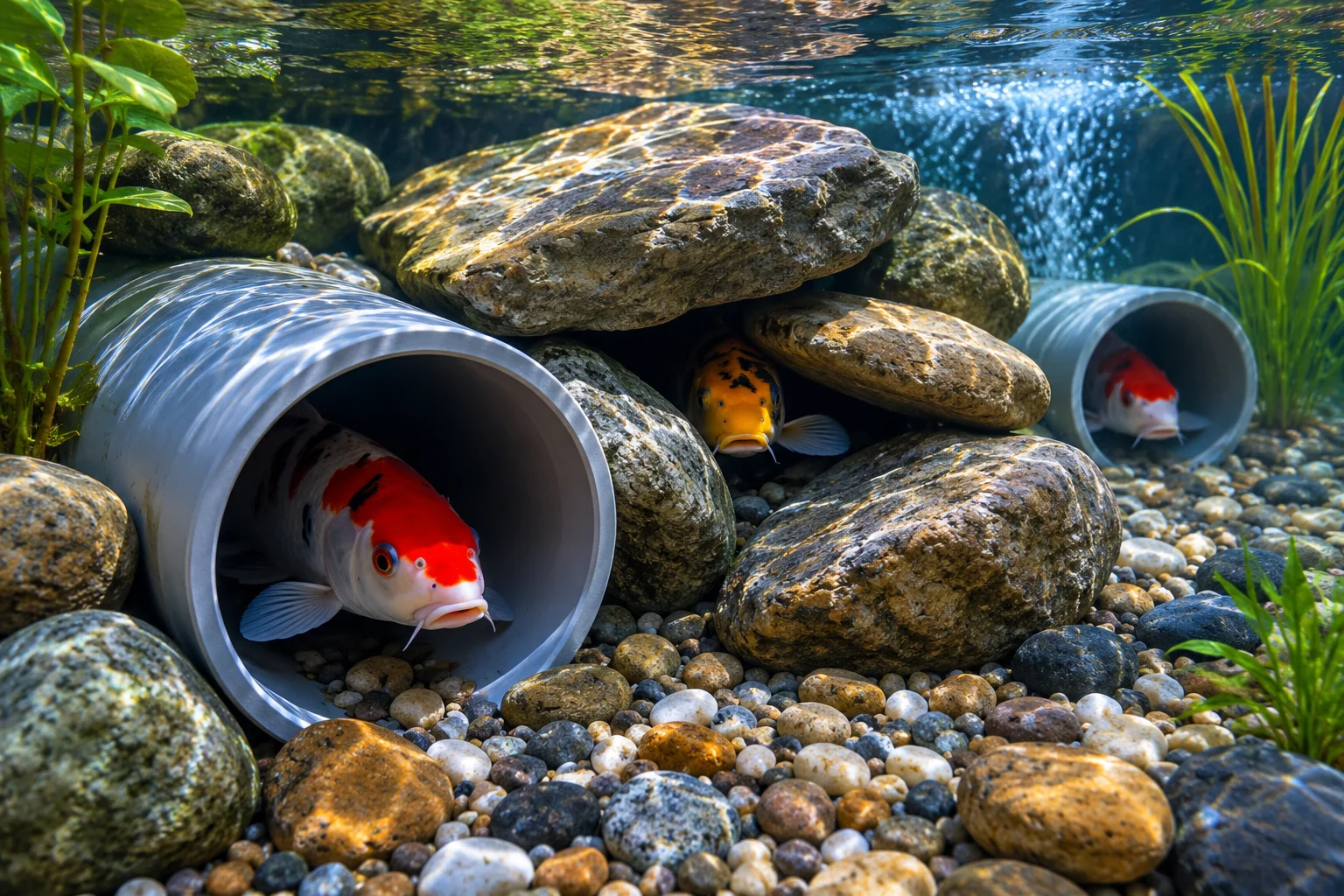
Fish caves are the most overlooked heron deterrent — but they may save more koi than any other single method. Here is why: even if a heron gets past your other defenses, koi with somewhere to hide will survive. Koi without hiding places will not.
How to create fish hiding places
- Large diameter pipe sections: 4–6 inch diameter PVC or clay pipe cut into 12–18 inch sections — lay flat on the pond floor. Koi will dart into these during an attack.
- Cave rocks: Stack flat rocks to create overhanging ledges and cave-like spaces on the pond floor.
- Commercial fish shelters: Available from pond suppliers — purpose-built shelters that multiple fish can retreat into simultaneously.
- Water lily pads: Dense floating coverage gives koi shade and visual cover from aerial observation.
- Size requirement: Caves must be large enough for your largest koi to fully enter. Measure your biggest fish and size caves accordingly.
4. Motion-activated sprinklers
Motion-activated sprinklers are the best active deterrent for herons. When the sensor detects movement, a sudden burst of water fires toward the intruder — startling the heron and driving it away. The key advantages: they work 24/7 including at night, they work against all perimeter predators (herons, raccoons, cats), and they do not harm the animal.
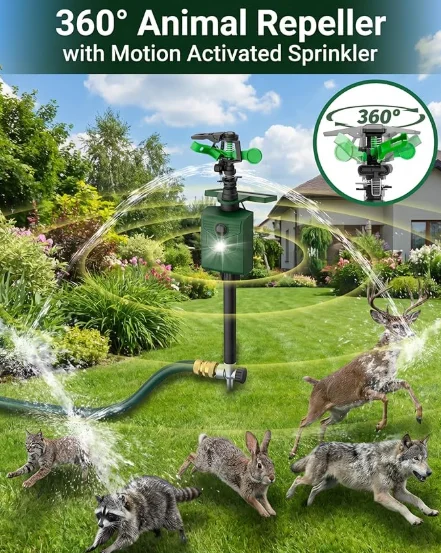
Motion-Activated Solar Animal Repellent Sprinkler
One of the most trusted motion-activated sprinklers for pond protection. Day/Night mode, 100ft detection range, adjustable sensitivity — works against herons, raccoons, cats, and other predators. Solar-assisted or battery powered.
View on Amazon →Setup tips
- Place sprinklers to cover the most likely approach angles — usually the open sides of the pond
- Adjust sensitivity to trigger on a large bird (heron) but not small animals or wind
- Most units cover 100–1,200 square feet — position to protect the full perimeter
- Check batteries regularly — a dead sprinkler gives false security
- Angle upward slightly to intercept herons as they approach on foot
Limitation: Herons may eventually learn the spray zone and approach from outside it. Combine with perimeter line or netting for best results.
5. Fishing line perimeter — the cheap, invisible solution
One of the most cost-effective heron deterrents costs less than $10 and is nearly invisible. Run monofilament fishing line on short posts around the pond perimeter at 6 inches and 12 inches above ground level.
Herons land near the pond and walk to the water’s edge. When they encounter fishing line at leg height, it disrupts their approach and startles them — they cannot see the line clearly and the unexpected resistance spooks them. This method works well because it targets exactly how herons access a pond: on foot from the perimeter.
How to set it up
- Use garden stakes or small posts every 3–4 feet around the pond
- Run 20–30 lb monofilament fishing line at two heights: 6 inches and 12 inches from the ground
- Complete the full perimeter with no gaps — herons will walk the perimeter looking for an entry point
- Check monthly — UV degrades monofilament over time; replace when fraying
Pros: Nearly invisible, very cheap, no maintenance, does not harm animals. Cons: Determined herons may eventually fly directly over the line and land in the pond — combine with depth or netting.
6. Heron decoy — works short-term, needs repositioning
A realistic heron decoy placed near the pond exploits the heron’s territorial nature — they typically avoid areas where another heron appears to be feeding. This works well when a heron has not yet discovered your pond.
How to use a heron decoy effectively
- Move it every 2–3 days — a stationary decoy is quickly recognized as non-threatening by an intelligent heron
- Place it in a natural-looking hunting stance at the pond edge
- Remove or reposition during breeding/mating season (spring) — herons may approach a decoy as a potential mate rather than a territorial rival
- Combine with other methods — a decoy alone is not reliable long-term protection
Pond Logic Blue Heron Decoy
Realistic Blue Heron decoy with weighted base for outdoor use. Effective as a first-line deterrent for ponds not yet discovered by herons. Best used alongside netting or motion sprinklers — move every 2–3 days for continued effectiveness.
View on Amazon →⚠️ Decoy limitations
Never rely on a heron decoy as your only protection. A hungry heron that has already found your pond will learn to ignore a stationary decoy within days. Decoys are best used as a first-line deterrent for ponds that have not yet been discovered — not as protection after a heron has already visited and fed.
7. Dense marginal plants
Herons prefer open, clear shorelines where they can stand unobstructed and observe the water. Dense plantings of tall marginal plants around the pond perimeter make approach difficult and remove the clear sightlines herons need to hunt effectively.
Best plants for heron deterrence: reeds, cattails, tall iris, rushes, and ornamental grasses. Plant them densely around the full perimeter — gaps allow herons to find clear approach angles. The additional benefit: marginal plants also provide shade and natural hiding for koi near the surface, and add beauty to the pond.
8. Electric pond fence
A low-voltage electric perimeter fence delivers a harmless but effective shock when a heron (or other predator) touches it. Electric fences target the heron’s landing approach and prevent it from reaching the water’s edge.
- Set the fence at 4–6 inches high around the perimeter — at heron leg height
- Delivers a harmless static shock — legal, humane, effective
- Works against all land-based predators (raccoons, foxes, cats) simultaneously
- Does not protect against herons that fly directly into the pond — combine with netting if needed
Gallagher Electric Fence Kit
Low-voltage electric perimeter fence — delivers a harmless but effective deterrent shock to herons, raccoons, and other pond predators. Simple setup around the pond perimeter. Works against all land-based predators simultaneously.
View on Amazon →9–10. Ultrasonic devices and reflective deterrents
9. Ultrasonic sound devices
Ultrasonic devices emit high-frequency sounds intended to be unpleasant to birds. Effectiveness is low — herons adapt to recurring sounds quickly and most pond keepers report limited results. Only useful as part of a broader multi-method approach, not as a standalone deterrent.
10. Reflective tape, CDs, and mirrors
Reflective objects create sudden flashes of light that can startle herons. Effectiveness is very low — works only in daylight, herons adapt within days, and the appearance is unattractive. Not recommended as a primary method. Floating reflective balls on the water surface may have slightly better results as they move with the water.
Signs a heron has visited your pond
| Sign | What it means | Action to take |
|---|---|---|
| Missing fish | Most obvious sign — fish eaten or taken | Count fish; implement deterrents immediately; the heron will return |
| Fish refusing to surface | Koi hiding at the bottom, won’t come up for feeding — classic stress response after a heron visit | Do not force feeding; give fish 24–48 hours to recover; install deterrents before heron returns |
| Fish on the lawn or ground | Heron caught fish but dropped it while flying away | Return fish to water quickly — they often survive if found within minutes |
| Fish with puncture wounds | Heron struck fish with its beak but could not retrieve it | Treat wounds immediately with pond-safe antiseptic; isolate injured fish in quarantine tank |
| Three-toed footprints in mud | Heron footprints around the pond edge — confirms heron visit even if no fish were lost | Treat as an active threat — the heron scouted your pond and may return when more confident |
| Stirred-up water and sediment | Heron waded in the shallows | Check pond depth at perimeter; add immediate deterrents |
Is it legal to harm or kill a heron?
⚠️ Important — herons are legally protected in most countries
- United States: Herons are protected under the Migratory Bird Treaty Act of 1918. Killing, harming, capturing, possessing, or even disturbing a heron at its nest is a federal offense with fines up to $15,000 per violation.
- United Kingdom: All herons are protected under the Wildlife and Countryside Act 1981. Killing or injuring a heron carries criminal penalties.
- Australia: Herons are protected under the Environment Protection and Biodiversity Conservation Act 1999.
- Philippines: Herons are protected under the Wildlife Resources Conservation and Protection Act (RA 9147).
Only humane deterrence is legal everywhere. All methods described in this guide are legal and humane.
Frequently asked questions
How do I stop herons from eating my koi?
The best combination: raised pond netting (physical barrier) + pond depth of 3+ feet at the perimeter + fish caves on the pond floor + motion-activated sprinkler. No single method is foolproof — use at least 3 methods together for reliable protection.
What is the best heron deterrent for a koi pond?
Pond netting is the single most effective deterrent — it creates a physical barrier no heron can bypass. The best overall system combines netting + pond depth of 3+ feet + fish caves + motion-activated sprinkler for redundant protection.
Do heron decoys work?
Yes — temporarily. Herons are territorial and will avoid a pond where another heron appears to be feeding. But a stationary decoy is quickly recognized as fake. Move it every 2–3 days to maintain effectiveness. Never use as your only deterrent. Remove during breeding season — herons may approach decoys as potential mates.
What depth pond do herons avoid?
At least 3 feet (90 cm) at the perimeter — ideally 4 feet (120 cm). Herons can only hunt by standing in water. Steep-sided ponds that immediately drop to 3+ feet at the edge are dramatically safer than shallow-sloped designs.
Do herons come back to the same pond?
Yes — absolutely. An adult heron needs ~13 oz of food daily (~3 medium koi). Once it finds a reliable food source, it returns every day. Once a heron has fed from your pond, treat it as a permanent ongoing threat and implement deterrents immediately.
Is it illegal to kill a heron?
Yes — in the US (Migratory Bird Treaty Act), UK (Wildlife and Countryside Act), Australia, and the Philippines, herons are legally protected. Killing or harming a heron carries serious criminal penalties. Only humane deterrence is legal.
What time do herons visit ponds?
Most commonly at dawn and dusk — but herons have excellent low-light vision (5x the rod density of human eyes) and hunt successfully at night. Motion-activated deterrents that work 24/7 are essential — human presence alone is not enough protection.
How do I know if a heron has been to my pond?
Signs: missing fish; koi refusing to surface for feeding; fish found on the lawn; fish with puncture wounds from beak strikes; three-toed footprints in mud around the pond; disturbed water and stirred sediment. If koi suddenly stop surfacing at feeding time — assume a predator has visited.
Related koi pond protection guides
- How to protect koi from all predators — complete guide
- Koi pond water quality — keeping stressed koi healthy after a heron attack
- Koi fish food guide — feeding koi that have stopped surfacing
- How long do koi live — protecting your long-term investment
- Most expensive koi fish — why protection is worth the investment
- Lucky number of koi in a pond — stocking guide
- Butterfly koi — long fins make them especially vulnerable to heron attacks
- Chagoi koi — the friendliest koi is also the most vulnerable to herons

Giovanni Carlo Bagayas
Founder, Giobel Koi Center · Koi keeper since the 1980s · Labangan, Zamboanga del Sur, Philippines
Giovanni has kept outdoor koi ponds since the 1980s and has direct experience with heron predation over four decades of keeping fish. His approach to heron deterrence has evolved from single-method attempts (that failed) to the layered multi-method strategy he describes in this guide — the one that has actually worked. His insights come from real losses and real solutions, not theory.

Passionate about fish keeping since elementary school in the 1980s, Giovanni Carlo has dedicated countless hours to collecting and breeding a diverse array of ornamental freshwater fish. From vibrant guppies and majestic koi to striking bettas and classic goldfish, he continues to explore the fascinating world of aquatics, sharing knowledge and enthusiasm with fellow fish enthusiasts.